

What if shipping an order to Auckland felt as effortless and cost-effective as sending one to Adelaide? For many Australian retailers, the Tasman Sea remains a significant operational hurdle. You’ve likely seen high international rates drain your profits or faced complaints from New Zealand customers frustrated by long delivery delays and confusing customs fees. It’s a common struggle, but it’s one that shouldn’t hold your business back from trans-Tasman expansion.
You can master ecommerce fulfillment shipping to new zealand from australia by integrating your local operations with smart logistics technology. This guide provides an expert roadmap for fulfilling New Zealand orders from your Australian base with total precision. We’ll show you how to navigate the April 2026 import levies, automate complex GST paperwork, and secure competitive shipping rates that keep your margins healthy. We’ll explore how to provide a “domestic-feel” experience that wins over Kiwi shoppers, allowing you to delegate the logistics and focus entirely on your core business growth.
Key Takeaways
- Scale your Australian brand efficiently by leveraging the cultural and seasonal alignment of the New Zealand market.
- Streamline your ecommerce fulfillment shipping to new zealand from australia by integrating automated workflows that handle customs and GST compliance.
- Avoid border delays and unexpected costs by mastering the specific documentation required for the New Zealand Low Value Goods (LVG) regime.
- Reduce your overheads and improve delivery speeds by accessing wholesale shipping rates through 3PL volume and strategic hub positioning.
- Reclaim your time by delegating complex international logistics to a partner that provides full visibility through a dedicated WMS platform.
The Trans-Tasman Opportunity: Scaling Your AU Brand to New Zealand
New Zealand is the logical first step for any Australian brand looking to grow. We share more than just a time zone; we share a language, seasonal retail cycles, and a similar consumer appetite for quality. The Australia-New Zealand Closer Economic Relations Trade Agreement provides the regulatory foundation that makes this expansion viable for businesses of all sizes. Success comes from adopting a “Domestic-Plus” mindset. You shouldn’t view Auckland or Christchurch as distant foreign outposts. Instead, view them as an extension of your existing Australian territory.
Manual shipping from your own office might work for a handful of orders each week, especially when using reliable equipment from DymoOnline to manage your labeling. However, it won’t work when you scale. Manual processes lead to human error, missed courier pickups, and high retail shipping rates that quickly eat your profit. Professional ecommerce fulfillment shipping to new zealand from australia requires a move away from the “international” label. It’s about creating a streamlined experience where the customer feels like they are buying from a local brand. If you manage the logistics correctly, the Tasman Sea becomes a bridge rather than a barrier.
Understanding the NZ eCommerce Landscape in 2026
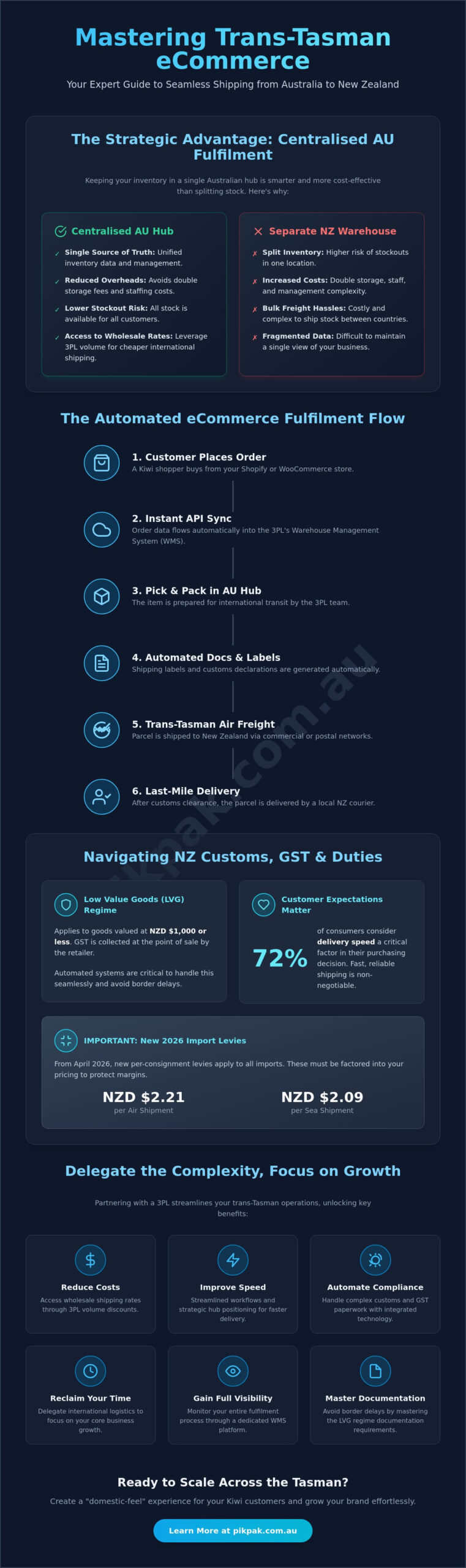
New Zealand online shopping is thriving, and shoppers there have high expectations. They want real-time tracking and zero “bill shock” at the border. As of April 2026, new goods management levies apply to all imports. For low-value goods under NZD $1,000, there’s a per-consignment levy of NZD $2.21 for air shipments and NZD $2.09 for sea shipments. If you don’t account for these costs at checkout, your margins will suffer. Speed is also non-negotiable. Industry data suggests that 72% of consumers in the region consider delivery speed a critical factor in their purchasing decisions. You need a system that gets parcels moving immediately to maintain customer trust.
Why Fulfilment from Australia is Often Better Than a Local NZ Warehouse
Many brands assume they need a physical warehouse in New Zealand to succeed. This often creates more problems than it solves. Splitting your stock between two countries doubles your storage fees and increases the risk of stockouts in one location while the other sits full. By keeping your inventory in a centralized Australian hub, you maintain a single source of truth for your data. You avoid the cost of bulk freight to a secondary warehouse and the complexity of managing two sets of staff. Instead, you leverage the volume of an Australian 3PL to access wholesale international rates. Using advanced technology support allows you to automate the entire workflow from pick to pack. You get the benefits of scale without the overhead of a second facility.
How eCommerce Fulfilment from Australia to New Zealand Works
The journey of a parcel from an Australian warehouse to a Kiwi doorstep is a multi-stage process that requires precision. It begins the moment a customer clicks ‘buy’ on your Shopify or WooCommerce store. Through direct API integrations, that order data flows instantly into your 3PL’s Warehouse Management System (WMS). This eliminates manual data entry and the risk of transcription errors. Once received, the pick and pack team prepares the item, ensuring it meets international transit standards. Mastering ecommerce fulfillment shipping to new zealand from australia involves more than just putting a parcel in a box; it’s about synchronising data and physical movement.
A 3PL acts as your operational backbone. They don’t just store stock. They manage the complex hand-offs between domestic transport, international air freight, and New Zealand’s local delivery networks. You can find useful Tips for Australian small businesses that highlight how these partnerships simplify the export process. You also need to choose between postal and commercial courier networks. NZ Post offers wide reach and is often cost-effective for smaller items. However, commercial networks like DHL or Team Global Express often provide faster transit and more robust tracking for premium service levels.
The Integrated Fulfilment Workflow
Automation is the engine behind successful international shipping. When your store talks directly to the warehouse, shipping labels and customs declarations are generated automatically. This includes the essential Harmonised System (HS) codes and GST information required for border clearance. Once the parcel leaves the AU hub, real-time tracking data is pushed back to your store. This gives your customers full visibility as their package crosses the ditch, which significantly reduces “Where is my order?” inquiries. If you want to see how this looks in practice, our technology support platform can help automate your shipping selections based on the most cost-effective rules.
Choosing Between Air Freight and Sea Freight for NZ Orders
For most B2C eCommerce brands, air freight is the only viable option. While sea freight might seem cheaper for bulk goods, the 14-plus day transit time is a deal-breaker for modern shoppers. Air freight typically delivers within 2 to 5 business days, meeting the high expectations of the 72% of consumers who value speed. To keep air freight costs manageable, focus on your packaging. Carriers charge based on the greater of actual weight or volumetric weight. Using custom-fit boxes or kitting services can reduce empty space, ensuring you aren’t paying to ship Australian air across the Tasman.
Navigating Customs, GST, and Duties: The Trans-Tasman Checklist
Customs clearance shouldn’t feel like a gamble. When you manage your ecommerce fulfillment shipping to new zealand from australia correctly, the border becomes a transparent step in the process rather than a roadblock. The key is understanding the New Zealand Low Value Goods (LVG) GST regime. For items valued at NZD $1,000 or less, you’re generally required to collect 15% GST at the point of sale if your annual New Zealand turnover exceeds NZD $60,000. If you don’t, your customers might face unexpected bills upon delivery, which is the fastest way to kill brand loyalty and trigger complaints.
As of April 2026, every consignment entering New Zealand is subject to new goods management levies. For air shipments, this is NZD $2.21 per consignment, and for sea shipments, it’s NZD $2.09. If an order exceeds the NZD $1,000 threshold, it’s treated as a high-value import. This requires a formal import declaration, and the customer may be liable for additional duties and taxes. To provide a seamless experience, many successful AU brands use a “Landed Cost” model. This ensures all taxes, levies, and duties are calculated and paid upfront, so the parcel arrives at the customer’s door without any hidden fees or friction.
Your commercial invoice is the most important document in the box. It must include accurate descriptions, values, and the correct Harmonised System (HS) Tariff Codes. The Australian Border Force mandates these 6-10 digit codes for all exports to ensure products are classified correctly for both tax and security purposes. Without them, your parcels will sit in a customs warehouse while officials manually assess the goods. This leads to the very delivery delays that cause customer frustration and increased support tickets.
GST Compliance for Australian Exporters
If you sell more than NZD $60,000 worth of goods to New Zealand customers annually, you must register for NZ GST with the Inland Revenue Department (IRD). Once registered, you collect the 15% tax at checkout and remit it periodically. This allows your parcels to clear customs faster as “GST paid.” Shoppers hate the “Delivery Duty Unpaid” (DDU) experience where they have to pay a fee to the courier before they can receive their package. By handling this at the point of sale, you create that “domestic-feel” that keeps Kiwi customers coming back to your store.
Documentation and Compliance Automation
Manual paperwork is the enemy of scale. A modern WMS automatically generates the necessary CN22 or CN23 customs forms based on the order data synced directly from your store. This includes managing specific biosecurity requirements for products containing wood, plant, or animal materials, which are strictly regulated in New Zealand. Pik Pak’s integrated WMS platform automatically generates precise customs documentation for every order, eliminating the manual errors that lead to border delays. This level of automation ensures your ecommerce fulfillment shipping to new zealand from australia remains compliant without requiring hours of manual data entry, allowing you to focus on your next marketing campaign.
Optimising Your Strategy: Reducing Costs and Delivery Times
Shipping costs shouldn’t be a mystery that changes with every invoice. To make your trans-Tasman expansion profitable, you need to move beyond retail courier rates and embrace wholesale logistics. When you use a 3PL, you’re not just buying a shipping label. You’re buying into a high-volume network that significantly reduces the per-parcel cost of ecommerce fulfillment shipping to new zealand from australia. While major gateways like Sydney are popular, Melbourne-based hubs often provide excellent access to consolidated air freight networks, offering a strategic balance between storage costs and dispatch speed.
Success in the New Zealand market also depends on the “last-mile” experience. Once your parcel touches down in Auckland or Christchurch, the baton passes to local experts like NZ Post or CourierPost. These carriers have the deepest reach into rural areas, ensuring your brand can serve customers from Invercargill to the Far North. By using a partner that integrates with these local networks, you provide your customers with familiar tracking links and reliable delivery windows, which builds the trust necessary for repeat business.
Strategies to Lower Shipping Rates
Don’t pay to ship empty space. Carriers calculate costs based on volumetric weight, so if your box is too big for the product, you’re effectively paying a “penalty” for shipping Australian air. Use kitting and assembly services to ensure your products are packed in the most efficient dimensions possible. You should also consider your pricing strategy at checkout. Many brands find that offering a “Free Shipping” threshold (for example, on orders over A$150) increases their Average Order Value (AOV) enough to easily cover the international shipping cost. This turns a logistics expense into a powerful marketing tool that drives higher revenue.
Handling Trans-Tasman Returns Efficiently
Returns management is often the most overlooked part of international expansion. Forcing a Kiwi customer to pay A$30 or more to ship a return back to Australia is a guaranteed way to lose them forever. A better approach is to set up a local New Zealand return address through your 3PL partner. This allows customers to send items back domestically, which is cheaper and faster for them. From there, you can choose to have items inspected and liquidated locally, or consolidated into a single bulk shipment back to your Australian warehouse. This “reverse logistics” strategy protects your margins and gives your customers the confidence to buy from you again. Learn how to optimise your home delivery shipping options and returns process today.
Pik Pak Logistics: Your Partner for Effortless Trans-Tasman Fulfilment
Pik Pak’s Melbourne-based operations serve as the ideal hub for your New Zealand expansion. Melbourne is a primary gateway for international air freight, allowing us to move parcels quickly from our warehouse to major New Zealand airports. This strategic positioning ensures that your ecommerce fulfillment shipping to new zealand from australia is not just reliable, but also incredibly fast. We provide a scalable solution that grows with you. Whether you’re sending your first ten orders to Auckland or managing high-volume daily shipments to every corner of the North and South Islands, our infrastructure adapts to your needs. This allows you to delegate the operational burden to a seasoned partner and reclaim your time to focus on business strategy.
The true value of our service lies in our technology support. While some providers offer generic global platforms, we provide deep integration with the specific carrier networks that matter most in the Australian and New Zealand markets. Our WMS platform acts as the bridge between your online store and the physical delivery. It automatically selects the most efficient trans-Tasman route based on your specific rules. This ensures you never overpay for shipping while maintaining the delivery speeds your customers demand. We treat your international orders with the same precision and care as a local delivery, removing the friction from cross-border commerce.
Technology That Removes the Border
Our technology provides real-time inventory visibility across all your orders, whether they’re destined for Perth or Palmerston North. You get a single source of truth for your stock levels, which prevents overselling and the resulting customer complaints. Our transparent reporting tools allow you to track shipping spend and delivery performance down to the individual parcel. This level of data-driven insight gives you total control over your logistics costs and helps you identify opportunities for further optimisation. It transforms a complex backend process into a simple, manageable task that you can monitor from any device.
Get Started with Trans-Tasman Fulfilment
Moving from a manual, in-house shipping model to Pik Pak’s professional 3PL model is a logical step for any growing brand. Our onboarding process is designed to be frictionless; we integrate your Shopify or WooCommerce store in minutes. This allows you to offload the stress of packing and customs paperwork immediately. We take our commitment to customer delivery excellence seriously, ensuring every parcel arrives in perfect condition and on time. Ready to scale your brand across the Tasman? Request a quote for NZ fulfilment today and see how effortless international expansion can be.
Ready to Scale Your Brand Across the Tasman?
Expanding into New Zealand is no longer a complex international project; it is a logical extension of your Australian growth strategy. Success in 2026 depends on your ability to provide a “domestic-feel” experience through transparent pricing and reliable delivery speeds. By mastering the new customs levies and moving away from manual shipping processes, you can protect your margins while building a loyal Kiwi customer base. The key is to stop viewing the Tasman Sea as a barrier and start seeing it as a bridge to a thriving market that shares your retail calendar and consumer values.
It is time to reclaim your time and refocus on your core business objectives. With our cloud-based WMS for real-time tracking and pre-built integrations for Shopify and WooCommerce, we make ecommerce fulfillment shipping to new zealand from australia effortless. Our deep expertise in trans-Tasman customs compliance ensures your parcels clear the border without friction or unexpected costs. Simplify your Trans-Tasman shipping with Pik Pak Logistics and take the stress out of international growth. Your brand is ready to reach new heights; let’s get your products moving today.
Frequently Asked Questions
Do I need to pay New Zealand GST on orders sent from Australia?
You must collect and remit 15% GST if your annual sales to New Zealand customers exceed NZD $60,000. For goods valued at NZD $1,000 or less, this tax is usually charged at your digital checkout. This compliance ensures your parcels clear customs faster under the Low Value Goods regime. If you’re below the threshold, the customer may still be charged GST by customs before they can receive their delivery.
How long does shipping from Australia to New Zealand typically take for eCommerce?
Air freight typically takes between 2 and 5 business days to reach major metropolitan areas like Auckland, Wellington, or Christchurch. While sea freight is an option for bulk cargo, it often takes 14 days or more. Most successful brands prioritise air transit because 72% of regional consumers consider delivery speed a critical factor in their buying decisions.
What are the cheapest shipping options for AU to NZ eCommerce?
The most cost-effective way to manage ecommerce fulfillment shipping to new zealand from australia is through consolidated air freight via a 3PL partner. This allows you to access wholesale rates that aren’t available to individual retail shippers. For very small, lightweight items, postal services like NZ Post often provide the lowest base rate, though commercial couriers offer more robust real-time tracking.
Can I use my existing Australian 3PL to ship to New Zealand?
You can use your Australian 3PL if they offer international dispatch and have a WMS that automates customs documentation. A capable partner will handle the pick and pack process in Australia and then hand off the parcel to a specialized trans-Tasman carrier. This keeps your inventory in one central Australian location while still serving the New Zealand market with total precision.
What products are restricted when shipping to New Zealand from Australia?
New Zealand has strict biosecurity laws that restrict or prohibit items containing wood, seeds, animal products, or plant materials. You must also follow international regulations for dangerous goods, such as lithium batteries, perfumes, and flammable liquids. Always verify your product’s Harmonised System (HS) code against the latest New Zealand Customs and Ministry for Primary Industries (MPI) guidelines to avoid border delays.
Do I need a New Zealand business number to sell to NZ customers?
You don’t need a New Zealand business number (NZBN) to sell to Kiwi shoppers as an Australian entity. However, you’ll need to register for an IRD number if you exceed the NZD $60,000 GST registration threshold. This allows you to legally collect and remit GST, which is essential for maintaining a professional and compliant cross-border operation.
How do I handle returns for customers located in New Zealand?
The most efficient method is setting up a local New Zealand return address through your logistics partner. This allows customers to send items back at domestic rates rather than paying for expensive international shipping to Australia. Once items are collected in New Zealand, they can be inspected, liquidated locally, or consolidated into a single bulk shipment back to your Australian hub to protect your margins.
Is it better to have a warehouse in New Zealand or ship from Australia?
For most brands, shipping from an Australian hub is the superior strategy. It prevents the risk of split inventory and avoids the high overhead of managing a second warehouse facility in a different country. By centralising your stock, you maintain better control over your levels and use ecommerce fulfillment shipping to new zealand from australia to reach customers quickly without the complexity of a local NZ footprint.