

Did you know that 67% of Australian shoppers say an easy returns process directly influences their decision to hit the buy button? While the Australian e-commerce market reached a massive AUD $69 billion in 2024, many global brands still struggle to capture this growth because of the friction at the border. You likely already know that shipping items back is expensive, but the real drain on your margins often comes from navigating the 10% GST and complex customs duty thresholds without a local presence.
This guide explains exactly how to handle international returns to australia by transforming a logistical burden into a competitive advantage. We’ll show you how to master Australian Border Force regulations, reclaim funds through duty drawbacks, and use local returns management to keep your overhead low. By the end of this article, you’ll have a clear, repeatable process to reduce reverse logistics costs and maintain the high level of trust your customers expect. We will break down the latest 2026 customs fees and provide a pragmatic strategy for seamless asset recovery.
Key Takeaways
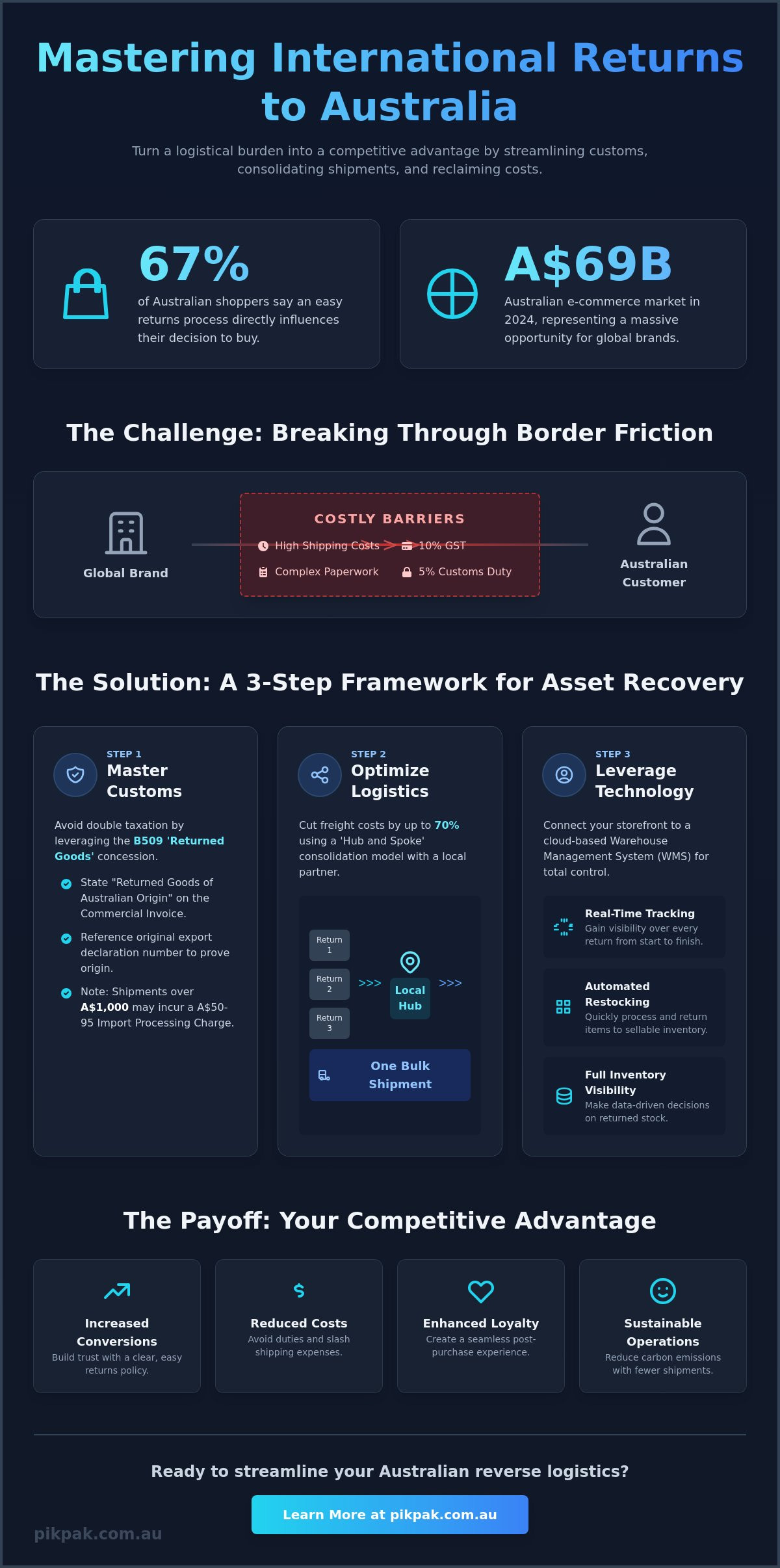
- Learn how to leverage the B509 ‘Returned Goods’ concession to prevent paying redundant duties and GST on items re-entering Australia.
- Master how to handle international returns to australia by choosing between local return hubs and direct shipping to optimize your speed and cost.
- Implement a ‘Hub and Spoke’ consolidation model to group individual returns into bulk shipments, significantly reducing your international shipping overhead.
- Connect your storefront to a cloud-based WMS platform for real-time tracking, automated restocking, and total visibility over your reverse logistics.
The Landscape of International Reverse Logistics in Australia
2026 has shifted the power dynamic in global eCommerce. Customers now view a return policy as a safety net, not a luxury. If you’re wondering how to handle international returns to australia effectively, you have to look beyond the local post office. Australia’s geographic isolation creates a “tyranny of distance” that makes standard shipping methods inefficient for returns. This is where Reverse logistics becomes your most valuable tool. It isn’t just about moving a box from point A to point B. It’s a complex cycle of customs compliance, physical inspection, and inventory recovery that keeps your business profitable. Understanding this difference is vital; shipping is a one-way expense, while reverse logistics is an asset recovery strategy.
A transparent return policy directly impacts your international conversion rates. Research shows that 67% of Australian shoppers let an easy returns process influence their final purchase decision. This expectation is even higher in mature markets like the US and UK. When you provide a clear path for returns, you remove the psychological barrier to buying from an overseas brand. You’re not just solving a logistical problem; you’re building a foundation of trust that drives long-term growth.
Why Returns Matter for Australian Global Growth
Clear return policies are the secret to cracking major global markets. In these regions, shoppers are conditioned to expect a risk-free experience. If your policy is vague or difficult to find, they’ll abandon their carts. While some brands choose a “refund-without-return” model to avoid high shipping fees, this approach drains your inventory and hurts your bottom line over time. Asset recovery allows you to put products back on the shelf and recoup value. Brands that utilize professional returns management see much higher customer retention because they’ve made the “post-purchase” experience effortless.
The 2026 Challenges: Freight Costs and Sustainability
Air freight costs for individual return parcels have climbed significantly, making one-off shipments a major margin killer for Australian businesses. Today’s consumers also demand sustainability. They prefer brands that offer consolidated return options to reduce carbon emissions. Automation is your best defense against these rising costs. By delegating these tasks to a partner with a robust WMS platform, you can group shipments and minimize manual errors. This proactive approach turns a chaotic operational hurdle into a predictable, manageable task that supports your brand’s green initiatives.
Navigating Australian Customs and GST for Returned Goods
Navigating Australian customs and GST is often the most intimidating part of global trade. If you don’t get the paperwork right, you’ll end up paying the 10% GST and a 5% customs duty on your own products. This double taxation kills your profit margins instantly. Understanding how to handle international returns to australia requires a firm grasp of the “Returned Goods” concession. This legal provision ensures you aren’t penalized for simply bringing your inventory back home.
The Commercial Invoice is the most important document in this process. It acts as the “passport” for your returned merchandise. To avoid unnecessary charges, your invoice must clearly state that the items are “Returned Goods of Australian Origin.” You’ll need to reference the original export declaration number to prove the goods haven’t been altered while overseas. Without this trail, the Australian Border Force (ABF) will treat the return as a brand-new import, triggering fees that could have been easily avoided.
Australian Border Force Requirements
To clear customs without a hitch, you need a meticulous paper trail. The ABF requires the original export documentation and the new return shipping labels to match perfectly. Using the correct Harmonized System (HS) codes for returned merchandise is also vital for automated clearance. The B509 concession allows Australian retailers to re-import goods originally exported from the country without paying customs duty, as long as the items remain in their original, unaltered state. This single rule is your best defense against redundant taxes. If the value of the returned shipment exceeds AUD $1,000, be prepared for an Import Processing Charge, which can cost between $50 and $95 depending on the declaration type.
Managing GST on International Returns
GST management is where many global brands lose money. If you’ve already paid or collected GST on the initial sale, you shouldn’t have to pay it again when the item comes back. However, the onus is on you to prove the return is legitimate. A professional returns management partner simplifies this by maintaining the digital records required for compliance. By using advanced technology support, you can integrate customs data directly into your workflow. This ensures that every return is flagged correctly from the moment the customer initiates the request, keeping your accounting clean and your margins protected. Don’t let administrative friction slow your growth; delegate the technical details to a partner who understands the Australian regulatory landscape.
A Step-by-Step Framework for Processing International Returns
Once you understand the customs landscape, you need a repeatable operational process. Managing the physical movement of goods is only half the battle. To truly master how to handle international returns to australia, you must integrate your digital storefront with your physical warehouse operations. This ensures that every return is an opportunity to recover value rather than a total loss. Following a structured framework removes the guesswork and allows your team to focus on growth instead of troubleshooting individual parcels.
- Step 1: Implement a Self-Service Portal. Don’t make customers email you for a label. A portal allows global users to initiate returns, print labels, and track their package, which significantly reduces your customer service workload.
- Step 2: Choose Your Shipping Route. Decide if you’ll use local return hubs for consolidation or ship directly back to Australia. Consolidation is often more cost-effective for high-volume brands, while direct shipping works best for high-value items that need immediate restocking.
- Step 3: Conduct Quality Control. Every item must be inspected the moment it hits the dock. This prevents damaged goods from being sold to a new customer, which would damage your brand reputation.
- Step 4: Execute Recovery Strategies. Based on the inspection, items are either restocked, refurbished for a secondary market, or responsibly disposed of.
- Step 5: Sync Inventory Levels. Your WMS must update your sales channels in real-time. If an item is restocked, it should be available for purchase on Shopify or Magento immediately.
The Physical Handling: From Dock to Shelf
The moment a return arrives, the physical handling determines your recovery rate. Many competitors stop at the shipping label, but the real work happens at the warehouse. You need a clear grading system to categorize items as New, Open Box, or Damaged. This precision ensures your inventory data is accurate. To maintain high standards, we follow strict warehouse receiving guidelines for every return. This systematic approach ensures that items are processed quickly and placed back into available stock without delay. It’s about turning a “problem” back into “profit” through disciplined execution.
Automation and Communication
Automation is the glue that holds your international strategy together. When your warehouse team scans a returned item, your WMS platform can trigger an automatic refund to the customer. This speed builds immense trust. Beyond the refund, your system should track the “return reason.” If 20% of your returns from the UK are due to “sizing issues,” that’s a data point you can use to adjust your product descriptions. Transparency is key; keeping the customer informed at every stage of the return journey ensures they feel confident buying from you again.
Reducing Costs Through Consolidation and Local 3PL Partners
Australia’s distance from major markets like the US or Europe means air freight is your biggest expense. Sending individual return parcels across the globe is a fast way to erode your margins. Instead, savvy brands use a “Hub and Spoke” model. By using international depots to collect returns locally, you can consolidate them into a single shipment. This is a primary strategy for learning how to handle international returns to australia without overspending on logistics. Partnering with a specialist for your logistics service allows you to delegate the collection process while maintaining control over the final destination of your stock. It’s a pragmatic way to reclaim your time and focus on scaling your brand.
The Consolidation Advantage
The math is simple. Imagine 10 individual customers in London each sending a 1kg parcel back to Sydney. You would pay 10 separate international shipping fees and 10 separate customs processing charges. By consolidating these into one 10kg shipment, you minimize customs brokerage fees through a single-entry declaration. This reduces the administrative burden on your team and the financial burden on your bottom line. Consolidating your returns into a single bulk shipment drastically lowers the cost-per-unit by spreading fixed customs and handling fees across multiple items. This approach also helps you avoid the Import Processing Charge for multiple low-value shipments that might otherwise aggregate and trigger fees.
Strategic Asset Recovery
Returns don’t have to be “dead stock.” Many items are returned in perfectly healthy condition but need a “refresh” before they can be sold again. A local partner can provide kitting and re-labelling services to get this inventory ready for the secondary market. This level of warehousing and fulfilment expertise turns potential losses into future sales. For items that truly cannot be saved, your partner can manage responsible disposal, preventing you from paying ongoing storage fees for unsellable goods. This proactive approach clears your shelves and keeps your capital moving. Implementing a smarter way for how to handle international returns to australia starts with seeing returns as inventory, not just waste.
Optimize your reverse logistics today by partnering with Pik Pak for professional returns management.
Scaling Your Global Brand with Pik Pak’s Returns Management
Mastering how to handle international returns to australia is the final step in securing your place on the global stage. You’ve navigated the customs regulations and optimized your consolidation routes. Now, you need a partner who can turn those strategies into a daily reality. Scaling a brand requires more than just shipping products; it requires total visibility over every item that moves through your supply chain. Our cloud-based platform provides this transparency, allowing you to track returns from the moment they are initiated until they are back on your warehouse shelf. You don’t need to guess where your inventory is or when a customer will get their refund. The data is right there, updated in real-time.
We’ve designed our systems to work with the tools you already use. Whether you’re running on Shopify, WooCommerce, or Magento, our platform integrates seamlessly with your storefront. This automation eliminates the manual data entry that often leads to errors in international shipping. For Australian businesses looking to grow, this means you can offer a world-class returns experience that rivals the biggest global retailers. You get the benefit of a sophisticated logistics infrastructure without the overhead of managing your own warehouse staff or physical location.
The Pik Pak Technology Advantage
Precision is the core of our technology. Our WMS platform provides real-time inventory updates, ensuring your digital storefront always matches the physical stock in our warehouse. This prevents the frustration of overselling and allows you to put returned items back into circulation the moment they pass inspection. If you have unique requirements, our API access allows for custom return workflows tailored to your specific product categories. This technical flexibility is a key component of our order fulfilment guide, which helps brands build a resilient backend for global trade. We don’t just provide space; we provide the digital architecture to manage it efficiently.
Your Partner in Effortless Logistics
Delegating your reverse logistics to Pik Pak allows you to reclaim your time and refocus on your core business objectives. We handle the heavy lifting, from the physical inspection on the warehouse floor to the complex data syncs required for customs compliance. While we manage the friction of how to handle international returns to australia, you can focus on your marketing, product development, and customer acquisition. We act as a seasoned expert in a chaotic field, providing the precision and reliability you need to scale with confidence. Don’t let logistics hurdles slow your momentum. It’s time to simplify your operations and prioritize your growth. Contact Pik Pak today to build a custom returns strategy that supports your global ambitions.
Turn Global Returns into Your Growth Engine
International expansion shouldn’t be stalled by the fear of a complex return process. By leveraging the B509 customs concession and adopting a consolidated “Hub and Spoke” shipping model, you can reclaim lost margins and build lasting trust with your global audience. You now have the framework for how to handle international returns to australia by treating reverse logistics as a strategic asset rather than a sunk cost. Success in 2026 belongs to the brands that prioritize a seamless, tech-driven post-purchase experience.
Pik Pak is here to simplify every step of this journey. Our platform offers real-time WMS visibility and seamless eCommerce integrations with Shopify, WooCommerce, and Magento, ensuring your inventory is always accurate across all channels. With our expert Australian-based support team handling the operational heavy lifting and customs compliance, you can refocus your energy on what matters most: growing your business. Scale your global brand with Pik Pak’s effortless returns management today. You’ve built a great brand; let’s make sure your logistics are just as impressive.
Frequently Asked Questions
Do I have to pay GST on items returned to Australia from overseas?
You don’t have to pay GST again if you correctly claim the “Returned Goods” concession. By proving the item originated in Australia and was previously exported, you avoid the 10% GST charge. It’s vital to have your original export declaration ready to show the Australian Border Force that the stock is simply returning to its point of origin.
What is the best way to ship international returns back to Australia?
Consolidation is the most cost-effective method for shipping returns in 2026. Instead of paying for individual air freight parcels, group your returns at an international depot before shipping them back in bulk. This strategy is a key part of how to handle international returns to australia because it slashes customs brokerage fees and per-unit shipping costs.
Can I use a 3PL to handle my international returns?
Yes, using a 3PL for returns management is a standard practice for scaling brands. A partner provides the physical warehouse space and the technology to track returns in real-time. This allows you to delegate the operational friction of reverse logistics, freeing up your time to prioritize marketing and product development.
How do I avoid paying import duty twice on returned products?
You avoid double duty by using the B509 concession for goods of Australian origin. Ensure your commercial invoice clearly states the items are being returned in an unaltered state. This documentation tells customs that the standard 5% duty was already accounted for, preventing redundant fees from eating into your profits.
What documents are required for an international return to Australia?
You’ll need the commercial invoice, the original export declaration, and the return shipping documents. The invoice must clearly describe the goods and state their value. If the returned shipment is valued over AUD $1,000, you’ll also need to manage the electronic import declaration and pay the relevant Import Processing Charge, which ranges from $50.70 to $95.
How long does the international return process typically take?
Most international returns take between 10 and 21 days to reach an Australian warehouse. This timeline includes local collection, international transit, and customs clearance. Using an automated WMS platform helps you track this journey, providing your customers with the transparency they expect during the 15% to 30% of transactions that result in a return.
Should I offer free international returns to my customers?
Free returns are a powerful conversion tool, but they aren’t always sustainable for international shipping. Many brands now use a tiered approach, offering free returns to loyal customers while charging a flat fee for others. This helps mitigate the $15 to $30 cost of processing a single e-commerce return while still maintaining high levels of customer trust.
What happens if a returned item is damaged during international transit?
When an item arrives damaged, your 3PL should flag it immediately during the quality control inspection. You can then use your WMS to update the inventory status to “damaged” or “unsellable.” This prevents faulty products from being sent to new customers and allows you to initiate an insurance claim with the carrier if the damage occurred during transit.