
Most fulfillment networks are built for shoeboxes, and they’ll penalize you the moment your SKU crosses the 22kg threshold. If you’re selling furniture, gym equipment, or bulky electronics, you’ve likely seen your margins eroded by the A$101.60 FedEx oversize charges or the 5% Australia Post price hike hitting in July 2026. It’s frustrating to watch shipping costs eat up 15% to 30% of your total revenue while transit damage claims pile up in automated sorting facilities. You deserve a logistics strategy that treats large items as a priority, not an inconvenience.
We know that managing heavy goods is a complex challenge that requires more than just a standard warehouse. This guide shows you exactly how to reduce shipping costs for large items by moving away from high-velocity automation toward specialized bulky logistics. You’ll learn how to navigate the 2026 surcharge landscape, optimize your Shopify or WooCommerce integration for heavy SKUs, and implement right-sizing techniques that can slash your per-package costs by up to 50%. We’re going to help you reclaim your time and transform your logistics from a source of friction into a streamlined engine for growth.
Key Takeaways
- Avoid automated generalist warehouses to eliminate unexpected manual handling fees and significantly reduce transit damage for oversized products.
- Master the 2026 dimensional weight formulas used by Australian carriers to ensure you are never overcharged for large, lightweight parcels.
- Learn how to reduce shipping costs for large items by identifying the specific volume thresholds where switching from parcel networks to LTL freight maximizes your margins.
- Use our professional checklist to audit potential 3PL partners for essential bulky infrastructure like reach trucks and specialized carrier accounts.
- Scale your business with a Melbourne-based logistics partner that provides seamless WMS platform access and expert home delivery shipping options.
Why Standard 3PLs Struggle with Oversized and Heavy Products
Standard fulfillment centers are built for speed and small boxes. They use high-velocity automated conveyor belts and robotic sorters that simply cannot accommodate a 30kg flat-pack wardrobe or a two-meter kayak. If your business is struggling with high surcharges, the first step in how to reduce shipping costs for large items is realizing that your 3PL’s infrastructure might be working against you. Most generalist warehouses view bulky items as a nuisance that slows down their “shoebox” workflow, leading to higher fees and frequent handling errors.
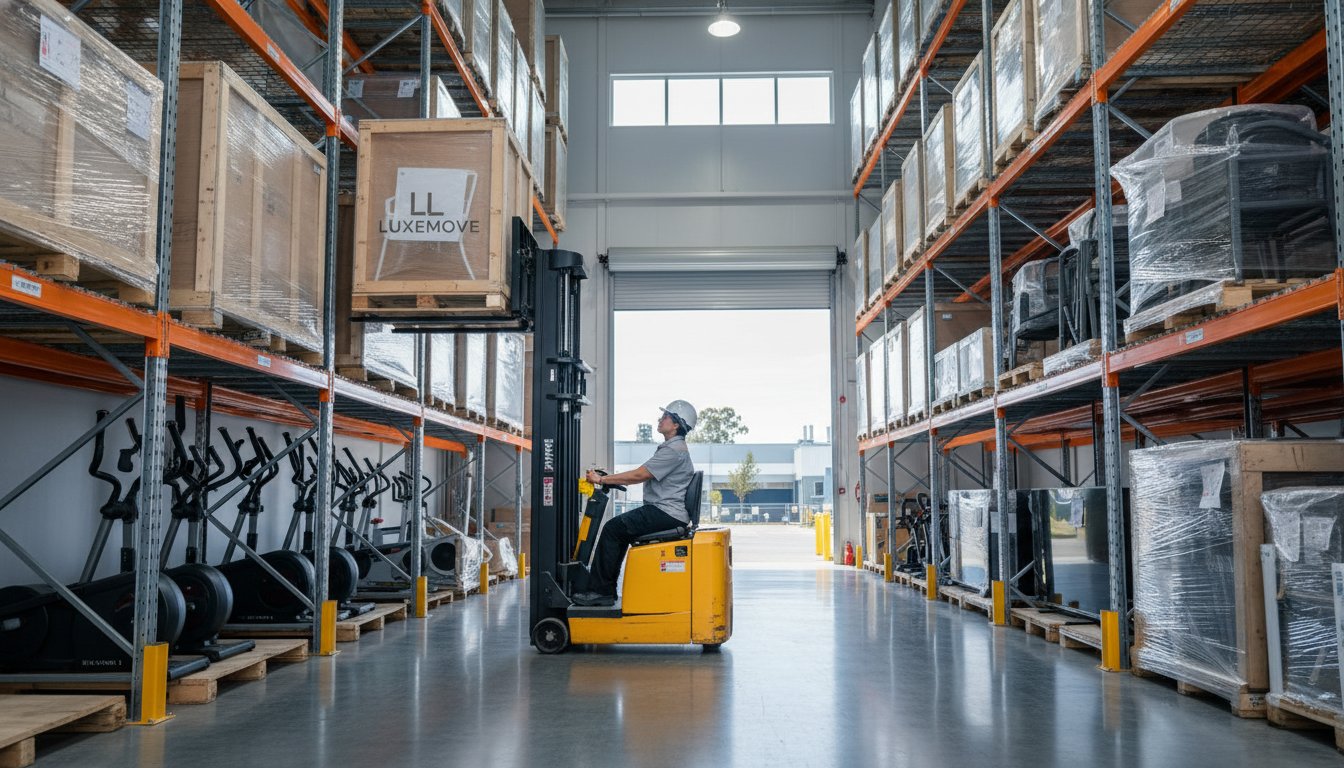
Specialized inventory storage for bulky goods requires specific physical investments. This includes wide aisles for maneuverability, heavy-duty racking for safe stacking, and Power Industrial Trucks (PIT) instead of simple manual pallet jacks. The human element is also vital here. In a specialized environment, trained staff understand load-bearing points and how to secure irregular shapes. Manual handling isn’t an inefficiency in this context; it’s a security measure that prevents the transit damage common in automated systems.
The Definition of Oversized in Australian Logistics
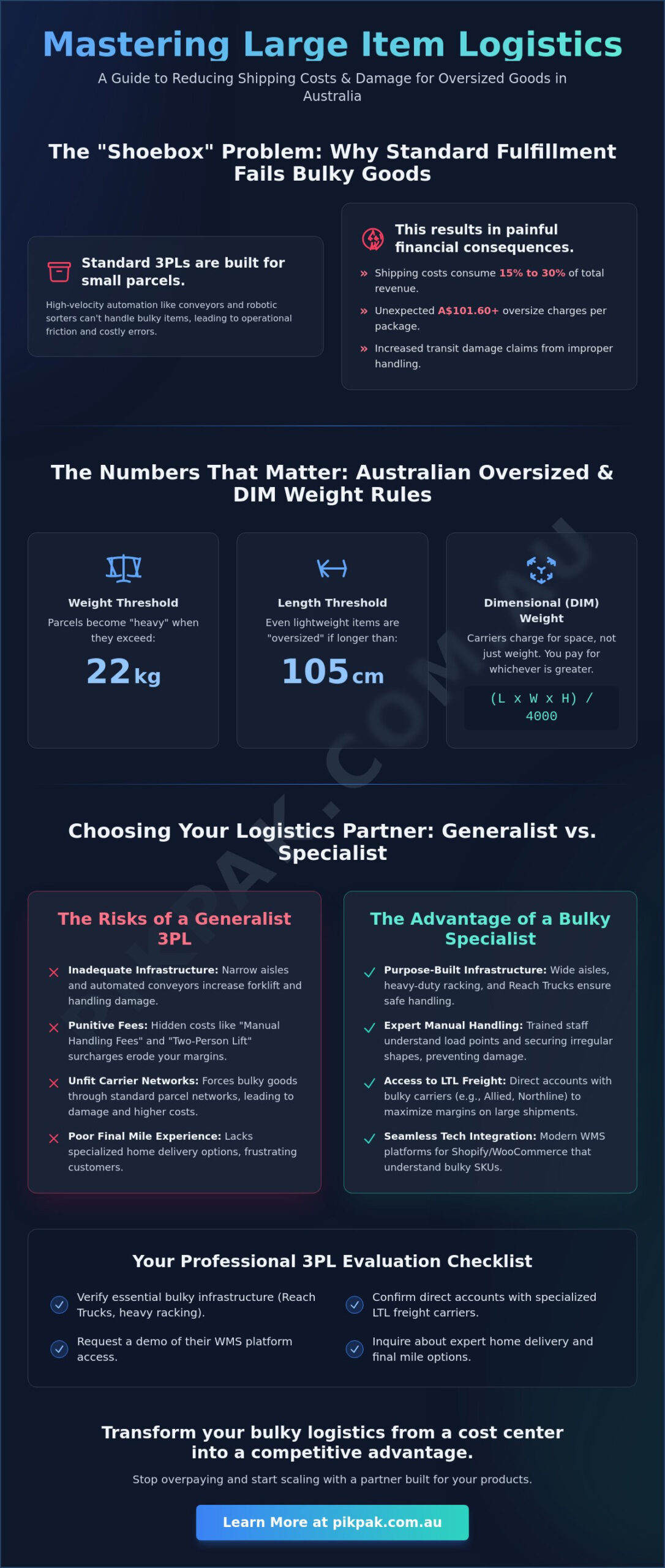
In the Australian market, 22kg is the magic number. Once a parcel exceeds this weight, most standard networks like Australia Post will either reject it or apply significant surcharges. However, weight isn’t the only factor. You must also account for length and girth thresholds. A lightweight item that exceeds 105cm in length often triggers “oversize” classifications, even if it weighs very little. Understanding the difference between “Big and Light” (volumetric weight) and “Heavy and Bulky” (deadweight) is essential for any strategy regarding how to reduce shipping costs for large items. For many of these products, Less-than-truckload (LTL) shipping becomes a much more economical path than standard parcel post.
The Risk of Generalist 3PL Partners
Generalist 3PLs often hide their inability to handle large items behind Manual Handling Fees (MHF). These are penalty rates designed to discourage you from sending bulky inventory to their facility. Because these providers lack direct accounts with bulky specialists like Allied or Northline, they’ll often force your heavy goods through parcel networks that aren’t fit for purpose. This creates several operational risks:
- Increased risk of forklift damage in tight, narrow-aisle warehouses.
- Exorbitant surcharges for items that require two-person lifts.
- A lack of tailored home delivery shipping options for the “final mile.”
When you delegate your operations to a partner that isn’t equipped for large-scale logistics, you aren’t just paying more in shipping. You’re also dealing with the administrative burden of damage claims and frustrated customers. A seasoned, tech-savvy partner removes these hurdles by using a system designed for the specific dimensions of your growth.
Understanding the True Cost: Dimensional Weight and Surcharges
Shipping a heavy item is expensive, but shipping a light, large item can be a financial disaster if you don’t understand dimensional (DIM) weight. In 2026, Australian carriers have tightened their cubic conversion standards. This is the industry standard where freight is billed based on the space it occupies rather than its actual weight. For example, Australia Post uses a divisor of 4000 cm³/kg. To calculate this, you multiply the length, width, and height of your package in centimeters and divide by 4000. If that result is higher than the deadweight on the scale, you pay the higher price. This is a primary reason why learning how to reduce shipping costs for large items starts with package geometry.
When evaluating a 3PL partner, you must look at how they manage these calculations. A light but large box, such as a flat-pack dog kennel, can cost significantly more than a small, heavy box of weights. Beyond the base rate, surcharges can quickly double your invoice. FedEx now applies an oversize charge of A$101.60 per package if you exceed their 2026 thresholds. Without a strategy to consolidate or right-size your packaging, these fees will consume your margins before the product even reaches the customer.
The Dead Space Tax in Bulky Warehousing
Storage costs for large items don’t follow the same rules as standard parcel inventory. While standard goods sit on uniform pallets, oversized items often require custom pick-faces or heavy-duty racking. Efficient Pik Pak Warehousing and Fulfilment strategies focus on minimizing this “dead space” to keep your monthly bill predictable. Cubic conversion is the standard for Australian freight billing where carriers charge based on the larger of the actual weight or the volumetric space occupied. To fight this, you should audit your packaging to remove even a few centimeters of air. Research shows that right-sizing can reduce shipping costs by 20% to 50% per package by avoiding aggressive dimensional weight triggers.
Carrier Surcharges You Must Anticipate
Residential deliveries for bulky goods introduce unique operational hurdles. If your item is too heavy for a single driver to handle, you will likely face a Manual Handling Surcharge (MHS). For home deliveries, you must also consider the following equipment needs:
- Tail-lift services: Required when the delivery address lacks a loading dock or forklift.
- Residential surcharges: Applied to any delivery in a non-commercial zone.
- Out-of-area fees: Significant costs for delivering bulky SKUs to regional Australian hubs.
The complexity doesn’t end at the front door. Big and bulky items are notoriously difficult to process during returns management. Reverse logistics for a 40kg item involves specialized pick-ups and higher transit risks. Anticipating these costs during the fulfillment stage is the only way to maintain a healthy bottom line.
Parcel vs. Freight: Choosing the Right Delivery Path
Choosing between a parcel network and a freight carrier is the most critical decision you’ll make when figuring out how to reduce shipping costs for large items. While parcel networks are optimized for speed, they often fail when handling items that require manual care. If your product is over 22kg, the standard Australia Post network is no longer an option. However, specialized parcel couriers can often accommodate up to 30kg. Beyond that weight, or when dimensions become too awkward for a conveyor, you’re entering the territory of Direct Freight and Home Delivery options.
The “Sweet Spot” for switching to freight occurs when the volumetric weight of your order triggers surcharges that exceed the base cost of a pallet. In the 2026 market, many Australian businesses find that once an order exceeds 0.25 cubic metres or 30kg, LTL freight becomes the more economical choice. This is especially true for high-end furniture or heavy appliances. For these items, a Two-Man Delivery service is often necessary to ensure the product reaches the customer’s room of choice without the damage risks associated with a single-driver parcel drop.
When to Use Parcel for Oversized Goods
Parcel networks are best for “Big and Light” goods that stay under the 30kg threshold. While they offer faster transit times, they are prone to rougher handling in automated hubs. You must implement “over-boxing” to protect your inventory. This involves placing the product inside a second, heavy-duty corrugated box to shield edges from high-velocity sorting arms. It’s a trade-off: you gain delivery speed but must invest more in protective kitting to avoid the high costs of reverse logistics.
The Benefits of LTL Freight for Bulky Items
Palletisation is your best defense against transit damage. By securing your bulky items to a pallet, you keep them stable and off the warehouse floor. In the 2026 Australian freight market, density is the primary driver of cost. A dense, well-stacked pallet often costs less to ship than several loose, oversized parcels that each trigger individual handling fees. You’ll need to manage customer expectations here, as freight usually involves curbside delivery and specific time windows rather than the “leave in a safe place” convenience of standard parcel post. By using a partner with integrated WMS platform access, you can automate the decision between parcel and freight for every order.
Checklist: Evaluating an Oversized 3PL Partner in Australia
Vetting a logistics provider for heavy goods requires a different set of criteria than standard e-commerce fulfillment. You aren’t just looking for shelf space; you’re looking for an operational environment that understands how to reduce shipping costs for large items through precision and specialized equipment. Use this structured framework to ensure your partner can actually handle your SKU profile without hidden damages or penalty fees.
- Step 1: Audit warehouse infrastructure. Verify the facility uses reach trucks and has dedicated oversized bays. Standard pallet jacks and narrow aisles are recipe for product strikes and forklift damage.
- Step 2: Review the carrier mix. Confirm they have direct, negotiated accounts with bulky specialists like Allied or Northline. Relying on generalist parcel networks for 40kg items is a primary cause of surcharge spikes.
- Step 3: Test the WMS capabilities. Your partner’s software must support real-time bulky SKU tracking and, crucially, store accurate dimensional data to automate the Parcel vs. Freight decisions we discussed earlier.
- Step 4: Verify Kitting and Assembly. If you sell product bundles, like gym sets or modular furniture, ensure the 3PL can perform complex kitting and assembly for heavy components on-site.
- Step 5: Review Receiving Protocols. Check their Warehouse Receiving Guidelines. Professional providers have strict rules for inbound stock to ensure every item is measured and weighed accurately the moment it hits the dock.
Technology and Integration for Bulky Goods
Real-time inventory visibility is critical for high-value, slow-moving oversized items where storage costs are higher. Your logistics partner should offer seamless technology support and integration for your Shopify or WooCommerce store. This ensures your checkout accurately calculates bulky shipping rates and offers specialized options like Two-Man Delivery for heavy appliances. When your WMS and storefront talk to each other, you eliminate the “shipping cost surprise” that leads to abandoned carts. For a partner that bridges this technical gap, explore our integrated WMS platform access.
Warehouse Receiving for Large Shipments
Efficiency starts at the loading dock. To keep costs low, you should pack inbound containers to maximize safety and minimize unloading time. This involves pre-sorting bulky items by SKU size during the initial loading process so they can be put away immediately upon arrival. Strict receiving protocols prevent downstream shipping errors by ensuring the WMS has the correct dimensions from day one. If your 3PL doesn’t measure every new bulky SKU upon entry, your shipping labels will eventually be hit with those aggressive A$101.60 FedEx surcharges we mentioned previously.
Scaling Your Bulky Brand with Pik Pak Logistics
Managing large-scale inventory requires more than just square meterage; it requires a partner that understands the nuances of the Australian carrier landscape. At Pik Pak, we position ourselves as the seasoned expert in Pick, Pack, and Ship Services for complex, bulky SKUs. Operating from our Melbourne-based network, we provide efficient national distribution that bypasses the friction of generalist warehouses. Our facility is specifically engineered to handle the heavy lifting, providing you with a clear roadmap on how to reduce shipping costs for large items while maintaining the integrity of your brand.
We don’t just move boxes. We manage kitting and assembly for oversized product bundles and special projects that standard 3PLs often refuse. Our team understands that a dining table or a treadmill isn’t just another parcel. These items require specialized equipment and a manual touch that automated systems simply can’t provide. By centralizing your bulky inventory in our Melbourne hub, you gain better control over transit times to major Australian metros, reducing the distance and the cost of the final mile.
Custom Solutions for Furniture and Equipment
Many bulky brands reach a tipping point where garage storage or small-scale warehousing no longer supports their growth. Scaling requires a shift to professional logistics that can handle the physical demands of heavy goods. We specialize in this transition, offering Human-Centred Fulfilment for items that require manual handling and extra protection. Our commitment to transparent, surcharge-aware pricing means you won’t be blindsided by unexpected AUD fees at the end of the month. We help you navigate the complexities of 2026 shipping rates with confidence, ensuring your margins remain protected as you expand your SKU count.
Ready to Outsource Your Oversized Logistics?
Delegating your operational burdens is the fastest way to refocus on marketing and business growth. When you stop worrying about tail-lift surcharges and transit damage, you reclaim the time needed to innovate and connect with your customers. We invite you to review our Service Priorities for bulky goods to see how we eliminate inefficiency at every step of the fulfillment journey. It’s time to move your business forward with a partner that treats your large items as a priority. Contact Pik Pak Logistics for an oversized quote today and see how effortless bulky logistics can be.
Take Control of Your Bulky Logistics Strategy
Mastering the logistics of oversized goods is no longer a matter of trial and error. You’ve seen how specialized infrastructure and a deep understanding of carrier surcharges can protect your margins. By auditing your packaging geometry and choosing the right delivery path, you can finally solve the puzzle of how to reduce shipping costs for large items. It’s about moving away from the limitations of standard automation and toward a system that treats heavy goods with precision and care.
Our Melbourne-based, Australian-owned facility is built for this exact challenge. We provide the specialized bulky goods infrastructure and real-time WMS tracking you need to scale with confidence. Stop letting exorbitant manual handling fees dictate your business growth. Delegate your operations to a partner that understands the 2026 landscape and the specific needs of your SKU profile. Get a Tailored 3PL Quote for Your Oversized Products and start focusing on your core business objectives today. You have the tools to succeed; now it’s time to streamline your operations and reclaim your time.
Frequently Asked Questions
What is considered an oversized product for 3PL fulfilment?
In the Australian logistics market, an oversized product is generally any item that exceeds 22kg in weight or 105cm in length. For warehouse operations, it also includes items that cannot fit within a standard Australian pallet footprint of 1.2m x 1.2m. These products often require specialized Power Industrial Trucks (PIT) and manual handling rather than automated conveyor belts.
How do 3PLs charge for oversized item storage compared to standard pallets?
Standard pallets are typically charged at a flat weekly rate, but oversized items often use cubic storage billing. This means you pay for the specific volume your inventory occupies in the warehouse. Specialized providers use dedicated bulky bays or cantilever racking to accommodate irregular shapes, ensuring you only pay for the space required for your specific SKU profile.
Can I use Australia Post for oversized products over 22kg?
No, Australia Post maintains a strict 22kg weight limit for domestic parcels. If your product exceeds this threshold, you must use a specialized courier or a freight network. It is also important to note the July 2026 price increases, which will see domestic parcel rates rise by an average of 5%, making it even more vital to find efficient alternatives for heavy goods.
How can I reduce shipping damage for heavy furniture or gym equipment?
The most effective strategy is to move away from high-velocity automated networks toward specialized manual handling. Using palletisation for gym equipment keeps the product stable and off the floor, while “over-boxing” furniture provides an extra layer of protection for vulnerable edges. Selecting a 3PL with a human-centred fulfillment approach ensures staff are trained to identify specific load-bearing points during the packing process.
What is a Tail-lift fee and when does it apply to my deliveries?
A tail-lift fee is a surcharge applied when a delivery vehicle requires a hydraulic lift to lower heavy items to the ground. This fee applies to almost all residential deliveries for bulky goods because home addresses lack loading docks or forklifts. You should factor this into your checkout pricing to ensure your margins remain protected during the final mile of delivery.
How does Dimensional (DIM) weight affect my shipping costs in 2026?
Dimensional weight allows carriers to charge based on the space a package occupies rather than its actual weight. In 2026, Australian carriers use aggressive divisors, such as the 4000 cm³/kg standard. This means a large, lightweight box can be billed at a much higher rate than its scale weight. Understanding these formulas is the first step in how to reduce shipping costs for large items through right-sizing packaging.
Do 3PLs offer assembly or kitting for large, oversized products?
Yes, specialized 3PLs provide kitting and assembly services to help streamline the delivery of complex product bundles. This is particularly useful for brands selling modular furniture or multi-component equipment. By assembling components on-site or bundling them into a single shipment, you can often simplify the logistics chain and provide a more seamless experience for your customers.
What is the difference between LTL and FTL for bulky goods shipping?
LTL (Less-than-Truckload) shipping involves sharing truck space with other shippers, which is a cost-effective way how to reduce shipping costs for large items that don’t require a full vehicle. FTL (Full Truckload) means you have reserved the entire truck for your inventory. For most e-commerce brands shipping bulky goods to consumers, LTL or specialized home delivery networks are the most common and economical choices.