
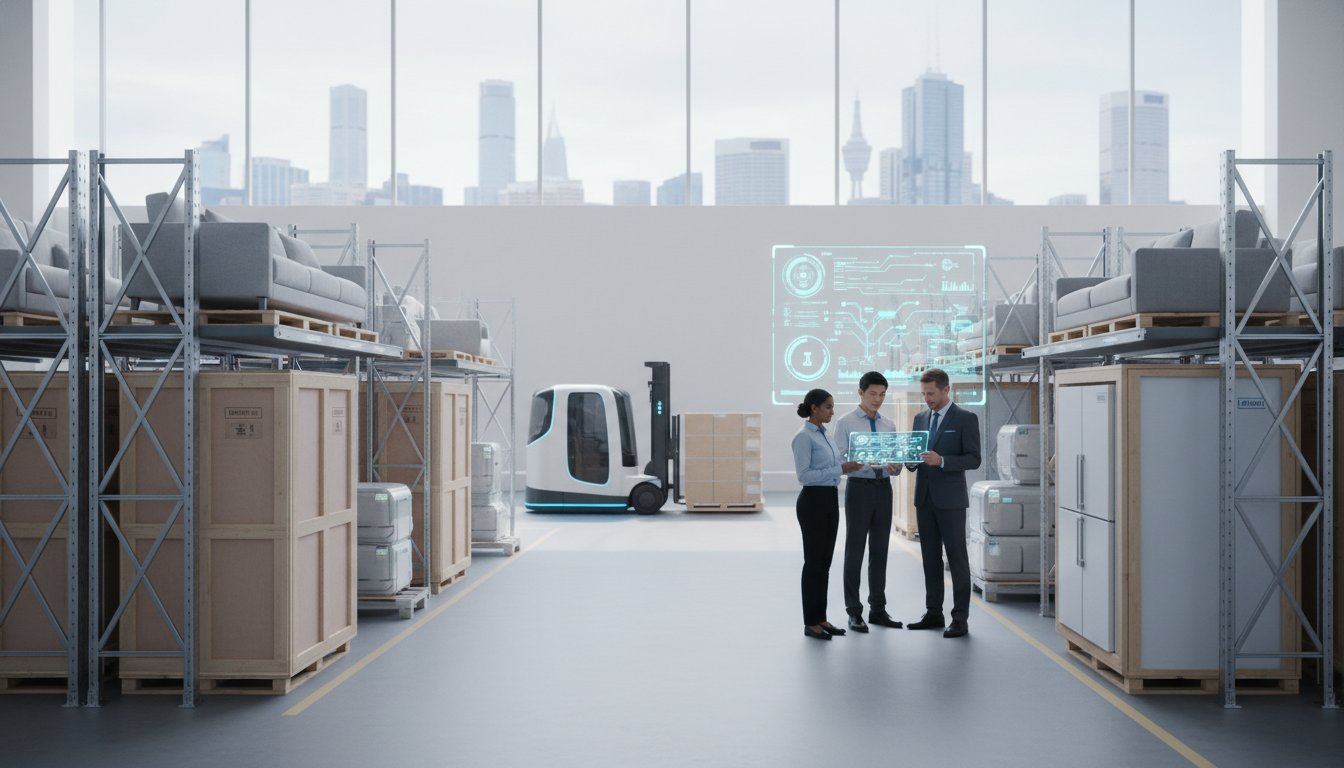
If you’re still relying on standard couriers for your oversized goods, you’re likely watching your profits disappear into a black hole of non-conveyable surcharges and transit damage. How do you manage bulky item returns without losing your entire profit margin to freight costs? With 26% of Australian online shoppers making a return in the last twelve months, the stakes for your reverse logistics have never been higher.
You already know that the return leg of a heavy item’s journey is where the most friction occurs. It’s stressful to lose visibility once a large item leaves a customer’s home, only to have it arrive back at your warehouse unsellable. This strategic guide will help you master the complexities of bulky item returns logistics australia, reduce transit damage, and protect your margins with specialised 3PL strategies. We’ll show you how to build a zero-touch carrier ecosystem that ensures predictable costs and a seamless link between your online store and your warehouse operations.
Key Takeaways
- Learn why standard pallet racking fails and how specialised high-clearance infrastructure prevents damage to your oversized inventory.
- Master a multi-carrier strategy to navigate bulky item returns logistics australia, effectively eliminating the “non-conveyable” surcharges that drain your margins.
- Discover how to integrate WMS data with platforms like Shopify and NetSuite to maintain total visibility over high-value assets throughout the return journey.
- Identify the operational red flags that signal it is time to transition to a specialist 3PL and learn how to audit your stock for fragile points.
- Simplify your reverse logistics by delegating complex heavy-item handling, allowing you to reclaim your time and refocus on core business growth.
Understanding Bulky Item Returns & Logistics in 2026
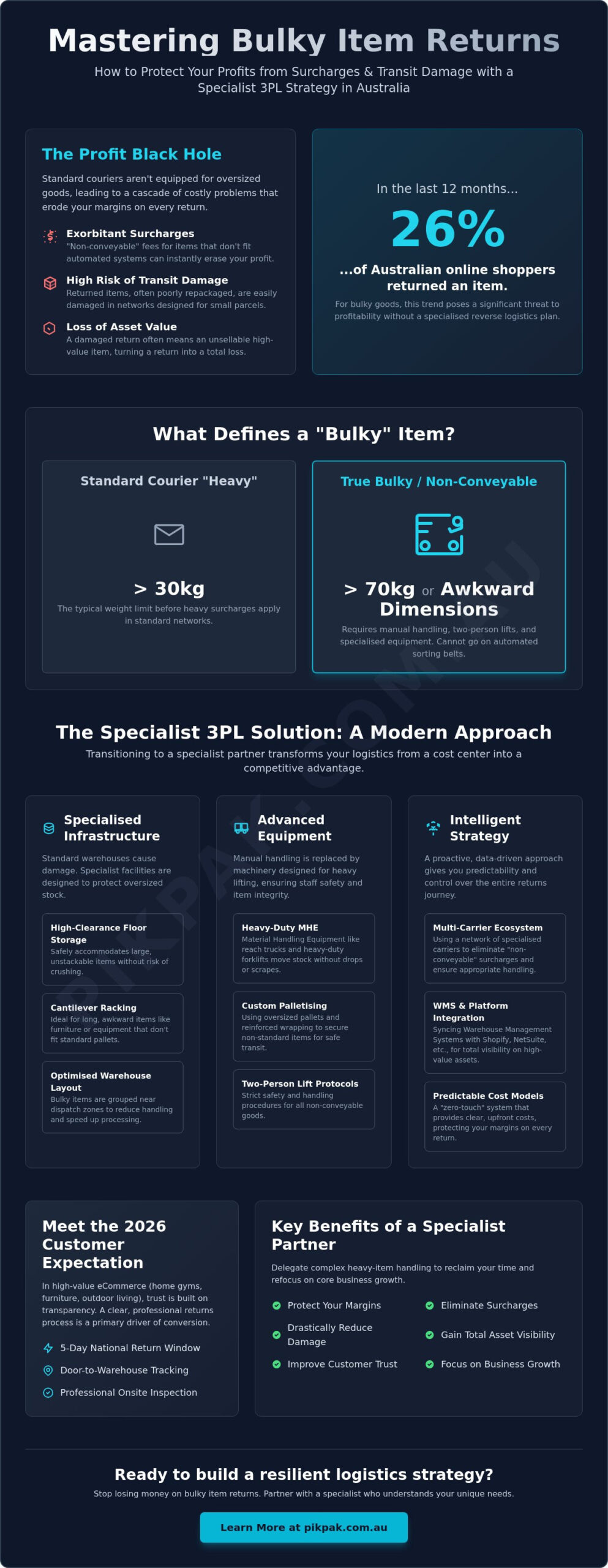
In the 2026 Australian market, bulky goods are no longer just defined by a weight limit. While most carriers classify anything over 30kg as heavy, true bulky items are those that exceed 70kg or possess dimensions that require two-person lifts and specialised equipment. These items are technically “non-conveyable.” They cannot travel on the automated sorting belts used by standard couriers. If you try to force these items through a traditional parcel network, you’ll face exorbitant surcharges that can instantly erase the profit from a high-value sale. Effective bulky item returns logistics australia requires a departure from these rigid, automated systems in favour of a manual, high-touch approach.
The economic impact of inefficient Reverse Logistics is particularly severe for high-AOV brands. When a A$2,000 modular sofa is returned, the cost isn’t just the freight. It’s the risk of transit damage during the return leg, which often occurs because the item is no longer in its original, factory-sealed packaging. Without a specialised strategy, your return costs can spiral, especially when you factor in the 26% return rate currently seen across Australian eCommerce. Managing these oversized assets requires a professional logistics partner who understands that a return is a recovery of capital, not just a transport task.
The Challenges of Oversized Logistics in Australia
Australia’s geography presents unique hurdles for bulky goods. Moving a heavy item from Melbourne to a regional area in Western Australia is a complex exercise in multi-modal transport. Standard 3PL warehouses built around conveyor belts are actually the enemy of bulky goods; these systems often lead to “clogged” workflows and increased handling damage. Furthermore, you must ensure your logistics provider adheres to the latest Australian mass management standards. These regulations dictate how heavy loads are secured and tracked to ensure road safety and legal compliance across state lines.
The 2026 Outlook for Big-Ticket eCommerce
We are seeing massive growth in sectors like home gym equipment, outdoor living, and modular furniture. Consumers now treat these large purchases with the same “click-to-door” expectations as a pair of shoes. Shipping transparency is now a primary driver of conversion. If a customer can’t see a clear, reliable return path for a heavy treadmill, they won’t hit the buy button. You must provide certainty to win their trust. In 2026, the new normal for bulky goods is a five-day national return window with door-to-warehouse tracking and professional onsite inspection.
Specialised Infrastructure: Why Your Warehouse Needs More Than Racks
Standard warehouse racking is built for uniform pallets and predictable dimensions. Standard racks won’t cut it. When you deal with oversized items like treadmills or modular lounges, that traditional setup becomes a liability. Effective bulky item returns logistics australia requires a facility designed specifically for non-conveyable stock. High-clearance floor storage and cantilever racking are essential components. These allow for the safe placement of long, awkward items that simply won’t fit into a standard bay. This infrastructure doesn’t just save space; it prevents the crushing and stacking damage that occurs when heavy items are forced into unsuitable areas.
According to a recent Global Supply Chains report, the modernisation of physical infrastructure is a critical step in building resilient, tech-enabled networks. For your business, this means moving away from “one size fits all” storage. A specialised layout reduces travel time for pickers by grouping oversized assets near dispatch zones. This efficiency is a core part of our Warehousing and Fulfilment model, ensuring that even the largest items move through the facility with precision and speed. By optimising your bulky item returns logistics australia through specialised infrastructure, you turn a complex operational burden into a streamlined process.
Specialised Storage and Handling Equipment
Moving a 70kg box requires more than just muscle. It demands Material Handling Equipment (MHE) like reach trucks and heavy-duty forklifts. These tools allow staff to move stock without the risk of drops or scrapes. Custom palletising strategies are also vital. We use oversized pallets and reinforced wrapping to secure non-standard loads. For high-value electronics or sensitive equipment, climate and dust control within the warehouse ensure that your bulky inventory remains in pristine condition. This applies whether it’s sitting in storage or being processed as a return.
Safety and Compliance in Heavy Goods Warehousing
Safety is the foundation of any successful bulky goods operation. We strictly adhere to Australian WHS standards, particularly regarding manual handling and the use of mechanical aids for items over 30kg. Regular racking inspections and weight-load certifications are non-negotiable. These audits ensure the structural integrity of the storage systems holding your heavy assets. Staff must undergo rigorous training to handle oversized stock and manage any hazardous materials. By delegating these complex safety requirements to an expert partner, you protect your business from liability and keep your team focused on growth. If you need a facility built for oversized stock, consider how a specialised warehousing and fulfilment partner can simplify your operations.
Mastering Reverse Logistics for Bulky Items
Stop treating a 100kg dining table like a pair of sneakers. Standard couriers excel at high-volume, small-parcel delivery, but they often lack the specialised equipment needed for heavy lifting. Attempting to force oversized returns through these networks usually results in “non-conveyable” surcharges and a high risk of transit damage. Effective bulky item returns logistics australia requires a partnership with carriers who specialise in heavy freight. These providers use tail-lift trucks and pallet jacks to handle items that simply cannot go on a sorting belt. This ensures your high-value inventory is handled with the respect it deserves from the moment it leaves the customer’s doorstep.
Managing the return leg is often more expensive than the initial delivery. Residential return pickups for large items frequently involve complex surcharges, especially if a tail-lift is required or if the item is located in a high-rise apartment. To protect your margins, you need a transparent approach to these costs. We see a growing demand for “White Glove” returns, where professional teams handle de-installation and room-of-choice pickup. This premium level of Customer Delivery service doesn’t just reduce the burden on your buyer; it ensures the item is inspected and secured properly before it even enters the truck.
Multi-Carrier Strategies for Bulky Freight
A single carrier rarely provides the best service across every Australian state. You need a multi-carrier strategy that blends local specialists for capital cities with national freight providers for interstate transit. By using automated carrier selection, you can instantly identify the most cost-effective provider based on the item’s weight, volume, and destination zone. This logic ensures you aren’t overpaying for a Perth-to-Sydney return when a local specialist could do it for less. Diversifying your carrier base also adds a layer of resilience to your supply chain, protecting you against local disruptions or capacity crunches in specific regions. You can explore our full range of logistics services to see how a blended approach works in practice.
Reducing Damage Rates with Protective Handling
The “Zero-Touch” philosophy is the gold standard for oversized goods. Every time a heavy item is handled manually, the risk of a drop or scrape increases. We prioritise mechanical movement and minimise the number of transfer points in the return journey. Because customers rarely keep original packaging, we implement custom crating and reinforced wrapping for fragile bulky returns at the point of pickup. This proactive step is essential for maintaining the resale value of your stock. It’s a proven strategy for your bottom line; proper palletisation reduces insurance claims by up to 40%. By focusing on protective handling, you ensure that a returned item remains an asset rather than becoming a total loss.
Data-Driven Logistics: Tech Integrations for Bulky Stock
Managing oversized assets without a robust digital backbone is a recipe for operational chaos. Real-time inventory visibility is critical when handling high-value items that take up significant warehouse footprint. You need to know exactly where a returned treadmill or lounge suite is at every moment. Integrating your Warehouse Management System (WMS) data directly with platforms like Shopify, Magento, or NetSuite ensures that your digital storefront always reflects your physical reality. This level of Technology Support eliminates the guesswork. It allows you to manage bulky item returns logistics australia with total confidence, turning a complex backend process into a simple, automated workflow.
Visibility shouldn’t stop once a freight carrier picks up the item. We provide customer-facing tracking for freight-only legs, giving your buyers peace of mind while their heavy item is in transit. This eliminates the “black hole” effect often associated with heavy freight returns. By automating these touchpoints, you reclaim your time and focus on scaling your brand. It is about creating a feeling of effortlessness for both you and your customer. If you are ready to upgrade your tech stack, explore how our integrated logistics technology can streamline your oversized operations.
Real-Time Inventory Visibility for Large Assets
Bulky goods often come in parts. A modular sectional sofa might consist of five different SKUs that must be tracked individually but sold as a single unit. Our systems manage this SKU-level complexity with ease; we ensure that modular components stay grouped and accounted for throughout the return cycle. Syncing stock levels across all your sales channels prevents the nightmare of overselling an item that is currently being processed in the warehouse. For electronics and appliances, we use serial number tracking to ensure the exact unit sent out is the one that comes back. This protects your margins against fraud and ensures warranty compliance is handled accurately.
Automating the Freight Quoting Process
One of the biggest hurdles for big-ticket eCommerce is the checkout experience. If a customer sees “shipping calculated later,” they will likely abandon their cart. We solve this by using API integrations that calculate live freight rates based on the cubic weight and dimensions of the specific items in the basket. This transparency instantly reduces cart abandonment by providing a final, landed price at the point of purchase. Our logic also handles complex surcharge calculations for regional or difficult-access delivery zones. This means you never undercharge for a delivery to a remote area, protecting your profits on every single transaction.
Transitioning to a Specialist Bulky Goods 3PL
If you’re currently watching standard couriers struggle with heavy lifts or seeing your sofas stored in unsuitable pallet bays, you’ve likely outgrown your generalist provider. Moving to a specialist is a strategic decision to protect your brand’s reputation and your bottom line. You should evaluate your current setup by looking at damage rates and the frequency of “unforeseen” freight surcharges. When these costs begin to outpace your growth, it’s time to shift. Transitioning your bulky item returns logistics australia to a dedicated partner ensures that your oversized inventory is managed by experts who possess the right infrastructure and carrier networks from day one.
We simplify this transition to ensure you experience zero sales downtime. The process begins with a comprehensive audit where we assess your stock dimensions, weights, and specific fragile points. This isn’t just about counting boxes; it’s about understanding the handling requirements for each SKU. We then move to final testing, where we validate the end-to-end delivery and return flow. This rigorous approach ensures that once your stock is live in our facility, every transaction feels effortless for you and your customers. You reclaim your time to focus on marketing and product development while we handle the heavy lifting.
Selecting the Right Partner
Don’t be tempted by the lowest storage rates. Choosing a partner based on the “cheapest per pallet” often leads to the highest total cost of fulfilment due to damage claims and inefficient handling. Ask potential partners about their specific Material Handling Equipment and their experience with two-man residential deliveries. You need a partner with a proven carrier network that specialises in heavy freight, not just small parcels. For a deeper dive into how these partnerships function, read our complete guide to 3PL.
The Onboarding Roadmap
A successful move relies on a structured roadmap. Step 1 involves data mapping and SKU synchronisation. We connect our WMS directly to your store, ensuring all oversized inventory data flows correctly between systems. Step 2 is the physical stock audit and compliance check. We ensure all incoming shipments meet our Warehouse Receiving Guidelines to prevent delays and ensure safety. By following these steps, we create a stable foundation for your bulky item returns logistics australia, allowing you to scale your big-ticket eCommerce business with total confidence and precision.
Future-Proof Your Oversized Strategy
Master the complexity of oversized assets by shifting from standard networks to a specialised logistics ecosystem. You’ve seen how the right infrastructure prevents damage and how integrated technology removes the “black hole” of freight tracking. By delegating these heavy operational burdens, you can reclaim your time and focus entirely on scaling your business. Managing bulky item returns logistics australia doesn’t have to be a source of friction or financial loss. With a cloud-based WMS for 24/7 visibility and specialised heavy-goods handling equipment, you can ensure every return is a recovery of value. Our tier-1 carrier network provides the national reach you need to grow with total confidence.
It’s time to stop overpaying for surcharges and start protecting your profit margins with a partner that understands the unique demands of heavy freight. You deserve a logistics process that works as hard as you do. Take control of your reverse logistics today and build a more resilient, profitable brand for the future.
Ready to simplify your bulky goods logistics? Get a tailored quote from Pik Pak today.
Frequently Asked Questions
What is considered “bulky goods” for 3PL fulfilment in Australia?
Bulky goods are items exceeding 30kg or standard parcel dimensions that require manual handling rather than automated conveyor belts. These include modular furniture, gym equipment, and large appliances. Managing these items through bulky item returns logistics australia requires specialised equipment and storage layouts to ensure they are handled safely and efficiently without the risk of damage common in standard parcel networks.
How do you calculate shipping costs for oversized items and returns?
Costs are determined by the greater of dead weight or cubic weight, which is calculated by multiplying the item’s length, width, and height. You also need to account for the destination zone and specific residential surcharges. For example, if a return requires a tail-lift truck for a heavy item, this adds a specific handling fee to the base freight rate to cover the specialised equipment needed.
Can you handle fragile bulky items like mirrors or glass furniture?
Yes, fragile bulky items are managed through a “Zero-Touch” philosophy that prioritises mechanical movement over manual lifting. We use reinforced crating and custom palletisation to protect mirrors and glass furniture from vibration and impact during transit. This approach significantly reduces the risk of transit damage compared to standard courier networks, ensuring your high-value assets remain in sellable condition.
Do you offer two-man delivery and pickup for very heavy items?
We provide two-man teams for items that require a multi-person lift to ensure compliance with Australian WHS standards. This service is essential for heavy furniture or large equipment that a single driver cannot safely move from a customer’s home or office. It provides a professional experience for your buyers and protects both the product and the residential premises during the pickup process.
How does Pik Pak prevent damage during the storage of bulky goods?
We use specialised infrastructure like cantilever racking and high-clearance floor storage to prevent the crushing or stacking damage often seen in generalist warehouses. Our team uses Material Handling Equipment (MHE) such as forklifts and reach trucks to move stock with precision. This environment is designed specifically for oversized assets, ensuring they are stored safely and are easily accessible for picking and packing.
What eCommerce platforms does your bulky goods software integrate with?
Our WMS platform integrates directly with major eCommerce systems like Shopify, Magento, and NetSuite via secure API connections. This allows for real-time inventory visibility and automated order syncing across all your sales channels. You get 24/7 access to your stock data, which helps prevent overselling and keeps your backend operations running smoothly while you focus on business growth.
Do you handle returns and reverse logistics for oversized products?
Returns management and reverse logistics are central to our service offering for oversized items. We coordinate the entire process of bulky item returns logistics australia, from scheduling the home pickup to inspecting the item once it arrives back at our warehouse. This helps you recover high-value assets quickly and maintain your profit margins by getting products back into inventory faster.
What is the typical lead time for delivering bulky goods across Australia?
Delivery lead times depend on the distance between the warehouse and the final destination. Metro deliveries in capital cities usually take between 1 and 3 business days. For interstate or regional deliveries, such as shipping from Melbourne to regional Western Australia, you should expect a window of 5 to 10 business days depending on the specific carrier network and the size of the item.