What if your biggest growth bottleneck isn’t a lack of customers, but the very warehouse walls holding your inventory? You’re likely exhausted from managing shipping delays and customer complaints while tripping over pallets in a cramped space. It’s frustrating to watch your scaling efforts stall because you’re stuck putting out operational fires instead of building your brand. With the Logistics Managers’ Index for Transportation Prices hitting a near-record 95.0 in May 2026 and capacity dropping to 28.4, the cost of “doing it yourself” has never been higher.
You need a way to show your executive team that outsourcing isn’t just an expense; it’s a strategic move to convert operational liabilities into scalable assets. This guide will show you how to get buy-in for a logistics partner by building a bulletproof business case that speaks the language of ROI. We’ll provide a clear framework to present to stakeholders and a roadmap to transition your storage and home delivery needs without disruption. It’s time to stop managing boxes and start reclaiming your time to focus on what matters most: growing your business.
Key Takeaways
- Shift the internal narrative from “outsourcing a task” to “securing a strategic partnership” to better align with long-term business objectives.
- Learn how to get buy-in for a logistics partner by exposing the hidden costs of in-house fulfilment, such as casual labour loading and warehouse inefficiencies.
- Discover how a WMS platform provides more visibility and control than manual spreadsheets, effectively neutralizing the common “loss of control” objection.
- Evaluate how kitting, assembly, and scalable storage allow your brand to expand into new markets without the risk of fixed real estate overhead.
- Build a structured implementation roadmap to ensure a seamless transition that avoids peak season disruptions and protects your customer experience.
Why Logistics Buy-In Fails (and How to Frame Your Pitch)
Securing executive approval for a 3PL often stalls because the pitch focuses on the wrong metrics. If you approach your leadership team with a list of tasks to outsource, you’re framing the move as a cost center rather than a growth engine. To understand how to get buy-in for a logistics partner, you must first acknowledge that your stakeholders aren’t looking for a warehouse; they’re looking for risk mitigation and scalability. Most internal pitches fail because they don’t address the underlying fears of the C-suite, such as loss of brand control or hidden contractual fees.
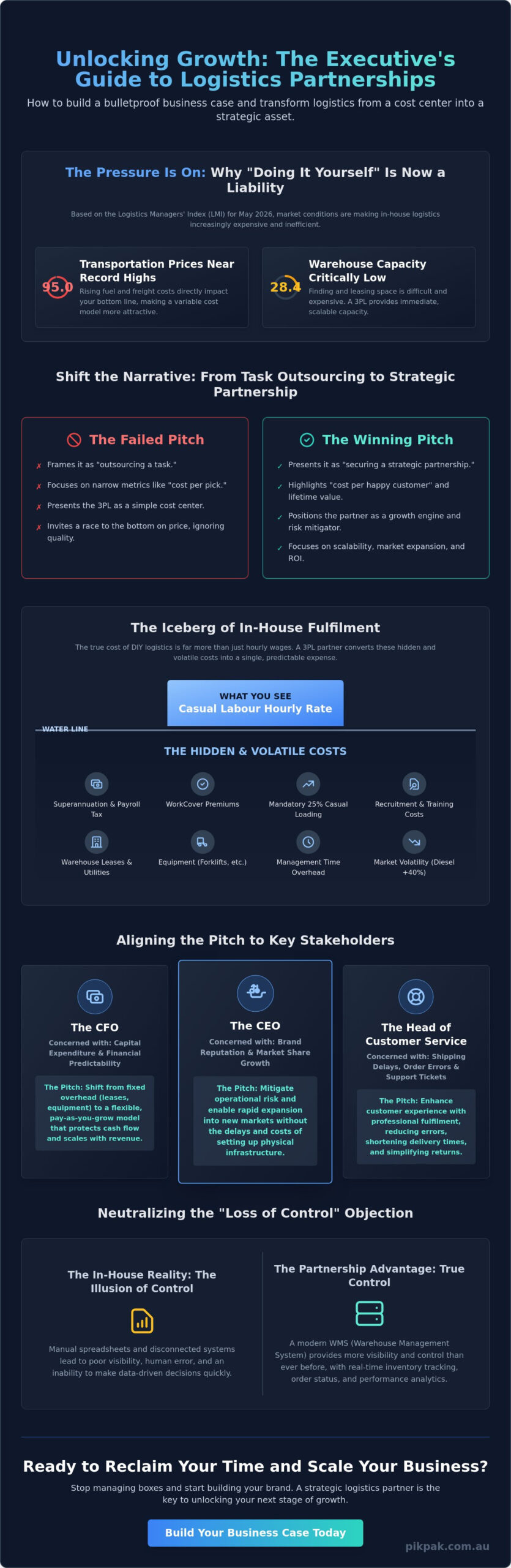
In May 2026, the Logistics Managers’ Index (LMI) for Transportation Prices reached 95.0, while capacity dropped to 28.4. These figures represent a tightening market where doing it yourself is no longer just a headache; it’s a financial liability. By shifting from fixed costs like long-term warehouse leases and permanent staff to a variable cost model, you protect the business against market volatility. The goal is to move from a rigid operational structure to one that breathes with your sales volume.
Identifying Your Internal Stakeholders
Each leader has a different pain point. Your pitch must address them specifically to gain traction:
- The CFO: Their primary concern is capital expenditure and financial predictability. Explain how a partner eliminates the need for expensive equipment and long-term lease commitments. Focus on the transition from fixed overhead to a pay-as-you-grow model.
- The CEO: They care about brand reputation and market share. Show them how a partner facilitates rapid expansion into new regions without the delay of setting up physical infrastructure.
- The Customer Service Team: They deal with the fallout of shipping delays and lost packages. Focus on how professional order fulfilment reduces support tickets and simplifies the returns process.
Reframing the Logistics Conversation
Don’t talk about cost per pick. That invites a race to the bottom that ignores quality. Instead, frame the discussion around cost per happy customer and the Theory of Constraints buy-in process. This methodology helps you identify the specific operational bottleneck that’s preventing your company from reaching its next revenue milestone. If your marketing team is ready to scale but your warehouse is at 95% capacity, that warehouse is your constraint.
The real challenge in how to get buy-in for a logistics partner is the opportunity cost argument. Every hour a senior manager spends troubleshooting a shipping delay or managing casual warehouse staff is an hour stolen from product development or high-level sales strategy. Use your internal data to show how many orders are delayed daily and what those delays cost in terms of customer lifetime value. When you position a logistics partner as the solution to a growth-killing bottleneck, the conversation changes from “Can we afford this?” to “How fast can we start?”
Building the Financial Case: Hard ROI and Hidden Costs
Most internal resistance to outsourcing stems from a narrow view of expenses. When a CFO looks at a 3PL proposal, they often compare the “cost per pick” against the hourly rate of a warehouse casual. This is the DIY logistics trap. To succeed in how to get buy-in for a logistics partner, you must broaden the scope to include the fully burdened labour rate. This figure accounts for every cent spent on a worker beyond their base pay, including superannuation, WorkCover premiums, payroll tax, and the mandatory 25% casual loading common in the Australian market. When you add the cost of recruitment and training for staff who may only stay for a single peak season, the in-house model quickly loses its shine.
The financial argument isn’t just about saving money; it’s about shifting risk. In May 2026, diesel prices are running roughly 40% above pre-war levels, and trans-pacific freight rates have jumped by over 30% in a single month. These volatile swings are difficult for a small in-house team to absorb. A professional partner provides a buffer against these spikes through volume-based carrier discounts and optimized warehousing and storage models. Securing stakeholder buy-in for logistics changes requires showing the board that a 3PL converts these unpredictable, fixed liabilities into manageable, variable costs.
Visible Costs vs. Hidden Overheads
Your internal audit should distinguish between what’s on the invoice and what’s hiding in the margins. Direct costs like rent, packaging materials, and shipping labels are easy to track. However, the hidden overheads often carry the heaviest weight:
- Management Drain: The hours your operations manager spends on roster disputes or tech maintenance instead of growth.
- Lease Liabilities: Long-term warehouse contracts that don’t shrink when your stock levels do.
- Equipment Upkeep: The capital tied up in forklifts, racking, and pallet jacks.
A fully burdened labour rate is the total cost of an employee’s work time, including all benefits and taxes, divided by their actual productive hours. Often, this rate is double the base hourly wage you see on a payslip.
The Scalability Multiplier
Consider the friction of scaling. If your business grows from 100 to 1,000 orders per day, an in-house operation requires a massive leap in headcount and physical space. This creates a “stair-step” cost profile where you’re often paying for more capacity than you need. A 3PL absorbs these peaks effortlessly. They provide the infrastructure to handle a 10x surge in volume without you needing to post a single job ad. This flexibility is a core reason why many brands review their current fulfilment strategy before a major sales event. By leveraging a partner’s existing scale, you gain the delivery speed of a retail giant without the astronomical capital investment.
Aligning Logistics with Long-Term Growth Goals
Growth is often limited by physical infrastructure. If your inventory is locked in a single location, your delivery times to distant states like Western Australia or the Northern Territory will inevitably lag. When you’re explaining how to get buy-in for a logistics partner, frame the partnership as a tool for rapid market entry. A professional 3PL allows you to bypass the months of setup time required for a new regional warehouse. This agility directly impacts your customer lifetime value (CLV). Faster delivery times lead to higher satisfaction and repeat purchases, turning a one-time buyer into a loyal advocate.
Achieving this level of operational excellence requires a top to bottom buy in from your entire organization. It’s not just about moving stock; it’s about integrating your sales channels with a reliable backend. By reducing the “Time to Customer,” you create a competitive advantage that’s difficult for in-house operations to match without massive capital expenditure. Frame your case for how to get buy-in for a logistics partner as a move toward geographic flexibility and long-term brand resilience.
Technology as a Growth Driver
Manual data entry is the enemy of scale. Leveraging advanced technology support ensures that your inventory visibility is absolute across every sales channel. An automated order flow moves a purchase from your e-storefront to the warehouse floor in seconds. This eliminates the lag and human error associated with manual spreadsheets. WMS-driven pick and pack processes ensure that the right product reaches the right customer every time. This precision allows you to scale from 50 orders a day to 500 without a single hitch in your operation.
Enhancing the Post-Purchase Experience
The relationship with your customer doesn’t end at the “checkout” button. The post-purchase experience is where brand loyalty is won or lost. Professional kitting and assembly services ensure your products arrive exactly as you envisioned, reflecting a level of care that builds trust. A robust returns management system handles reverse logistics with ease, removing the friction that often prevents repeat business. Providing clear customer delivery options, from standard home delivery to express shipping, gives your buyers the control they crave. When you simplify the delivery and return process, you prove to your stakeholders that logistics is a marketing tool, not just a line item expense.
Addressing the “Loss of Control” Objection
The most common roadblock in how to get buy-in for a logistics partner is the fear of losing oversight. Many founders feel that if they can’t physically walk through their warehouse and count boxes, they’ve lost their grip on the business. However, relying on manual spreadsheets and “tribal knowledge” in your own facility is actually a higher risk. A professional 3PL replaces guesswork with a “Glass Warehouse” model. This approach uses technology to provide 24/7 visibility into your inventory, ensuring you remain the ultimate decision-maker without needing to be on the warehouse floor.
Service Level Agreements (SLAs) are your primary tool for maintaining quality. Unlike an internal team where performance might fluctuate without clear consequences, a logistics partner is contractually bound to specific KPIs. These include picking accuracy, shipping speed, and stock integrity. If you’re struggling with how to get buy-in for a logistics partner, suggest starting with a pilot program. Moving a single product line or a specific region’s stock allows the team to test the WMS interface and see the reliability of the shipping process first-hand.
Transparency Through Technology
Modern WMS platforms offer real-time transparency, providing a 24/7 digital window into every inventory movement and order status. From the moment of warehouse receiving to the final home delivery, every touchpoint is logged and visible. This level of data allows you to track picking accuracy and shipping times with a precision that manual systems can’t match. Instead of asking a warehouse manager for a status update, you simply refresh your dashboard. This shift from manual tracking to automated reporting builds immediate confidence with your internal stakeholders.
The Security and Reliability Factor
Professional facilities offer security protocols that are often cost-prohibitive for smaller businesses. This includes 24/7 monitoring, sophisticated fire suppression systems, and strict access controls. Beyond physical security, a partner provides business continuity. If your sole warehouse manager falls ill or resigns, your operations don’t grind to a halt. A 3PL eliminates this “key person” dependency by providing a seasoned team that follows standardized, documented processes. You’re not just buying storage; you’re buying a resilient system that protects your brand’s reputation.
Ready to see how a digital warehouse gives you more control? Explore our WMS platform features to see our transparency in action.
Finalising the Buy-In: The Implementation Roadmap
Once you’ve built the financial case and addressed the “loss of control” fears, the final step in how to get buy-in for a logistics partner is presenting a clear path forward. Executives don’t just want to know why a change is necessary; they want to know how it will happen without breaking the business. A well-defined implementation roadmap removes the ambiguity that often kills a deal at the last minute. By mapping out a phased transition, you prove that the move is a calculated strategic shift rather than a desperate reaction to operational stress.
Selecting the right provider is about alignment. Review your service priorities to ensure the partner’s strengths match your brand’s specific needs, whether that’s rapid home delivery or complex kitting and assembly. Pik Pak Logistics simplifies this pitch for you by providing the transparency and technology required to satisfy even the most skeptical CFO. We don’t just offer warehouse space; we provide a plug-and-play solution that integrates directly with your existing storefront, making the transition feel effortless for your team and your customers.
Your final proposal should be concise. Start with an executive summary that highlights the transition from fixed to variable costs and the projected improvement in delivery speed. Use the data gathered in your internal audit to show the ROI. When you present a plan that accounts for risk and offers a clear timeline, you’re not just asking for permission. You’re leading a transformation that allows the business to reclaim its focus on growth. This is the ultimate goal of how to get buy-in for a logistics partner: turning a backend headache into a front-end competitive advantage.
The 30-60-90 Day Transition Plan
- Day 1-30: Tech Integration and Stock Transfer: Connect your e-commerce platform to the WMS. Begin the physical transfer of inventory during a low-volume period to avoid peak season disruption.
- Day 31-60: Parallel Testing and Initial Fulfilment: Run a small percentage of orders through the new system. This allows you to verify picking accuracy and shipping times while your team gets comfortable with the new dashboard.
- Day 61-90: Full Optimisation and Reporting: Move 100% of your fulfilment to the partner. Start reviewing monthly performance reports to identify further efficiencies and cost-saving opportunities.
Next Steps for the Internal Champion
Don’t let the momentum stall. Gather your current logistics data, including your fully burdened labour rates and current lease commitments, to prepare a comparative quote. This data is the foundation of your business case. Book a discovery call to see the technology in action and understand how real-time visibility will change your daily operations. When you’re ready to secure approval, contact Pik Pak Logistics to start building your bulletproof business case today.
Take Control of Your Operational Scalability
Securing a logistics partner is the bridge between a business that’s merely surviving and one that’s ready to dominate the Australian market. By shifting your perspective from outsourcing chores to investing in infrastructure, you unlock the ability to scale without the weight of fixed lease liabilities. You’ve seen how to build the financial case and how to dismantle the “loss of control” myth using real-time data. Now, the final step in how to get buy-in for a logistics partner is taking that first step toward a more efficient future.
Pik Pak Logistics provides the tools you need to make this transition effortless. Our cloud-based WMS offers 24/7 visibility into every SKU, while our expertise in complex kitting and assembly ensures your brand standards never slip. We specialize in scalable solutions designed specifically for the unique challenges of Australian e-commerce. Don’t let operational friction hold back your next phase of growth. Request a custom logistics proposal to present to your team and start reclaiming your time today. You’ve built a great brand; it’s time to give it the operational engine it deserves.
Frequently Asked Questions
How do I explain 3PL costs to my CFO?
Frame the conversation as a shift from capital expenditure to operational expenditure. Instead of tying up cash in warehouse leases and expensive equipment, you pay only for the storage and labour you use. This move improves your balance sheet by converting fixed liabilities into variable costs that scale with your revenue.
What is the biggest risk when outsourcing logistics?
The primary risk is a lack of data synchronization between your storefront and the warehouse. If your inventory levels don’t update in real time, you risk overselling and damaging your brand reputation. You can mitigate this by choosing a partner with a modern WMS that integrates directly with your existing sales channels.
How long does it typically take to get buy-in for a logistics partner?
The process usually spans 90 to 180 days from the initial research phase to the final executive sign-off. This timeline allows for a thorough internal audit, stakeholder presentations, and contract negotiations. Starting the process early ensures you aren’t making a rushed decision under the pressure of an upcoming peak season.
Will we lose our brand identity if we use a 3PL?
You maintain full control over the unboxing experience through professional kitting and assembly services. Your partner follows your specific instructions to ensure every order reflects your brand standards. Your customers won’t see a change in presentation; they’ll only notice that their deliveries are faster and more reliable.
How do I calculate the ROI of outsourcing my fulfilment?
When you’re researching how to get buy-in for a logistics partner, start by quantifying the sales lost to stockouts and shipping delays. Combine these figures with the savings from eliminated warehouse rent, utilities, and payroll taxes. This total represents your hard ROI, which often justifies the service fees within the first twelve months.
Can a 3PL integrate with my current e-commerce platform?
Most professional providers use cloud-based WMS platforms that offer native integrations with major stores like Shopify, Magento, and WooCommerce. This creates an automated flow where orders are sent to the warehouse floor instantly. Tracking numbers and shipping updates are then pushed back to your store without any manual data entry.
What happens if our order volume fluctuates after we outsource?
A 3PL partner absorbs the volatility of your sales cycles effortlessly. If your volume drops, your storage and pick fees decrease automatically, protecting your margins during slow periods. This flexibility is a major advantage over the in-house model, where you’re forced to pay for empty warehouse space and idle staff.
How do I handle the transition of our existing warehouse staff?
Transparency is the best approach for internal change management. Some businesses successfully transition warehouse team members into customer support or inventory planning roles where their product knowledge is highly valuable. Other companies coordinate with their new partner to identify potential employment opportunities for experienced staff within the 3PL’s facility.