
The most expensive part of your business isn’t your shipping rate. It’s the hours your team spends manually packing boxes while Australian warehouse rents and labor costs continue to climb. You likely recognize that your current setup is hitting a ceiling, but figuring out how to convince my boss we need a 3pl is a different challenge entirely. It’s common for leadership to worry about losing the “personal touch” or the brand experience when outsourcing.
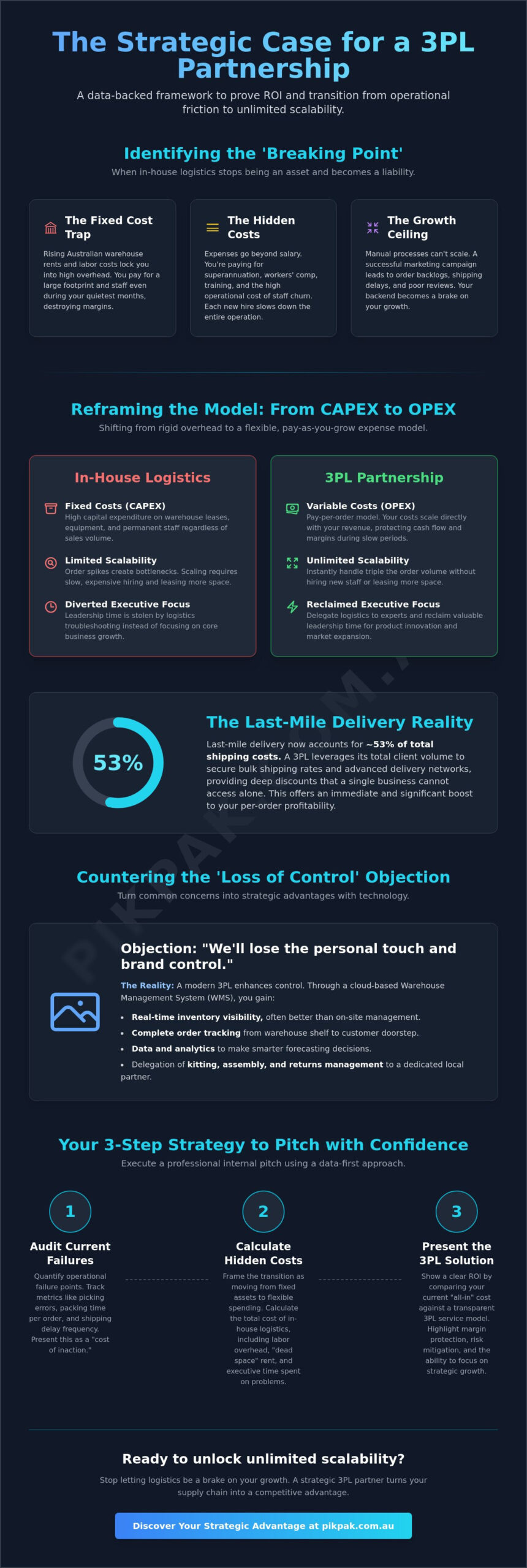
This guide gives you a professional framework to turn those concerns into a strategic advantage. You’ll learn how to present a data-backed business case that proves 3PL ROI and addresses risk head-on. With last-mile delivery now accounting for roughly 53% of total shipping costs, we’ll show you how to frame outsourcing as a tool for unlimited scalability rather than just another overhead expense. We’ll walk through the exact steps to handle objections about brand control, explain the benefits of advanced WMS platform access, and provide a roadmap for a seamless transition into a more efficient, automated future.
Key Takeaways
- Identify the exact moment in-house logistics becomes a liability by calculating the hidden costs of manual picking and rising warehouse rent.
- Use our data-backed ROI framework to learn how to convince my boss we need a 3pl by framing the transition as a move from fixed assets to flexible spending.
- Overcome the “loss of control” objection by demonstrating how cloud-based WMS technology offers better inventory visibility than on-site management.
- Execute a professional internal pitch using a three-step audit that compares current operational failure points against a transparent 3PL service model.
- Reclaim executive time for core business objectives by delegating kitting, assembly, and returns management to a dedicated local partner.
Identifying the ‘Breaking Point’: Why In-House Logistics Fails at Scale
Growth is the goal for every brand, but it often brings a hidden enemy: operational friction. Every scaling business eventually hits an “Operational Breaking Point.” This is the specific moment where the internal cost of managing logistics, including labor, rent, and errors, exceeds the efficiency of a professional partner. If you’re researching how to convince my boss we need a 3pl, start by shifting the conversation toward opportunity cost. Every hour your leadership team spends troubleshooting shipping delays or managing warehouse staff is an hour stolen from product development and strategic expansion.
The 2026 Australian warehouse market has made the in-house model even riskier. With industrial vacancy rates at historic lows and rent prices at record highs, many businesses are stuck in a “Fixed Cost Trap.” You’re forced to pay for a large warehouse footprint even during your quietest months. Transitioning to a Third-party logistics (3PL) model changes the math. It turns rigid overhead into a flexible, variable expense that only grows when your revenue does.
The Hidden Costs of ‘Doing it Yourself’
Staffing involves much more than a base salary. You have to account for superannuation, workers’ compensation, training time, and the high cost of staff churn. When a seasoned picker leaves, your entire operation slows down until a replacement is found and trained. There’s also the “dead space” problem. Paying for a half-empty warehouse during off-peak seasons destroys your margins. Utilizing professional warehousing and fulfilment services eliminates this waste. You pay for the space you use today, not the space you might need in six months.
Recognising the Growth Ceiling
Manual processes eventually hit a hard ceiling. Your current team can only pack a certain number of boxes per shift. When a marketing campaign succeeds or a holiday sale spikes, you likely experience the “Friday Afternoon Panic.” This is when order backlogs lead to shipping delays and poor customer reviews. These bottlenecks act as a brake on your company’s growth. It’s a common reason behind the question of how to convince my boss we need a 3pl; without a scalable backend, marketing can’t afford to win. In 2026 eCommerce, scalability is the ability to triple your daily order volume instantly without hiring new staff or leasing more floor space.
Translating 3PL Benefits into Executive Language: The ROI Framework
To win over a risk-averse executive, you must stop talking about “outsourcing” and start talking about “margin protection.” Most decision-makers view logistics as a cost center. Your goal is to reframe it as a strategic tool for financial stability. When researching how to convince my boss we need a 3pl, the most powerful argument is the transition from CAPEX to OPEX. This shift moves the company away from heavy capital expenditures, like warehouse leases and forklift fleets, toward a flexible operating expense model.
This financial agility is a massive competitive advantage in 2026. A 3PL partnership acts as a risk mitigation strategy against supply chain disruptions. Instead of your business bearing the full weight of labor shortages or rising facility costs, you lean on a partner with the infrastructure to absorb those shocks. You can establish a baseline for these financial terms by reviewing a professional logistics service overview, which helps translate operational tasks into the balance sheet language your boss understands.
Protecting the Bottom Line with Variable Pricing
Traditional warehousing is a “sunk cost.” You pay for the square footage and the staff regardless of your sales volume. If you have a slow month, your margins shrink because those fixed costs don’t move. A 3PL uses a pay-per-order model, meaning your costs naturally contract during quiet periods. This protects your cash flow when you need it most. Furthermore, 3PLs leverage their total client volume to secure bulk shipping rates. These are deep discounts that a single small business simply cannot access on its own, providing an immediate boost to your per-order profitability.
The ‘Focus’ Dividend: Reclaiming Executive Time
Logistics is a notorious time thief. Calculate the hours your leadership team spends on staff management, inventory counts, or troubleshooting shipping errors. Those are hours stolen from product innovation and market expansion. A 3PL acts as a force multiplier for your productivity. It allows the CEO to stop working “in” the warehouse and start working “on” the business. This “Focus Dividend” is often the most persuasive part of the pitch for a boss who feels buried by daily operational friction. If you want to see how this transition looks in practice, exploring professional fulfillment services can help you visualize the time you’ll get back. It’s not just about moving boxes; it’s about reclaiming the mental bandwidth required to scale your brand to the next level.
Countering the ‘Loss of Control’ Objection with Technology
The most common pushback from leadership is the fear of the unknown. Many executives feel that if they can’t physically walk onto a warehouse floor and see their stock, they’ve lost the ability to manage it. This is a valid emotional concern, but it’s often based on an outdated view of logistics. When you’re preparing how to convince my boss we need a 3pl, you must demonstrate that digital visibility is actually far more powerful than physical proximity. Modern technology support provides a level of oversight that manual, in-house operations simply cannot match.
In a manual warehouse, you’re often relying on the memory of a floor manager or a spreadsheet that was last updated three hours ago. A tech-enabled 3PL replaces this guesswork with precision. Every SKU is tracked in real-time, from the moment it arrives at the dock to the second it reaches the customer’s doorstep. This level of data doesn’t just provide peace of mind; it directly impacts customer satisfaction by ensuring that what your website says is in stock is actually on the shelf. If the boss can see every order status from their phone, they haven’t lost control; they’ve gained a more efficient way to exercise it.
Visibility is the New Control
Think of it as the “Glass Warehouse” concept. Instead of peering through a dusty office window at a stack of pallets, your boss gets a clean, real-time dashboard. Cloud-based Warehouse Management Systems (WMS) offer a single source of truth. Through seamless API integrations, your eCommerce platform talks directly to the warehouse. This automation eliminates the risk of overselling or out-of-stock errors that occur when human data entry fails. Moving away from spreadsheets means your data is live, accurate, and accessible from anywhere in the world.
Standardising the Unboxing Experience
A major worry for brand-conscious bosses is that an external partner won’t care about the “unboxing moment” as much as they do. The reality is that 3PLs thrive on Standard Operating Procedures (SOPs). These are strict, documented rules that ensure every package is packed exactly to your specifications every single time. Whether you require specific tissue paper or a custom thank-you note, services like Kitting and Assembly ensure that your brand premiumness is maintained without needing your own staff to do the heavy lifting. By using automated picking systems and barcode verification, professional providers often guarantee 99% or higher order accuracy. This level of precision is nearly impossible to achieve in a manual environment where fatigue and human error are constant factors.
Your 3-Step Strategy to Pitch a 3PL Partnership
Moving from an in-house operation to an external partner is a significant shift. Even with the financial benefits clearly defined, your boss might still hesitate. To bridge this gap, you need a tactical plan that replaces emotional worry with objective data. If you’re wondering how to convince my boss we need a 3pl, the answer lies in a structured, three-step approach that prioritizes risk reduction and transparency. Before you start, it helps to review a comprehensive guide on what is order fulfilment to ensure you’re defining the full scope of the project correctly.
Start by auditing your current failure points. Document every late shipment, lost item, and hour of overtime paid during the last peak season. Next, request a comparison quote to show the specific gap between your current internal spend and a professional service fee. Finally, propose a pilot program. This allows the business to test the waters without committing to a total warehouse overhaul on day one.
Building the ‘Current State’ Cost Audit
Executives respond to numbers. Your audit must go beyond simple shipping rates to include “hidden” costs that often fly under the radar. Gather data on the following points to build a complete picture:
- Consumables: Total spend on packing tape, boxes, and dunnage.
- Facility Overhead: A portion of the electricity, internet, and insurance allocated to the warehouse space.
- Labour Friction: The cost of training new staff and the management time spent on warehouse supervision.
- Customer Churn: The estimated revenue lost from customers who didn’t return after a shipping error or delay.
- Cost-per-order: Your total monthly logistics spend divided by the number of orders shipped.
The ‘Low-Risk’ Transition Plan
The fear of a “failed migration” is a major hurdle. You can lower this barrier by proposing a limited trial. Suggest moving a single high-volume product line or using a 3PL specifically for “Peak Season” overflow. This proves the concept without disrupting your entire supply chain. Emphasise that modern platforms integrate seamlessly with Shopify, WooCommerce, or NetSuite, making the technical setup a simple task rather than a months-long IT project.
When you sit down for the meeting, start with a punchy, benefit-oriented opening statement. Try something like: “I’ve identified a strategy to cap our logistics costs at a fixed rate per order while doubling our daily shipping capacity.” This immediately frames the 3PL as a growth engine. To prepare your data for this conversation, you can view our service models to see which options best fit your current volume.
Why Pik Pak Logistics is the Strategic Choice for Australian Growth
Selecting a partner is the final, most critical step in your proposal. When you present the idea of outsourcing, your boss needs to feel that the company’s reputation is in safe, capable hands. Pik Pak Logistics offers the specific combination of Australian-centric expertise and local Melbourne support that risk-averse leaders require. We don’t just provide a service; we provide a partnership that scales with you. Whether you’re shipping 10 orders a day or 10,000, our infrastructure adapts to your needs without requiring you to lease more floor space or hire additional seasonal staff.
The biggest hurdle in how to convince my boss we need a 3pl is often the fear of becoming “just another number” to a large provider. Pik Pak Logistics solves this by offering a high-tech, high-touch model. Our web-based platform gives your leadership team the granular control they crave, while our end-to-end management handles everything from customer delivery to complex returns management. This ensures a consistent brand experience that protects your hard-earned customer loyalty while removing the friction of daily logistics tasks.
Effortless Integration for Busy Executives
A transition shouldn’t create more work for your office team. The Pik Pak Logistics onboarding process is designed to be “set and forget.” Our technology integrates directly with your existing eCommerce store, which completely eliminates the need for manual data entry or daily order uploads. This automation reduces the risk of human error and frees up your staff to focus on marketing and sales. To ensure a smooth experience, we provide a dedicated point of contact. This means your boss always has a single, reliable person to talk to, removing the stress of navigating a complex corporate hierarchy.
A Scalable Future Without the Overhead
The long-term goal of this transition is to transform your company into an “asset-light” business. By removing the weight of warehouse leases and equipment maintenance, you gain the financial freedom to pivot and grow. You’re no longer limited by the physical walls of your current facility. Outsourcing your logistics isn’t about giving up control; it’s about leveling up your operations to meet modern consumer demands. It’s an enabling force that allows your brand to compete with larger retailers on speed, accuracy, and reliability.
Ready to build your business case? Get a tailored quote from Pik Pak Logistics today.
Transform Your Logistics Into a Growth Engine
Reframing the internal conversation is the first step to unlocking your brand’s potential. By shifting the focus from the daily grind of manual packing to a variable, scalable model, you’re protecting your company’s margins and reclaiming executive time for what matters most. You now have the framework to address “loss of control” fears with real-time WMS visibility and a structured 3-step pitch strategy. This data-driven approach turns a logistical headache into a clear business case for expansion.
Mastering the art of how to convince my boss we need a 3pl is ultimately about demonstrating that outsourcing isn’t just about shipping boxes; it’s about building an asset-light, resilient business. With seamless integration for platforms like Shopify and WooCommerce, the transition is simpler than it’s ever been. You’ll gain access to scalable Australian-based warehousing that grows with your order volume, ensuring your customers receive a premium experience every time.
Request a custom 3PL quote from Pik Pak Logistics to show your boss the savings and start your journey toward effortless operations. You’ve identified the bottlenecks. Now, it’s time to lead the way toward a more efficient, automated future.
Frequently Asked Questions
How do I explain the cost of a 3PL to a boss who only sees the invoice?
Explain that a 3PL invoice is a consolidated cost that replaces multiple internal expenses. Instead of paying separately for warehouse rent, electricity, packing supplies, and warehouse staff, these are bundled into one transparent fee. This makes it much easier to calculate your exact cost-per-order. It is a vital argument when learning how to convince my boss we need a 3pl, as it highlights financial predictability over fluctuating overhead.
Will we lose our ‘personal touch’ if we use a 3PL for shipping?
You maintain your brand identity through strict Standard Operating Procedures (SOPs). Most professional providers offer kitting and assembly services to replicate your specific unboxing experience. You define the packing rules, and the warehouse team executes them with precision. This ensures every customer receives a package that looks exactly how you intended, even during high-volume sales periods.
What happens to our current warehouse staff if we move to a 3PL?
Transitioning to a 3PL allows you to redeploy your internal team to growth-focused roles. Instead of spending hours packing boxes, your staff can focus on customer support, product development, or marketing strategy. This shift moves your human capital from manual labor to high-value activities that directly increase revenue. It is a strategic move to optimize your internal talent for business expansion.
How long does it typically take to integrate our store with a 3PL like Pik Pak Logistics?
Technical integration with a partner like Pik Pak Logistics is typically a fast process that takes just a few business days. Modern WMS platforms connect directly to eCommerce stores like Shopify or WooCommerce via API. Once the connection is established, your orders flow automatically to the warehouse for picking and packing. This “set and forget” setup is a major selling point when researching how to convince my boss we need a 3pl.
Can a 3PL handle our custom packaging and branding requirements?
Yes, professional providers specialize in custom branding through kitting and assembly services. You can supply your own branded boxes, tissue paper, or stickers for the team to use. The warehouse staff follows your exact instructions to ensure your brand aesthetic remains consistent. This allows you to scale your premium presentation without the physical burden of managing the packing process yourself.
Is a 3PL more expensive than hiring a part-time warehouse assistant?
A 3PL is often more cost-effective because you only pay for the work actually performed. A part-time assistant requires a flat wage, superannuation, and management time even during slow sales months. With a 3PL, you eliminate the overhead of equipment, insurance, and warehouse facility costs. You gain access to a professional logistics team for the price of a single variable expense.
How does a 3PL handle customer returns and reverse logistics?
Returns management is a standard service that streamlines the entire reverse logistics process. When a customer sends an item back, the 3PL receives it, inspects the condition, and updates your inventory levels in real-time. This keeps your stock accurate and ensures that resellable items are back on the virtual shelf as quickly as possible, improving your overall cash flow.
What is the best way to start a pilot program with a 3PL?
The most effective pilot program involves moving a single product category or a specific high-volume SKU to the 3PL. You can also use a 3PL to handle overflow specifically during peak sales periods like Black Friday or Christmas. This low-risk trial proves the efficiency of the technology and the accuracy of the fulfillment process before you commit to a full operational transition.