Did you know that the average value of a stolen shipment reached over $336,000 late last year? For an eCommerce founder, your inventory isn’t just boxes on a shelf; it’s the lifeblood of your growth. It’s natural to feel “stock anxiety” when you hand over the keys to a third party. You need to know that your partner treats your goods with absolute care. Getting your warehouse security and insurance strategy right is the only way to ensure your operations run like clockwork while you focus on scaling.
We understand that the fine print of Australian logistics can feel complex. You likely wonder who is actually liable if a pallet goes missing or how the 14% drop in property insurance rates in early 2026 affects your overheads. This guide simplifies the entire process. You’ll learn the difference between mandatory and optional policies, the high tech security standards you should demand from a 3PL, and how to ensure your digital tracking is as ironclad as the physical locks on the door. Let’s clear the confusion so you can get back to business with total peace of mind.
Key Takeaways
- Understand the dual-layer approach to warehouse security and insurance that combines physical barriers with digital transparency to protect your stock from evolving threats.
- Discover how to bridge the “Liability Gap” and clarify why Industrial Special Risk (ISR) policies are vital for large-scale inventory protection.
- Learn why a real-time Warehouse Management System (WMS) is a critical security tool for eliminating inventory loss and tracking errors.
- Use our actionable audit checklist to vet a 3PL’s physical security, staff training, and compliance with the 2026 Workplace Exposure Limits (WEL).
- Find out how to leverage the current downward trend in Australian commercial insurance premiums to lower your operational risks and costs.
Why Warehouse Security and Insurance are Critical in 2026
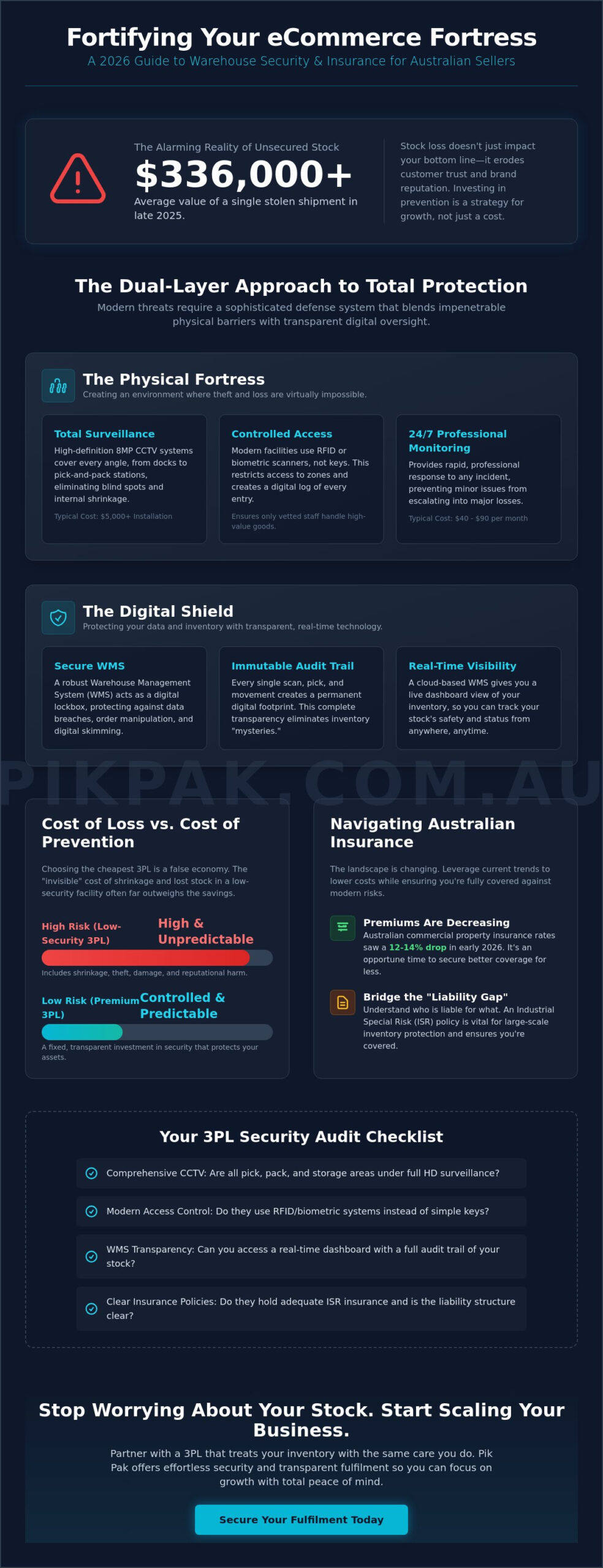
Warehouse security is no longer just about padlocks and basic fire cover. In 2026, it’s a comprehensive shield that blends Physical security standards with digital oversight and strict operational protocols. This dual-layer approach ensures your stock stays exactly where it should be until it’s time to ship. The stakes are higher than ever. Criminals now use AI and data scraping to identify high-value shipments before they even leave the dock. Late 2025 saw the average value of a stolen shipment jump to over $336,000. If your stock isn’t protected by a sophisticated system, your business is a target. Beyond the immediate financial hit, stock loss destroys customer trust. When an order goes missing, customers don’t blame the thief; they blame your brand.
The Evolution of Australian Warehouse Risks
Porch piracy is often the final symptom of a warehouse security failure. If dispatch protocols are weak or tracking is imprecise, packages are more likely to be intercepted. Additionally, the extreme climate events of 2024 and 2025 changed the Australian insurance landscape. While commercial insurance rates declined by 12% in early 2026, insurers are now much stricter about where and how stock is stored. In 2026, Australian warehouse risk is defined by the intersection of high-tech theft and increasing environmental volatility.
The Cost of Stock Loss vs. The Cost of Prevention
Choosing a partner based on the lowest storage rate is often a false economy. Cheap, unmonitored warehouses frequently suffer from high shrinkage rates. This invisible drain on your margins can easily exceed the cost of a premium warehousing and fulfilment service. A secure 3PL provides a massive return on investment by keeping your inventory levels accurate and your goods safe. We call this “risk-adjusted fulfilment costs.” It’s the total cost of moving your product, including the price of potential losses. When you eliminate the headache of missing stock, you free up your time to focus on growth. Investing in warehouse security and insurance isn’t just a defensive move; it’s a strategy for scaling without the risk of sudden inventory collapses.
Physical and Digital Security Standards for Modern Warehousing
Effective warehouse security and insurance starts with total visibility. You can’t protect what you can’t see. In 2026, the gold standard for physical protection involves a multi-layered approach that goes far beyond a simple perimeter fence. It begins with high-definition CCTV. Professional 8-camera, 8MP systems often cost upwards of $5,000 for installation in Australia. These aren’t just for the front gate. Cameras must cover every pick and pack station to ensure total accountability. When every movement is recorded, internal shrinkage and inventory errors virtually disappear. Integrating robust warehouse security and insurance protocols also means your 3PL should utilize 24/7 professional monitoring. This usually costs between $40 and $90 per month but provides the rapid response needed to prevent a minor incident from becoming a total loss.
Physical Barriers and Surveillance
Access control is a non-negotiable pillar of modern logistics. Standard metal keys are a liability because they’re easily lost or copied. Instead, elite facilities use RFID or biometric scanners to restrict staff access to specific zones. This ensures only vetted team members handle your high-value inventory. For eCommerce sellers, this level of detail in Pik Pak warehousing and fulfilment provides the reassurance that stock won’t just “walk away.” Every entry and exit is logged, creating a culture of responsibility that protects your bottom line.
Cybersecurity and Data Integrity
Digital security is the new frontier for warehouse safety. Your 3PL’s Warehouse Management System (WMS) acts as a digital lockbox for your business data. If a partner’s API security is weak, hackers can manipulate orders or hide theft through digital skimming. You need a cloud-based WMS that creates an immutable audit trail. Every time a worker scans a barcode, a permanent digital footprint is created. This transparency is a core feature of Pik Pak technology support, giving you real-time visibility from your own dashboard. You don’t need to be a tech expert to see that your stock is safe. You just need a partner who takes data integrity as seriously as physical locks.
Security also starts the moment a truck hits the dock. Following secure receiving guidelines ensures that stock is counted and verified immediately upon arrival. This prevents disputes with suppliers and ensures your insurance coverage is valid from the second the goods enter the building. By combining these physical and digital standards, you create a warehouse environment where operations run like clockwork and risk is managed professionally.
Navigating Warehouse Insurance: What Australian Sellers Need
Many eCommerce owners fall into a dangerous trap. They assume that because their stock is in a 3PL facility, the 3PL is responsible for insuring it. This is rarely the case. We call this the “Liability Gap.” While a 3PL facility carries insurance for the building and their own equipment, the actual inventory usually remains the responsibility of the seller. Understanding warehouse security and insurance is vital to ensure you aren’t left exposed if a disaster strikes. Most 3PL contracts include a “Goods in Custody” clause. This clause states that while the provider takes every precaution to keep your goods safe, they don’t provide the primary insurance cover for your stock. You need your own policy to protect your investment.
For larger operations, Industrial Special Risk (ISR) is the heavy lifter. It’s a high level policy designed for businesses with assets typically exceeding $5 million. It covers everything from fire and theft to business interruption. If you’re a smaller seller, you might look at standard Business Insurance, but there’s a better way. Stock Throughput Insurance is often the most efficient choice for eCommerce. It covers your goods from the moment they leave the factory, while they sit in the warehouse, and until they reach the customer’s door. This eliminates the need for separate transit or marine cargo policies, making your logistics much simpler.
The Mandatory vs. Optional Coverage List
Don’t guess what you need. Take this checklist to your insurance broker to ensure your inventory storage is fully protected:
- Stock Throughput: Does it cover raw materials, work in progress, and finished goods?
- Public and Products Liability: Does it protect you if a product you sold causes injury or damage?
- Goods in Custody: Have you confirmed where the 3PL’s liability ends and yours begins?
Often, sellers find that having a professional partner with high security standards makes it easier to get these policies approved.
Cyber Insurance and Supply Chain Risks
By 2026, cyber threats are just as physical as a break-in. If a hacker targets a Warehouse Management System (WMS), your entire supply chain could grind to a halt. This is why cyber insurance is now a mandatory consideration for automated fulfilment. It covers the costs of data recovery and the loss of income during a system outage. The good news? The Australian commercial insurance market saw a 12% price decline in early 2026. This softening market is the perfect time to secure better terms. When you can prove your 3PL uses a secure, cloud-based WMS, insurers often view your business as a lower risk. This leads to lower premiums, helping you scale your business without the extra stress. If you have more questions about how this works, check our warehousing questions page for more detail.
Audit Checklist: How to Evaluate a 3PL’s Security and Insurance
Handing over your inventory is a major step in scaling your business. You shouldn’t do it without a thorough investigation. A physical site visit is the best way to verify if a provider’s claims about warehouse security and insurance actually hold up in reality. During your walkthrough, look past the shiny equipment. Watch how the staff moves and how stock is handled at the dock. If the environment feels chaotic, your stock is at risk. A professional 3PL should treat your inventory with the same respect you do, ensuring every pallet is accounted for from the moment it arrives.
Start your audit by asking about staff vetting. Since a significant portion of warehouse theft is attributed to internal actors, thorough background checks are mandatory. Ask how often they run security training and what their protocols are for unauthorized visitors. Next, verify their insurance certificates. Don’t just ask if they have coverage; ask for the “Certificate of Currency” and check the liability limits. If the 3PL’s coverage doesn’t align with the value of the goods they store, you’re looking at a massive liability gap. You should also review their warehouse receiving guidelines. If the inbound process isn’t strict, stock can “disappear” before it’s even entered into the system.
Verifying Physical and Digital Redundancy
Security isn’t just about stopping thieves; it’s about protecting against accidents and system failures. Check the maintenance records for fire suppression systems and smoke alarms. In a high density warehouse, a small fire can become a disaster in minutes. On the digital side, ask about data backups. If the warehouse loses internet connectivity, your 3PL should have a failover system to ensure your WMS data remains accurate and accessible. For more tips on what to look for, our list of warehousing questions offers a great starting point for your audit.
Understanding the Claims Process
You need to know exactly what happens when things go wrong. Ask the provider for a clear breakdown of their claims process. If a forklift driver clips a pallet, who pays for the damage? A reliable partner will have a transparent protocol that includes photographic evidence and immediate digital logging. This transparency extends to Returns Management. Your reverse logistics must be just as secure as your outbound shipping to prevent stock from leaking out of the system during the returns cycle.
Ready to move your stock into a facility that treats security as a priority? Let Pik Pak handle the hard work for you with our secure, tech-driven fulfilment solutions.
Pik Pak: Effortless Security and Transparent Fulfilment
Choosing a logistics partner shouldn’t feel like a gamble. At Pik Pak Logistics, we’ve turned “Pick, Pack & Ship Made Easy” into a reality by building our operations on a foundation of rigorous security. We understand your stock is your biggest asset. That’s why our facilities are designed to meet and exceed 2026 safety standards, including the transition to Workplace Exposure Limits (WEL) and updated WHS regulations. By handling the complex headache of logistics safety, we let you focus on your business. You get the benefits of elite warehouse security and insurance standards without having to manage the minute details yourself. We make what seems like a challenge into an easy game.
Our approach is grounded in the belief that logistics should be emotionally reassuring. When you know your provider is a seasoned, tech-savvy problem-solver, the stress of scaling disappears. With the Australian commercial insurance market seeing a 12% price decline in early 2026, there’s never been a better time to align with a partner that prioritizes risk management. We eliminate waste and ensure your operations run like clockwork, giving you the confidence to chase bigger goals while we watch the warehouse floor.
Built-in Security via Technology
Transparency is the ultimate security feature. Our cloud-based Pik Pak technology provides a point-and-click audit trail for every single SKU in our care. You don’t need to be a computer geek to see exactly where your stock is at any moment. This real-time visibility eliminates the fear of inventory “disappearing” and ensures your records always match our physical counts. Plus, our “Pay as you go” model means you get access to this secure infrastructure without the heavy overhead of building your own facility. As you explore our fulfilment services, you’ll see that you can scale as you grow, knowing your data and products are shielded by professional-grade encryption and surveillance.
The Peace of Mind Partnership
We believe in a partnership where “it’s all done for you.” This means we don’t just store boxes; we manage risk professionally. While we’ve discussed how the Australian insurance market softened in early 2026, we also help you understand your specific logistics service responsibilities so there are no surprises. Our team at Pik Pak Logistics is here to ensure your operations run like clockwork, giving you back your most valuable resource: time. We act as the calm expert in a chaotic field, promising to protect your stock as if it were our own. Don’t let the fear of stock loss hold your business back. Get started with a secure 3PL partner today and experience the freedom of effortless fulfilment.
Scale Your Business with Absolute Confidence
Protecting your inventory in 2026 requires more than just a locked door. It’s about combining high-definition surveillance with the digital transparency of a modern WMS to eliminate shrinkage and errors. By understanding the “Liability Gap” and securing the right stock throughput policy, you can take advantage of the 12% drop in Australian insurance rates seen in early 2026 while keeping your assets safe. Managing warehouse security and insurance doesn’t have to be a logistical headache when you have the right partner watching your back.
At Pik Pak, we handle the hard work so you can reclaim your time. Our state-of-the-art Australian facilities and real-time WMS inventory tracking ensure your operations run like clockwork. With our transparent, pay-as-you-go pricing, you get elite-level security without hidden fees or complex contracts. It’s all done for you, allowing you to focus on growth while we ensure your products are always ready to ship. Let’s make your fulfilment simple and secure.
Secure your stock with Pik Pak Logistics today
Frequently Asked Questions
Does my 3PL provider’s insurance cover my stock if the warehouse burns down?
Usually, the answer is no. A 3PL provider typically carries insurance for their building, equipment, and public liability, but the physical stock belongs to you. Most contracts include a clause stating the seller is responsible for insuring their own inventory. If a disaster occurs, you’ll need your own policy to recover the value of your goods. Always review your service agreement to see exactly where the 3PL’s liability ends.
What is the difference between warehouse security and warehouse insurance?
Security is your first line of defence, while insurance is your financial safety net. Security includes the physical and digital tools like CCTV, alarms, and WMS tracking used to prevent theft or damage. Insurance is the contract that compensates you if those prevention measures fail. A robust strategy for warehouse security and insurance ensures that you’ve done everything possible to stop a loss while remaining protected if the unthinkable happens.
Do I need my own insurance if I use a 3PL in Australia?
Yes, you almost always need your own insurance policy. Even the most secure facilities in Australia can’t legally insure goods they don’t own. You should look for a policy that specifically covers “Goods in Custody” or a Stock Throughput policy. This ensures your investment is protected while it sits in a third party facility. It’s a small price to pay for the peace of mind that your business can survive a major incident.
What is “shrinkage” and who is responsible for it in a warehouse?
Shrinkage refers to inventory that is lost, stolen, or damaged between the point of manufacture and the point of sale. In a 3PL environment, responsibility is usually governed by a “shrinkage allowance” in your contract. This is a small, agreed-upon percentage of acceptable loss. If the 3PL loses more than this amount, they are typically responsible for reimbursing you. Using a digital WMS helps keep these numbers near zero by tracking every movement.
How much does warehouse insurance typically cost for an eCommerce business in 2026?
Costs vary based on your inventory value, but premiums are currently more affordable due to increased competition in the Australian market. Your specific price will depend on your product’s risk level and the security standards of your chosen 3PL. When you use a partner with high-tier warehouse security and insurance protocols, you often qualify for lower rates. Insurers view professional, monitored facilities as much lower risks, which can significantly reduce your monthly overheads.
What security features should I look for in a 3PL warehouse?
Look for a balance of physical barriers and digital transparency. You want a facility with 24/7 professional monitoring, restricted access control, and high-definition CCTV covering all pick and pack stations. Just as importantly, ensure they use a cloud-based Warehouse Management System. This creates a digital audit trail for every item. When physical security and digital tracking work together, it creates an environment where your operations run like clockwork.
Can I get insurance for high-value items like electronics or jewellery in a 3PL?
You can certainly insure high-value goods, but you’ll need to disclose these items to your broker. Insurers may require the 3PL to have extra security features, such as specialized cages or additional surveillance cameras in specific zones. A professional 3PL will have no problem accommodating these requirements. By proving the facility meets these higher standards, you can secure the necessary coverage without the headache of massive premium hikes.
What happens if my stock is damaged during the picking and packing process?
If a warehouse staff member damages your stock, the 3PL is usually liable for the replacement cost. A reliable partner will have a clear protocol for this, including taking photos of the damage and logging it immediately in the WMS. This transparency ensures you aren’t left wondering why your inventory levels have dropped. It’s all part of a professional partnership designed to help you focus on your business while the logistics are handled safely.