

One lost batch of inventory can wipe out your monthly margins, yet many eCommerce owners still rely on manual spreadsheets that invite human error. With global eCommerce sales projected to reach $7.41 trillion in 2026, the stakes for brand protection have never been higher. You’re likely feeling the pressure of new regulations, such as the FDA Quality Management System Regulation that replaced older standards on February 2, 2026. Implementing robust batch tracking and expiry date management isn’t just about following rules; it’s about making sure your logistics don’t become a constant source of anxiety.
You deserve a warehouse system where inventory rotation happens automatically and audits are stress-free. This guide will show you how to eliminate waste through FEFO automation and maintain the 24-hour record accessibility required by modern food and medical device standards. We’ll break down how to integrate traceability into your daily workflow so you can stop worrying about accidental shipments of expired goods. It’s time to let technology do the hard work so you can reclaim your time and focus on your business. We’ll show you how to make complex logistics feel like an easy game.
Key Takeaways
- Learn how to turn 2026 supply chain transparency requirements into a competitive advantage that builds lasting customer trust.
- Master the picking logic of your warehouse by switching to FEFO to ensure the oldest stock always leaves first.
- Discover how automated batch tracking and expiry date management eliminates the risk of shipping expired goods and failing audits.
- Standardize your labels and digital workflows to maintain total accuracy from the moment stock arrives at the warehouse.
- See how partnering with a tech-savvy 3PL lets you scale your business while experts handle the heavy lifting of inventory logistics.
Understanding Batch Tracking and Expiry Management in 2026
Batch tracking is the unique identification of a specific group of products produced together. While SKU tracking tells you what an item is, batch tracking tells you exactly when and where it was made. In 2026, this distinction is vital. Global eCommerce sales are hitting $7.41 trillion this year, and consumers demand higher transparency than they did even 12 months ago. Batch production methods allow you to isolate specific units if a quality issue occurs, saving you from the nightmare of recalling your entire inventory.
Switching from manual spreadsheets to an automated WMS platform is a simple, headache-free way to protect your brand. Manual errors cause thousands of dollars in stock write-offs every year. By implementing automated batch tracking and expiry date management, you ensure your digital records always match your physical stock. This transparency is now a global requirement. For example, the European Database on Medical Devices (EUDAMED) becomes mandatory on May 28, 2026. Even if you don’t sell medical gear, the trend toward strict traceability is moving across every sector. It’s about staying ahead of the curve so your logistics never slow you down.
Batch Tracking vs. Lot Tracking: Is There a Difference?
In the Australian 3PL industry, experts often use these terms interchangeably. Usually, “Lot” refers to raw materials, while “Batch” refers to the finished production run. For your online store, the definition is simple. Batch tracking identifies products sharing a production date or material source to ensure end-to-end traceability. It’s a pragmatic tool that gives you total control over your supply chain without the technical jargon.
The Core Pillars of Expiry Date Management
Logistics efficiency depends on the “Best Before” versus “Use By” distinction. A “Use By” date is a strict safety deadline, while “Best Before” indicates peak quality. Digital timestamps prevent “hidden” expired stock from gathering dust in a dark corner of the warehouse. Real-time visibility reduces spoilage by letting you see exactly which items need to move. When you know your dates, you can run flash sales or clear stock before it becomes a loss. This keeps your inventory fresh and your operations running like clockwork. Let Pik Pak do the hard work of monitoring these dates so you can focus on your business growth.
Why Your eCommerce Brand Cannot Afford to Ignore Traceability
In 2026, there are 2.86 billion online shoppers worldwide, and their expectations for safety are at an all-time high. They don’t just want a package; they want peace of mind. Traceability has moved from a back-office task to a front-facing brand promise. When you can prove your inventory’s origin, you build a level of trust that keeps customers coming back. This transparency is a powerful competitive advantage in a market where 21.8% of all retail purchases now happen online. It’s about showing your customers that you care about the details as much as they do.
A single unmanaged recall is often the end for a growing eCommerce brand. The financial blow is massive. You’re looking at the cost of the lost inventory, the logistics of the return, and potential legal fees. Beyond the money, the damage to your reputation can be permanent. Pik Pak turns this complex challenge into an easy game with automated reporting. Our systems ensure you always have the data you need to act fast. By mastering batch tracking and expiry date management, you protect your bottom line and your brand’s future simultaneously.
Regulatory Compliance in Australia: FSANZ and TGA
In Australia, the regulatory landscape is strict and unforgiving. Food Standards Australia New Zealand (FSANZ) mandates that food businesses must have a traceability system in place. You have to be able to track one step back and one step forward in the supply chain at all times. For health brands, the Therapeutic Goods Administration (TGA) requires even higher standards for supplements and medical products. You need to understand the nuances of Food Product Dating to ensure your labels meet these rigorous local requirements. Failing to meet these standards can lead to heavy fines or immediate business closure.
Protecting Brand Reputation During a Recall
Batch tracking lets you perform a “surgical” recall. Instead of pulling every item from your digital shelves, you only remove the specific production run that’s affected. This saves your margins and prevents unnecessary panic among your customer base. Speed is the most important factor here. With a tech-savvy 3PL, you can identify exactly which customers received a specific batch in seconds. We handle the reverse logistics too, managing the return of tracked batches effortlessly so you can focus on your business. Our logistics services are designed to keep your reputation intact even when things go wrong.
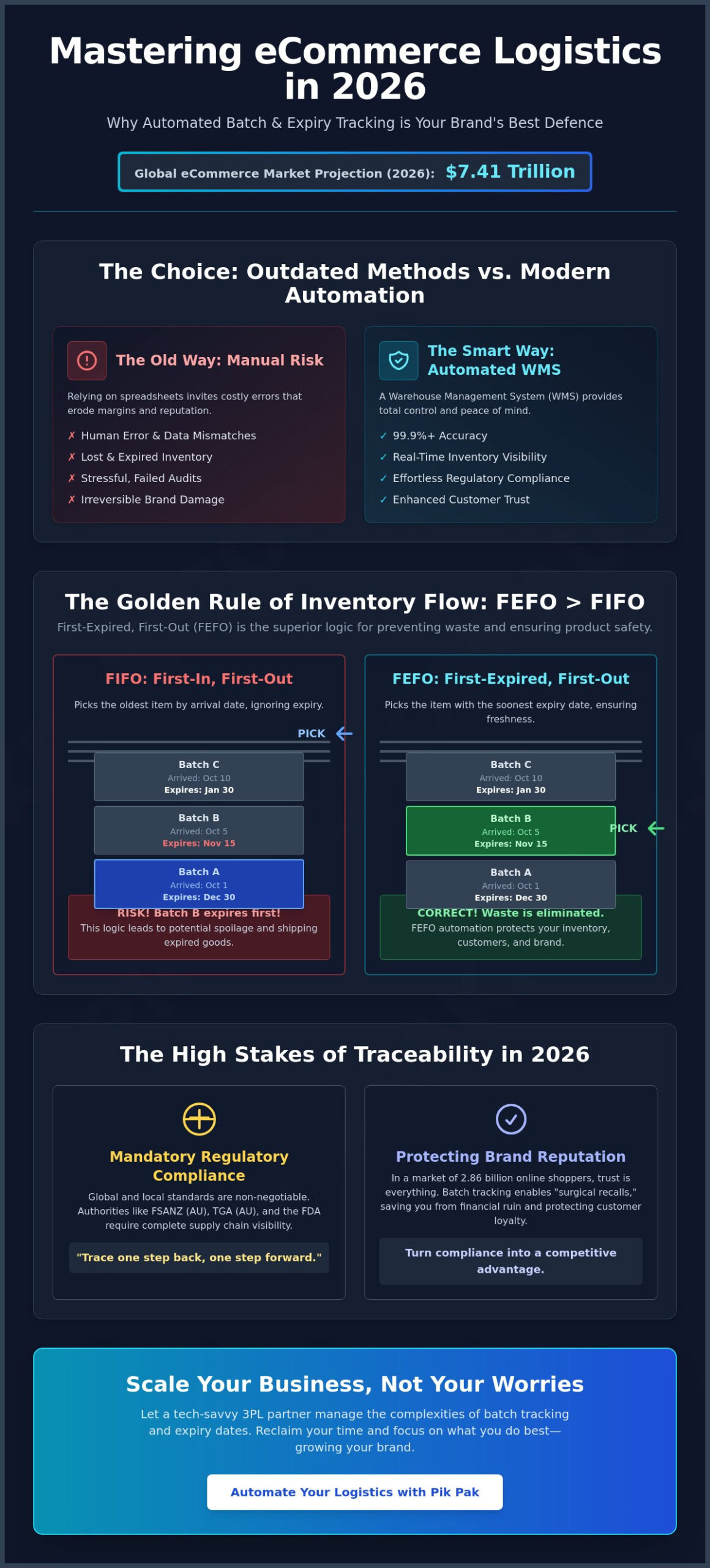
Optimising Inventory Flow: FEFO vs. FIFO
Picking logic is the “brain” of an efficient eCommerce warehouse. Without a clear strategy, your staff might grab the closest box rather than the right one. For most general goods, FIFO (First In, First Out) is the standard. It ensures that the stock arriving first is the first to leave. However, for cosmetics, supplements, or food, FIFO isn’t enough. You need FEFO (First Expired, First Out). This method ensures that the product with the nearest expiry date moves to the front of the queue, regardless of when it arrived at the facility.
Automated picking logic removes the “guesswork” from the warehouse floor. Human error is a major risk when staff have to manually check tiny print on every bottle. A robust warehousing and fulfilment system automates this process. When an order comes in, the system directs the picker to the specific batch that needs to go out next. This level of Track And Trace capability is what separates professional brands from those struggling to scale. It ensures your operations run like clockwork while you focus on your business.
The FEFO Strategy: Why Expiry Dates Rule the Warehouse
FEFO prioritises the oldest usable stock to maximise shelf life for your end customer. It’s a simple way to guarantee that your shoppers always receive the freshest possible product. Within a modern WMS, the system acts as a digital gatekeeper. If a batch has passed its expiry date, the software automatically blocks it from being picked. This safety net eliminates the risk of shipping a “Use By” item that could harm a customer or your brand’s reputation. Effective batch tracking and expiry date management means you never have to worry about what’s hiding in the back of your racks.
Calculating the Real Cost of Expired Stock
Expired stock is “dead stock,” and it carries a heavy price tag. You don’t just lose the initial cost of goods (COGS); you suffer a “Double Loss” by missing out on the potential revenue from a successful sale. Additionally, you’re paying for inventory storage on items that can’t be sold. In 2026, where mobile commerce accounts for 60% of total online sales, your stock must move fast. Use your data to adjust procurement. If specific batches keep hitting their expiry dates before they sell, it’s a clear signal that you’re over-ordering. Refining these numbers helps you eliminate waste and protect your margins.
Implementing Batch Tracking: From Receiving to Delivery
Software alone doesn’t track inventory; people and processes do. Even the most sophisticated batch tracking and expiry date management system fails if the physical workflow is broken. Digital accuracy starts the moment a pallet lands on the loading dock. You need to ensure your suppliers are standardising batch labels before they ever reach the warehouse. This simple step prevents delays and ensures every unit is accounted for from day one. For the best results, follow our Pik Pak Warehouse Receiving Guidelines to streamline this transition and keep your supply chain moving.
Real-time data sync is the bridge between your online store and the physical stock. When a customer buys a bottle of serum on your site, the warehouse system should already know which specific batch is being allocated to that order. This isn’t magic; it’s a series of automated triggers. As stock moves through the facility, the data flows back to your storefront, keeping your inventory levels precise. This level of control removes the headache of overselling or accidentally shipping the wrong production run. It allows you to focus on your business while we handle the heavy lifting.
Barcoding and WMS Integration
Manual entry is a relic of the past that invites disaster. Every batch must have a scannable barcode to ensure 100% accuracy on the warehouse floor. Our Pik Pak Technology Support team helps you set up API connections that push batch data directly to platforms like Shopify or WooCommerce. This “point, click, and connect” approach means you don’t need to be a computer geek to have a world-class setup. It’s about creating a secure, automated loop where information moves as fast as your products. We make the technical side easy so you can stay in control.
Staff Training and Quality Control Checks
Warehouse staff are your first line of defence against stock errors. During the inbound process, they verify every expiry date against the digital manifest. We use a “Double-Check” system where items are scanned at receiving and again at picking to catch any discrepancies. One of the most effective methods we use is “blind receiving,” which is a process where staff must manually enter the quantities and dates they see rather than just confirming what the system expects. This ensures they actually check the physical dates on the packaging. It makes complex logistics feel like an easy game. Let Pik Pak do the hard work for you and ensure your operations run like clockwork.
Ready to automate your inventory and protect your brand? Explore our pick, pack, and ship services today.
Outsourcing to Pik Pak: Making Batch Management Effortless
Logistics shouldn’t be a constant headache. It should be a tool that enables your growth. When you partner with Pik Pak, you’re choosing a seasoned team that understands the high stakes of brand protection. We provide a pragmatic “point, click, and connect” solution that removes the technical burden from your shoulders. Our “Pay as you go” model ensures that professional batch tracking and expiry date management is affordable without the high upfront costs of standalone software. For example, as of February 2026, Digit Inventory software starts at $199 per month; with Pik Pak, you get the technology and the physical labor in one seamless package. We handle the complexity so you can reclaim your time and focus on your business.
Managing a warehouse requires precision that manual systems simply cannot provide. You need a partner that treats your inventory with the same care you do. By outsourcing, you eliminate the stress of potential recalls and the waste of expired stock. We make what seems like a challenge into an easy game. Our systems are designed to be secure and simple, allowing you to scale as you grow without the need for additional software or complex training. Let Pik Pak do the hard work for you while you focus on reaching more of the 2.86 billion online shoppers currently active worldwide.
Real-Time Visibility via Our Cloud-Based WMS
You need to know your stock status at a glance. Our cloud-based WMS dashboard provides total transparency from anywhere in Australia. It highlights exactly which batches are nearing expiry, sending automated alerts before products become unsaleable. This visibility is crucial for meeting the 24-hour record retrieval requirements of modern food and health regulations. You see exactly what we see, ensuring your inventory records are always audit-ready and accurate. Visit our Pik Pak Warehousing and Fulfilment page to see how our technology keeps your business running like clockwork.
Scalable 3PL Solutions for Perishable Goods
Scaling a business is difficult enough without worrying about fulfillment errors during peak seasons. Our Melbourne-based team specializes in handling perishable and sensitive eCommerce goods. We manage sudden demand spikes with ease, ensuring batch accuracy remains perfect even when order volumes triple overnight. With mobile commerce accounting for nearly 60% of total online retail sales in 2026, your brand can’t afford a single shipping mistake. We ensure your logistics run like clockwork, so you don’t have to. It’s all done for you, from receiving to final home delivery. Focus on your business and let us handle the rest.
Take Control of Your Inventory Traceability Today
Mastering your supply chain is the most effective way to protect your brand from the risks of expired stock and regulatory fines. We’ve explored how FEFO picking logic ensures product freshness and why automated systems are essential for meeting the 2026 standards set by FSANZ and the TGA. Implementing robust batch tracking and expiry date management doesn’t have to be a struggle. It’s a strategic move that turns a complex logistical headache into an easy game, allowing you to focus on growth while your operations run like clockwork.
You deserve a partner that simplifies your workflow. Pik Pak provides a state-of-the-art Cloud WMS for real-time visibility and a transparent “Pay as you go” pricing model that scales as you grow. Our expert Australian-based support team is here to ensure your transition to automated logistics is smooth, secure, and entirely effortless. Stop worrying about manual spreadsheets and start reclaiming your time for what matters most.
Focus on your business and let Pik Pak handle the hard work—Get a Quote Today. What seems like a challenge is an easy game with the right partner by your side. We are ready to help you scale with confidence.
Frequently Asked Questions
Is batch tracking necessary for all eCommerce products?
No, it is not strictly required for every product, but it is essential for items with a shelf life like food, health, and beauty products. For the brands selling the 21.8% of global retail now online, it acts as a vital safety net. Even for non-perishables, tracking production runs helps you isolate quality issues without recalling your entire inventory. It’s a pragmatic way to protect your margins.
Can I track expiry dates in Shopify without a 3PL?
You can use third-party apps to add this functionality, but Shopify’s native system does not handle granular batch tracking and expiry date management out of the box. Managing this yourself often leads to the manual spreadsheet errors that cause stock write-offs. A 3PL with a dedicated WMS automates the physical-to-digital link. This removes the headache of manual checks and ensures your records are always accurate.
How does FEFO picking save my business money?
FEFO saves money by ensuring your oldest usable stock leaves the warehouse first, which prevents items from becoming unsaleable “dead stock.” You avoid the “Double Loss” where you lose both the initial cost of the goods and the potential sales revenue. By reducing waste and spoilage, your inventory stays fresh. This keeps your customers happy and ensures your operations run like clockwork.
What happens if a product with a tracked batch is recalled?
You can perform a “surgical” recall by identifying only the specific production run that is affected. Because our WMS links every order to a specific batch number, we can identify affected customers in seconds. This speed is critical for complying with FSANZ or TGA standards in Australia. It turns a potential brand disaster into a manageable task, keeping your reputation intact while you focus on your business.
Does batch tracking increase my fulfillment costs?
While the initial receiving process might take a few extra minutes, the long-term savings are significant. US eCommerce sales hit $1.2337 trillion in 2025, and the cost of a single unmanaged recall can dwarf the small expense of tracking. Preventing stock spoilage and avoiding regulatory fines actually improves your bottom line. It’s a secure investment in your brand’s long-term stability and growth.
Can Pik Pak handle batch tracking for cosmetics and supplements?
Yes, we specialize in high-compliance categories like health, beauty, and supplements. Our Melbourne-based team uses a cloud-based WMS to manage “Use By” and “Best Before” dates with 100% precision. We take care of the complex logistics so you don’t have to be a tech expert. We make it an easy game for you to scale your brand while we handle the hard work.
How do I get my suppliers to provide batch numbers correctly?
You should include clear labeling requirements in your purchase orders and supplier contracts. Standardizing these labels before they arrive at the warehouse is the best way to ensure digital accuracy. When your suppliers follow our receiving guidelines, your stock moves through the inbound process much faster. This simple step ensures your inventory data is secure and ready for real-time tracking from day one.
Is there a difference between a batch number and a serial number?
Yes, a batch number identifies a group of items produced at the same time, while a serial number is unique to one specific unit. Batch tracking is the standard for products like supplements or cosmetics where groups share an expiry date. Serial numbers are typically used for high-value electronics. Understanding this difference helps you choose the right level of traceability for your specific product range.