Did you know the global logistics automation market has reached a staggering $90.72 billion in 2026? Despite this massive industry shift, many founders still struggle to implement logistics automation for small business, finding themselves buried under manual packing slips and inventory spreadsheets. You know the feeling of losing hours to tasks that don’t actually grow your brand. It’s a common headache to manage skyrocketing shipping costs while trying to maintain real-time visibility across your sales channels.
It’s a challenge, but it doesn’t have to be your reality. This guide will show you how to achieve a “hands-off” fulfilment process that reduces operational costs by up to 30% and wipes out manual errors for good. We’ll explore how to scale without the burden of a private warehouse or equipment loans that currently carry interest rates up to 7.75%. From navigating the EU AI Act to leveraging pay-as-you-go models, you’re about to see how logistics becomes an easy game so you can finally free up your time and focus on your business.
Key Takeaways
- Shift from manual spreadsheets to real-time digital workflows that ensure your fulfillment runs like clockwork.
- Compare the high capital costs of private warehouse robots against the flexible, variable-cost model of a tech-enabled partner.
- Identify the three high-impact areas where logistics automation for small business delivers the fastest ROI without the need for massive upfront investment.
- Follow a pragmatic five-step roadmap to integrate your sales channels and achieve 100% visibility over your stock levels.
- Learn how to lower your shipping rates through automated carrier selection and finally free up your time to focus on marketing.
What is Logistics Automation for Small Business?
Logistics automation is the strategic integration of software and systems to handle the repetitive, time-consuming tasks that usually clutter your to-do list. It’s the bridge between a customer clicking “buy” and that package landing on their doorstep without you needing to touch a single roll of packing tape. For most founders, this journey begins by ditching manual spreadsheets and moving into real-time digital workflows. It transforms your operations from a reactive “firefighting” mode into a proactive, streamlined engine.
In 2026, the landscape has shifted significantly. Small retailers are now leveraging AI-driven demand forecasting to predict stock needs before they run out, a tool once reserved for global giants. You don’t need a factory floor full of expensive robots to see these benefits. For SMEs, logistics automation for small business primarily lives in the cloud. It’s about smart data, seamless integrations, and cloud-based platforms that manage your inventory while you sleep. It’s not about heavy machinery; it’s about making your data work harder so you don’t have to.
The Core Components of an Automated System
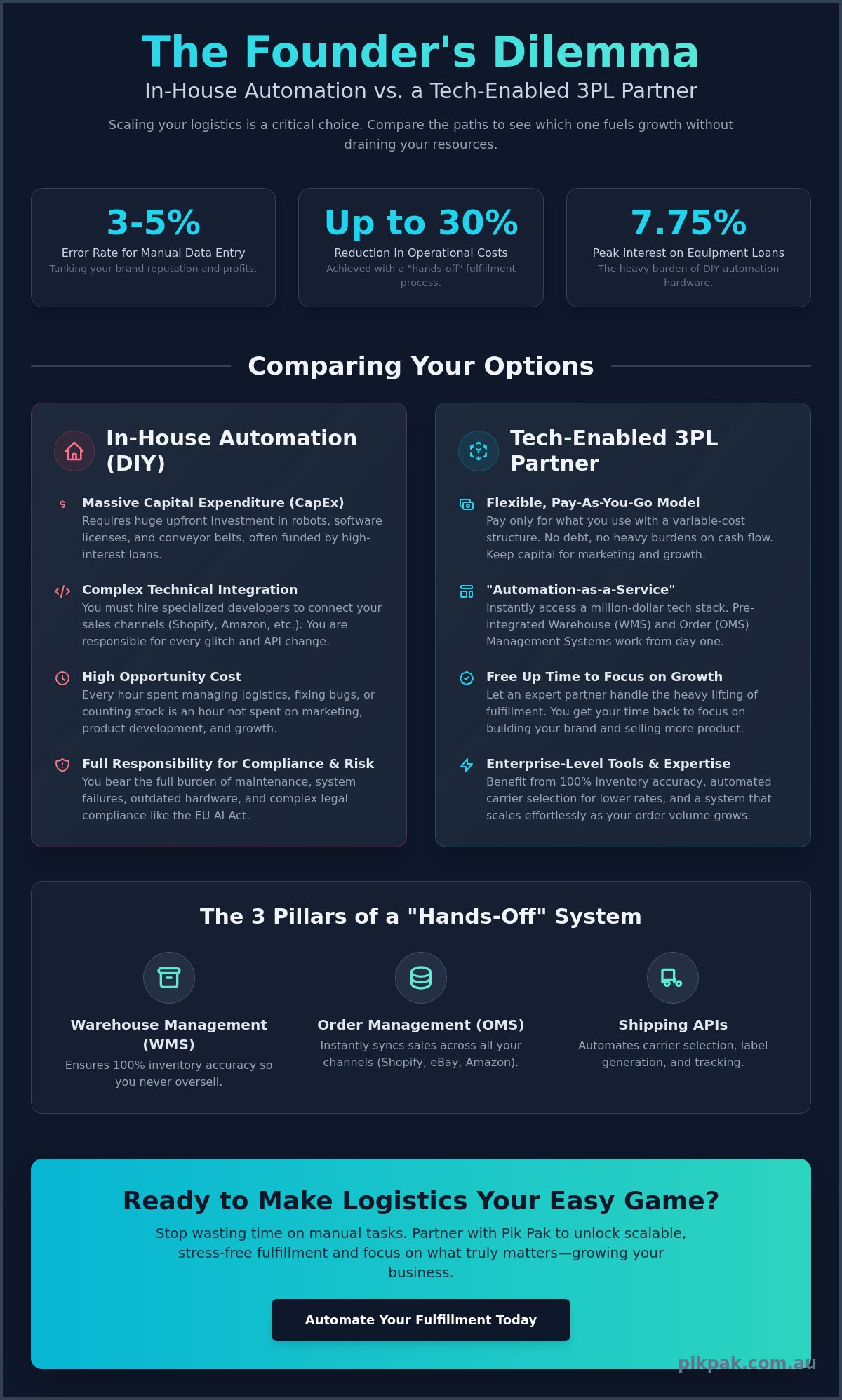
A truly automated workflow relies on three pillars. First, a Warehouse Management System (WMS) ensures 100% inventory accuracy, so you never sell a product that isn’t on the shelf. Second, an Order Management System (OMS) syncs your sales across Shopify, eBay, and Amazon instantly. Finally, shipping APIs generate labels and tracking numbers the moment an order is picked. Our technology support ensures these systems talk to each other without you needing to be a “computer geek.” It’s a simple “point, click, and connect” solution that makes complex logistics an easy game.
Why Manual Logistics is a Growth Killer
Relying on manual processes is a recipe for what we call the “Headache Factor.” Industry data shows that manual data entry leads to error rates between 3% and 5%. While that sounds small, five wrong orders out of every hundred will quickly tank your brand’s reputation and your profit margins. There’s also a massive opportunity cost involved. Every hour you spend manually typing addresses or counting stock is an hour you aren’t spending on marketing or growth. Manual systems create scaling friction. You simply cannot double your order volume without doubling your stress and your staff costs. Automation removes that ceiling, allowing you to scale as you grow without the overhead.
3PL vs. In-House Automation: Comparing Your Options
When you decide to scale your operations, you face a critical fork in the road. Do you build an automated warehouse yourself or partner with a tech-enabled 3PL? For most founders, this choice is between massive capital expenditure (CapEx) and a flexible, variable-cost model. As of April 2026, interest rates for equipment financing sit between 5% and 7.75%. Taking on that level of debt to buy conveyor belts, sensors, and robots is a heavy burden that can stifle your cash flow. It’s often better to keep your capital for marketing and product development while letting a partner handle the heavy lifting.
Think of a 3PL as “Automation-as-a-Service.” You get the full power of a million-dollar tech stack without the million-dollar price tag. Companies like Pik Pak have already built the infrastructure and done the hard work of integrating high-end Warehouse Management Systems (WMS). This approach allows you to implement logistics automation for small business without the technical “headache” or the risk of owning outdated hardware. It’s a pragmatic way to ensure your fulfillment runs like clockwork from day one.
The Hidden Costs of DIY Automation
Software licenses are just the starting point of the DIY trap. You’ll need specialized developers to connect your Shopify, eBay, and Amazon stores to your warehouse hardware. This SBA guide to auto-fulfillment highlights how these technical complexities often catch small business owners off guard. Systems break, and APIs change. If you manage it all in-house, you’re responsible for every glitch. Additionally, the EU AI Act became fully enforceable in 2026, which means any automated system you build must comply with strict new regulations regarding worker safety and decision-making transparency. Managing this legal compliance yourself adds another layer of stress you don’t need.
The Benefits of a Tech-Enabled 3PL Partner
Partnering with a 3PL gives you instant access to enterprise-level tools that would otherwise be out of reach. You get a cloud-based WMS that tracks every item with 100% accuracy, ensuring you never oversell. You also benefit from automated carrier rate shopping. Our systems compare rates in real-time across multiple providers to find the cheapest and fastest route for every single parcel. Our platform offers seamless integration with various eCommerce platforms, making the setup a simple “point and click” task. This level of logistics automation for small business turns what used to be a challenge into an easy game. If you’re ready to stop fighting with spreadsheets, it’s time to explore how our logistics services can free up your time for growth.
Identifying the “Low-Hanging Fruit” for Automation
The biggest hurdle for most founders is the belief that they aren’t “big enough” for high-level systems yet. This is a common misconception that keeps businesses stagnant. You don’t wait for a flood to build a dam; you build the infrastructure so you can handle the flow. If you’re processing just 10 orders a day, you’re already managing 300 shipments a month. That represents 300 opportunities for a manual data entry error or a missed inventory update. Implementing logistics automation for small business isn’t about replacing a massive workforce. It’s about ensuring your current operations run like clockwork so you can scale without the stress. What seems like a challenge is an easy game with the right tools in place.
Research shows that an essential strategy for logistics automation can help companies see a 20% to 30% reduction in operational costs. This ROI comes fastest when you target the repetitive tasks that eat up your morning. By focusing on “low-hanging fruit,” you reclaim your schedule. You can finally stop playing catch-up and start looking at the big picture. Let Pik Pak do the hard work for you while you focus on your business and your customers.
Inventory Syncing Across Channels
Selling across Shopify, Amazon, and eBay is a brilliant growth strategy, but it’s a nightmare for manual stock control. If you’ve ever had to send a “sorry, we’re actually out of stock” email, you know how quickly it kills customer trust. Automated syncing eliminates this headache by updating your stock levels across every platform in real-time. You can also set automated reorder points. This ensures you never run dry on bestsellers and prevents your capital from being tied up in slow-moving items. You can explore more about professional stock management on our Warehousing and Fulfilment page.
Automated Carrier Selection and Labelling
Stop wasting time guessing which courier offers the best deal for a specific postcode. Modern logistics automation for small business uses smart algorithms to choose between Australia Post, StarTrack, or CouriersPlease based on the weight and destination of every parcel. This happens in milliseconds. It significantly reduces the “label-to-door” time by automating the entire manifest process. This doesn’t just save you money on shipping rates; it provides a professional, consistent brand experience through better Customer Delivery. When your shipping is automated, your business looks and acts like a global leader, regardless of its current size.
5 Steps to Automate Your Logistics Workflow
Moving from manual chaos to a streamlined system doesn’t happen overnight, but it doesn’t have to be a headache. It’s about adopting a “Scale as you Grow” mindset. You don’t need to automate every single process at once. Instead, focus on a pragmatic roadmap that delivers immediate relief. By following these five steps, you can implement logistics automation for small business using a “Point, Click, and Connect” approach that keeps your focus where it belongs: on your brand.
Step 1: Audit Your Current Manual Bottlenecks
Before you turn on any software, you need to know what’s actually broken. Track how many hours per week your team spends on manual data entry, label printing, and inventory counts. If you’re losing 15 hours a week to these tasks, that’s nearly 800 hours a year wasted on low-value work. Identify exactly where the 3-5% error rate we discussed earlier is hitting your customer reviews. A Logistics Audit is the foundation of automation success.
Step 2: Choose Your “Automation Shortcut”
You have to decide if you want to manage complex software yourself or leverage a tech-enabled 3PL service. If you choose the 3PL route, you skip the steep learning curve. Look for “Plug and Play” integrations that connect to Shopify or eBay in minutes without requiring a developer. Ensure the provider offers API availability so your tech stack remains future-proof as you add new sales channels or marketplaces.
Steps 3-5: Integration, Testing, and Scaling
Once you’ve selected your partner, connect your store to the Warehouse Management System (WMS). This is the “Easy Game” approach where orders flow directly from your cart to the warehouse floor. Don’t rush the launch. Run a pilot program with a small subset of 5 to 10 high-volume SKUs to test the data flow and tracking updates. Once the pilot runs like clockwork, monitor your “Time Saved” metric. When you see those 15 hours a week returning to your schedule, you’ll have the confidence to expand automation across your entire inventory. It’s time to stop packing boxes and start growing. Get your automated logistics strategy started today and let us do the hard work for you.
Why Pik Pak is the Ultimate Automation Partner for SMEs
Logistics can feel like a storm of spreadsheets and shipping labels. Pik Pak acts as your seasoned partner, turning that chaos into a controlled, efficient operation. We believe that logistics automation for small business shouldn’t be intimidating or expensive. Our cloud-based platform is designed for founders, not “computer geeks.” You don’t need to write code or manage complex servers. With a simple “point, click, and connect” setup, your store is integrated and ready to scale in minutes. It’s about making your operations run like clockwork without the technical burden.
We understand that cash flow is the lifeblood of your brand. That’s why we operate on a “Pay as you go” model. There are no long-term contracts, no software to install, and no hidden fees. This flexibility allows you to scale as you grow, paying only for the space and services you actually use. It eliminates the financial risk of high upfront investments while giving you the same competitive edge as major retailers. We take the stress out of the warehouse so you can put your energy back into your products.
Our Tech Stack: Built for Your Growth
Automation is only as good as the visibility it provides. Our Technology Support portal gives you real-time access to your stock levels and order status across every sales channel. You’ll never have to wonder where a parcel is or if you’re running low on a bestseller. We also handle the “reverse logistics” headache. Automated returns management ensures your customers stay happy without you having to manually process a single refund or exchange. Every action we take is guided by our Service Priorities framework, ensuring your brand maintains consistent quality and speed.
Make Logistics an “Easy Game” Today
You started your business to build something great, not to spend your life taped to a packing bench. It’s time to reclaim your schedule and eliminate the logistics headache for good. Our “Pick, Pack & Ship Made Easy” promise isn’t just a slogan; it’s a commitment to your growth. What seems to be a challenge is an easy game with Pik Pak. Let us do the hard work for you so you can finally free up your time and focus on your business. Get started with Pik Pak today and see how effortless your fulfillment can be.
Future-Proof Your Growth with Smarter Fulfilment
The global supply chain management market is projected to reach $30.9 billion by late 2026. This shift proves that staying small is no longer an excuse for staying manual. You’ve seen how identifying “low-hanging fruit” like inventory syncing can eliminate the 5% error rates that plague manual workflows. By choosing a tech-enabled partner, you bypass the 7.75% interest rates of equipment loans and gain immediate access to enterprise-level tools. Logistics automation for small business is no longer a luxury; it’s the standard for any brand that wants to scale without the overhead of a private warehouse.
Our “Pick, Pack & Ship Made Easy” philosophy is built to give you total control. With our cloud-based WMS and real-time inventory tracking, your operations will run like clockwork while you focus on what you do best. Our transparent “Pay as you go” pricing ensures you only pay for what you need as you grow. It’s time to stop fighting with boxes and start building your legacy. Focus on your business and let Pik Pak handle the hard work—Get Started Today. You’ve built a great brand, and we’re here to help you take it to the next level.
Frequently Asked Questions
What is the most affordable way for a small business to automate logistics?
A pay-as-you-go 3PL model is the most affordable way to implement logistics automation for small business. This approach avoids the high upfront costs of warehouse robots and the 5% to 7.75% interest rates currently found in equipment financing as of April 2026. You simply pay for the space and orders you use, which keeps your cash flow healthy while you scale.
Do I need to be tech-savvy to use logistics automation software?
You don’t need to be a “computer geek” or have technical expertise to use these systems. Most modern automation tools use a “point, click, and connect” method to sync with platforms like Shopify, Amazon, and eBay. We take care of the complex integrations and API connections in the background, making the entire setup a simple and easy game for you.
Can I still use my own custom packaging with an automated 3PL?
Yes, you can continue to use your own custom mailers, tissue paper, and branded inserts to maintain your brand identity. Tech-enabled warehouses treat your custom packaging as a specific SKU in the system. The automation ensures that every time an order is picked, your unique branded materials are used, ensuring the professional experience your customers expect.
How much time can I expect to save by automating my order fulfilment?
Most founders reclaim between 10 and 20 hours every single week by removing manual packing and data entry tasks. Over a full year, that adds up to more than 800 hours of saved time. This is a massive amount of time you can reinvest into marketing and product development while your warehouse runs like clockwork in the background.
What happens if the automated system makes a mistake with an order?
Automated systems are designed to be self-correcting and provide 100% visibility through real-time tracking logs. If an order issue ever arises, the digital trail shows exactly where the process stalled, making it simple to fix. You can trigger a replacement or a return in seconds, ensuring the customer is looked after without the usual logistics headache.
Is logistics automation only for high-volume eCommerce stores?
No, logistics automation for small business is actually most effective when implemented early in your growth journey. Even at 10 orders a day, automating your workflow prevents the 3% to 5% error rate common in manual data entry. It ensures your operations are professional from day one so you can scale without any operational friction.
How does automation help with managing customer returns?
Automation turns the returns process into a “hands-off” self-service experience for your customers. They can use a portal to generate their own return labels, while your inventory levels update automatically once the item is scanned back into the warehouse. This eliminates manual back-and-forth emails and ensures your stock counts remain accurate without any extra effort on your part.
Will automating my logistics improve my shipping speeds in Australia?
Yes, automation significantly boosts shipping speeds by choosing the fastest carrier for every specific postcode in milliseconds. The system compares providers like Australia Post, StarTrack, and CouriersPlease based on real-time data to find the optimal route. This removes the manual guesswork and ensures your parcels get out the door and to your customers as quickly as possible.