
In 2026, the dream of building a sustainable brand while making customers wait 20 days for a package has officially ended. You’ve worked hard to build your store, but thin margins and lack of quality control are likely keeping you awake at night. It’s exhausting to handle complaints about generic packaging when you know your brand deserves better. You need to know: is dropshipping or 3pl better for me to finally scale without the constant logistics headache?
This guide reveals how to protect your profit margins and reclaim your time by choosing the right fulfillment strategy for the current Australian market. We’ll compare real costs, like the A$2.50 to A$4.00 pick and pack fees, and look at how the 2026 Unfair Trading Practices Bill changes the game for local sellers. It’s time to let Pik Pak do the hard work so you can focus on your business and deliver the professional unboxing experience your customers demand. Let’s look at which model will make your operations run like clockwork.
Key Takeaways
- Master the fundamental differences between inventory ownership and supplier-led shipping to protect your long-term business growth.
- Compare the financial impact of high per-unit costs against the higher profit margins achieved through bulk buying and local storage.
- Evaluate whether is dropshipping or 3pl better for me by analyzing the effect of 48-hour Australian delivery on your customer satisfaction.
- Identify the five critical signs that it’s time to automate your fulfillment, including spending over 10 hours a week on manual shipping tasks.
- Discover how a flexible, pay-as-you-go 3PL model lets you scale your brand without the risk of expensive warehouse leases or complex software.
Understanding the Basics: What is Dropshipping vs. 3PL?
The choice between these two models often comes down to one question: is dropshipping or 3pl better for me right now? To answer that, you have to look at who owns the stock. Dropshipping is a retail fulfillment method where you don’t keep the products you sell in stock. Instead, when you sell a product, you purchase the item from a third party and have it shipped directly to the customer. What is Dropshipping in the eyes of an entrepreneur? It’s a way to test the market without risking capital on inventory. It’s a laboratory for ideas.
Contrast this with 3PL, or Third-Party Logistics. With this model, you buy your inventory in bulk, own it outright, and outsource the storage and shipping to a professional partner. The fundamental difference is control. In a 3PL setup, you decide how items are packed and which carriers are used. This choice significantly impacts your legal obligations. For instance, if your turnover exceeds A$75,000 in a 12-month period as of April 2026, you must register for GST. Under Australian Consumer Law, you are also responsible for returns and quality, regardless of where your supplier is located. Choosing 3PL makes managing these obligations easier because you have direct access to your stock.
How Dropshipping Works in Practice
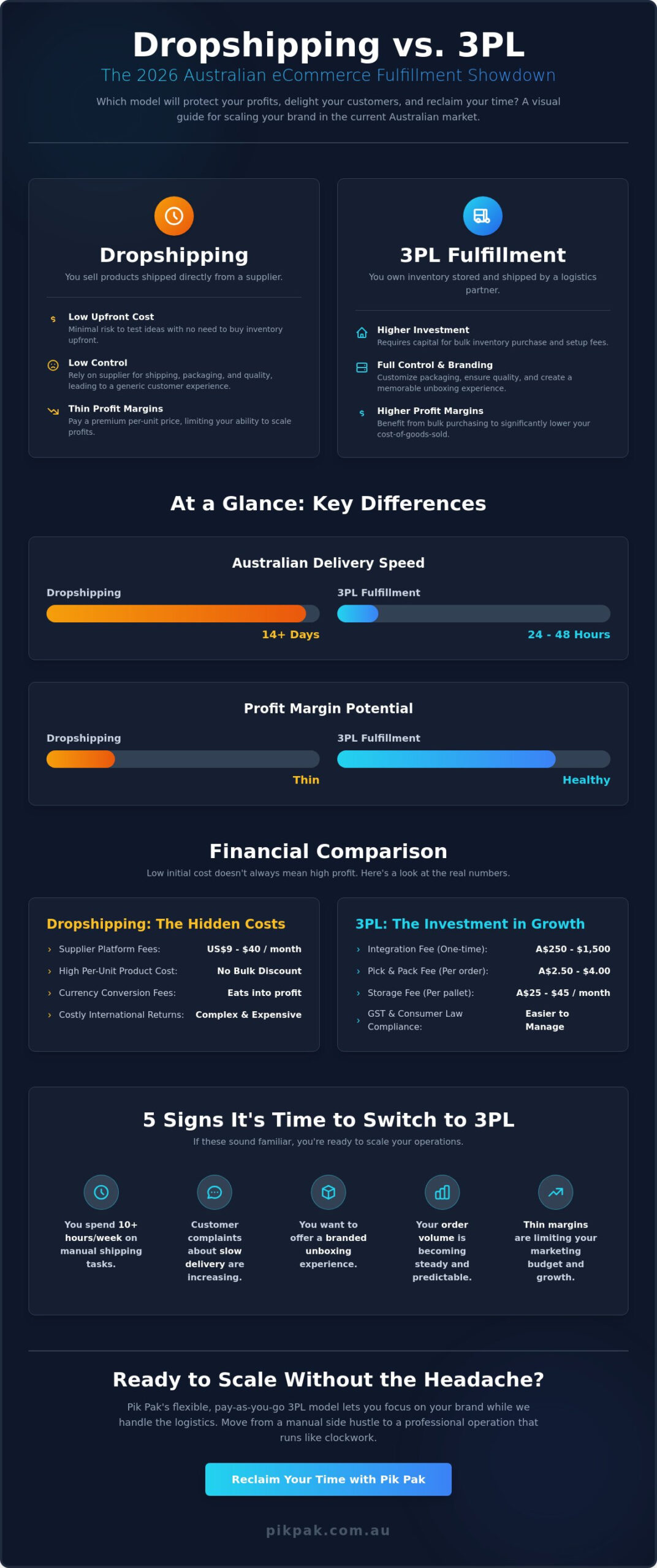
Dropshipping offers a low-barrier entry. You don’t need to sign warehouse leases or buy thousands of units upfront. Most sellers use platforms like AliExpress, Spocket, or DSers to sync products to their Shopify or WooCommerce stores. It’s a fast way to get started. However, the trade-off is often steep. You rely entirely on third-party shipping speeds, which can stretch to 14 days or more. Your customers receive generic packaging that lacks your brand’s personality, making it harder to build long-term loyalty in a competitive 2026 market. It’s a low-risk entry point, but it often leads to a high-stress customer service inbox.
How 3PL Fulfilment Works in Practice
3PL is the engine for a growing brand. You purchase inventory in bulk, which immediately lowers your cost-of-goods-sold (COGS) and protects your margins. Your stock sits in a professional pick and pack warehouse, ready for immediate dispatch. When an order comes in, the technology link is seamless. Your store connects directly to a Warehouse Management System (WMS), which automates the process. This ensures your Australian customers receive their orders in 24 to 48 hours, providing the fast, reliable service they expect. It’s about moving from a manual side hustle to a professional operation that runs like clockwork. You free up your time to focus on marketing while the logistics are handled for you.
Financial Comparison: Margins, Risks, and Upfront Costs
Deciding which model fits your budget is often the moment you realize that low cost doesn’t always mean high profit. When you’re trying to figure out is dropshipping or 3pl better for me, you have to look beyond the initial setup fee. Dropshipping is undeniably cheap to start. You might pay US$9 to US$39.99 for a supplier platform subscription, but you’ll pay a premium for every single unit you sell. This is the “scaling tax” that competitors often ignore. Your margins stay thin because you never benefit from bulk pricing, no matter how many orders you process.
In contrast, 3PL requires more capital upfront. You’ll likely face an integration fee between A$250 and A$1,500, and you’ll need to buy your inventory before you can sell it. However, owning your stock allows you to negotiate much lower prices from manufacturers. While you’ll pay storage fees of A$25 to A$45 per pallet and pick and pack fees starting at A$2.50, the reduction in your cost-of-goods-sold often makes 3PL the more profitable choice once you’re moving steady volume. It’s about balancing the risks and rewards of dropshipping against the stability of a managed supply chain.
The risk profile also shifts between these models. Dropshipping leaves you vulnerable to supplier reliability. If your supplier runs out of stock or ships a faulty item, you have no way to verify it until a customer complains. With 3PL, the main risk is “dead stock,” or inventory that doesn’t sell. However, with the Australian e-commerce market reaching A$82.6 billion in 2025, a data-driven approach to ordering can minimize this waste. You can check our warehousing guidelines to see how to manage stock levels effectively and keep your capital moving.
The Hidden Costs of Dropshipping
Many entrepreneurs forget about currency conversion and transaction fees. When you buy from overseas suppliers in USD but sell in AUD, those small percentages eat into your profit. Returns are another profit-killer. Without a local warehouse, you often have to tell customers to keep the faulty item and issue a full refund because international shipping is too expensive. This doesn’t just cost you the sale; it destroys your marketing efficiency by lowering your Customer Lifetime Value. You’re constantly paying to acquire new customers because you can’t satisfy the ones you have.
The ROI of 3PL Logistics
A professional 3PL model lets you scale without the overhead of hiring staff or signing long-term warehouse leases. You get access to bulk shipping rates that are usually reserved for much larger companies. By choosing our 3pl logistics solution, you convert what would be fixed overhead into variable costs that only grow when your sales do. This setup ensures your operations run like clockwork while you focus on your business.
Customer Experience: The Make-or-Break Factor
In the Australian market of 2026, delivery speed is no longer a luxury. It’s the baseline. With 9.8 million households now shopping online, 41% of them make purchases at least fortnightly. If you’re currently weighing up is dropshipping or 3pl better for me, the answer often lies in your customer’s patience. Dropshipping from overseas often results in 15 to 30 day wait times. This delay is a primary source of dissatisfaction according to April 2026 research. A 3PL model allows for 24 to 48 hour local delivery, meeting the high expectations of modern shoppers who want their items fast.
Deciding is dropshipping or 3pl better for me also means deciding how much control you want over your brand’s physical touchpoints. With dropshipping, you never see the product before it reaches your buyer. You can’t verify the quality or add a branded thank-you note. 3PL gives you the power of custom boxes, inserts, and professional presentation. This builds a brand, not just a transaction. In an era where 81% of consumers are searching for deals, a premium unboxing experience justifies your price point and encourages repeat business. You also gain transparency with real-time tracking numbers that work within the Australian postal network, eliminating the “where is my order” emails that clog your inbox.
Meeting Australian Delivery Expectations
Using local hubs for fulfillment beats overseas shipping every time. When you use customer delivery options like express post, Direct Freight, or local couriers, your conversion rates on Shopify or WooCommerce naturally climb. Shoppers are more likely to hit buy when they see a 3 to 5 day delivery window. This speed builds immediate trust and positions you as a reliable Australian business rather than a faceless international middleman. It makes the logistics of your business run like clockwork.
Managing Returns and Reverse Logistics
International returns are a nightmare in a dropshipping model. Most customers won’t wait weeks for a replacement or pay high shipping costs to send a faulty item back overseas. A 3PL handles returns locally, making the process easy and stress-free for the customer. We can receive the item, inspect it, and either restock it or refurbish it to salvage value. This local presence reduces your refund rate and protects your profit margins, turning a potential negative into a professional service experience that frees up your time.
When to Switch: 5 Signs 3PL is Better for You
Knowing exactly when to transition your operations can be the difference between scaling or stalling. If you’re asking, “is dropshipping or 3pl better for me,” look at your weekly schedule first. When you spend more than 10 hours a week chasing overseas suppliers or manually fulfilling orders, you’ve reached a ceiling. Your time is better spent on marketing and growth. Another sign is your return strategy. If you’re forced to use a “refund and keep” policy because international return shipping is too expensive, you’re bleeding profit. A local 3PL turns those returns into a professional, manageable process that protects your bottom line.
The decision of whether is dropshipping or 3pl better for me often becomes clear when customer complaints about shipping times start to hurt your brand reputation. In the 2026 Australian market, “Where is my order?” should not be your most frequent support ticket. If it is, your fulfillment model is failing you. You should also consider the switch when you want to move from simply selling products to building a genuine brand. This requires custom inserts or kitting, which dropshipping suppliers rarely offer. Finally, if your product range is getting complex, you need the accuracy of a professional team to ensure the right items reach the right customers every time.
The Hybrid Strategy: A Safe Way to Transition
You don’t have to move everything at once. Many successful Australian stores use 3PL for their “winners” or best-selling items while keeping new product testing on a dropshipping model. This limits your risk. You can manage these dual inventory streams through a single technology platform that connects your store to the warehouse. As your local stock levels grow and your brand stabilizes, you can phase out unreliable overseas suppliers. This approach ensures your operations run like clockwork without a massive upfront gamble.
Preparing Your Business for 3PL
Moving to a warehouse requires a bit of organization. Start by standardizing your SKU list. Each product needs a unique identifier for warehouse efficiency. You should also review our warehouse receiving guidelines to understand how to label and package your first shipment. Once your stock arrives, we set up the API integration between your store and our fulfillment center. It’s a simple “point, click, and connect” process that automates your orders. If you’re ready to stop the manual grind, you can get started with a scalable fulfillment partner today and reclaim your time.
Pik Pak: Making the Move to 3PL Simple and Scalable
Transitioning from a hands-off dropshipping model to a structured 3PL operation can feel like a massive leap. If you’ve been asking is dropshipping or 3pl better for me, the answer often depends on how much you value your time. Pik Pak removes the fear of scaling by offering a “Pay as you go” model. You don’t have to sign long-term warehouse leases or worry about high fixed overheads. You only pay for the space you use and the orders we ship. This flexibility allows you to grow at your own pace while keeping your capital liquid.
We believe logistics should be an “easy game.” Our Warehouse Management System (WMS) provides real-time visibility into your inventory levels and order status. You don’t need to be a “computer geek” to use it. The interface is designed for busy business owners who need facts fast. By letting us handle the heavy lifting, you shift your focus from packing tape and shipping labels to marketing and brand growth. It’s about working on your business, not in it. We ensure your operations run like clockwork, giving you the freedom to explore new markets or launch new product lines. If you are curious about niche markets, you can learn more about Lockpick Pros and their specialized inventory. This is the simplest way to determine if is dropshipping or 3pl better for me as you plan for a bigger 2026.
Tech-First Fulfilment for Modern Stores
Efficiency starts with a seamless connection. We offer one-click integrations with major platforms including Shopify, eBay, and Amazon Australia. Once connected, your order flow is entirely automated. When a customer clicks “Buy Now,” the order transmits directly to our warehouse. We pick, pack, and ship it without you ever needing to enter data manually. You’ll also receive automated inventory alerts. This ensures you never run out of your best-selling stock again, protecting your revenue and keeping your customers happy.
Your Growth Partner in Australia
Scaling a brand requires a reliable infrastructure. As your partner, we give you immediate access to our extensive network of transport companies to secure the best possible shipping rates. Whether you’re shipping 10 orders a month or 10,000, our systems and staff adapt to your volume. We remove the operational burdens that typically slow down growing eCommerce stores. If you’re ready to see how a professional fulfillment strategy can protect your margins, you should get a custom quote to see the 3PL advantage firsthand. Let Pik Pak do the hard work for you.
Build a Brand That Scales in 2026
Choosing your fulfillment model is the most important strategic decision you’ll make this year. While dropshipping serves as a low-risk starting point, it often hits a wall when your brand needs to scale. You’ve seen how 3PL protects your profit margins by reducing cost-of-goods-sold and how it satisfies the 24-48 hour delivery expectations of 9.8 million Australian households. When you stop asking is dropshipping or 3pl better for me and start prioritizing the customer experience, you position your business to capture a larger share of the A$82.6 billion eCommerce market.
Logistics shouldn’t be a source of stress. It should be a seamless process that supports your ambition. With Pik Pak, you get real-time WMS inventory tracking and expert pick, pack, and ship services across Australia. There are no software fees or long-term contracts to hold you back. It’s about moving from manual tasks to automated success. You deserve to focus on the creative and strategic work that built your store in the first place. We’re here to ensure your operations run like clockwork every single day.
Focus on your business and let Pik Pak handle the hard work—Get Started Today. Your brand is ready for the next level; let’s make it happen together.
Frequently Asked Questions
Is dropshipping or 3PL better for a total beginner?
Dropshipping is usually better for a total beginner with limited capital because it requires no upfront investment in stock. It acts as a low-risk laboratory to test product ideas without the pressure of managing inventory. However, if you have a validated product and a small amount of startup capital, starting with a 3PL allows you to build a professional brand with fast Australian shipping from day one.
How many orders do I need per month to justify using a 3PL?
Most businesses find that 100 to 150 orders per month is the sweet spot for transitioning to a 3PL. At this volume, the manual labor of packing boxes often takes more than 10 hours a week, which is time better spent on marketing. When deciding is dropshipping or 3pl better for me, calculate the value of your time against the professional efficiency of an automated warehouse.
Can I use a 3PL and still sell on Amazon Australia?
Yes, you can use a 3PL to fulfill Amazon Australia orders via the Merchant Fulfilled Network (MFN) or to prep stock for Amazon’s own warehouses. Our technology integrates directly with Amazon to ensure your orders flow into our system the moment a customer buys. This setup allows you to maintain high seller ratings by meeting the strict shipping windows that Amazon customers expect in 2026.
What happens if my stock doesn’t sell in a 3PL warehouse?
If your stock remains unsold, you’ll continue to pay monthly storage fees, which typically range from A$25 to A$45 per pallet according to 2026 industry rates. To prevent “dead stock” from eating your profits, we provide real-time visibility through our WMS. This data allows you to identify slow-moving items early so you can run targeted promotions and keep your capital moving through the business.
Do I need to live in Australia to use an Australian 3PL?
You don’t need to be an Australian resident to use our fulfillment services. Many international entrepreneurs use a local 3PL to provide 24 to 48 hour delivery to their Australian customer base. You simply need to ensure your business complies with local regulations, such as registering for GST if your Australian turnover exceeds A$75,000 in a 12-month period.
How long does it take to set up 3PL fulfillment for my online store?
The setup process typically takes 5 to 10 business days once your inventory arrives at our warehouse. This timeframe includes the API integration with your store, SKU standardization, and a final system test. Our “point, click, and connect” software is designed to be simple, ensuring your logistics run like clockwork without requiring you to be a technical expert.
Is a 3PL more expensive than shipping orders from my own garage?
A 3PL is often more cost-effective than a garage when you account for your time and shipping rates. While a garage has no rent, you’ll pay full retail prices for labels and packaging. A 3PL provides access to bulk rates from major transport companies, often saving you enough on postage to cover the pick and pack fees while freeing you to focus on growth.
Can a 3PL handle custom branding and gift wrapping?
Yes, a professional 3PL can manage custom branded boxes, tissue paper, and promotional inserts. This is a critical advantage when weighing is dropshipping or 3pl better for me, as dropshipping suppliers usually ship in generic, unbranded packaging. We help you create a professional unboxing experience that justifies your margins and encourages customers to shop with you again.