What if the lowest per-pick quote you just received is actually the most expensive mistake your eCommerce business will make this year? It’s a frustrating reality for many Australian brands. You’ve likely felt the stress of opening a monthly invoice only to find fuel levies or account management fees that weren’t clear during the sales pitch. Understanding the various 3pl pricing models australia offers is no longer just a logistics task. It’s a vital financial strategy for 2026.
We know how difficult it is to compare quotes when every provider uses different terminology. It’s easy to fear that your hard-earned margins are being swallowed by complex fulfillment costs. This guide will help you master those complexities. We’ll provide a clear framework to evaluate every line item, explain the critical differences between activity-based and flat-rate models, and show you how a transparent partner like Pik Pak can turn logistics from a headache into a competitive advantage. You’re about to gain the confidence to choose a model that scales as fast as you do.
Key Takeaways
- Understand why shifting from fixed warehouse overheads to a variable cost structure is the key to protecting your margins during rapid growth.
- Compare the most common 3pl pricing models australia offers to find the perfect balance between activity-based and transactional fees for your business.
- Learn how to identify and account for often-overlooked expenses like tech integration fees and fuel levies before signing a contract.
- Gain a pragmatic framework for comparing the true cost of in-house warehouse management against the efficiency of professional 3PL services.
- Discover how real-time visibility through a cloud-based WMS provides effortless control over your inventory and total logistics spend.
Understanding the Australian 3PL Pricing Landscape in 2026
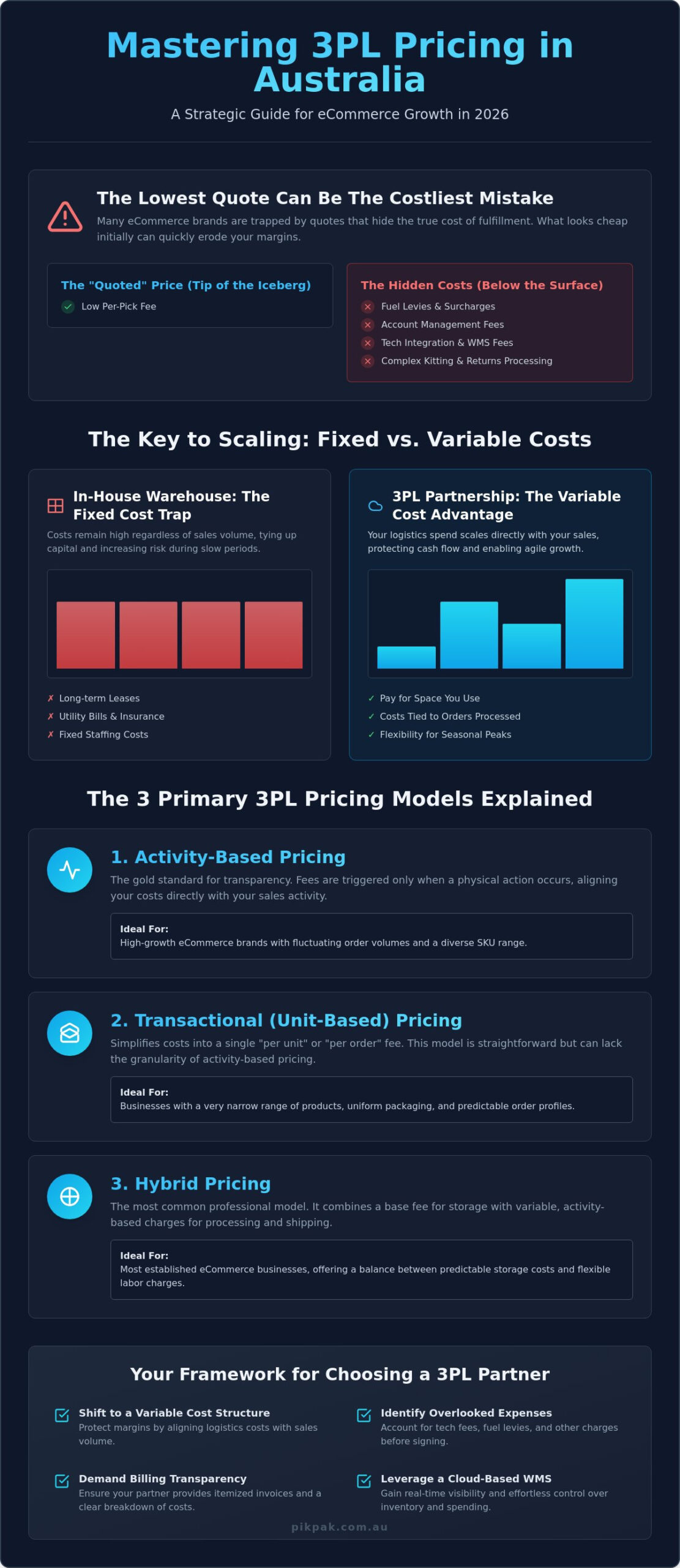
Think of your warehouse as a living expense, not a static monument. For many Australian eCommerce businesses, the traditional warehouse lease is a heavy anchor. You’re paying for empty space during quiet months and scrambling for staff during peaks. Third-party logistics (3PL) changes this dynamic by turning those fixed overheads into a variable cost structure. Instead of a rigid monthly rent check, your expenses move in sync with your sales volume.
The landscape of 3pl pricing models australia is shifting rapidly in 2026. Factors like rising energy costs, updated labor regulations, and the integration of robotics into local warehouses are redefining how providers calculate their rates. While these shifts might sound daunting, they actually drive efficiency. Modern providers use automation to stabilize pick and pack times, ensuring that your costs remain predictable even as market conditions fluctuate.
Managing an in-house warehouse often leads to a “fixed cost trap.” You are locked into long-term leases, utility bills, and insurance premiums regardless of whether you ship one order or ten thousand. A 3PL model offers a flexible alternative. You only pay for the storage space you use and the orders actually processed. This shift allows you to maintain healthy margins during the inevitable ebbs and flows of the retail calendar.
Success in logistics isn’t about finding the cheapest individual pick fee. It’s about mastering your “Total Cost of Fulfillment.” This metric combines every touchpoint, from receiving stock to processing returns. When you view your logistics through this lens, you see the true value of a partner who eliminates hidden inefficiencies.
Why Pricing Transparency is the New Industry Standard
The days of “bundled” fees that hide operational bloat are over. Today, the best what is 3pl providers offer itemized, transparent billing. You should see exactly what you’re paying for, from storage increments to kitting tasks. Modern WMS platforms provide this clarity through real-time dashboards. You can track every cent spent, giving you effortless control over your operational budget without the guesswork.
The Economic Impact of Scaling with Variable Costs
Scaling a business is inherently risky, but variable cost models mitigate that risk. During seasonal dips, such as the period following the Christmas rush, your logistics costs naturally contract. This protection of your cash flow is vital. It allows you to reclaim your time and capital, redirecting those resources toward marketing and product development. You focus on growing the brand while your logistics partner handles the heavy lifting.
The 3 Primary 3PL Pricing Models Explained
Choosing the right warehouse setup requires specialist skills in logistics, supply chain management, but you don’t need a master’s degree to spot the right fit for your brand. In the current market, 3pl pricing models australia generally fall into three categories. Each model caters to different business stages and operational rhythms. Understanding these differences is the first step toward reclaiming your time and protecting your margins.
The first is Activity-Based Pricing, which is the gold standard for transparency in the Australian market. Fees are only triggered when a physical action occurs. The second is the Transactional or Unit-Based model, which simplifies costs into a single “per unit” fee. This is often best for businesses with a very narrow range of products and uniform packaging. Finally, the Hybrid model combines base storage fees with variable activity charges. This is the most common approach for professional providers because it balances warehouse space costs with labor intensity.
To choose the right model, look at your SKU count and order velocity. If you have hundreds of unique items that move slowly, storage costs will be your primary concern. If you have five best-sellers that move in thousands of units daily, you should prioritize the lowest possible pick-and-pack fee. For a deeper look at how these structures apply to your specific business, explore our logistics services.
Activity-Based Pricing: Paying for What You Use
This model is built on granular precision. You aren’t paying for “potential” labor; you’re paying for actual work. Fees trigger only when an action like receiving, picking, or packing occurs. This makes it ideal for high-growth eCommerce brands with fluctuating volumes. Activity-based pricing aligns your logistics spend directly with actual sales events. It ensures that during a massive promotion, your costs stay proportional to your success, while during quiet periods, your expenses drop automatically.
Flat-Rate vs. Tiered Pricing Structures
Flat-rate pricing offers a predictable “all-in” cost per order. While this feels simple, it often results in higher margins for the 3PL because they must price in their own risk. Tiered pricing is much more pragmatic for a scaling business. It rewards higher volume with lower per-unit costs. As your business grows and your order density increases, the 3PL can operate more efficiently. A tiered structure ensures those efficiency gains are shared with you, lowering your total cost of fulfillment as you reach new milestones.
Core Components: What Makes Up Your 3PL Bill?
Your 3PL bill shouldn’t be a source of anxiety. It’s a functional breakdown of services rendered. By understanding the core components of 3pl pricing models australia, you can spot inefficiencies before they impact your profit. It starts with the digital foundation. Onboarding and tech integration represent the one-time cost to sync your eCommerce platforms, like Shopify or WooCommerce, with a Warehouse Management System (WMS). This isn’t just a setup fee; it’s an investment in 24/7 visibility and effortless control over your stock from day one.
Storage fees are the next essential category. These are usually calculated based on the physical footprint your inventory occupies. Pallet storage is the standard for bulk inventory, while shelf and bin storage are designed for smaller, high-rotation items. A tech-savvy provider uses their WMS to optimize this space, ensuring you aren’t paying for air. This flexibility allows you to scale your storage footprint up or down as your inventory levels fluctuate throughout the year.
Fulfillment fees, often called “Pick and Pack” charges, cover the physical labor of processing an order. The mechanics are straightforward. Most providers charge a base fee for the first item in an order, followed by a reduced, incremental rate for every additional item included in that same shipment. This structure is highly beneficial for brands with high average order values. It ensures your logistics costs don’t double just because a customer bought a second item.
Inbound Logistics: Receiving and Handover
Inbound logistics focus on how your stock enters the facility. You’ll encounter different rates depending on how the goods arrive. Container de-stuffing requires significant manual labor to unload loose boxes, whereas palletized receiving is faster and generally more cost-effective. Precision is key here. Adhering to specific warehouse receiving guidelines is essential to maintain efficiency. This prevents processing delays and helps you avoid the administrative penalty fees that often arise from poorly labeled or disorganized shipments.
Shipping and Last-Mile Delivery Costs
Last-mile delivery is often the largest variable in the total cost of fulfillment. Professional 3PLs leverage their massive shipping volumes to negotiate better rates with Australian couriers than a single business could typically achieve. Your final shipping price is influenced by zone-based pricing and current fuel levies. By choosing a partner with a wide range of customer delivery options, you can balance delivery speed with cost-effectiveness to meet your specific customer expectations.
3PL vs. In-House: A Strategic Cost-Benefit Framework
Many founders start their journey in a garage or a small storage unit. At that scale, DIY fulfillment feels like a way to save money. But as your order volume grows, this “DIY” model often becomes a financial and operational trap. To make an informed choice, you must look beyond the surface and understand how the 3pl pricing models australia offers compare to the true cost of running your own facility. It’s not just about rent. It’s about the total burden of logistics management.
Hidden costs accumulate quickly in a private warehouse. When you manage your own space, you’re responsible for several fixed expenses that don’t disappear when sales are slow:
- Commercial rent and long-term lease commitments.
- Utilities, high-speed internet, and security systems.
- Warehouse equipment like racking, forklifts, and packing stations.
- Business insurance and workers’ compensation premiums.
- Consumables like tape, boxes, and void fill.
Labor management is another major friction point. Hiring and training staff requires significant time and HR expertise. You also face the challenge of seasonal staffing. With a 3PL, you replace the headache of payroll and training with a simple, predictable per-pick fee. You only pay for the labor you actually use. This shift gives you effortless control over your margins, regardless of whether it’s a peak holiday period or a quiet mid-year month.
Technology is the final piece of the puzzle. An enterprise-grade Warehouse Management System (WMS) can cost thousands in monthly licensing fees. When you partner with a 3PL, you gain access to this tech as part of the service. You get real-time visibility and seamless integrations without the heavy upfront investment. This allows you to scale your operations instantly, moving from a small unit to a massive, tech-driven facility without the growing pains.
The Opportunity Cost of Self-Fulfillment
Calculate the actual hours you spend packing boxes and labeling shipments. If you’re the founder, your time is your most valuable asset. Every hour spent in the warehouse is an hour lost to revenue-generating activities like marketing, product design, or building strategic partnerships. Delegating these operational tasks isn’t just about outsourcing work. It’s an enabling force that allows you to refocus on the core objectives that actually grow your brand.
Risk Mitigation and Liability
When you manage your own warehouse, stock damage and shipping errors are your financial burden. Outsourcing shifts this liability. You benefit from professional warehousing and fulfilment standards that minimize errors and protect your inventory. This peace of mind allows you to sleep better, knowing your logistics are in the hands of experts. Ready to see how much you could save? Get a transparent quote from Pik Pak today.
Navigating Your 3PL Partnership with Pik Pak
Choosing a logistics partner is one of the most significant decisions you’ll make for your eCommerce brand. While understanding the various 3pl pricing models australia offers is a vital first step, the real value lies in how that model is executed. Logistics shouldn’t be a black box. At Pik Pak, we replace complexity with a pragmatic, tech-driven approach that puts you back in the driver’s seat of your business operations. We don’t just move boxes; we provide the infrastructure for your growth.
Our cloud-based WMS serves as the heartbeat of our operation. It provides 24/7 visibility into your inventory levels and fulfillment costs. You won’t have to wait until the end of the month to see how your budget is performing. Every pick, pack, and ship event is recorded in real-time, allowing you to monitor your spend with total precision. This level of transparency is designed to alleviate the stress of scaling, giving you the “effortless control” needed to focus on your higher-level business goals.
We understand that every eCommerce business has unique requirements. This is why we focus on specific service priorities rather than offering a generic, one-size-fits-all solution. Whether you need specialized kitting for subscription boxes or complex returns management, our team acts as a seasoned problem-solver. We frame these logistical hurdles as manageable tasks, ensuring your customers receive a consistent, professional experience every time they order.
Getting an accurate quote shouldn’t be a guessing game. To provide a clear breakdown, we look at your SKU profiles, order history, and projected growth. This data-driven approach ensures that the 3pl pricing models australia we propose align perfectly with your revenue. It eliminates the fear of hidden fees and ensures your logistics costs remain a scalable asset rather than a mounting liability.
The Pik Pak Advantage: Tech-First Logistics
Our commitment to technology support is a direct cost-saving tool for your business. By utilizing automated integrations with your existing storefronts, we significantly reduce the risk of manual data entry errors. These errors often lead to mispicks or shipping delays, which carry high hidden costs in the form of customer dissatisfaction and return freight. Our tech-first mindset ensures precision, helping you maintain healthy margins as your order volume increases.
Ready to Scale? Your Next Steps
It’s time to stop losing sleep over logistics friction. We encourage you to perform a simple “Logistics Audit” of your current in-house or 3PL costs. Look at your total spend, including the time you personally spend managing warehouse issues. Once you have those figures, reach out to us. Visit the Pik Pak homepage to start a tailored consultation. Let’s build a fulfillment strategy that removes your operational hurdles and lets you reclaim your time today.
Take Control of Your Fulfillment Strategy
Master the shift from static overheads to a flexible logistics model. You’ve seen how the right 3pl pricing models australia offers can safeguard your margins during seasonal peaks and valleys. By itemizing costs and leveraging technology, you move from guesswork to precision. This clarity is what allows you to reclaim your time and refocus on scaling your eCommerce brand with confidence. Every dollar saved on inefficient warehouse management is a dollar you can reinvest into your next marketing campaign.
Don’t let complex contracts or hidden fees hold your business back. Partnering with an expert means gaining real-time WMS visibility and a seamless Shopify or WooCommerce integration that keeps your operations moving at the speed of your sales. With expert Australian-based support at your side, logistical challenges become simple, manageable tasks. The path to a more efficient business starts with a single, clear decision.
Request a Transparent 3PL Quote from Pik Pak Today and start your journey toward effortless operational control. Your growth shouldn’t be limited by your warehouse space. It’s time to build the efficient, scalable future your brand deserves.
Logistics and Fulfillment FAQs
How much does 3PL typically cost per month for a small Australian eCommerce business?
Monthly costs for small businesses vary based on your specific activity levels. For many efficient operations, total fulfillment costs represent between 8% and 15% of gross sales. This variable structure is a core benefit of 3pl pricing models australia, as it ensures you aren’t paying for a massive warehouse when your order volume is low. You replace high fixed rent with costs that scale directly with your success.
What are the most common “hidden fees” in 3PL pricing models?
Fees often hide in the fine print of complex contracts. Look out for monthly account management fees, minimum activity requirements, and administrative charges for processing manual orders. Some providers also charge extra for “non-conveyable” items that can’t move on automated belts. Transparency is key to avoiding these surprises. Always ask for an itemized breakdown of every potential charge before signing a partnership agreement.
Is there a difference between “pick and pack” fees and “fulfillment” fees?
“Pick and pack” is a specific labor charge for the physical act of selecting an item and placing it in a box. “Fulfillment” is a broader term. It typically encompasses the entire journey from the moment an order is received to the moment it leaves the warehouse. While some people use them interchangeably, fulfillment usually includes receiving, storage, picking, packing, and shipping as a combined process.
Do 3PL providers in Australia charge extra for returns (reverse logistics)?
Returns management is almost always an additional service. 3PLs charge for the labor involved in inspecting returned goods, updating inventory levels, and restocking items. It’s a vital part of reverse logistics that requires manual attention to ensure items are fit for resale. Managing this through a professional partner is often much faster and more accurate than handling returns in-house.
How does SKU count affect my monthly 3PL storage and handling bill?
Your SKU count directly impacts your storage footprint. A business with 500 unique SKUs will likely pay more for storage than a business with 5 SKUs, even if the total number of units is the same. Each unique SKU requires its own dedicated bin or shelf space for picking efficiency. High SKU counts can also increase the time needed for inventory counts and inbound receiving tasks.
Can I use my own courier accounts with a 3PL, or must I use theirs?
Most providers offer the flexibility to use your own courier accounts if you have established relationships. However, 3PLs often provide access to their own negotiated rates. These bulk-buy discounts are usually significantly lower than what a single small business can secure independently. You should compare your current rates against the 3PL’s shipping quotes to see which option provides the best value for your margins.
What is an onboarding fee, and why do 3PLs charge it?
This is a one-time charge covering the cost of syncing your eCommerce platform with the provider’s technology. It includes setting up API connections, mapping your SKUs, and testing the data flow between systems. This technical foundation ensures your inventory visibility is accurate from the start. It’s a pragmatic investment that prevents manual data errors and ensures your orders flow through the warehouse without friction.
How do fuel levies work in Australian 3PL shipping quotes?
Fuel levies are a variable percentage added to the base shipping rate. They fluctuate based on the current market price of fuel in Australia. Most providers update these monthly to reflect the actual costs charged by major couriers. It’s a standard industry practice designed to manage the volatility of transport costs. Always check the current levy percentage when you are calculating your total landed shipping costs.