Are you spending more time wrestling with packing tape and shipping labels than you are with your marketing plan? As your store grows, the daily grind of printing, packing, and queueing at the post office can quickly become a major bottleneck. For many successful Australian businesses, managing WooCommerce order fulfillment in-house starts to cost more than just money-it costs you the time needed to actually grow. What was once a manageable task is now a logistical headache holding you back.
This guide is designed to change that. We’ll show you how to move beyond packing boxes yourself and build a scalable, automated fulfillment strategy that delights customers and runs like clockwork. You’ll learn exactly how to reduce shipping costs, slash delivery times, and finally free up your schedule to focus on what you do best: marketing your products and scaling your brand. Let’s make your fulfillment process a competitive advantage, not your biggest chore.
What is WooCommerce Order Fulfillment? (And Why It Gets Complicated)
At its core, WooCommerce order fulfillment is everything that happens behind the scenes after a customer clicks “Place Order”. It’s the physical journey your product takes from your shelf to your customer’s doorstep. This entire process, often referred to as Order fulfillment, encompasses a series of critical steps that ensure a happy customer and a smooth transaction. For a new store, this might start on the kitchen table-a simple, manageable task. But as your orders climb from 5 to 50, then to 500 a month, that kitchen table operation quickly transforms into a major logistical bottleneck that can stall your growth.
The fulfillment journey consists of six core stages:
- Receiving: Accepting and logging new inventory from your suppliers.
- Storage: Securely warehousing your products in an organised system for easy access.
- Picking: Finding and retrieving the correct items from storage for each specific order.
- Packing: Boxing the items safely, adding marketing inserts, and preparing them for transit.
- Shipping: Attaching the correct label and handing the package over to a courier like Australia Post or Aramex.
- Returns: Managing the reverse logistics process for customer returns or exchanges.
The Basic Fulfillment Workflow
When you’re just starting, the process is straightforward. A new order appears, you walk to your garage to find the product, pack it in a box, print a shipping label from your computer, and drop it at the post office. You then manually update the order in WooCommerce and email the tracking number. It’s simple, but it’s 100% your time.
Common Pain Points for Growing Stores
What seems easy at first quickly becomes a challenge. As your store scales, the manual approach to woocommerce order fulfillment creates significant headaches that stop you from focusing on your business:
- Inventory Nightmares: Manually tracking stock leads to overselling popular items or holding onto dead stock, costing you sales and capital.
- Packing & Shipping Errors: A simple mistake like sending the wrong size or colour results in unhappy customers and costly returns, with return shipping fees eating into your margins.
- Lost Time: Every hour spent packing boxes is an hour you’re not spending on marketing, product development, or customer service.
- High Shipping Costs: Without a high volume of shipments, you can’t negotiate better rates with carriers, leaving you paying top dollar for postage.
The 3 Fulfillment Models for WooCommerce Stores
Choosing your woocommerce order fulfillment strategy isn’t just a logistical decision-it’s a direct reflection of your business’s stage of growth. What works when you’re packing five orders a day from your garage simply won’t work when you’re shipping fifty. Understanding these models helps you transition from a mindset of ‘doing it all’ to one of ‘managing the process’ for scalable success.
Let’s break down the three primary models so you can identify which one is the right fit for your store right now.
Model 1: In-House / DIY Fulfillment
This is the starting line for most eCommerce entrepreneurs. You receive an order, you pick the item, you pack it in a box, and you take it to Australia Post. You are the entire fulfillment department.
- Who it’s for: New stores with low order volumes (typically fewer than 10-15 orders per day).
- Pros: You have complete control over branding and the unboxing experience, and the initial cash outlay is minimal.
- Cons: It’s extremely time-consuming and doesn’t scale. Hidden costs like packaging supplies, storage space, and fuel for post office runs can quickly add up.
Model 2: Dropshipping
With dropshipping, you act as the storefront, but a third-party supplier holds the inventory and ships orders directly to your customers. You never physically handle the products.
- Who it’s for: Businesses that want to test a wide range of products without the risk of holding inventory.
- Pros: No inventory risk means less capital required upfront, and you can offer a massive product selection.
- Cons: Profit margins are notoriously thin. You have zero control over shipping quality or speed, which can damage your brand reputation.
Model 3: Outsourcing to a 3PL Partner
This is the growth stage. When order volume makes DIY fulfillment a bottleneck, you partner with a third-party logistics (3PL) provider. They handle everything from inventory storage to picking, packing, and shipping.
- Who it’s for: Growing stores ready to scale operations and reclaim their time.
- Pros: It automates your woocommerce order fulfillment, frees you to focus on marketing, provides access to logistics expertise, and often lowers shipping costs through bulk rates.
- Cons: It requires an investment. However, viewing this as a strategic part of managing your business finances for growth is key. You also have less hands-on control over individual packages, which is why choosing a trusted partner is essential.
5 Signs You’ve Outgrown In-House WooCommerce Fulfillment
Growth is exciting, but it creates new challenges. What worked for 10 orders a day quickly breaks down at 100. If you’re feeling the strain, you’re not alone. It’s a clear signal that your current process is holding your business back. Recognising these signs is the first step toward a simpler, more scalable solution that lets you focus on what you do best: growing your brand.
1. You Spend More Time Packing Than Selling
Consider the opportunity cost. If your time is worth A$100 an hour in sales or marketing, every hour you spend printing labels and taping boxes is a direct loss. When logistics becomes your main job, growth stalls. Your to-do list should be about strategy and customer acquisition, not hunting for the right-sized box. This is a classic sign that your manual woocommerce order fulfillment system has reached its limit.
2. Your Home or Office is Now a Warehouse
Are product boxes creeping into your living room or office hallways? When your space becomes a makeshift warehouse, inefficiency and errors are inevitable. Without proper shelving and organisation, picking the wrong item becomes a common mistake. The next logical step, renting a dedicated warehouse in Australia, can cost thousands per month-a prohibitive expense for many growing businesses.
3. Shipping Costs Are Eating Your Profits
Paying standard consumer rates with carriers like Australia Post puts you at a major disadvantage. Without the volume to negotiate commercial discounts, your shipping costs soar. This makes it nearly impossible to offer the competitive options customers now expect, like free or express delivery. You’re forced to either absorb the high cost, shrinking your margins, or pass it on and risk losing sales.
4. Your Customer Service is Drowning in Shipping Questions
If your inbox is constantly flooded with “Where Is My Order?” (WISMO) emails, it’s a red flag. In-house fulfillment often struggles with speed and tracking accuracy, leading to customer frustration. This doesn’t just waste your team’s time; it damages your brand. Soon, you’ll see the impact where it hurts most: negative reviews focused on slow delivery or damaged items.
5. Mistakes and Returns Are on the Rise
As order volume increases, so does the chance for human error. Sending the wrong size, colour, or product entirely not only costs you in return shipping and replacement stock, but it also erodes customer trust. A disorganised picking process without a proper warehouse management system (WMS) makes these mistakes more frequent, turning a profitable sale into a costly problem to fix.
How a 3PL Automates Your WooCommerce Fulfillment Process
Outsourcing your fulfillment might sound complex, but with a modern 3PL, it’s a simple, automated system designed to run like clockwork. The magic happens through a seamless integration between your store and the 3PL’s powerful software, turning a major operational headache into a hands-off asset. Let’s break down how a 3PL completely automates your woocommerce order fulfillment process, from checkout to delivery.
Step 1: Simple Store Integration
Connecting your store is the first, and surprisingly simple, step. Most 3PLs offer a pre-built plugin or API that securely links your WooCommerce backend to their Warehouse Management System (WMS). Once connected, your product catalog and SKUs are synced, and you simply send your physical inventory to their fulfillment centre. That’s it-the foundation for effortless fulfillment is laid.
Step 2: The Automated Order Workflow
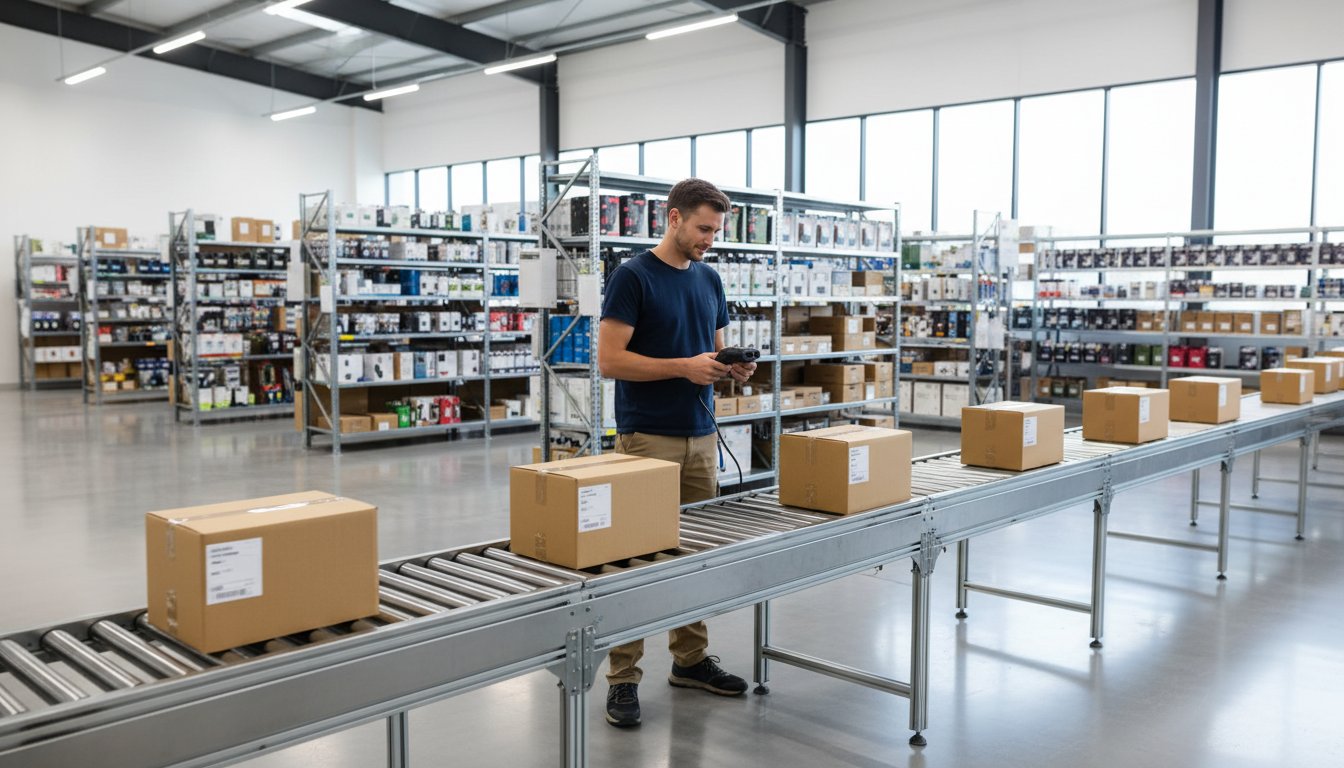
This is where you see the real power of automation. When a customer places an order on your site, the information is instantly and automatically sent to the 3PL’s WMS. You don’t have to lift a finger. The 3PL’s professional team immediately gets to work picking the correct items, packing the order to your specifications, and preparing it for dispatch with the best-fit carrier.
Step 3: Closing the Loop
The automation doesn’t stop once the package leaves the warehouse. The 3PL’s system automatically pushes tracking information back into your WooCommerce dashboard. This triggers your store to send a ‘Your order has shipped!’ notification to the customer. Simultaneously, inventory levels are updated in real-time on your site, preventing overselling and ensuring your stock counts are always accurate.
Beyond Picking & Packing: Value-Added Services
A true fulfillment partner does more than just ship boxes. They can handle a range of value-added services that help you grow and delight your customers, including:
- Kitting and Bundling: Assembling promotional product sets or gift boxes on demand.
- Custom Packaging: Using your branded boxes and inserts to create a memorable unboxing experience.
- Returns Management: Efficiently processing returns (reverse logistics) to get products back into your saleable stock quickly.
See how easy it is. Let Pik Pak handle the hard work for you.
Choosing the Right 3PL Partner for Your WooCommerce Store
Outsourcing your fulfillment is a significant step towards scaling your business. But choosing the right provider is more than a line item on a spreadsheet; it’s about finding a true partner. The right 3PL will act as a seamless extension of your team, removing the operational headaches so you can focus on growth. Use this practical checklist to ask the right questions and make an informed choice.
Essential: Seamless WooCommerce Integration
Your 3PL’s technology must talk to your WooCommerce store flawlessly. Without a deep, reliable integration, you’re just trading one set of problems for another. This connection is the engine of your automated fulfillment process, ensuring orders, inventory levels, and tracking information sync instantly. Don’t just take their word for it-ask for proof.
- Does the 3PL have a proven, native WooCommerce integration?
- Can you see a live demo of their platform and how it connects?
- Is data syncing real-time and two-way to prevent overselling?
Critical: Transparent and Scalable Pricing
Hidden fees and complex contracts can quickly erode your profit margins. A trustworthy partner offers a clear, simple pricing structure. Look for a model that scales with you, not one that locks you into high costs before you’re ready. You should only pay for the services you actually use.
Understand the core fees-receiving, storage (per pallet or per cubic metre), pick and pack, and shipping. The ideal model is ‘pay as you go,’ freeing you from long-term contracts and high monthly minimums, which is perfect for growing stores where sales volumes can fluctuate.
Important: Location and Shipping Network
In Australia, warehouse location is everything. A 3PL with facilities strategically located near major hubs like Sydney, Melbourne, and Brisbane can significantly reduce shipping times and costs. This allows you to offer fast, affordable delivery to the majority of your customers. Also, inquire about their shipping partners. A good 3PL leverages its volume to get discounted rates from carriers like Australia Post and passes those savings on to you.
Ultimately, the right partner transforms your woocommerce order fulfillment from a daily chore into a powerful growth engine. They provide the technology, infrastructure, and expertise to make logistics simple, letting you get back to building your brand. If you’re looking for a partner that makes it easy, see how Pik Pak can help.
Streamline Your WooCommerce Fulfillment and Reclaim Your Time
As your WooCommerce store scales, manual fulfillment inevitably shifts from a simple task to a major growth obstacle. Recognizing when you’ve outgrown packing boxes yourself is the first step. The next is finding a trusted partner to automate the process, freeing you to focus on what you do best: growing your brand and delighting your customers.
Making the switch doesn’t have to be complicated. With Pik Pak, you can simplify your entire woocommerce order fulfillment from day one. Our direct WooCommerce integration connects your store in just a few clicks. With Australian-based warehousing for fast local delivery and scalable, pay-as-you-go pricing, you get a powerful logistics partner designed to help you grow, not hold you back.
Your time is too valuable to be spent in the stockroom. Let us handle the logistics so you can get back to building your business. Stop Packing Boxes and Start Scaling. Get a Free Quote from Pik Pak.
Frequently Asked Questions
What’s the difference between a 3PL and dropshipping for a WooCommerce store?
The key difference is inventory ownership. With a 3PL partner, you own your inventory. You purchase stock and send it to our warehouse, and we handle the storage and shipping for you. This gives you full control over product quality and branding. In contrast, with dropshipping, you never physically handle the products. You simply pass customer orders to a third-party supplier who then ships directly to your customer, meaning you have less control over the fulfillment experience.
How much does outsourcing WooCommerce fulfillment to a 3PL cost?
Costs are transparent and scale with your business. You typically pay for four main services: receiving stock, monthly storage (e.g., A$25 per pallet), picking and packing each order (starting around A$3-A$4 per order), and the actual shipping cost from carriers like Australia Post. This “pay-as-you-go” model means you avoid fixed overheads. What seems like a complex cost is a simple, predictable expense that grows as you do, freeing up your capital and time.
Can a 3PL use my store’s custom branded packaging and boxes?
Absolutely. Maintaining your brand’s unboxing experience is crucial, and we make it easy. You simply provide us with your custom boxes, mailers, branded tape, or promotional inserts. Our team will then use your materials to pack each order according to your specifications. This ensures every customer receives a package that looks and feels like it came directly from you, strengthening your brand identity while we do the hard work behind the scenes.
How long does it take to integrate my WooCommerce store with a 3PL like Pik Pak?
Getting connected is fast and straightforward. Thanks to our pre-built integration, connecting your WooCommerce store is a simple “point, click, and connect” process that doesn’t require any technical expertise. For most stores, the entire setup, from authorising the connection to syncing your products and seeing orders flow through, can be completed in under an hour. We handle the technical side so you can focus on your business from day one.
Will I lose control over my customer service if I use a 3PL?
No, you actually gain more time to focus on it. By outsourcing your WooCommerce order fulfillment, you are freeing yourself from the time-consuming tasks of packing boxes and running to the post office. You retain full control over all customer communication. Our system provides real-time order status and tracking information, empowering you to proactively answer customer queries with speed and accuracy. You handle the customer, we handle the logistics.
What happens if a customer wants to return an order?
Returns, or “reverse logistics,” are a simple, managed process. When a customer needs to make a return, they contact you first. You then provide them with instructions to send the item back to our warehouse. Upon arrival, our team will inspect the product based on your predefined rules, update your inventory levels accordingly, and notify you. This allows you to process the customer’s refund or exchange promptly, making the entire experience seamless for everyone.