

Last Monday, a Melbourne based eCommerce founder discovered they had sold 24 units of a product on Shopify that simply weren’t on the shelf. This single inventory error triggered a four hour cycle of apology emails and manual refunds. If you’re currently losing 12 hours every week to manual data entry between eBay and courier portals, you’re familiar with this specific brand of logistics headache. Understanding what is a WMS in logistics is the essential first step to ending the chaos and making your operations run like clockwork.
It’s frustrating when shipping errors and stockouts stall your momentum. You deserve to focus on your brand’s growth rather than getting buried in spreadsheets. This article shows you how a Warehouse Management System transforms your fulfilment into a streamlined, automated engine. We’ll break down exactly how these systems work, help you decide whether to run your own software or partner with a 3PL, and show you how to finally free up your time for marketing and scaling your business.
Key Takeaways
- Understand what is a WMS in logistics and how this digital “brain” eliminates paper trails to track your inventory with real-time precision.
- Learn how to protect your profit margins by quantifying the true A$ cost of “mispicks” and why accuracy is the ultimate engine for eCommerce growth.
- Discover the automated lifecycle of an order from the receiving dock to your customer’s door, ensuring every item is accounted for without the manual stress.
- Navigate the “Build vs. Buy vs. Outsource” debate to avoid the hidden Australian costs of server maintenance, licensing, and expensive hardware.
- Find out how to skip the tech headache entirely by using a cloud-based WMS, allowing you to reclaim your time and focus on growing your business.
Defining the Warehouse Management System: The Brain of Modern Logistics
A Warehouse Management System (WMS) isn’t just a digital ledger. It’s a specialized software solution that controls every moving part of your facility. From the moment stock arrives at the loading dock to the second a courier scans a parcel for delivery, the WMS is in charge. Understanding what is a WMS in logistics starts with viewing it as a central nervous system. It receives data from your online store, processes it, and sends direct instructions to the warehouse floor.
When you start a business, a basic Excel sheet or a Google Doc might suffice. You can track five or six orders a day without much stress. However, as soon as you hit 10 or more orders daily, manual systems fail. Human error creeps in. You lose track of stock levels. You send the wrong size to a customer in Perth while you’re based in Sydney, and suddenly your profit margin disappears into return shipping costs and administrative headaches. In the Australian market, where shipping distances are vast, these errors are expensive.
The evolution of these systems has been rapid. We’ve moved from simple paper lists in the 1990s to sophisticated, cloud-based automation. By 2026, a WMS will do more than just track boxes; it will use predictive analytics to tell you what to restock before you even run out. At Pik Pak, we believe smart fulfilment should be accessible to everyone, not just retail giants.
The Core Function of a WMS
- Inventory tracking: You get a real-time view of your stock. You’ll know exactly what you have and where it sits on the shelf, down to the specific bin location.
- Workflow optimisation: The system calculates the most efficient path for staff to take. This reduces walking time and ensures orders are picked faster.
- Data synchronisation: Your WMS links directly to platforms like Shopify or WooCommerce. When a customer clicks “buy,” the warehouse knows instantly.
Who Needs a WMS?
If you’re an eCommerce brand scaling beyond a home garage or a small storage unit, you need a WMS. It’s for the wholesaler managing complex B2B and B2C orders simultaneously who can’t afford a inventory mismatch. If “out of stock” or “wrong item sent” has become a recurring nightmare for your business, it’s time to upgrade. Using professional logistics technology allows you to focus on your business while the software ensures operations run like clockwork. What is a WMS in logistics if not your most reliable employee? It doesn’t take sick days and it doesn’t forget where it put the stock.
How a WMS Works: From Receiving Dock to Customer Doorstep
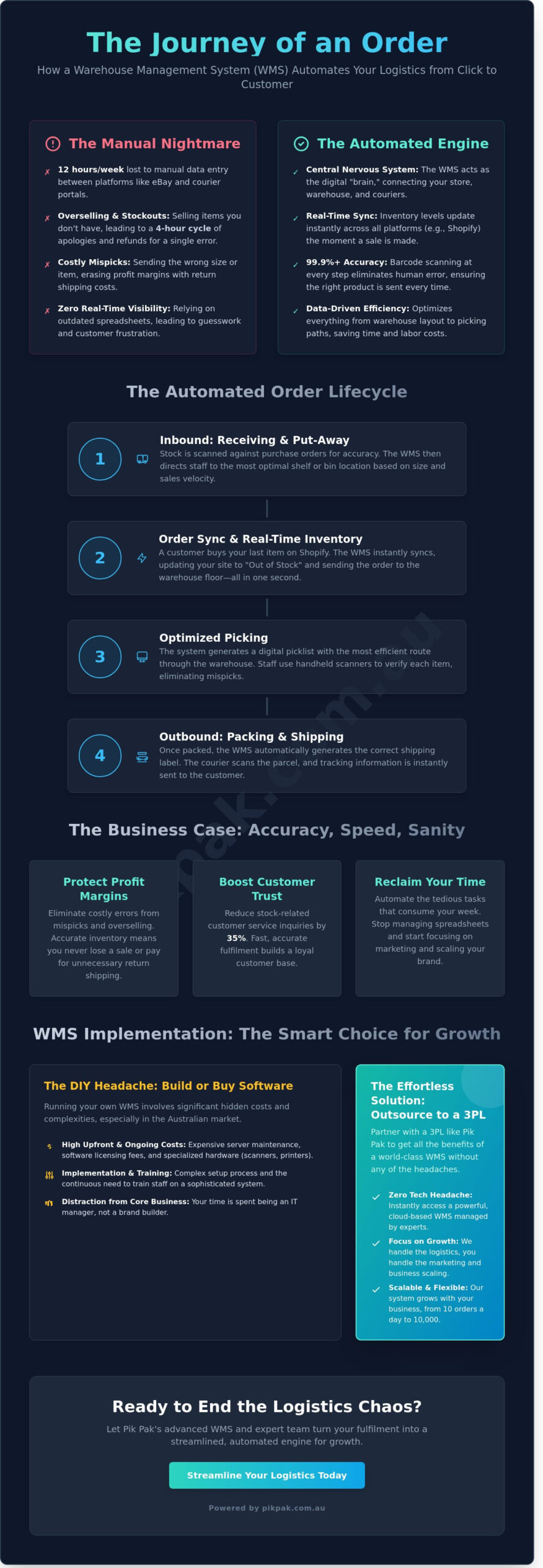
Understanding what is a WMS in logistics requires looking at the warehouse as a living organism. The software acts as the central nervous system, coordinating every movement from the second a pallet arrives to the moment a parcel hits the delivery van. By replacing paper pick-slips with digital barcodes, the system creates a transparent, paperless environment. This digital trail ensures that every item is accounted for, eliminating the “hide and seek” games that plague manual warehouses.
Real-time updates are the heartbeat of modern eCommerce. When your WMS is integrated with platforms like Shopify or WooCommerce, inventory levels sync instantly. If a customer buys the last pair of sneakers at 2:00 PM, your website reflects “Out of Stock” by 2:00 PM and one second. This precision prevents the headache of overselling and the subsequent “we’re sorry” emails that damage brand trust. A 2023 logistics industry benchmark indicated that businesses using real-time sync reduced customer service inquiries related to stock errors by 35%.
Inbound Logistics: Receiving and Put-Away
The process starts at the receiving dock. Instead of checking off items on a clipboard, staff use handheld scanners to verify incoming stock against the original purchase order. If the count is off, the system flags it immediately. The WMS then directs the operator to a specific bin or shelf. This “directed put-away” logic considers item size and how fast the product sells. For urgent backorders, the system enables cross-docking. This allows staff to move items directly from the receiving area to the shipping station, skipping the storage phase entirely to get orders out faster.
This level of precision highlights the role of WMS in automation. By removing human guesswork, the facility operates at peak efficiency 24/7. You don’t need to worry about where stock is hidden; the system already knows.
Outbound Logistics: Picking, Packing, and Shipping
When an order drops in, the WMS calculates the most efficient path for the picker. It uses two primary methods to save time:
- Wave Picking: Orders are grouped by shipping schedules or carrier pick-up times.
- Batch Picking: A picker grabs items for multiple orders in one trip, reducing warehouse travel time by up to 50%.
At the packing station, accuracy is the priority. Staff scan each item into the box. If the wrong item is scanned, the system blocks the process. Once verified, the WMS communicates with the courier network to generate shipping labels based on the exact weight and destination. This closes the loop by automatically pushing the tracking number back to your store and your customer. It’s a seamless flow that makes complex fulfilment feel like a simple game. If you’re tired of manual errors, it might be time to explore how smart technology can simplify your operations.
The Business Case for WMS: Accuracy, Speed, and Sanity
Understanding what is a WMS in logistics is more than a technical exercise; it is a fundamental shift in how you protect your profit margins. In the competitive Australian eCommerce landscape of 2026, a single “mispick” is a silent profit killer. When you factor in the cost of the initial shipping, the return label, the labor to process the return, and the potential loss of a customer, one wrong item can cost your brand upwards of A$35 per incident. A WMS turns this variable risk into a controlled, predictable process.
The real power of this technology lies in its ability to remove the “logistics headache” that keeps business owners awake at night. Instead of manually checking shelves or wondering if your stock levels are correct, you gain a system that does the thinking for you. This allows you to scale your operations effortlessly. With the right technology support, handling 1,000 orders becomes as simple and systematic as handling 10. You stop being a warehouse manager and start being a business owner again.
Eliminating the “Human Error” Tax
Manual paper lists are the primary source of fulfillment errors. By implementing barcode scanning technology, a WMS reduces error rates to near zero, often achieving 99.9% accuracy. This isn’t just about saving the A$35 return fee; it’s about building long-term trust. When a customer receives exactly what they ordered, on time, every time, you secure the 5-star reviews that drive organic growth. Getting it right the first time is the most effective way to eliminate the “tax” that reverse logistics places on your bottom line. It makes your entire warehousing and fulfilment operation run like clockwork.
Real-Time Visibility: Data as a Growth Tool
- Automated Reordering: Set triggers based on real-time stock levels.
- Live Tracking: Monitor picker productivity and warehouse flow instantly.
- Scalability: Add new sales channels without increasing your administrative burden.
Focus on your business and let the software handle the complexity. It’s about working smarter, not harder, to ensure your customers stay happy and your sanity stays intact.
Implementation Strategies: Buying Software vs. Partnering with a 3PL
Choosing how to deploy your warehouse technology is a pivotal decision for Australian eCommerce brands. When you investigate what is a WMS in logistics, you’ll find three main paths: building a custom solution, buying a commercial license, or outsourcing to a 3PL. For most growing businesses, the “buy” and “outsource” options are the only realistic contenders. However, buying your own software comes with a heavy tail of hidden expenses that can drain your capital quickly.
Running an in-house WMS requires more than just a monthly subscription. You’ll need to invest in local servers or cloud hosting, per-user licensing fees, and specialized hardware. Ruggedized handheld scanners often cost upwards of A$1,500 per unit. When you factor in the time spent on setup, the total cost of ownership often exceeds the initial budget by 25% to 40%. This is why cloud-based integrations have become the gold standard for eCommerce fulfilment. They allow for agility without the massive upfront investment.
Partnering with a 3PL provides a distinct advantage. You gain immediate access to enterprise-grade technology without the capital expense. You don’t have to worry about the software; you just reap the benefits of its efficiency. It’s about making your operations run like clockwork while you focus on scaling your brand. By using a 3PL’s established what is a WMS in logistics framework, you eliminate the risk of picking the wrong software for your specific niche.
The Challenges of In-House WMS Management
Managing your own system creates significant technical debt. APIs for platforms like Shopify or Amazon Australia change frequently. If your WMS isn’t updated to match these changes, your data flow breaks. You also face a constant training burden. Every time you hire a new warehouse staff member, you must spend days teaching them a complex system. Additionally, your facility needs high-speed industrial Wi-Fi and mesh networks to ensure scanners don’t drop connections in dead zones between steel racking.
Seamless Integration with Your Sales Channels
A modern WMS should follow a “point, click, and connect” philosophy. You shouldn’t need to be a computer geek to link your store. High-performing systems offer native connections to Shopify, WooCommerce, eBay, and Amazon Australia. This automation ensures your inventory levels stay accurate across every channel. By linking your WMS directly to transport management systems, you also gain instant access to the best shipping rates across Australia, ensuring your margins stay protected.
Ready to skip the technical headaches and use our enterprise-grade tech? Explore our technology and support options today.
Effortless Logistics: How Pik Pak’s WMS Empowers Your Brand
Pik Pak’s cloud-based platform isn’t just another software package; it’s the strategic partner your brand needs to thrive. When business owners ask what is a WMS in logistics, they’re usually looking for a way to stop drowning in spreadsheets and manual data entry. We take that tech headache away entirely. Our system is designed for ease, offering a “point, click, and connect” setup that integrates with your eCommerce store in minutes.
Real-time visibility is the cornerstone of modern growth. You can check your stock levels or track an order directly from your phone while you’re at a meeting or scouting new products. This level of transparency ensures you’re always in control without being tied to a desk. If your brand requires a personal touch, our digital system seamlessly manages kitting and assembly. Whether you’re bundling promotional packs or building custom gift sets, every component is tracked with precision to ensure your inventory remains accurate.
Our Technology, Your Competitive Edge
We believe enterprise-level features should be accessible to businesses of all sizes. You don’t need a massive capital budget to use the same tools as global retailers. Our pay-as-you-go flexibility means you avoid those heavy upfront software fees that often drain a growing company’s cash flow.
The results are tangible. One Australian beauty brand managed to scale their order volume by 3x within 12 months of migrating to our warehousing and fulfilment system. By automating their order flow, they eliminated the 15% error rate they faced with manual picking, achieving a near-perfect dispatch record that boosted their customer retention.
Free Up Your Time for What Matters
It’s time to stop acting as a warehouse manager and start acting like a CEO. Logistics shouldn’t be the thing that keeps you awake at night. When you understand what is a WMS in logistics and how it applies to your workflow, you realize it’s about reclaiming your schedule.
We provide the peace of mind that comes from knowing your operations run like clockwork. We eliminate waste, reduce shipping times, and ensure your customers receive exactly what they ordered. This reliability allows you to shift your energy toward marketing, product development, and strategy. Focus on your business and let Pik Pak handle the rest while we turn your fulfilment into a silent, high-performing engine for your brand’s success.
Scale Your Brand with Smarter Logistics
Understanding what is a WMS in logistics is the first step toward transforming your supply chain from a source of stress into a competitive advantage. A robust system ensures high order accuracy and eliminates the manual errors that drain your profits. By moving away from messy spreadsheets, you can finally reclaim your time to focus on growth. In the fast-moving Australian eCommerce market, where 82% of households now shop online according to Australia Post, precision is non-negotiable.
Pik Pak makes this transition effortless. Our platform provides real-time inventory visibility across all your channels. You don’t need to be a technical expert; we offer seamless Shopify and eBay integrations that connect in seconds. There are no software fees to worry about because you only pay for the fulfilment you use. This keeps your overheads predictable while you scale. Let us handle the heavy lifting so your operations run like clockwork.
Get a Free Fulfilment Quote and See Our WMS in Action
Your brand deserves a logistics partner that works as hard as you do. We’re ready to help you grow.
Frequently Asked Questions
What is the difference between a WMS and an ERP?
An ERP manages your entire business operations like accounting and HR, while a WMS focuses exclusively on warehouse efficiency. While an ERP gives you a high-level view, understanding what is a WMS in logistics provides the granular control needed for real-time stock tracking and order accuracy. Most Australian retailers find that using a dedicated system eliminates the 15% error rate often found in manual entry.
Does a small eCommerce business really need a WMS?
Yes, a WMS is essential if you process more than 10 orders a day or plan to grow. Without one, you’ll likely spend 40% of your time fixing shipping errors instead of marketing your products. Our system automates the boring stuff so you can focus on your business. It’s a simple way to ensure your small shop runs like a global enterprise from day one.
Can a WMS help with managing product returns (reverse logistics)?
A WMS streamlines reverse logistics by automating the return-to-shelf process. When a customer sends an item back, the system generates a unique SKU label and updates your inventory levels instantly. This reduces the time it takes to process a return by 50% compared to paper-based systems. It keeps your stock counts accurate and your customers happy with faster refunds and exchanges.
How long does it take to integrate a WMS with my Shopify store?
You can connect your Shopify store to our WMS in under 30 minutes using a standard API connection. The full sync of your product data and inventory levels usually finishes within 24 hours. There’s no need for complex coding or hiring expensive IT consultants. It’s a point and click process designed to get you shipping orders without any technical headaches or downtime.
What hardware is required to run a Warehouse Management System?
You only need a smartphone, a tablet, or a handheld barcode scanner to get started. Our cloud-based system runs on existing hardware, so you don’t need to buy expensive servers or specialized computers. Add a standard thermal label printer for shipping labels, and your warehouse is ready. This setup reduces initial capital expenditure by 60% for most Australian startups and growing brands.
Is a cloud-based WMS secure for my customer data?
Cloud-based systems are highly secure, utilizing 256-bit SSL encryption to protect sensitive customer information. Data is stored in secure Australian data centres that comply with the Privacy Act 1988 and local regulations. We perform daily backups and security patches automatically. This means your data is safer in the cloud than on a physical hard drive sitting in your office or warehouse.
How does a WMS improve shipping speeds for Australian customers?
A WMS improves shipping speeds by instantly selecting the fastest Australian carrier for each specific postcode. By automating the pick-and-pack path, warehouse staff can fulfill orders 3 times faster than manual methods. This efficiency often allows for same-day dispatch on orders placed before 2 PM. You’ll hit those tight delivery windows across the country without breaking a sweat or losing time.
Can I access my inventory data remotely with a WMS?
You can access your real-time inventory data from any device with an internet connection. Whether you’re at a trade show in Melbourne or working from home, you can see exactly what’s on the shelf at that moment. This 24/7 visibility means you’ll never oversell an item again. It’s all about giving you total control over your stock levels, no matter where you are in the world.