

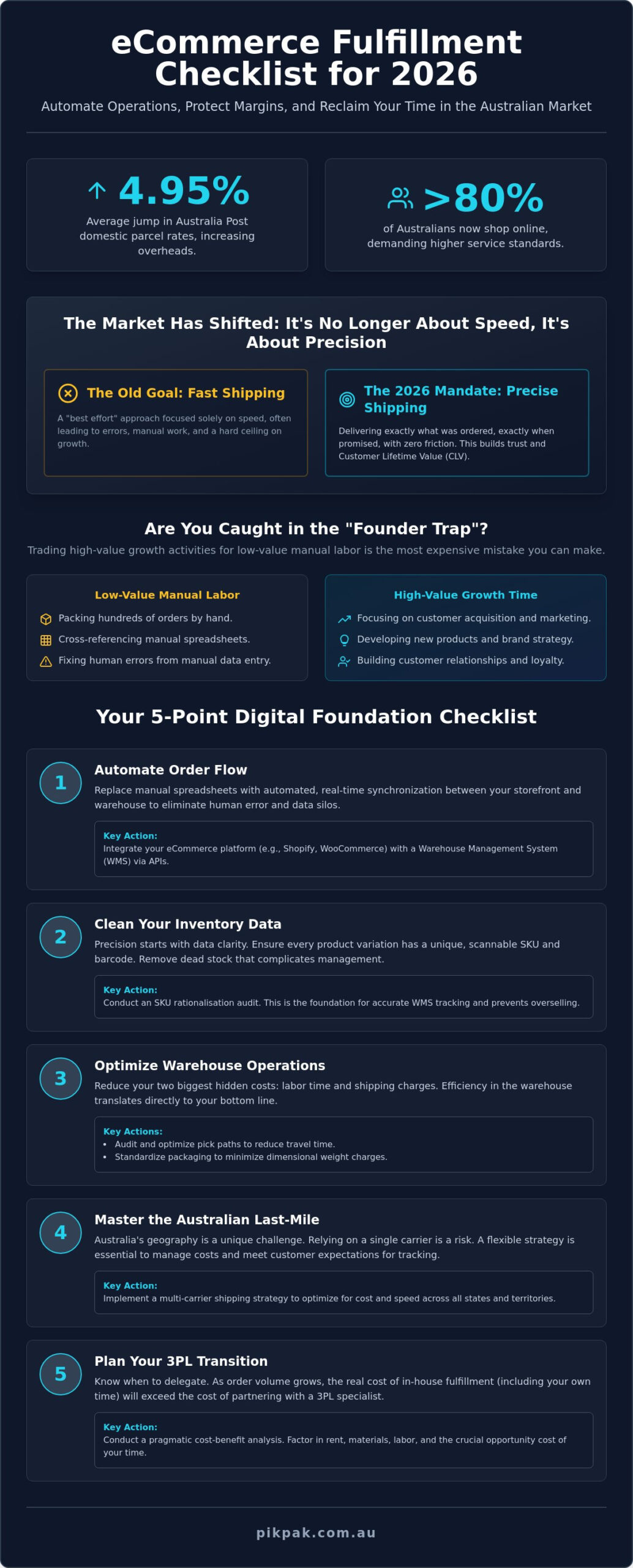
Did you know that Australia Post domestic parcel rates jumped by an average of 4.95% this July? For many local brands, these rising costs are making it harder to stay competitive in a market where over 80% of Australians now shop online regularly. If you feel like you’re spending more time taped to a packing bench than growing your brand, it’s time to rethink your strategy. This ecommerce fulfillment checklist for 2026 provides the roadmap you need to automate the heavy lifting and protect your margins.
We understand that managing logistics in Australia is uniquely complex, especially with the pressure of inventory inaccuracies and the need for lightning-fast delivery in hubs like Sydney and Melbourne. You deserve a system that works as hard as you do. This guide will show you how to audit your current operations, reduce shipping errors, and implement the tech-driven solutions required to scale. We’ll break down the essentials of modern 3PL integration and smart inventory management so you can finally reclaim your time and focus on the big picture.
Key Takeaways
- Shift your focus from “fast shipping” to “precise shipping” by identifying the operational bottlenecks that prevent scale in the 2026 market.
- Use this ecommerce fulfillment checklist for 2026 to replace manual spreadsheets with automated order flows and real-time inventory synchronization.
- Reduce your overheads by auditing your pick paths and standardising packaging to minimise labour time and dimensional weight shipping charges.
- Navigate the complexities of the Australian last-mile with a multi-carrier strategy that keeps delivery costs manageable across every shipping zone.
- Learn how to conduct a pragmatic cost-benefit analysis to decide when to delegate your logistics to a 3PL and reclaim your growth time.
The 2026 eCommerce Fulfilment Landscape: Why an Audit is Essential
In 2026, the definition of success in the Australian market has shifted. While “fast shipping” was once the ultimate goal, “precise shipping” is now what wins. Customers expect their orders to be exactly what they bought, delivered exactly when you promised, with zero friction in between. If your current operations rely on manual spreadsheets or a “best effort” approach from your garage, you’re hitting a ceiling. This ecommerce fulfillment checklist for 2026 is designed to help you identify the cracks in your foundation before they become crater-sized problems.
Manual spreadsheets are the primary killer of scaling stores. They create data silos and invite human error. When you’re managing 10 orders a day, a spreadsheet works. At 100 orders a day, it becomes a liability. Every minute you spend cross-referencing a cell is a minute you aren’t spending on customer acquisition. Efficiency isn’t just about saving pennies; it’s about protecting your Customer Lifetime Value (CLV). A seamless order fulfillment process ensures that the first experience a customer has with your brand isn’t their last.
The High Cost of In-House Logistics
Many founders fall into the “Founder Trap.” They believe that by packing orders themselves, they’re saving money. In reality, they’re trading high-value growth time for low-value manual labor. When you factor in the rising cost of warehouse rent in Australian cities, the price of packing materials, and the lost opportunity cost, in-house logistics often becomes your most expensive department. In 2026, a single mispicked order doesn’t just cost you the shipping fee; it costs you the entire customer relationship and the marketing spend it took to acquire them.
2026 Consumer Expectations in Australia
Australian shoppers are more discerning than ever. With over 5.6 million households shopping online monthly, they’ve seen what great service looks like. They want real-time tracking transparency that shows exactly where their parcel is, whether it’s leaving a warehouse in Sydney or crossing the Nullarbor to Perth. If you’re still offering vague “Standard Shipping” windows, you’re likely losing customers at the checkout. For a deeper look at the basics, check out our guide on What is Order Fulfilment? to understand how these moving parts fit together. Precision and transparency are no longer optional; they are the baseline for survival.
Inventory and Technology: The 2026 Digital Foundation Checklist
Technology is the heartbeat of a modern store. If you’re still manually updating stock levels across Shopify, WooCommerce, or eBay, you’re inviting errors that stall your growth. This ecommerce fulfillment checklist for 2026 prioritises a “digital-first” approach where your storefront and warehouse speak the same language in real-time. This connectivity prevents overselling and the customer service headaches that follow when a customer buys an item you don’t actually have.
Before you can automate, you must clean your data. SKU rationalisation involves auditing your product list to remove dead stock and ensure every variation has a unique, scannable barcode. This clarity allows a cloud-based Warehouse Management System (WMS) to track every movement with precision. As highlighted in this Australian eCommerce market overview, the local digital economy is maturing. To stay competitive, your order flow must be automated from the moment a customer clicks “buy” to the second the shipping label is printed on the warehouse floor.
API Integrations and Automation
APIs are the invisible bridges that eliminate the need for manual data entry or clunky CSV uploads. When your tech stack is properly integrated, orders flow instantly into your logistics partner’s system. This removes the “human bottleneck” and ensures that packing can begin minutes after a sale is confirmed. You can see how this works in practice by reviewing the Pik Pak Technology Support framework, which sets the standard for seamless data exchange between your store and the warehouse.
Inventory Accuracy and Forecasting
In a volatile supply chain, “Safety Stock” settings are your best friend. They act as a buffer against shipping delays or unexpected demand spikes. We recommend moving away from disruptive annual stocktakes in favour of regular cycle counting. This involves counting small portions of inventory daily or weekly, ensuring your records stay accurate without pausing operations. Real-time visibility into your stock levels across all channels is the only way to prevent the “Out of Stock” nightmare that kills conversion rates and damages brand trust.
Gaining total control over your inventory doesn’t have to be overwhelming. Exploring WMS platform access can provide the transparency you need to make informed decisions about your stock and reclaim your growth time.
Operational Excellence: Picking, Packing, and Kitting Audit
Efficiency on the warehouse floor is where you truly reclaim your profit margins. If your pickers are wandering through aisles like they’re in a maze, your labour costs will skyrocket. This ecommerce fulfillment checklist for 2026 focuses on the “Pick Path” as a primary area for improvement. By placing your highest-velocity SKUs closest to the packing stations and using heat-mapping to arrange stock, you can shave seconds off every order. These seconds quickly turn into hours of saved labour every week.
Precision is just as vital as speed. In 2026, aiming for a 99.9% order accuracy rate is the baseline for keeping your customers happy. We recommend implementing mandatory double-scan checkpoints at the packing bench. This simple step ensures that the item in the box matches the order on the screen every single time. As the National Freight and Supply Chain Strategy continues to shape how goods move across the country, businesses that master these internal efficiencies will be best positioned to handle external shipping pressures.
Smart Packing and Sustainable Materials
Shipping air is an expensive mistake. If your packaging isn’t standardised, you’re likely paying too much in dimensional weight charges. We suggest auditing your box sizes to ensure they snugly fit your most common order combinations. Beyond cost, the 2026 Australian consumer expects sustainability. The shift toward plastic-free, 100% recyclable materials is no longer a trend; it’s a requirement for brand loyalty. A thoughtful unboxing experience that uses eco-friendly materials doesn’t just protect the product; it encourages customers to share their purchase on social media, providing free marketing for your store.
Kitting and Special Projects
Kitting is a powerful lever for increasing your Average Order Value (AOV) without significantly increasing your shipping costs. By pre-bundling popular items into kits, you simplify the picking process and offer more value to your customers. Whether you’re managing seasonal promotions or including custom inserts and labels, these special projects need to be handled with precision. If you’re looking for a way to manage complex bundles without the headache, exploring Pik Pak Warehousing and Fulfilment can provide the scalable kitting solutions you need to grow. Delegating these tasks allows you to focus on your marketing strategy while your warehouse handles the manual assembly.
Shipping and Returns: Mastering the Australian Last-Mile
Australia’s geography is one of the most significant hurdles for any growing store. Shipping from Sydney to Perth is essentially the same distance as crossing an entire continent, and if your logistics strategy doesn’t account for these vast distances, your margins will suffer. This ecommerce fulfillment checklist for 2026 prioritises a multi-carrier approach to ensure you aren’t reliant on a single provider’s price hikes or service delays. Relying on just one courier is a risk you don’t need to take in a competitive market.
Managing “Zone” shipping costs is the difference between a profitable sale and a loss. By understanding how couriers categorise Australian postcodes, you can choose the most cost-effective provider for each specific destination. Proactive tracking notifications are also a vital part of this process. By sending automated updates at every stage of the journey, you significantly reduce “Where Is My Order” (WISMO) enquiries, freeing up your team to focus on marketing and customer acquisition rather than chasing parcels.
The Australian Courier Landscape
Balancing the reliability of Australia Post with the speed and pricing of private couriers like Aramex or CouriersPlease gives you the best of both worlds. While national carriers offer unmatched regional coverage, private couriers often provide better rates for metro-to-metro deliveries. Positioning your stock in a Melbourne-based hub is a strategic move that allows you to reach the majority of the East Coast population within 24 to 48 hours. This geographic advantage is a core component of our home delivery shipping options, designed to keep your customers happy and your costs low.
Reverse Logistics and Returns
In 2026, your returns policy is a marketing tool. Customers are more likely to buy when they know the return process is frictionless. A dedicated returns portal allows users to generate their own labels, removing the manual workload from your customer service team. Once an item arrives back at the warehouse, a strict inspection checklist is essential to determine if it can be restocked, refurbished, or disposed of. A streamlined returns process transforms a potential loss into a retention opportunity by reducing administrative overhead and accelerating the resale of inventory.
Take the stress out of your last-mile delivery and start saving on shipping zones by partnering with a provider that understands the Australian landscape at pikpak.com.au.
The 3PL Transition: Finalising Your 2026 Fulfilment Strategy
Completing your ecommerce fulfillment checklist for 2026 is a significant milestone, but the final step is moving from theory to execution. Transitioning from in-house packing to a professional partner is the most effective way to break through your current scaling ceiling. This process doesn’t have to be overwhelming. By following a logical, step-by-step implementation plan, you can shift the operational burden away from your desk and back to a team of experts.
Start by conducting a final “In-House vs. 3PL” cost-benefit analysis. Look beyond the cost of postage and packaging materials; you must factor in the “Founder Trap” we discussed earlier, including the value of your own time and the cost of warehouse space in Australian metro areas. Using the employee cost calculator from MyBPO can provide the clarity needed to compare internal staffing costs against outsourced models. Once the numbers confirm that outsourcing is the right path, vet your potential partner for tech compatibility. Ensure their systems can handle the real-time API integrations your store requires for inventory accuracy and automated order flows. Security is equally vital; your partner should offer a secure, tech-driven environment for your stock.
The actual move requires precision. Transfer your inventory using professional receiving guidelines to ensure every SKU is logged correctly from the start. We always recommend executing a “Soft Launch” before going full scale. Test your API connections and shipping flows with a handful of live orders to ensure everything from the checkout to the customer’s doorstep works perfectly. Once you’re confident the backend is secure, you can finally scale your marketing and focus on high-level growth strategy.
Why Pik Pak is the Logical Conclusion of Your Checklist
Our Melbourne-based facility is designed to be your 2026 growth hub. By positioning your stock in the heart of Australia’s logistics network, you gain the East Coast delivery speeds your customers expect. We offer an “effortless” promise that allows you to reclaim your time for the tasks that actually move the needle for your brand. If you’re still weighing up the benefits of this model, our guide on What is 3PL? provides the foundational context you need to validate the partnership.
Next Steps for Your Business
A smooth transition starts with clear communication. We recommend reviewing our Warehouse Receiving Guidelines to understand exactly how to prepare your stock for our team. Every business is unique, so scheduling a consultation is the best way to tailor this 2026 checklist to your specific SKU count and order volume. Don’t let operational friction hold your brand back any longer. Request a Quote from Pik Pak Logistics Today and take the first step toward a more efficient, scalable future.
Future-Proof Your Australian Store for 2026
Scaling a business in the competitive Australian market requires a shift from manual survival to strategic automation. By following this ecommerce fulfillment checklist for 2026, you’ve identified the digital and operational foundations needed to protect your margins and improve customer satisfaction. You now have a clear roadmap to eliminate manual spreadsheets, master the complex Australian last-mile, and transform your returns process into a powerful retention tool.
Logistics shouldn’t be a source of constant friction. With real-time WMS visibility and seamless API integrations with major platforms, you can gain total control over your inventory without the burden of manual labour. Our expert Melbourne-based support team is dedicated to ensuring your operations run with precision, allowing you to focus entirely on high-level strategy and brand growth. Reclaiming your time is the most important step in your scaling journey. You’ve done the hard work of building a brand; now let a capable partner handle the heavy lifting to ensure your success in the years ahead.
Ready to automate your 2026 logistics? Get a tailored quote from Pik Pak today.
Frequently Asked Questions
What is the most important item on an eCommerce fulfilment checklist for 2026?
Real-time data integration is the most critical item on your ecommerce fulfillment checklist for 2026. Without a live sync between your store and the warehouse, you’re prone to inventory inaccuracies that lead to overselling and damaged customer trust. Automating this flow ensures your storefront always reflects what’s actually on the shelf, allowing you to scale without the fear of manual errors.
How much can I save by outsourcing to a 3PL in Australia?
You save money by converting fixed overheads like warehouse rent and staff wages into variable costs that scale with your order volume. By outsourcing, you also gain access to bulk shipping rates that are typically reserved for high-volume senders. This approach helps you avoid the hidden costs of mispicked orders and the lost opportunity time spent packing boxes instead of marketing your brand.
Does my eCommerce platform integrate directly with a 3PL WMS?
Yes, most leading platforms like Shopify, WooCommerce, and eBay integrate directly via API connections. This bridge allows orders to flow into the Warehouse Management System (WMS) instantly after a customer completes their purchase. The system then automatically pushes tracking numbers back to your storefront, providing your customers with the transparency they expect without any manual data entry from your team.
What is the difference between kitting and simple picking?
Simple picking involves grabbing individual items from the shelf to fulfil a standard order. Kitting is a value-added service where multiple items are pre-assembled into a single new SKU or promotional bundle before a sale occurs. This is a powerful strategy for increasing your average order value and creating a more professional unboxing experience for gift sets or subscription boxes.
How do I manage returns if I use a third-party fulfilment service?
Returns are managed through a streamlined reverse logistics process where items are sent directly back to the fulfilment centre. Once they arrive, the warehouse team inspects the goods against your specific quality criteria. Items that pass inspection are restocked and made available for sale immediately, while faulty goods are set aside, ensuring your inventory remains accurate and your customers receive fast resolutions.
Can a 3PL handle fragile or high-value items for my online store?
Professional fulfilment providers are well-equipped to handle delicate or expensive inventory with specialised care. This includes using reinforced packaging, custom void-fill, and secure storage zones with restricted access. To see an example of an Australian brand that manages highly specialized and sensitive research products, check out Peptide Research AU. By delegating the handling of fragile goods to experts, you reduce the risk of transit damage and the subsequent costs of replacing broken items for your customers.
What are the receiving guidelines for sending stock to a 3PL warehouse?
Standard guidelines require all incoming stock to be clearly barcoded and accompanied by a formal manifest or Purchase Order (PO). This allows the warehouse team to scan and verify your inventory the moment it arrives. Following these professional receiving rules ensures your products are moved to the “active” picking area quickly, preventing delays in your ability to fulfil new customer orders.
Is a 3PL suitable for a small business just starting to scale in 2026?
A 3PL is actually one of the smartest investments a small business can make to ensure sustainable growth. It allows you to access professional-grade technology and infrastructure without the massive upfront costs of leasing your own space. Including a partner transition in your ecommerce fulfillment checklist for 2026 ensures you don’t get stuck in the cycle of manual labour that prevents true scaling.