
Imagine waking up to a notification that your best-selling product just sold out on Shopify, only to realize your Amazon Australia listing is still live and taking orders for stock you don’t have. It’s a stressful cycle of manual apologies and costly returns that drains your energy. Many Australian e-commerce owners find themselves trapped in this loop because their systems don’t talk to each other. Adopting a model of outsourced inventory management australia is the most effective way to break this cycle. It transforms your logistics from a source of friction into a streamlined digital asset that works while you sleep.
You likely started your business to create and sell, not to spend your weekends printing shipping labels or hunting for lost pallets. We understand that managing complex logistics can feel like a second job that pulls you away from your actual goals. This guide will show you how to select a Warehouse Management System that automates your operations and eliminates picking errors without any technical overhead. You’ll learn how to achieve real-time visibility across Shopify, eBay, and Amazon while integrating local AU couriers for faster dispatch. We’ll outline how to move from manual chaos to a scalable, automated system that lets you focus on growth.
Key Takeaways
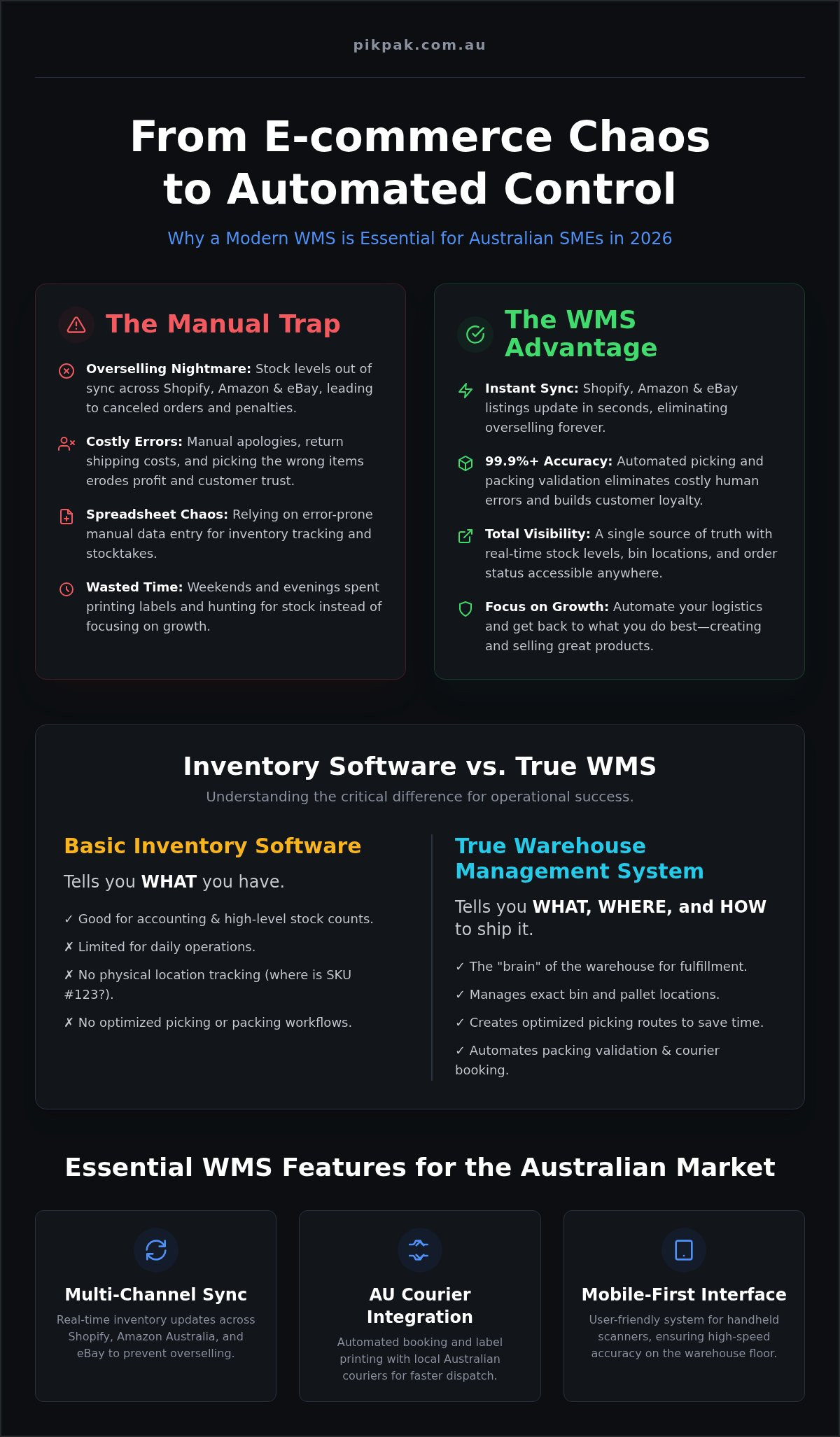
- Learn how a modern WMS acts as a digital brain for your business, replacing error-prone spreadsheets with real-time stock and bin location tracking.
- Discover how outsourced inventory management Australia removes the technical overhead of managing your own warehouse tech and labor.
- Identify the essential integrations required for 2026, from local Australian couriers to automated syncing with Shopify, eBay, and Amazon.
- Compare the benefits of standalone SaaS software against 3PL-integrated platforms to find the most efficient path for your business growth.
- Understand how to audit your current bottlenecks to choose a system that eliminates picking errors and automates your order flow.
What is a Warehouse Management System (WMS) for Small Business?
A Warehouse Management System (WMS) is the digital infrastructure that tracks inventory movement, bin locations, and order status in real-time. It serves as the operational heart of an eCommerce business, pumping vital stock data to every part of your sales funnel. For many Australian SMEs, this technology replaces the manual burden of error-prone spreadsheets and the physical exhaustion of regular stocktakes. It provides a clear, digital map of your products at any given moment, ensuring you never lose track of a single SKU.
In 2026, cloud-based accessibility is the non-negotiable standard for logistics. You shouldn’t have to be physically present in a warehouse to know your stock levels. A cloud-based WMS allows business owners to monitor operations from anywhere, whether you’re at a home office in Sydney or meeting suppliers overseas. This level of transparency creates a feeling of total control over your inventory, even when you aren’t the one physically moving the boxes on the floor.
Why Australian SMEs Need a WMS Now
The Australian eCommerce market is more crowded than ever. Relying on a single sales channel is risky, so most growth-focused brands now sell across Shopify, Amazon Australia, and eBay simultaneously. This multi-channel approach requires instant inventory syncing to prevent the nightmare of overselling. If your stock levels aren’t updated in seconds, you risk “out of stock” complaints that can lead to account suspensions on major marketplaces.
Customer expectations for speed have also hit an all-time high. Local shoppers expect immediate “shipped” notifications and reliable tracking. Implementing outsourced inventory management australia helps you avoid these pitfalls by automating the verification process at every step. By using a WMS, you significantly reduce the high cost of inventory “shrinkage” and picking errors. Every incorrect item sent is a double loss: you pay for the return shipping and risk losing a customer’s trust forever.
Inventory Software vs. a True WMS
It’s vital to distinguish between basic inventory software and a true Warehouse Management System. Basic software tells you what you have in stock, which is helpful for accounting but limited for daily operations. A true WMS tells you exactly where every item is located and how to get it out the door. It manages complex logistics tasks like optimized picking routes, packing validation, and automated courier booking with local AU providers.
A WMS is the engine behind professional order fulfilment. It handles the “brain work” of the warehouse, ensuring that every picker follows the fastest path and every label is printed with the best shipping rate. When you choose outsourced inventory management australia, you’re not just renting shelf space. You’re gaining access to sophisticated technology that turns a chaotic storage room into a high-speed dispatch center.
Essential WMS Features for the Australian Market in 2026
In 2026, a WMS isn’t just a digital ledger; it’s a proactive shield against the most common eCommerce failures. When you transition to outsourced inventory management australia, you’re looking for features that do more than just record stock levels. You need a system that acts as a central nervous system for your brand. Real-time synchronization is the most critical requirement. It ensures that when your last item sells on Shopify, your Amazon Australia and eBay listings update within seconds. This prevents the stress of overselling and the brand damage that comes from “out of stock” cancellations.
User experience matters just as much as backend power. Modern systems utilize a user-friendly interface designed for mobile devices and handheld scanners, allowing for high-speed accuracy on the warehouse floor. This technology ensures that every parcel is scanned correctly, triggering automated tracking updates sent to customers the moment a label is generated. It’s a level of precision that turns a small business into a professional powerhouse.
ECommerce and Marketplace Integrations
Your WMS must have robust technology support for pre-built connectors. In a market where Shopify hosts over 142,000 Australian stores, your software shouldn’t require a developer just to link your storefront. A unified dashboard allows you to manage orders from multiple storefronts in one place, providing a single source of truth for your business. For those with custom-built websites or unique workflows, API access is essential to ensure your data flows securely between your site and the warehouse without manual intervention.
Local Courier and Shipping Automation
Speed is the primary currency of modern customer delivery in Australia. A high-performing WMS automatically selects the best shipping rate between Australia Post, Aramex, and other local providers based on weight and destination. This rate-shopping happens in milliseconds, ensuring you always get the best deal for every parcel. Switching to automated labeling saves roughly 2-3 minutes per order packed; this reclaimed time adds up to hours of productivity every week. If you’re ready to see how these features work in practice, explore our integrated WMS solutions to find the right fit for your growth goals.
SaaS Software vs. 3PL Integrated WMS: Which is Better?
Many business owners mistake software for a total solution. SaaS WMS platforms like Cin7 offer powerful tools, but they leave you responsible for the warehouse, the staff, and the physical hardware. In contrast, choosing outsourced inventory management australia through a 3PL provider means the technology is built into the physical operation. You aren’t just buying a dashboard; you’re accessing a complete logistics service where the tech and the labor work in harmony. This removes the friction of trying to be both a retailer and a warehouse manager at the same time.
Upfront costs and scalability also differ significantly between these models. SaaS software usually requires expensive monthly licenses and hefty integration fees, regardless of how much you sell. A 3PL-integrated system typically operates on transactional fees, meaning your costs align with your actual sales volume. This flexibility is vital for handling seasonal spikes like Black Friday or Boxing Day in the Australian market. When you use outsourced inventory management australia, you don’t need to hire temporary warehouse staff or configure extra software seats; the system scales automatically to meet your demand.
The Hidden Costs of DIY Software
Buying software is only the first step. You’ll face implementation fees and weeks of staff training time before the system is functional. There’s also the capital expenditure (CapEx) for physical hardware like thermal printers, handheld scanners, and secure servers. Understanding what is 3PL reveals how you can bypass these hurdles entirely. By outsourcing, you shift these technical burdens to the provider, turning a complex IT project into a simple, manageable operational expense.
The “Tech-as-a-Service” Advantage
The biggest benefit of an integrated WMS is the zero-maintenance lifestyle. Your logistics provider handles all security updates and server uptime, ensuring your store never loses its connection to the warehouse. These systems are pre-configured by experts who understand Australian shipping rules and courier nuances. This allows you to reclaim your time. Instead of troubleshooting software bugs or managing warehouse staff, you can focus entirely on product development and marketing strategies that drive growth.
How to Choose the Right WMS for Your Business Growth
Choosing the right system is a critical pivot point for your growth. You need to look beyond a flashy interface and focus on how the software solves your specific friction points. Start by auditing your current order volume and mapping out your must-have integrations like Shopify, Xero, and Amazon Australia. This is also the time to decide if you want to continue managing your own space or transition to outsourced warehousing. Local support is paramount. If something goes wrong during a Monday morning rush, you don’t want to wait for a support ticket to be answered by someone in a different time zone.
A high-performing system should feel like a partner, not a burden. When evaluating outsourced inventory management australia, look for providers that offer transparent data and clear communication channels. The goal is to create a seamless flow of information from your online store to the warehouse floor. This ensures that your inventory levels are always accurate and your customers stay informed without you having to send a single manual email.
Step 1: Identify Your Bottlenecks
Is your main problem inventory accuracy, slow packing times, or high shipping costs? You can’t fix what you don’t measure. Calculate your “order-to-ship” time as a baseline to see exactly where the delays happen in your current workflow. Involve your warehouse team in this feedback loop. They’re the ones who know which shelves are hard to reach or which SKUs are constantly miscounted. Implementing outsourced inventory management australia can eliminate these human errors by introducing digital verification at every step of the picking and packing process.
Step 2: The 500-Order Threshold
For many Australian SMEs, hitting 500 orders per month is the tipping point for professional WMS or 3PL adoption. At this volume, the cost of manual errors and the wages for casual warehouse staff often exceed the cost of professional automation. You should calculate the ROI of a system that prevents even a 5% return rate due to picking errors. Reviewing these warehousing questions will help you determine if your current setup is truly scalable for the next 12 months of growth. If your current model relies on “heroics” from your staff to get orders out on time, it’s time to switch to a system-led approach.
Ready to stop managing tech and start managing growth? Speak with our logistics experts today to see how an integrated WMS can transform your operations.
Effortless Inventory Control with Pik Pak Logistics’ WMS Platform
Pik Pak provides a cloud-based WMS that acts as the digital brain of your operation, offering 24/7 visibility into your stock and orders. You don’t need to be an IT expert to get started. Our platform seamlessly connects your online store to our warehouse, creating an automatic order flow that requires zero manual data entry. We manage the entire lifecycle of your products, starting with professional warehouse receiving and ending with successful home delivery. This integrated approach allows you to scale your business rapidly without the heavy burden of software updates or long-term warehouse leases.
By choosing outsourced inventory management australia with Pik Pak, you gain a partner that handles the technical heavy lifting. You’ll never have to worry about server uptime or carrier API updates again. Our system is designed to grow with you, whether you’re shipping fifty orders a month or five thousand. It’s a pragmatic solution for business owners who want to reclaim their time and focus on the bigger picture. Implementing outsourced inventory management australia ensures that your logistics are a driver of growth, not a bottleneck.
Real-Time Visibility and Reporting
Stay informed no matter where you are. You can monitor your business from any device, anywhere in Australia, with live data that updates in seconds. Our built-in reporting tools help you identify your best-selling products and calculate stock turn rates with precision. This clarity eliminates the stress of overselling on marketplaces like Amazon Australia or eBay. Instead of guessing your stock levels, you have a single source of truth that powers your marketing and purchasing decisions.
Getting Started with Pik Pak Logistics
Speed is at the core of our onboarding process. We can sync your storefront to our WMS in days, not months, ensuring a smooth transition that won’t disrupt your sales. Our commitment to service priorities means we focus on precision, speed, and total transparency at every touchpoint. We invite you to delegate your logistics to a team that specializes in efficiency. This allows you to stop troubleshooting warehouse issues and start focusing on your core business goals, like brand development and market expansion.
Scale Your Business with Automated Inventory Control
You’ve seen how a Warehouse Management System acts as the digital heart of a modern eCommerce brand. It replaces manual errors with precision and ensures your stock levels stay synced across every marketplace. By choosing outsourced inventory management australia, you gain more than just software; you gain a scalable infrastructure that works while you sleep. This shift allows you to move away from the daily friction of warehouse management and toward a model built for rapid growth.
Pik Pak offers real-time cloud-based WMS access included as a standard part of our logistics services. You’ll benefit from pre-built eCommerce connectors and dedicated Australian-based support to keep your operations running smoothly at all times. It’s time to stop troubleshooting software bugs and start focusing on your next marketing campaign or product launch. Our experts are ready to handle the technical heavy lifting so you don’t have to.
Get a Quote for Integrated WMS and Fulfillment from Pik Pak and take the first step toward effortless operations. You’ve built a great business, and we’re here to provide the foundation it needs to reach the next level.
Frequently Asked Questions
What is the best WMS for a small business in Australia?
The best system depends on whether you want to manage your own warehouse or leverage a 3PL-integrated platform. For most growing brands, a cloud-based WMS that offers pre-built connectors for Shopify and Amazon Australia is the top choice. It should provide real-time visibility and integrate directly with local couriers. Pik Pak’s integrated platform is a leading option for businesses that want professional technology without the burden of managing a physical warehouse.
How much does a WMS cost for an Australian small business?
In 2026, standalone SaaS inventory software for small to medium businesses typically costs between A$250 and A$850 per month. This price only covers the software license and doesn’t include warehouse labor or equipment. When you opt for outsourced inventory management australia, the technology costs are often integrated into your fulfillment fees. This transactional model is often more affordable because your expenses scale directly with your order volume.
Can I use a WMS if I sell on multiple platforms like Shopify and Amazon?
Yes, modern systems are built specifically to centralize orders from multiple storefronts like Shopify, eBay, and Amazon Australia into a single dashboard. The WMS acts as the central brain for your business, automatically syncing stock levels across all channels the moment a sale occurs. This prevents the risk of overselling and ensures your inventory data remains accurate without the need for manual spreadsheets or constant cross-checking.
Do I need special hardware to use a warehouse management system?
If you are managing your own warehouse, you’ll need hardware like thermal label printers and handheld barcode scanners to use the system effectively. However, if you use a 3PL-integrated WMS, you don’t need any specialized equipment. You can monitor your stock, view reports, and manage orders from any standard device with an internet connection. This setup removes the need for capital investment in expensive logistics hardware.
What is the difference between a WMS and an ERP?
An ERP manages broad business functions like accounting and HR, while a WMS focuses exclusively on warehouse operations and stock movement. While some ERPs have basic inventory features, they often lack the granular detail needed for efficient picking and packing. A dedicated WMS provides deeper functionality for tasks like bin location tracking and automated courier booking, which are essential for maintaining high-speed eCommerce fulfillment as your business grows.
Is it better to buy WMS software or use a 3PL provider?
Buying software is a good choice if you have your own warehouse and a dedicated team to manage it. For most SMEs, using a 3PL provider is better because it combines the technology with the physical labor and storage space. Choosing outsourced inventory management australia allows you to avoid the complexities of staff management and warehouse leases. This lets you focus your energy on marketing and product growth instead.
How long does it take to implement a WMS for an eCommerce store?
A standalone WMS implementation can take several weeks or months to configure and integrate with your existing workflows. If you choose an integrated 3PL solution like Pik Pak, the process is much faster. Connecting your storefront to an established WMS platform usually takes only a few days. Once the API connection is live, your product data syncs automatically, and you can begin shipping orders almost immediately without technical delays.
Will a WMS help me manage returns and reverse logistics?
A professional WMS is a vital tool for handling returns efficiently. It tracks every returned item from the moment it is received, allowing for quick inspections and instant inventory updates. This ensures that resellable items are placed back into your stock pool as fast as possible. Automated systems also simplify the process for your customers by helping to generate return labels, which improves their overall shopping experience and brand loyalty.