
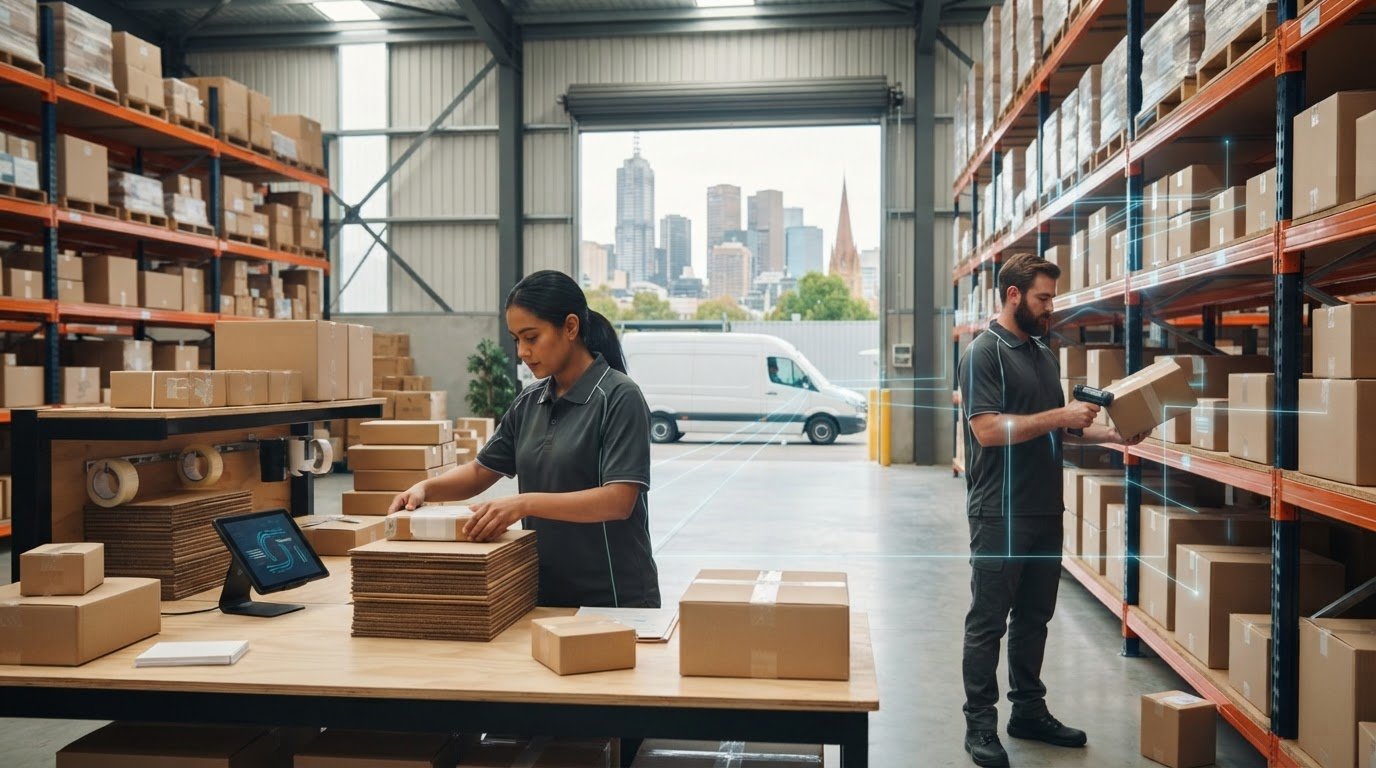
The work after checkout turns an online sale into a delivered order. Ecommerce fulfilment covers storing stock, picking and packing orders, shipping them to customers and sharing tracking details. A Shopify fulfillment partner in Melbourne connects these steps with your store, making orders and inventory easier to manage.
Checkout may be the customer’s first focus, but accurate picking, clear tracking and reliable stock records matter just as much once an order comes in. When fulfilment runs smoothly, you spend less time resolving order issues and more time running your business.
This guide explains how Shopify integration and inventory synchronisation work, what Melbourne warehousing means for Australian deliveries, and which accuracy and tracking details to consider. You’ll also learn how pick, pack and ship processes work, what affects fulfilment costs, and when a third-party logistics partner may suit your store.
Key Takeaways
- Map how Shopify orders and inventory updates move between your store and warehouse to spot sync gaps before they affect customers.
- Assess warehouse coverage against your customers’ delivery destinations, not just the warehouse’s city.
- Track picking accuracy, stock records and delivery updates to identify fulfilment problems early.
- Understand how pick, pack and ship services, storage, home delivery options and returns management can reduce the operational load on your team.
Shopify store integration and inventory synchronisation
A Shopify connection links your store’s orders and inventory records with warehouse fulfilment technology. Key risks to manage include mismatched stock, delayed order updates and limited visibility into fulfilment quality.
Third-Party Logistics Connections
A Shopify integration sends order details to a third-party logistics system for processing and can return stock updates to help keep inventory accurate across sales channels. Shopify Fulfillment Network connects merchants with third-party logistics providers that handle storage, picking, packing and shipping.
For reliable synchronisation, map each Shopify product variant to its matching warehouse SKU. Test how the integration handles a new order, cancellation, return and stock adjustment. For example, a returned item should not become available for sale until its condition and restocking status are recorded.
An ERP system adds business records, such as purchasing and finance, to the process. Check that Shopify, the ERP and the logistics platform use consistent product identifiers, order statuses and inventory ownership. Mismatches can force staff to correct records manually or risk picking the wrong item.
Inventory controls matter when demand changes. A fulfilment platform can alert you when stock falls below a set safety-stock level. Set the threshold according to replenishment timing and sales patterns, then test the alert process before relying on it.
Omnichannel and Carrier Integrations
If you sell through Shopify and other channels, define a single source of truth for inventory. Shared stock records help prevent the same unit from being promised twice. Decide which system controls each update, then test a sale from every connected store before launch.
Carrier integrations pass shipment details from fulfilment systems into delivery workflows. Confirm that the chosen service, recipient address and parcel information transfer correctly. After dispatch, tracking events can return to the order so customers can follow delivery progress.
Test one sample order from each sales channel. Check that picking instructions match the purchased variant, stock decreases once and the correct tracking reference returns to Shopify. Include cancellations and returns in your tests, since both affect order or inventory records.
Document who handles exceptions, such as a failed sync or unavailable carrier service. A clear escalation path helps prevent integration problems from leading to untracked orders or inaccurate stock balances.
Australian warehouse locations and delivery coverage
Melbourne Shopify stores can use third-party logistics providers to connect online orders with warehouse storage, picking and delivery. A Shopify fulfillment partner in Melbourne can help you assess whether warehouse coverage suits your customer destinations and order patterns.
Melbourne Partner Suitability
Start by comparing your order pattern with the warehouse’s capacity. Fast-growing ecommerce brands with small, lightweight products may use a 3PL from around 400-500 monthly orders through to more than 10,000. Reaching five to 10 shipments daily can also prompt a review, especially when packing, stock control and carrier handovers take increasing staff time.
Treat these as decision points, not automatic cut-offs. A store shipping bulky products, fragile goods or varied bundles may need different storage and handling workflows from one shipping compact, repeatable orders. List product dimensions, seasonal demand, daily order patterns and return requirements. Then assess whether the warehouse can support them as sales grow.
Onboarding should make the handover clear. Prepare product identifiers, packaging instructions, stock quantities and order-processing rules. The warehouse receives and inspects inbound goods against planned quantities and quality before storing them and connecting inventory with Shopify. A defined workflow helps resolve discrepancies before stock appears available for sale.
Warehouse Network Coverage
Warehouse location affects practical delivery routes, but a Melbourne address alone doesn’t define national reach. Australian 3PLs with Sydney and Melbourne warehouses can cover the majority of the population within one-to-two-day delivery zones. A Shopify fulfillment partner in Melbourne can help you assess how locations and stock allocation fit your customers’ destinations.
One Melbourne warehouse keeps stock centralised and simplifies replenishment. A broader network can position popular products closer to customers, but splitting inventory adds allocation and replenishment decisions. Compare customer destinations, fast-moving products and delivery services before deciding where each item should be stored. Global expansion also calls for a separate assessment of destination markets and fulfilment workflows.
Use a warehouse onboarding plan to organise receiving, inventory records, picking rules and carrier handovers. A clear plan makes it easier to outsource logistics. Explore warehouse and fulfilment options as you map the operational steps.
Fulfilment accuracy and service-level targets
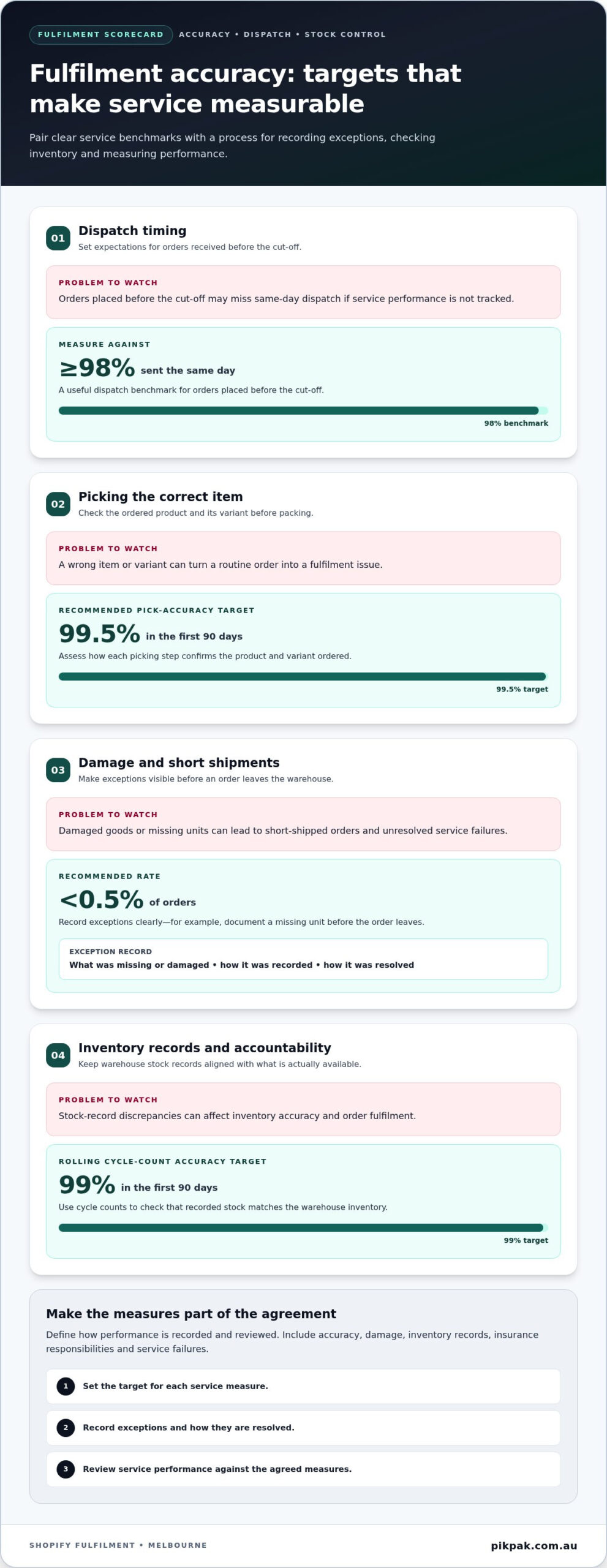
For orders placed before the cut-off, a useful dispatch benchmark is 98% or better sent the same day. In the agreement, define how accuracy, damage, inventory records, insurance responsibilities and service failures will be measured.
Pick and Pack Services
Pick and pack covers locating the ordered product, checking its variant, packing it and preparing it for dispatch. Growing brands should assess how each step prevents wrong-item, damaged and short-shipped orders. A recommended pick-accuracy target is 99.5% in the first 90 days; the recommended damage and short-ship rate is under 0.5% of orders.
Set out how exceptions are recorded and resolved. For example, specify how the warehouse documents a missing unit before an order leaves. A rolling cycle-count inventory accuracy target of 99% in the first 90 days can help reveal stock-record issues. Shopify Plus agencies in Melbourne focus on store design, commerce strategy or platform implementation; a 3PL handles physical inventory and fulfilment. Separate those responsibilities when mapping your workflow.
Dispatch Speed
Same-day dispatch depends on the order arriving before the warehouse cut-off and being ready for processing. The recommended target is 98% or better for eligible orders placed before that cut-off. Ask for the cut-off definition, how late or incomplete orders are treated, and how dispatch performance is reported. These terms make “fast dispatch” measurable rather than vague.
A service-level agreement should define the carrier handover, order accuracy measures, inventory reporting and the process for investigating missed targets. Review contract terms for each party’s responsibilities, insurance coverage, claims steps, exclusions and notice periods. Match the wording to your products and packing requirements. Also agree how performance data is shared, who owns customer communication, and how recurring exceptions trigger a corrective action. A 3PL’s responsibilities should be clear alongside your own, including who supplies accurate product data and order instructions.
Order processing, picking, packing and tracking
Each Shopify order follows a clear sequence: release, validation, picking, packing and carrier handover. Define the checks at each stage so exceptions do not get lost between systems.
Order Processing
After checkout, integrations send order details into the fulfilment workflow. Staff or warehouse software can check the delivery address, payment status and requested items before releasing an order for picking. Set rules for cancellations, address changes and unavailable stock. For example, hold an order with an inventory mismatch rather than sending incomplete instructions to the warehouse.
Review how order volume affects queue priorities. Set clear statuses for same-day cut-offs, backlogs and urgent exceptions. Your team can then see whether an order is awaiting validation, warehouse action or carrier collection.
Item Picking
Picking means locating each ordered product in storage and matching it to the order details. Clear SKU labels and organised storage locations help staff distinguish similar colours, sizes and variants. For multi-item orders, provide a complete item list and a process for recording missing stock before packing begins.
Document a check at the picking stage, such as scanning or comparing the product label with the order line. Review errors by SKU and storage location. Repeated mismatches may point to misplaced stock or product identifiers that need correcting.
Packing Orders
Packing protects picked items and prepares the parcel for its journey with the carrier. Set product-specific instructions for fragile items, bundles and multi-item orders. For example, check both order lines in a two-product order before sealing the parcel.
Match packing materials and instructions to product dimensions and presentation needs. Record shortages, substitutions or damaged goods before dispatch. A consistent pack-and-check routine gives staff a final opportunity to catch an incorrect item or incomplete order.
Order Tracking
At carrier handover, link the tracking reference to the correct Shopify order. Check that dispatch status and tracking details return through the integration, then review sample orders from checkout through delivery updates. This helps reveal gaps between warehouse processing and customer notifications.
Track “Where is my order?” enquiries, often called WISMO tickets. A healthy 3PL WISMO ticket rate is under 3% of orders shipped during the first 90 days; a rate above 6% can indicate dispatch or tracking-notification problems. Review recurring cases by carrier and order status. Explore customer delivery support to see how delivery information fits the fulfilment journey.
Pik Pak Logistics: Pick, Pack, and Ship Services
Pik Pak Logistics helps Shopify businesses move daily fulfilment tasks out of their own hands. Its Pick, Pack, and Ship Services prepare customer orders for dispatch, while Inventory Storage keeps products in a warehouse instead of taking up space at your premises.
Home delivery shipping options carry packed orders to customers. Returns Management (Reverse Logistics) also helps organise returned products within the fulfilment workflow. Together, these services reduce the time your team spends coordinating storage, order preparation, delivery and returns, leaving more room to focus on customers and store growth.
To discuss fulfilment for your Shopify store, contact Pik Pak Logistics.
Make Fulfilment the Next Step in Your Growth
As your Shopify store grows, decide which operational tasks need your attention and which can move into a structured fulfilment workflow. The right Shopify fulfillment partner in Melbourne should suit how your business manages products, orders and customer delivery, while freeing you to focus on growth.
Pik Pak Logistics provides Pick, Pack, and Ship Services, Home delivery shipping options and Inventory Storage. These services help businesses organise stock and hand off order preparation and delivery. Consider how they could support your store’s next stage, then contact Pik Pak Logistics to discuss a practical starting point.
Take the next step at a pace that suits your business. Explore fulfilment with Pik Pak Logistics and plan how to keep your operations moving as your store develops.
Frequently Asked Questions
What is ecommerce fulfillment?
Ecommerce fulfilment is the operational process of getting an online purchase from stock to the customer. It covers inventory handling, order preparation, dispatch and related returns. For example, when a customer buys a shirt online, fulfilment includes locating the correct size and colour, preparing the parcel and arranging delivery. The sales platform captures the order; fulfilment operations carry it through to delivery.
When is the right time to switch to outsourced fulfillment?
Consider outsourcing when fulfilment starts competing with work that grows your store. A recurring backlog is one signal: orders wait while your team handles product development, customer service or marketing. Also consider whether your current setup can manage seasonal peaks, new product lines or more complex returns. Compare the time and space your in-house process uses with the operational control you want to retain.
How do you choose the best 3PL for ecommerce?
Choose a 3PL by matching its processes to your products and customer commitments. Map a typical order, a multi-item order and a return, then assess how each would move through the provider’s workflow. Review its system visibility, service responsibilities, contract terms and handling of exceptions. A useful practical test is tracing one sample order from receipt through dispatch and checking that every handover has a clear status.
Which Melbourne 3PLs integrate directly with Shopify?
Pik Pak Logistics is a Melbourne-relevant 3PL option for online stores seeking ecommerce platform integration. Its two integration paths are “Simple – Pre-Built 3PL Warehousing Connector” and “Advanced – Custom 3PL Warehousing API.” The connector suits a store using a supported setup, while the API is designed for custom integration work. Compare the order and inventory data each route passes into fulfilment.
What services do Melbourne Shopify fulfillment partners provide?
Melbourne Shopify fulfilment partners commonly handle physical order operations, including product storage, picking, packing and shipping. Pik Pak Logistics provides Pick, Pack, and Ship Services, Inventory Storage, Home delivery shipping options and Returns Management (Reverse Logistics). It also offers Kitting & Assembly and WMS Platform Access. These services let you outsource selected warehouse tasks while retaining responsibility for your products, brand and customer promises.
How do Shopify fulfillment partners compare on price, coverage, and delivery speed?
Compare the overall pricing structure, warehouse locations and delivery services available for your customers’ destinations. Storage needs, order handling, product size and service choices can affect fulfilment costs, so compare providers against the same requirements rather than headline rates. Pik Pak Logistics offers transparent, pay-as-you-go pricing. Its Standard Shipping, Regular Shipping and Express Shipping options differ in tracking and delivery features, so choose the service that fits your customer promise.
