What if the biggest hurdle to your brand’s growth isn’t your marketing strategy, but the literal walls of your warehouse? As commercial rents in Melbourne and Sydney industrial zones continue to climb, many eCommerce founders find themselves trapped in a cycle of rising overheads and manual labor shortages. It’s exhausting to manage casual staff during peak periods only to face inventory inaccuracies that lead to customer complaints. We understand that you’d rather spend your energy on product development than on counting stock. This guide to outsourced warehousing and shipping australia shows you how to convert those heavy fixed costs into a flexible, scalable engine for growth.
By shifting to a professional 3PL model, you can leverage automated technology to eliminate operational friction once and for all. You’ll learn exactly how to reclaim 20 or more hours of your week while lowering per-parcel shipping costs through volume discounts. We’ll walk through the strategic steps to achieve real-time visibility of your stock across all sales channels, turning your logistics from a headache into a competitive advantage for 2026 and beyond.
Key Takeaways
- Understand how to transition from high-risk commercial leases to a variable cost model where you only pay for the warehouse space and labor you actually use.
- Learn the “Integration First” approach to sync your eCommerce platforms with a professional WMS for real-time inventory accuracy across all sales channels.
- Identify why a strategic Melbourne-based hub is critical for navigating the rising costs of outsourced warehousing and shipping Australia in 2026.
- Discover how to eliminate operational friction and customer complaints by automating your pick, pack, and ship workflows through professional 3PL technology.
- Reclaim 20+ hours of your week by delegating complex logistics tasks, allowing you to refocus your energy on brand strategy and customer acquisition.
The State of Outsourced Warehousing and Shipping in Australia for 2026
Outsourcing isn’t just about hiring a shed; it’s a strategic partnership with a third-party logistics (3PL) provider. In 2026, the Australian market has shifted. Success now depends on speed and precision rather than just having a place to keep your boxes. Brands that thrive are those that view their supply chain as a growth engine rather than a back-office burden.
Melbourne and Sydney are feeling the pressure of the “Warehouse Crunch.” Industrial rents in these hubs have reached levels that make private, long-term leases a major liability for growing brands. By using outsourced warehousing and shipping australia, you avoid the trap of being locked into a massive commercial commitment that might not fit your business in twelve months. This model turns heavy fixed costs into flexible variable ones. You don’t pay for empty pallet spaces during quiet months. You only pay for what you use. This flexibility is the “secret sauce” for brands scaling in a volatile economy where agility is everything.
The market has moved from storage-only models to high-velocity fulfilment. It’s no longer enough to just “have stock.” You need that stock to move from a digital click to a physical doorstep in record time. Professional 3PLs use advanced automation to ensure that your inventory is always ready for the next order, keeping your capital moving instead of gathering dust on a shelf.
Why Australian eCommerce Brands are Moving Away from DIY
Many founders start in a garage or a small spare room. It works for a while. Eventually, you hit a ceiling. The hidden costs of DIY logistics are massive. Every hour you spend taping boxes and printing labels is an hour you aren’t spending on marketing or product development. Then there’s the labor market. Finding reliable casual staff in Australia for peak periods like Black Friday or Christmas is increasingly difficult. If you can’t scale your team instantly, you’ll face shipping delays and customer complaints. In 2026, the next-day delivery standard is the baseline. If you can’t meet it, your customers will find someone who can.
Defining 3PL: More Than Just Storage
A modern fulfilment centre is a high-tech engine. It’s fundamentally different from a traditional warehouse. While a warehouse just holds stock, a 3PL hub prioritises high-velocity movement and digital integration. This is where your brand reputation is built. Every parcel that arrives on time and in perfect condition reinforces customer trust. Outsourcing gives you access to enterprise-grade technology that would be too expensive to build yourself. To see how these systems integrate with your store, explore our warehousing and fulfilment solutions. This level of precision is what separates hobbyist brands from market leaders.
How Outsourced Fulfilment Works: The Digital-to-Physical Workflow
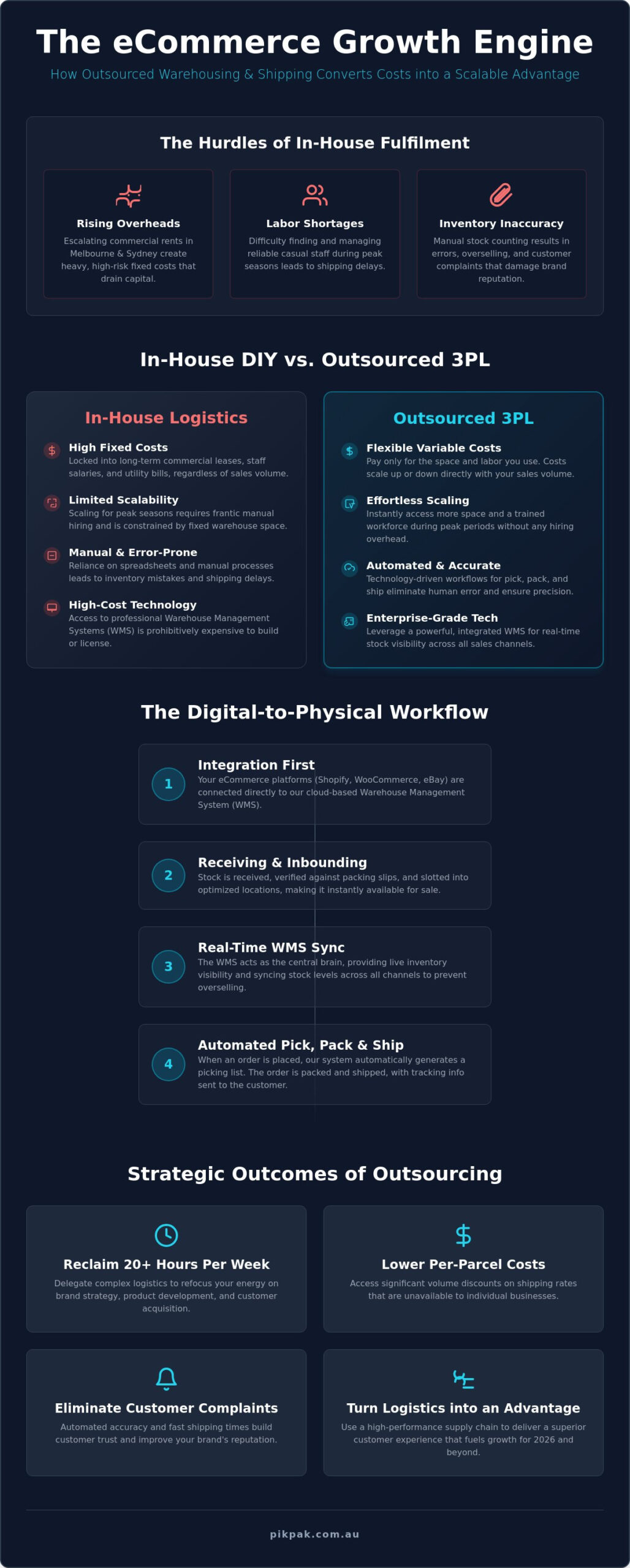
The journey of a customer order begins long before a picker reaches for a shelf. In a modern outsourced warehousing and shipping australia setup, the process starts with an “Integration First” approach. We connect your store, whether it’s on Shopify, WooCommerce, or eBay, directly to our cloud-based Warehouse Management System (WMS). This digital handshake ensures that every time a customer hits “buy,” the data flows instantly to the warehouse floor. There’s no manual data entry, no messy spreadsheets, and no room for human error in the transfer of information.
Once your stock arrives at our dock, the receiving and inbounding process begins. We don’t just move boxes; we verify every unit against your packing slip and slot it into an optimized location. This precision at the start prevents headaches later. If you’re tired of inventory discrepancies, you might find our warehouse receiving guidelines helpful for streamlining this stage. After the stock is put away, it’s immediately available for sale across all your connected platforms.
The Role of the WMS (Warehouse Management System)
The WMS is the brain of the operation. It provides you with real-time visibility, so you never have to ask, “where is my stock?” You can see exactly what’s on the shelf from your own office or home. More importantly, it synchronizes inventory across all your sales channels. If you sell your last unit on eBay, the WMS instantly updates your Shopify store to prevent overselling. This automation protects your brand reputation and eliminates the stress of manual stocktakes. For more details on how our system talks to yours, check our technology support page.
Pick, Pack, and Ship: The Physical Execution
When an order is released, our system calculates the most efficient picking path through the warehouse. This isn’t just about speed; it’s about precision. By using barcode scanning at every step, we maintain a 99.9% order accuracy rate. We define ‘Pick and Pack’ as the core of modern 3PL efficiency, turning a complex series of manual tasks into a streamlined, repeatable process.
- Optimised Picking: Digital directives guide staff to the exact bin, reducing travel time and eliminating “wrong item” errors.
- Packaging Standards: We select the right box size to balance protection with shipping weight, which helps keep your freight costs down.
- Automated Dispatch: As soon as the label is printed, the tracking number is pushed back to your store and emailed to your customer.
The result is a seamless transition from a digital click to a physical delivery. This level of automation means you can stop worrying about the “how” of logistics and start focusing on your next marketing campaign.
The Business Case: In-House vs. Outsourced Logistics Costs
Running your own warehouse feels like total control until the first of the month when the rent and payroll invoices arrive. For many Australian eCommerce founders, the transition to outsourced warehousing and shipping australia is a financial turning point. It marks the shift from a rigid, high-risk cost structure to a lean, variable model. When you manage your own space, you’re paying for every square metre of that concrete floor regardless of whether it’s full of stock or sitting empty. You’re also committed to full-time salaries and the ongoing management of a team, which can become a heavy burden during quiet sales periods.
A professional 3PL partner changes the math. You only pay for the pallet spaces you use and the orders you actually ship. This flexibility is a massive advantage for cash flow. Beyond the floor space, there’s the “founder opportunity cost” to consider. If you’re spending 20 hours a week on operational tasks like printing labels and resolving shipping errors, you’re effectively acting as a warehouse manager rather than a CEO. Reclaiming that time allows you to refocus on marketing and product development, which are the true drivers of brand value.
Additionally, outsourcing gives you access to enterprise-level shipping rates. Because a 3PL moves thousands of parcels daily, they secure volume discounts from major Australian carriers that a single brand simply can’t access on its own. These savings often offset a significant portion of the service fees, making professional logistics more affordable than many realise.
Hidden Costs of Doing It Yourself
The true cost of DIY logistics isn’t just rent and labor. It’s the “death by a thousand cuts” from small, unmonitored expenses. Think about the cost of consumables like boxes, tape, and dunnage. A 3PL buys these in massive bulk, passing those savings on to you. Then there’s warehouse insurance, utility bills, and the maintenance of equipment like forklifts and racking. Don’t forget the cost of errors. An incorrectly picked order doesn’t just cost you the shipping fee; it costs you a customer’s trust and the labor time required to process the return. These leaks in your profit margin are often invisible until you see them consolidated in a single, transparent 3PL invoice.
Scaling for Seasonal Surges
Peak periods like Black Friday and Christmas are the ultimate stress test for any eCommerce brand. In an in-house setup, these surges usually mean a desperate scramble to hire and train reliable casual staff at the last minute. It’s a recipe for exhaustion and errors. With an outsourced model, scaling is effortless. The 3PL handles the staffing and the volume, ensuring your customers receive their orders on time without you having to lift a single box. To understand the full scope of this process, you can read our guide on what is order fulfilment. This ability to scale down just as quickly during quiet months protects your margins and keeps your business agile.
Selecting the Right Outsourced Partner in Australia
Choosing a partner for outsourced warehousing and shipping australia is a decision that will either accelerate your growth or create a bottleneck. You aren’t just looking for a vendor; you’re looking for a technology partner that understands the Australian market. The first thing to verify is technology compatibility. If their Warehouse Management System (WMS) doesn’t have pre-built connectors for Shopify, WooCommerce, or eBay, you’ll end up paying for custom development or dealing with manual data syncs. You need a system that works out of the box so you can start shipping immediately.
Location strategy is the next pillar. A Melbourne-based hub is often the most effective choice for serving the national market. Melbourne’s infrastructure and proximity to major shipping ports make it a logical central point for distribution across the East Coast, where the majority of your customers likely reside. Beyond geography, look for service transparency. Avoid providers that bury “account management fees” or “technology maintenance surcharges” in the fine print. You want a partner with a clear pricing model that scales as you do, whether you’re moving 100 orders or 10,000 orders a month.
Questions to Ask Your Potential 3PL Provider
Don’t be afraid to dig into the operational details during your discovery calls. Ask about their cut-off times for same-day dispatch. If an order comes in at 2:00 PM, will it leave the warehouse that afternoon? You should also ask how they handle returns and reverse logistics. A messy returns process can kill your profit margins and frustrate your customers. For a comprehensive list of what to look for, review our full checklist of warehousing questions to ensure no detail is overlooked.
Navigating the Australian Shipping Landscape
The Australian shipping environment is unique due to our vast geography. In 2026, consumer expectations for the “last mile” have never been higher. Your partner should leverage a diverse carrier network, including Australia Post, StarTrack, and local couriers, to ensure the best balance of speed and cost. Managing the difference between metro and regional delivery is critical. While metro customers might expect next-day delivery, regional orders require a different strategy to keep costs manageable without blowing out lead times. A pragmatic 3PL will automatically select the best carrier for each specific postcode, saving you money on every parcel.
Maintaining cargo integrity during long-haul regional transits is just as essential as choosing the right courier. If you are looking for professional-grade transport safety solutions to protect your shipments, you can discover CargoCare NZ and explore their range of specialized cargo nets and handling equipment that set the standard for secure transit.
If you’re ready to stop managing boxes and start managing your brand’s future, it’s time to partner with a logistics expert who can handle the heavy lifting for you.
Effortless Growth with Pik Pak’s Intelligent 3PL Solutions
You’ve seen the data and you understand the cost benefits of moving away from a traditional lease. Now, it’s time to choose a partner that actually delivers on the promise of scalability. Pik Pak positions itself as the pragmatic expert in outsourced warehousing and shipping australia, specifically designed for eCommerce brands that have outgrown their current setup. We don’t just provide shelf space; we provide a “Set and Forget” backend that allows you to reclaim your time and refocus on what you do best: growing your brand and talking to your customers.
Our commitment to precision is baked into every workflow. By using our cloud-based WMS, we eliminate the operational friction that usually leads to shipping delays and inventory errors. It’s about creating a feeling of total control for you, even though you aren’t physically in the warehouse. You can check your stock levels or order statuses from any device, knowing that our team is executing your fulfilment with enterprise-grade security and accuracy. To see how we tailor these operations to your specific needs, explore your logistics service options.
Beyond Shipping: Kitting and Special Projects
Many 3PL providers struggle when a job requires more than just picking a single item off a shelf. At Pik Pak, we thrive on complexity. Whether you’re launching a subscription box, bundling products for a seasonal promotion, or requiring custom labelling for the Australian retail market, our team handles the manual labour for you. Pik Pak’s ability to handle complex promotional bundles ensures your brand can launch new marketing initiatives without worrying about the physical assembly. We manage the kitting and re-packaging in-house, ensuring that every bundle meets your exact brand standards before it reaches the customer’s doorstep.
End-to-End Returns Management
A return shouldn’t be the end of a customer relationship. In fact, it’s often an opportunity to build loyalty. We turn returns from a logistical headache into a streamlined customer loyalty tool. Our reverse logistics process includes rigorous quality assurance checks. We inspect every returned item to ensure it meets your criteria before it’s returned to active stock. This prevents damaged goods from being resold and protects your brand reputation. We handle the documentation and the physical processing, so you don’t have to deal with the mess of inbound parcels.
The journey from account setup to your first “shipped” notification is designed to be as simple as possible. We guide you through the API integration, help you slot your first shipment of inventory, and then we take it from there. If you’re ready to stop managing boxes and start scaling your business, you can request a quote from Pik Pak today. Let’s build a logistics engine that works as hard as you do.
Take Control of Your Operational Future
Transitioning to a professional 3PL isn’t just about moving boxes; it’s about securing your brand’s future in an increasingly expensive Australian market. By converting heavy fixed overheads like industrial rent and casual payroll into a scalable variable model, you protect your cash flow and your sanity. You’ve seen throughout this guide how automated workflows and real-time inventory synchronisation eliminate the friction that holds most eCommerce brands back.
Navigating outsourced warehousing and shipping australia requires a partner that prioritises technology as much as physical execution. It’s time to stop acting as a warehouse manager and start leading your business. With Pik Pak, you gain real-time WMS visibility, 99.9% picking accuracy, and seamless eCommerce integrations that work out of the box. This isn’t just about outsourcing a task; it’s about building a foundation for effortless growth.
Reclaim your time and scale your business with Pik Pak Logistics today. Your next phase of growth is waiting, and we’re here to help you reach it without the operational headaches.
Common Questions About Professional Logistics
What is the difference between 3PL and outsourced warehousing?
3PL and outsourced warehousing are often used interchangeably, though 3PL is the professional term for a comprehensive logistics partnership. While a basic warehouse might only offer storage, a 3PL partner manages the entire digital to physical workflow. This includes receiving stock, inventory management, and the final dispatch to your customer. It’s a more integrated approach that focuses on movement rather than just holding items.
How much does it cost to outsource warehousing in Australia?
Costs for outsourced warehousing and shipping australia are structured as variable expenses rather than fixed overheads. You generally pay for the pallet space you occupy and a fee for each order picked and packed. This model allows you to scale your costs directly with your sales volume, which helps you avoid the financial risk of a long term commercial lease or high fixed salaries.
Will I lose control over my brand if I outsource shipping?
You maintain full control over your brand standards while gaining the precision of professional logistics. You still define the packaging requirements and customer experience, and the 3PL team executes those instructions consistently. Our real time WMS gives you more visibility into your operations than you likely had when managing a garage or small storage unit, ensuring you stay in the driver’s seat.
How long does it take to integrate my online store with Pik Pak?
Integrating your store with our system is a straightforward process that typically takes less than a day. We use pre-built API connectors for platforms like Shopify, eBay, and WooCommerce to sync your inventory and orders automatically. Once the link is active, your backend operations become a set and forget engine for growth. This allows you to focus on marketing while we handle the physical execution.
Can an outsourced warehouse handle my returns?
Yes, professional 3PLs manage the entire returns process, which is often called reverse logistics. We receive the returned items, perform quality assurance checks according to your standards, and return eligible stock to the shelves. This automation removes the stress of managing inbound parcels from your daily schedule. It also ensures that your customers receive their refunds or replacements much faster than manual processing allows.
Is outsourcing warehousing suitable for small businesses or just large ones?
Outsourcing is a strategic move for brands of all sizes, from startups to enterprise level retailers. Small businesses especially benefit from outsourced warehousing and shipping australia because it provides access to volume shipping discounts and advanced technology without huge upfront costs. You don’t need a massive team to scale when you have a reliable logistics partner handling the heavy lifting behind the scenes.
What happens to my inventory if I decide to stop using a 3PL?
Your inventory is always your asset, and you have the flexibility to move it whenever you choose. If you decide to transition to a different model, you simply coordinate a stock pickup from the warehouse. We believe in building partnerships based on performance and transparency rather than restrictive, long term lock in contracts. This keeps you in total control of your business assets at all times.