
What if your inventory didn’t require your physical presence, and your office was simply wherever you chose to open your laptop? For many Australian founders, the dream of seeing the world is often cut short by the reality of packing boxes and managing local couriers. You likely feel that inventory management acts as a set of handcuffs, keeping you tied to a single location while the rest of the world remains unexplored. Understanding how to run an online store while travelling is the key to breaking free, yet many fear that a flight across time zones will lead to shipping delays or a backlog of unhandled returns.
We’re here to show you that managing a global brand from the road isn’t about finding a “hack”; it’s about a professional logistics strategy. You can decouple your physical goods from your location and manage a thriving eCommerce business from a beach in Bali, a cafe in Paris, or even a luxury safari tent at Lošinj Glamping. This 2026 guide provides a pragmatic roadmap to achieving a business that runs on autopilot. We’ll cover how to leverage cloud-based warehouse management systems and scalable logistics to ensure your presence is never the bottleneck for your brand’s growth.
Key Takeaways
- Identify why self-fulfillment acts as an “inventory cage” and how to decouple your physical goods from your personal location.
- Utilise a cloud-based WMS to maintain real-time visibility over your stock levels and order status from any time zone.
- Discover how to run an online store while travelling by delegating pick, pack, and ship tasks to a professional logistics partner.
- Master reverse logistics by using 3PL services to handle returns and inspections without requiring your physical presence in Australia.
The Logistics Barrier: Why Physical Stores Struggle with Location Independence
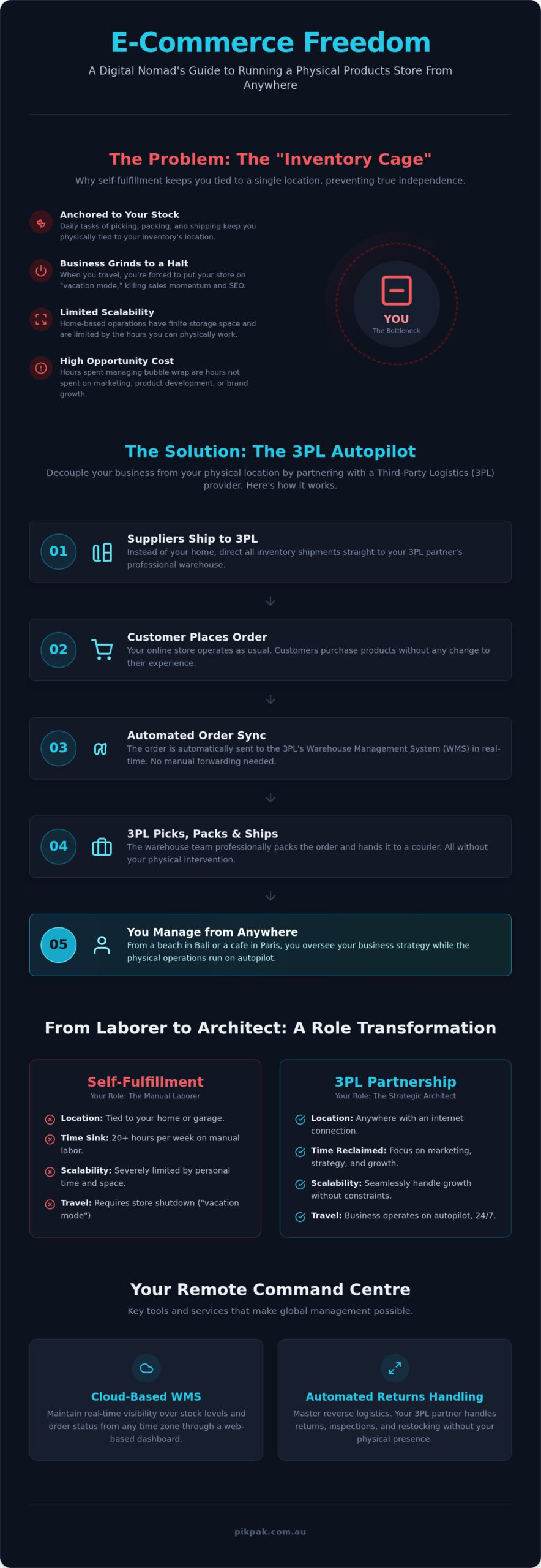
Many Australian eCommerce founders start their journey in a spare bedroom or garage. While this setup saves on initial overheads, it eventually creates what we call the “Inventory Cage.” You might dream of working from a villa in Tuscany, but the reality of daily orders keeps you anchored to your local post office. Self-fulfillment is often the single greatest obstacle to true location independence. If you are the person picking the stock and taping the boxes, your business cannot grow beyond your physical reach. Learning how to run an online store while travelling requires you to stop being the manual labourer and start being the strategic architect of your brand.
The hidden costs of “doing it all yourself” are significant. Beyond the hours spent packing, there is the opportunity cost of lost growth. When you spend your morning managing bubble wrap, you aren’t spending it on marketing or product development. Traditional digital nomad advice usually focuses on service-based roles like coding or writing, where the only tool needed is a laptop. Physical product entrepreneurs face a different reality. You cannot simply “upload” a physical item to the cloud. To find freedom, you must transition from a hands-on operator to a strategic owner who delegates the heavy lifting to professional third-party logistics services.
The Limitations of Home-Based Fulfillment
Home-based operations eventually hit a ceiling. Storage space is finite, and your ability to scale is limited by how many hours you can stay awake to pack orders. This creates a burnout cycle that leaves no room for travel. More importantly, your business effectively grinds to a halt the moment you step onto a plane. If you don’t have a system in place to handle orders while you are in the air, you are forced to put your store on “vacation mode,” which kills your momentum and SEO rankings. Reliability is the currency of eCommerce, and a business that stops when the owner travels isn’t a scalable asset.
Why Physical eCommerce Needs a Different Nomad Strategy
A digital nomad with a physical store needs a domestic anchor. While you might be mobile, your inventory shouldn’t be. Success depends on having a secure, professional warehouse in Australia that manages your warehousing and fulfilment while you manage the brand. This setup provides the stability your customers expect while granting you the mobility you desire. By establishing this remote command centre, you ensure that shipping times remain consistent and professional, regardless of which time zone you happen to be in. It is about creating a system where your physical presence is the only thing that’s optional.
Scaling Your Freedom: How 3PL Services Automate Your Physical Operations
Most “nomad” advice assumes you sell digital products like courses or software. If you sell physical goods, you need a different approach to maintain your freedom. A 3PL provider acts as your remote warehouse, staff, and shipping department. It’s the operational backbone for location-independent brands. By using third-party logistics services, you essentially outsource the entire physical side of your business to experts who specialize in efficiency.
The “Pick, Pack, and Ship” process happens entirely without your intervention. When an order comes in from your website, the warehouse team receives the notification automatically. They select the correct item, pack it securely, and hand it to the courier for delivery. You can be on a different continent while your customers receive their orders on time and in perfect condition. This level of automation allows you to reclaim 20 or more hours every week that were previously lost to manual labour and post office runs.
The 3PL Workflow for Travellers
For a traveller, the workflow begins with your suppliers. Instead of receiving stock at your home or a local storage unit, you direct shipments straight to the 3PL facility. Our team handles the warehousing and fulfilment, ensuring every item is logged, inspected, and stored securely. Real-time order synchronization means your store talks directly to the packing bench. You don’t need to send manual emails or forward orders; the system handles the data flow while you focus on high-level brand strategy.
Cost vs. Opportunity: Is 3PL Worth It?
Many founders hesitate at the thought of external fees, but the financial logic is clear. You trade fixed costs, like warehouse rent, utilities, and staff wages, for variable 3PL fees that scale with your actual sales volume. If you sell less one month, your expenses drop automatically. If you scale up, the infrastructure is already there to support you without needing to find a bigger garage or hire more people. This flexibility is vital when you’re managing a business from abroad.
Consider the value of your own time. If you spend 80 hours a month packing boxes, what is the cost to your business growth? Outsourcing allows you to reinvest that energy into marketing, SEO, and product design. It’s a pragmatic shift that turns a manual job into a scalable, hands-off asset. If you’re ready to see how this fits your model, you can explore our service options to find the right fit for your brand.
Building a Remote Command Centre: Tech and Integrations for Global Management
While your inventory stays in Australia, your control remains global. The Cloud-Based Warehouse Management System (WMS) is the engine that makes this possible. It provides real-time visibility into your inventory levels from anywhere with an internet connection. You can check stock on a beach in Bali and see exactly how many units are ready for sale; it eliminates the guesswork of remote management. This transparency is what allows you to sleep soundly, knowing your physical assets are secure and accounted for.
Automation is the secret to how to run an online store while travelling in 2026. By connecting your eCommerce platform like Shopify, WooCommerce, or eBay directly to your 3PL via API integrations, orders flow seamlessly from the customer to the warehouse. There’s no need for manual data entry or late-night spreadsheets. The system handles the heavy lifting of data transfer, ensuring that the warehouse team has exactly what they need to fulfill orders the moment they are placed.
Even complex tasks like kitting and assembly can be managed from afar. You simply provide digital instructions through the WMS, and the warehouse team handles the physical bundling of your products. This keeps your brand dynamic and allows you to launch new bundles or promotional sets without ever touching a single piece of tape. It’s a professional approach that treats your logistics provider as an extension of your own team.
Essential Software for the Travelling Store Owner
Your tech stack should be lean and integrated. A reliable eCommerce platform is just the start. You need a system that offers deep technology support and integration to bridge the gap between your digital storefront and the physical warehouse. This ensures that stock levels update automatically across all your sales channels; it prevents the dreaded “out of stock” notification for a customer who has already paid. Real-time data is your best defence against operational friction.
Managing Time Zones and Communication
Time zones become irrelevant when your systems are automated. You can master how to run an online store while travelling by setting up automated customer notifications. This ensures tracking numbers are sent the moment a label is printed in Australia. Use the WMS dashboard as your single source of truth; it’s more reliable than a dozen email threads. When you do need to speak with someone, ensure your 3PL partner provides dedicated, multi-channel support. This gives you peace of mind that a human expert is available to solve problems while you’re asleep or in transit.
Managing the “Un-Automated”: Handling Returns and Customer Support from Abroad
Returns are often the final hurdle for entrepreneurs learning how to run an online store while travelling. It’s one thing to ship a product out; it’s quite another to handle a faulty item or a change of mind from a customer when you’re in a different hemisphere. This is where reverse logistics becomes your best friend. Instead of returns piling up at your parents’ house or a vacant office, they go directly to your logistics partner. This shift removes the operational friction that usually keeps business owners tied to a single post code.
Professional 3PL providers don’t just receive boxes. They act as your quality control team. When a return arrives, the warehouse staff inspects the item according to your specific instructions. If it’s in perfect condition, they restock it immediately. If it’s damaged, they can provide photos and await your digital command to either discard it or set it aside. This process keeps your inventory moving and your customers happy without you ever needing to touch a parcel. You maintain the “personal touch” by handling the communication while your partner handles the physical goods.
Automating the Returns Process
Efficiency starts with a local return address. By using the 3PL warehouse as your official return hub, you provide customers with a professional, Australian-based destination. This builds trust and reduces shipping friction. You can even set up automated refund triggers. Once the warehouse scans the returned item into the WMS, your store can automatically process the refund or store credit. This level of returns management ensures that your brand remains reliable even when you’re thousands of miles away. It’s about building a system that values the customer’s time as much as your own.
Kitting and Special Requests Remotely
You don’t need to be in the warehouse to launch a new bundle or a seasonal promotion. Digital communication allows you to send assembly instructions directly through the WMS. If you want to combine three separate products into a “Summer Gift Pack,” you simply create the kitting request online. The team on the ground handles the physical assembly. This capability allows your brand to stay agile and responsive to market trends. To understand more about how these moving parts fit together, you can review our overview of professional logistics services. Managing these special projects remotely is a core part of how to run an online store while travelling successfully.
To keep everything running smoothly, you must create a clear Standard Operating Procedure (SOP). This document tells your 3PL exactly how to handle every scenario, from minor packaging scuffs to incorrect items. When your partner knows your expectations, they can make decisions on your behalf. This eliminates the need for middle-of-the-night phone calls and allows you to focus on your travel itinerary. If you’re ready to offload the stress of reverse logistics, contact us to discuss your returns strategy today.
Transitioning to 3PL: How to Hand Over the Keys and Start Your Journey
Moving your business from a home-based operation to a professional warehouse is the final step toward location independence. It requires a mindset shift from doing the work to managing the system. Start by auditing your current workflow. Document every step you take to fulfill an order, from printing the label to dropping it at the post office. This audit reveals exactly what you’re delegating. Once you understand your own process, you can select a partner that aligns with your specific growth goals and tech stack. This is the foundation of how to run an online store while travelling successfully.
Before you book your flight, enter a “Pilot Phase.” Move a subset of your best-selling products to the warehouse first. This allows you to test the integration between your store and the WMS without risking your entire inventory. You’ll see how the team handles your products and how the data flows in real-time. Use this period to refine your SOPs and build trust with your remote warehouse manager. It’s much easier to troubleshoot a minor integration glitch while you’re still in the same time zone.
Choosing the Right Partner in Australia
Local expertise is non-negotiable for Australian brands. Your customers expect fast domestic shipping, and a partner who understands the local courier landscape is essential. Evaluate potential providers based on their technology and how easily they integrate with your existing platform. You need a partner that shares your service priorities, focusing on accuracy and speed. A tech-savvy 3PL makes the transition feel effortless, providing the control you need to lead your business from a laptop.
Preparing Your Stock for the Move
The physical move of your stock is a critical logistical task. To ensure a smooth transition, you must follow specific warehouse receiving guidelines. This includes clear labelling, organized packing lists, and correct SKU identification. When your stock arrives at the warehouse in good order, it can be shelved and made available for sale immediately. This prevents delays that could frustrate your customers during the handover period.
Once your inventory is moved and your systems are synced, you’re ready to go “laptop only.” Your new “office” fits in a backpack. Here is your final nomad checklist:
- A reliable laptop with a high-quality VPN for secure WMS access.
- Access to your 3PL’s dedicated support channels.
- A clear schedule for checking inventory levels and sales data.
With these elements in place, you’ve mastered how to run an online store while travelling. You’ve reclaimed your time, removed your operational hurdles, and created a business that thrives wherever you happen to be—giving you the freedom to explore Panga Fishing Packages or other world-class adventures.
Launch Your Global Journey with Confidence
Building a thriving eCommerce brand doesn’t have to mean staying anchored to a warehouse. By decoupling your inventory from your location, you transform your business from a manual operation into a scalable, high-growth asset. You now have the roadmap for how to run an online store while travelling by leveraging automation and professional logistics. Delegating the physical tasks of picking, packing, and managing returns allows you to reclaim your time and focus on your core objectives.
Success from the road depends on having a reliable partner on the ground. We provide real-time WMS visibility from any device and seamless integration with Shopify and WooCommerce to keep your data flowing. Our expert Australian-based logistics support ensures your customers receive professional service, no matter which time zone you’re in. Ready to go location-independent? See how Pik Pak Logistics can manage your fulfillment while you travel.
Your business is ready to grow beyond the confines of a single office. Take the leap, trust your systems, and start exploring the world today.
Frequently Asked Questions
How do I handle shipping labels if I am in a different country?
You don’t need to generate or print labels yourself when using a professional 3PL provider. The system automates this process by pulling order data directly from your online storefront and printing labels at the packing bench in Australia. This eliminates the need for you to manage local couriers or print labels from abroad. Your only task is to monitor the dashboard to ensure the flow remains consistent while you enjoy your travels.
What happens if my 3PL warehouse runs out of stock while I am travelling?
Your cloud-based WMS provides real-time visibility to help you prevent stockouts before they occur. If levels run low, you simply coordinate with your supplier to ship new inventory directly to the 3PL warehouse facility. The warehouse team receives and logs the stock into the system, making it available for sale immediately. This remote management cycle ensures your store stays active without requiring your physical presence to count or move boxes.
Is it more expensive to use a 3PL than to ship orders myself?
While 3PL services involve handling and storage fees, they often prove more cost-effective than self-fulfillment when you factor in your time and overheads. You trade fixed costs like rent and utilities for variable fees that only apply when you actually sell a product. This flexibility is essential for anyone learning how to run an online store while travelling, as it allows your expenses to scale naturally with your business volume.
Can I still offer personalized packaging if I use a 3PL?
You can maintain your brand’s unique feel by using our kitting and assembly services. You simply provide your custom packaging materials to the warehouse, and the team will use them according to your specific digital instructions. Whether it’s a specific box, a branded sticker, or a thank-you note, these special projects are managed through the WMS. This allows you to offer a premium unboxing experience without ever touching the physical stock yourself.
How do I manage returns if I don’t have a physical office?
Managing returns is straightforward when you use a 3PL as your official return hub. Customers send items directly to the warehouse, where the team performs inspections based on your specific requirements. They can restock items in good condition or provide photos of damaged goods for your review. This professional approach to reverse logistics removes the need for a physical office and ensures your customers receive prompt, reliable service regardless of your location.
Which eCommerce platforms integrate best with 3PL services?
Most major eCommerce platforms, including Shopify, WooCommerce, and eBay, integrate seamlessly with modern 3PL systems via API connectors. These integrations automate the transfer of order data and inventory levels between your store and the warehouse. This connectivity is a vital component of how to run an online store while travelling, as it creates a single source of truth for your business operations. Our technology support ensures these links remain secure and efficient.
Do I need to visit the warehouse before I start travelling?
A physical visit is not required to start your journey. Because our WMS platform is entirely cloud-based, you can manage every aspect of your inventory, shipping, and returns from any device with an internet connection. We handle the physical infrastructure in Australia while you maintain full strategic control through your digital dashboard. This remote-first approach is designed to give you total freedom without sacrificing operational oversight or security.
How do I track my inventory levels in real-time?
You track your inventory through a dedicated WMS platform access point. This software provides a live view of every SKU in the warehouse, showing you exactly what is on the shelf, what is currently being packed, and what is in transit. Real-time data synchronization ensures that your online store reflects these levels accurately. This transparency allows you to make informed decisions about reordering and promotions from anywhere in the world.