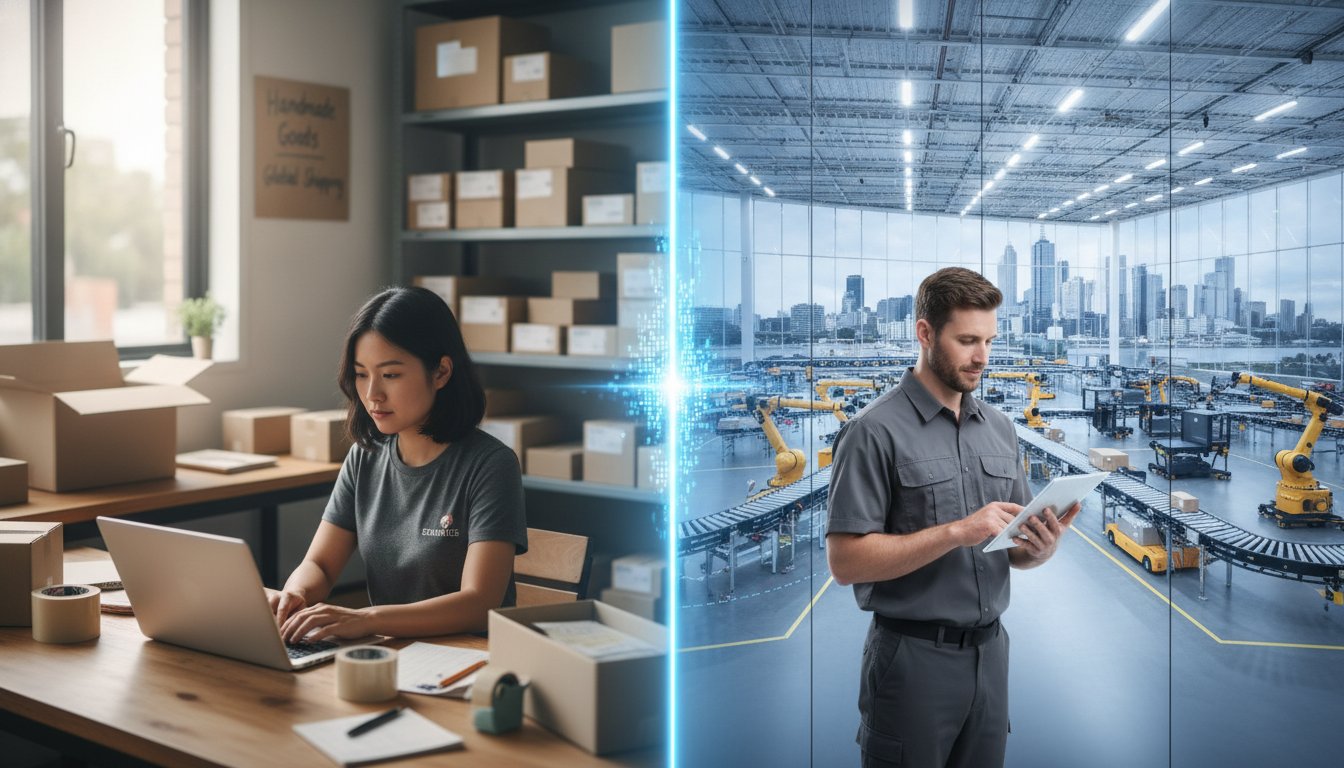
Hiring a dedicated logistics manager to streamline your warehouse might feel like the ultimate milestone for a growing brand, but it could be the very thing that anchors your growth. You’re likely feeling the weight of daily order fulfillment and the stress of inconsistent shipping times during peak seasons. It’s exhausting to manage a revolving door of casual staff while staring down the high overhead of a warehouse lease. You want your time back, and you want your operations to feel effortless.
We understand that the choice between hiring a logistics manager vs outsourcing to a 3pl is about more than just a paycheck. It’s about deciding whether you want to manage processes or own the infrastructure that executes them. In 2026, with the average logistics manager salary reaching $78,699, the financial stakes are higher than ever. This guide compares the total costs, operational control, and scalability of building an in-house team versus partnering with an Australian 3PL provider. We’ll show you how to weigh fixed salaries against variable fulfillment costs so you can make a pragmatic decision that protects your margins and your sanity.
Key Takeaways
- Understand the fundamental operational differences between managing an internal team and leveraging a partner’s ready-to-use infrastructure.
- Calculate the true cost of hiring a logistics manager vs outsourcing to a 3pl, factoring in Australian expenses like superannuation, payroll tax, and warehouse leases.
- Discover how instant WMS integration and automated kitting services eliminate the friction of manual order processing and seasonal hiring.
- Identify the specific “tipping point” in monthly order volume where outsourcing becomes more cost-effective than managing a private warehouse.
- Learn how delegating logistics management allows you to reclaim your schedule and focus entirely on scaling your eCommerce brand.
Logistics Manager vs. 3PL: Defining the Two Models
When your eCommerce brand moves past the “garage stage,” you hit a fork in the road. You can either build an internal logistics department from scratch or partner with an established expert. The choice between hiring a logistics manager vs outsourcing to a 3pl often dictates how fast you can scale over the next 24 months. One path involves managing people and property. The other involves managing a partnership. It’s a fundamental shift from owning infrastructure to accessing a service.
A logistics manager is a full-time internal hire. They become the architect of your supply chain, responsible for everything from signing warehouse leases to managing floor staff. In contrast, third-party logistics (3PL) providers offer an end-to-end service model. They provide the physical space, the labour, and the technology as a scalable utility. You aren’t buying a person’s time; you’re buying a result. This distinction is vital for founders who want to focus on marketing and product development rather than warehouse floor layouts.
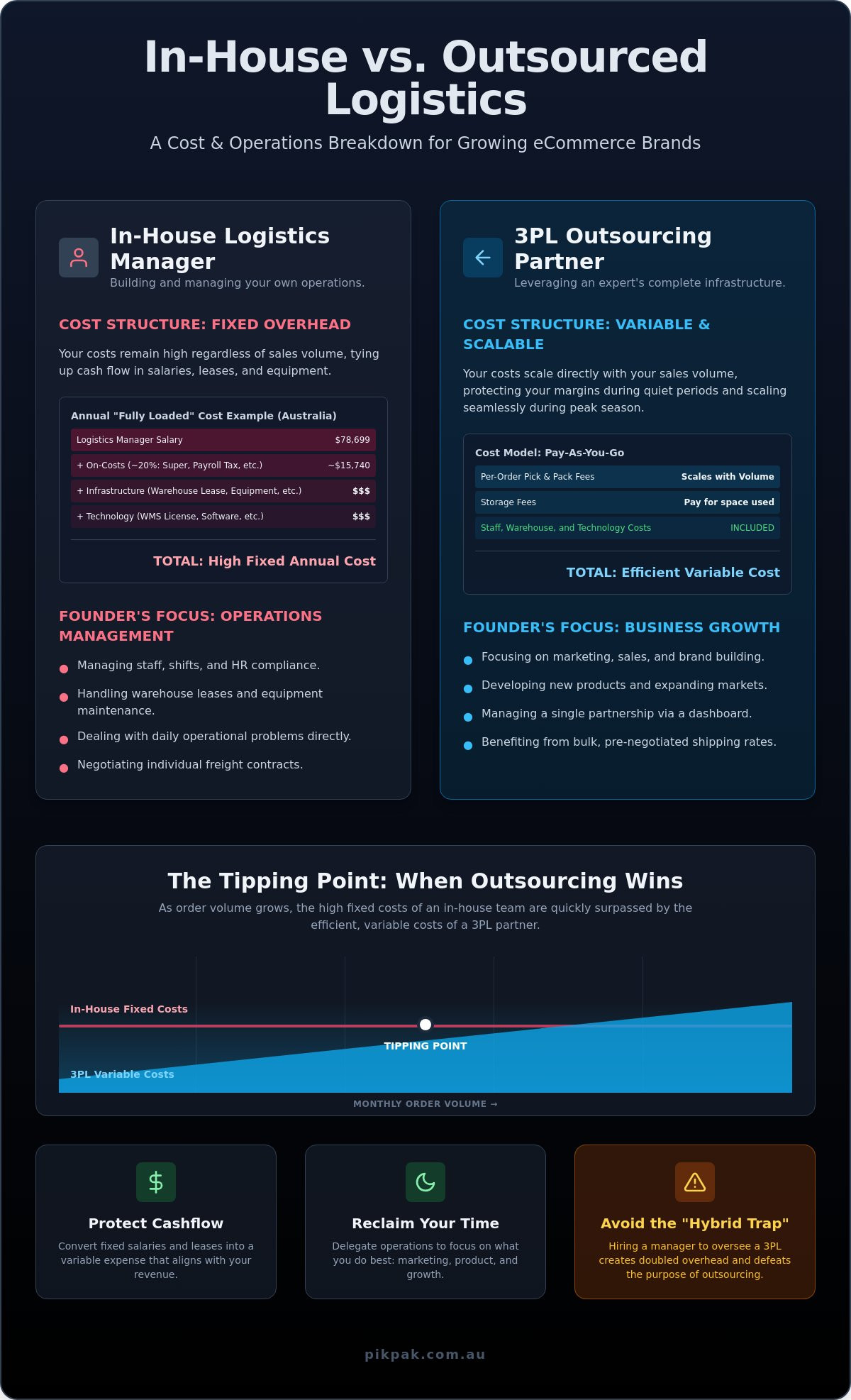
Some founders try a “hybrid” approach. They hire an internal manager to oversee a 3PL partner. This often backfires. It creates doubled overhead and fragmented data. You end up paying for a high-level salary to manage a partner that is already designed to be self-sufficient. It’s cleaner to choose a model and commit to it fully. Trying to do both usually leads to “too many cooks” in the supply chain, which slows down your dispatch times and complicates your inventory reporting.
The core difference sits in the financial structure. In-house logistics is a fixed overhead. You pay for the warehouse space and the manager’s salary whether you ship one order or ten thousand. A 3PL operates on a variable cost model. Your expenses shrink and grow with your sales volume. This protects your cash flow during quiet months and ensures you aren’t paying for empty shelf space or idle staff. This logic of choosing flexible, on-demand services over fixed assets is a staple of modern business, whether you are outsourcing your fulfillment in Australia or securing reliable transport through SPS Car Hire when coordinating business travel in the Pattaya region.
The Role of an In-House Logistics Manager
An internal manager handles the granular details of your physical operation. They spend their day scheduling shifts, managing WorkCover requirements, and ensuring the warehouse floor meets safety standards. They also act as your primary negotiator with freight companies. While this gives you direct oversight of every staff member, it also means you’re responsible for every operational hiccup. If a forklift breaks or a picker calls in sick, the problem lands directly on your desk.
When hiring for these positions, you may encounter highly skilled candidates who have the practical knowledge but lack formal certification. In these cases, encouraging them to explore RPL Process can help bridge the gap between their hands-on expertise and Australian qualification standards.
The Role of a 3PL Partner like Pik Pak
A 3PL partner removes the operational friction entirely. Instead of managing people, you manage a dashboard. We provide instant access to professional technology that syncs with your store in minutes. This includes a pick and pack warehouse process that is fully automated through API integrations. You benefit from bulk shipping rates and a team that scales up for peak seasons without you ever needing to post a job ad. It’s about turning a complex department into a simple line item on your balance sheet.
The True Cost of Hiring: Salary vs. Service Fees
Deciding between hiring a logistics manager vs outsourcing to a 3pl isn’t just about comparing a base salary to a service invoice. It’s about looking at the “fully loaded” cost of an employee in the Australian market. When you hire internally, the sticker price of the salary is only the beginning. You’re also committing to mandatory 11.5% Superannuation, WorkCover premiums, and payroll tax. These “hidden” costs can easily add 20% or more to your annual employment budget before a single parcel has even left the building.
Beyond the headcount, you have to consider the physical infrastructure. Renting warehouse space in major hubs like Melbourne or Sydney is a significant commitment. You aren’t just paying for the floor space; you’re paying for racking, forklifts, security systems, and insurance. These are capital expenditures that tie up your cash flow. If your sales dip in February, those warehouse costs remain exactly the same. You’re paying for empty shelves and idle equipment. A 3PL removes this risk by providing a variable cost model where you only pay for the space and labor you actually use.
Technology adds another layer of overhead. A professional Warehouse Management System (WMS) and integrated shipping software are essential for accuracy, but they come with hefty annual licensing fees and setup costs. When you partner with a provider, these tools are included as part of the service. You gain the benefits of high-end automation without the upfront software investment. If you want to see how this structure fits your current growth, you can explore our range of fulfillment services to see the difference between fixed and variable models.
The In-House Expense Checklist
- Base Salary: Expect to pay between $85,000 and $120,000 AUD for an experienced Logistics Manager.
- Statutory Costs: Factor in Superannuation, leave entitlements, and payroll tax.
- Facility Costs: Monthly rent, utilities, and the ongoing maintenance of warehouse equipment.
- Operational Friction: The cost of training new staff, managing churn, and the inevitable human errors that happen in manual systems.
The 3PL Variable Cost Model
Working with a 3PL shifts your logistics from a fixed liability to a scalable asset. You move to a pay-per-order system that aligns your expenses directly with your revenue. This protects your margins during quiet periods and ensures you have infinite capacity during peak seasons like Black Friday. By using Pik Pak’s transparent pricing, you can forecast your exact fulfillment costs per unit, making your financial planning simple and predictable. You stop worrying about warehouse leases and start focusing on your next product launch.
Scalability and Technology: The 3PL Competitive Edge
Technology is the invisible engine of modern eCommerce. While a logistics manager can oversee a warehouse floor, they often lack the technical expertise to build and maintain the complex digital infrastructure required to stay competitive. When you weigh up hiring a logistics manager vs outsourcing to a 3pl, you’re really choosing between building your own software stack from scratch or plugging into one that already works. API access acts as a digital bridge that automates the flow of order information between your store and the warehouse to eliminate manual data entry.
The true test of any system is the peak season challenge. During events like Black Friday or Christmas, your order volume might jump 10x overnight. An in-house manager has to scramble to find temporary staff, rent extra equipment, and manually troubleshoot shipping delays. A 3PL partner handles this surge effortlessly. Because the infrastructure is already built for high-volume throughput, your scaling happens behind the scenes. You don’t need to interview casual pickers or worry about warehouse capacity; you just keep selling.
Real-time visibility is the difference between proactive growth and constant firefighting. Relying on a manual spreadsheet managed by an internal hire creates a lag in your data. By the time you see a stockout, it’s already too late. Professional technology support provides a level of control that manual systems can’t match. You see every movement of your inventory as it happens, allowing you to manage your cash flow with total precision.
Why In-House Tech Often Fails Growing Brands
- The Integration Trap: Maintaining custom connections with multiple couriers is a full-time job that requires constant developer attention.
- Data Silos: When your sales platform and your warehouse don’t talk to each other, you risk overselling stock and disappointing customers.
- Legacy Costs: Upgrading your own Warehouse Management System (WMS) is a massive capital expense that internal hires rarely have the budget to execute properly.
Pik Pak’s Tech-First Approach
We focus on removing the technical friction that stops brands from scaling. Our platform offers seamless connectivity with major eCommerce stores, ensuring that orders flow directly to our pick and pack teams without delay. You’ll have access to real-time inventory tracking and clear warehouse receiving guidelines to ensure your stock is processed accurately from day one. This tech-first mindset turns your logistics from a bottleneck into a competitive advantage, giving you the reporting and analytics you need to drive smart business decisions.
The Tipping Point: When to Hire vs. When to Outsource
Every eCommerce brand reaches a stage where the current setup begins to crack under the pressure of growth. Determining the right path between hiring a logistics manager vs outsourcing to a 3pl depends on specific operational triggers rather than just a gut feeling. Industry data suggests the economic breakeven point for bringing logistics in-house typically sits between 100 and 200 orders per month. If you are processing fewer than 200 orders, the fixed costs of a manager’s salary and a warehouse lease will likely drain your margins. Above this threshold, the decision becomes a choice between reinvesting in your own infrastructure or leveraging a partner’s existing scale.
Complexity is the next major factor. If your products require specialized kitting and assembly or specific multi-item packaging, managing this in-house requires constant supervision. A 3PL partner uses automated workflows to handle these tasks with precision, ensuring that even the most complex orders are dispatched without errors. Geography also plays a role. If you’re based in Perth but 70% of your customers are in Sydney or Melbourne, a single in-house warehouse will struggle to provide the fast, affordable shipping your customers expect. Outsourcing allows you to position your inventory closer to your primary market without the risk of a long-term commercial lease.
Finally, consider your strategic focus. Every hour you spend managing warehouse staff or negotiating carrier contracts is an hour taken away from product development and marketing. If you find yourself spending more than 20% of your day on operational “firefighting,” you’ve reached the tipping point. It’s time to delegate the operational burden so you can focus on the high-level tasks that actually drive revenue.
Signs It’s Time to Hire a Manager
- Your products are highly specialized or custom-manufactured on-site, requiring immediate assembly by a technical team.
- You’ve already signed a long-term warehouse lease and have significant capital tied up in racking and forklifts.
- Logistics is your primary competitive advantage, such as offering hyper-local delivery within an hour that requires total internal control.
Signs It’s Time to Outsource to a 3PL
- Inconsistent shipping times and dispatch errors are starting to damage your brand reputation and customer reviews.
- Operational tasks are preventing you from focusing on growth, marketing, and new product launches.
- You want to scale nationally or internationally but don’t want the risk of opening and staffing multiple physical locations.
If your brand is ready to move past the stress of daily fulfillment, explore how our logistics solutions can help you reclaim your time and scale effortlessly.
Making the Switch: Transitioning to Pik Pak Logistics
The final hurdle in the debate over hiring a logistics manager vs outsourcing to a 3pl is often the fear of losing visibility. You’ve built your brand from the ground up, so handing over the keys to your inventory feels like a massive risk. We understand this anxiety. That’s why our approach focuses on total transparency. With real-time customer delivery tracking and WMS access, you actually gain more oversight than you’d have with a manual in-house system. You aren’t losing control; you’re gaining a professional infrastructure that works while you sleep.
Transitioning to our warehouse is designed to be a streamlined process rather than a disruptive event. Our onboarding team integrates your existing store setup with our platform in a matter of days, not months. We handle the technical heavy lifting, ensuring your SKU data and order flows are synced perfectly before the first pallet arrives. The best 3PL partners act as an extension of your brand, not just a third-party vendor. Once the connection is live, your logistics becomes a “set and forget” function, allowing you to reclaim your schedule and refocus on your primary business objectives.
Effortless eCommerce Fulfilment
Managing the “after-purchase” experience is just as important as the sale itself. We provide comprehensive returns management and reverse logistics to ensure that even a returned item becomes a positive touchpoint for your customers. By leveraging our established network of Melbourne transport companies, we secure faster transit times and more reliable home delivery options than most individual brands can negotiate on their own. You get the benefit of a dedicated account manager who understands your specific growth goals and provides personalized support whenever you need it.
Next Steps for Your Business
Before you make a final decision, we recommend performing a deep audit of your current operational costs. Don’t just look at the shipping labels; factor in the “true” price of management time, warehouse insurance, and the cost of human error in manual picking. This data usually makes the path forward very clear. If you’re ready to see how our technology can transform your operations, you can book a consultation to see our WMS in action. It’s the most pragmatic way to verify how our systems will handle your specific product requirements.
Ready to scale without the overhead? Request a quote from Pik Pak Logistics today and see how effortless your growth can be.
Future-Proof Your eCommerce Operations
The choice between hiring a logistics manager vs outsourcing to a 3pl is a strategic pivot that defines how fast your brand can grow. Managing an internal team requires you to shoulder the burden of warehouse leases, staff churn, and rising employment costs. In contrast, a 3PL partner turns these liabilities into a scalable service. You’ve seen how the variable cost model protects your margins, while professional automation eliminates the manual errors that stall your momentum.
By delegating your fulfillment, you gain instant access to a cloud-based WMS for 100% visibility and API integrations that sync with every major eCommerce platform. Our strategic Melbourne-based warehousing puts your inventory in the heart of the action, ensuring fast dispatch without the stress of managing a physical facility. It’s time to stop firefighting operational issues and start focusing on your next big product launch.
Scale your business with Pik Pak’s effortless 3PL services and experience the freedom of a truly automated supply chain. Your brand is ready for the next level; let us provide the foundation to get you there.
Frequently Asked Questions
Is it cheaper to hire a logistics manager or use a 3PL for a small business?
It is almost always more cost-effective for a small business to use a 3PL rather than hiring an internal manager. Small brands typically process fewer than 200 orders per month, which doesn’t justify the fixed cost of a professional salary and a warehouse lease. By outsourcing, you convert these massive fixed expenses into a variable cost model that only grows as your revenue increases.
Will I lose control over my brand’s packaging if I use a 3PL?
You retain full control over your brand’s presentation through detailed kitting and assembly instructions. Professional fulfillment partners follow your specific guidelines for custom packaging, tissue paper, or marketing inserts. You provide the materials, and the warehouse team ensures every parcel looks exactly as it would if you packed it yourself in your own office.
How much does it cost to outsource logistics in Australia?
The cost of outsourcing depends on your specific SKU count and monthly order volume, but it is structured to be predictable. You pay for the storage space you occupy and a fee for each order picked and packed. This variable structure is designed to be more efficient than paying for an underutilised warehouse and a full-time staff member during quiet sales months.
What is the difference between a warehouse manager and a logistics manager?
A warehouse manager focuses on the physical day-to-day operations of a facility, while a logistics manager oversees the broader strategy of the supply chain. Warehouse managers handle staff rosters and inventory placement on the floor. A logistics manager analyzes carrier performance, negotiates freight contracts, and manages the technology integrations that connect your sales channels to your fulfillment center.
Can a 3PL integrate with my Shopify or WooCommerce store?
Yes, modern 3PL providers use API integrations to connect directly with major platforms like Shopify, WooCommerce, and Magento. This connection is seamless and automates the entire order flow. When a customer completes a purchase on your site, the data is instantly transmitted to the warehouse for fulfillment, which eliminates manual data entry and reduces the risk of shipping errors.
What happens to my logistics during the Christmas peak season?
A 3PL scales its labor and warehouse capacity automatically to handle the massive surge in Christmas orders. You don’t have to worry about recruiting temporary staff or renting extra equipment to keep up with demand. The provider’s infrastructure is built to handle 10x spikes in volume, ensuring your customers receive their holiday gifts on time without any extra effort from you.
Do I still need a logistics manager if I outsource to a 3PL?
Most eCommerce brands find they no longer need a dedicated internal hire once they have outsourced their operations. When weighing the choice of hiring a logistics manager vs outsourcing to a 3pl, remember that the 3PL acts as your management team. You can oversee the entire operation through a digital dashboard, which allows your existing staff to focus on marketing and product development.
How do I transition from my own garage to a 3PL warehouse?
The transition begins with a digital integration of your store and a physical audit of your current stock. Once your online platform is synced with the warehouse management system, you arrange for your inventory to be delivered to the 3PL facility. They process the stock according to strict receiving guidelines, and your fulfillment becomes “set and forget” from the moment the first pallet is scanned in.