
What if the physical walls of your spare room are the only thing standing between your brand and its next major growth milestone? It’s a common story for Australian founders: you start by packing orders on the kitchen table, but eventually, the hustle becomes a hurdle. When you’re spending more time managing bubble wrap than marketing your products, it’s a sign that your current setup is holding you back. Transitioning to professional eCommerce warehousing Melbourne isn’t just about finding a place for boxes; it’s about reclaiming your time and ensuring your customers get their orders faster than ever.
We understand that handing over your inventory feels like a massive step. You want to know that your orders will sync perfectly and that costs won’t spiral out of control. This strategic guide for 2026 will show you how to move from manual storage to a tech-driven 3PL model that scales with you. We’ll explore how to reduce delivery times to Melbourne and interstate customers while using a pay-as-you-go system that keeps your overheads predictable. By the end of this article, you’ll have a clear roadmap to eliminate inventory inaccuracies and turn your logistics into an effortless engine for growth.
Key Takeaways
- Learn why 2026 consumer expectations for rapid delivery make local fulfillment a mandatory requirement for business growth.
- Capitalise on Melbourne’s role as Australia’s freight capital to improve your inbound stock speed and national distribution reach.
- Compare the hidden costs of managing a private lease against the flexible, pay-as-you-go model of eCommerce warehousing Melbourne.
- Identify the critical tech integrations and WMS features that ensure your inventory remains accurate and visible in real time.
- See how delegating complex logistics to a seasoned partner removes operational friction and allows you to focus on marketing.
The Evolution of eCommerce Warehousing in Melbourne for 2026
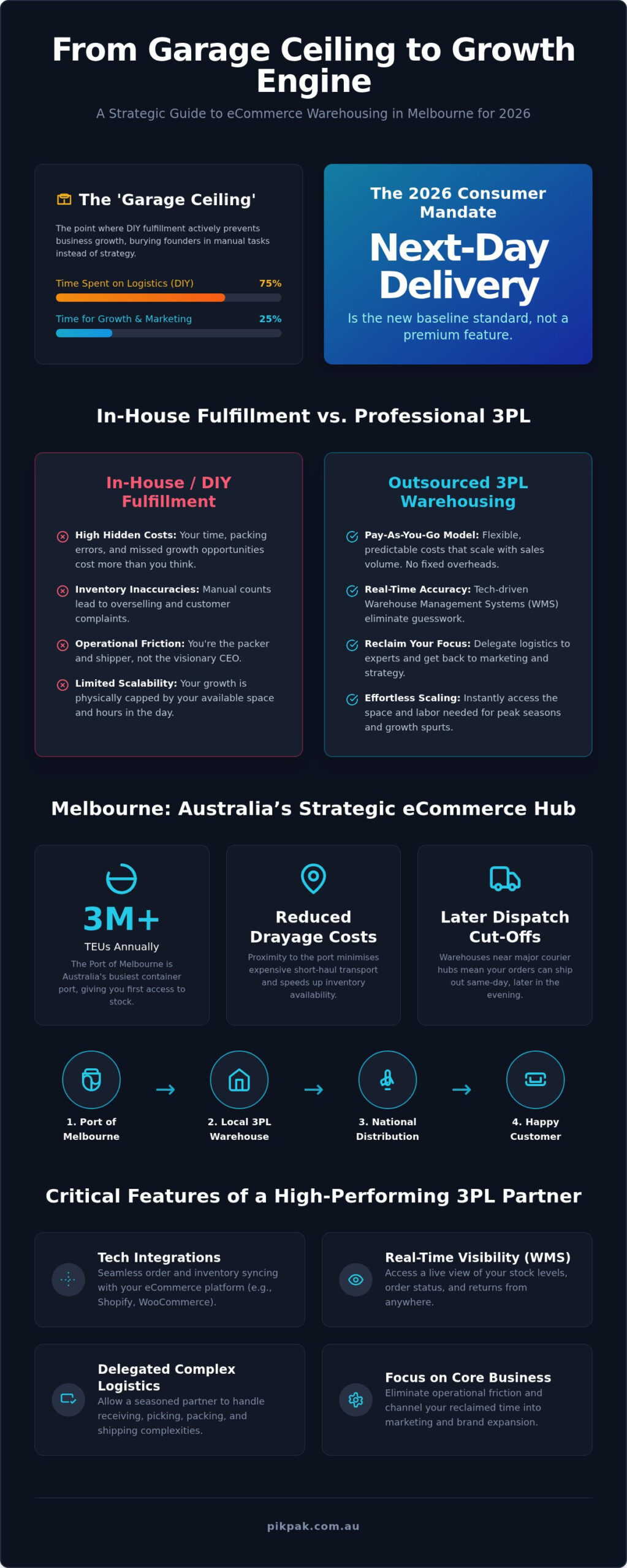
eCommerce warehousing Melbourne has moved far beyond the traditional concept of just storing boxes. In 2026, it serves as the strategic engine that powers online sales. This process involves the precise management of inventory, from the moment it arrives at the dock to the second it hits a customer’s doorstep. With consumer expectations now firmly set on ‘Next Day Delivery’ as the baseline standard, having a local footprint isn’t just an advantage; it’s mandatory for anyone wanting to compete in the Australian market. If you aren’t shipping from a central hub, you’re likely losing customers to someone who can deliver faster.
Most founders eventually hit what we call the ‘Garage Ceiling.’ This is the operational limit where DIY fulfillment actively prevents business growth. You reach a point where you’re so buried in bubble wrap and shipping labels that you’ve lost the time to focus on marketing or product development. To break through this barrier, modern brands are turning to Third-party logistics (3PL) as their primary fulfillment model. It provides the professional infrastructure needed to scale without the massive overhead and stress of managing your own facility.
From Storage to Strategy: What Has Changed?
The shift in Melbourne’s logistics sector has been dramatic. We’ve moved from dusty shelving to automated, data-driven inventory management. Real-time visibility is no longer a luxury; it’s a customer expectation. Shoppers want to know exactly when their order is picked, packed, and shipped. Melbourne’s world-class infrastructure supports these 24/7 eCommerce operations, allowing for faster transit times from the port to the final mile. Our city’s road networks and proximity to the Port of Melbourne mean stock moves from container to shelf with minimal delay, keeping your inventory levels accurate and ready for immediate dispatch.
Identifying Your Need for a Professional Warehouse
Signs that your current storage is failing you are often subtle at first. You might notice inventory inaccuracies causing customer complaints or a slow creep in shipping times that frustrates your buyers. These are clear indicators that your current setup is costing you sales. While storing goods in your own home or office might seem ‘free,’ the hidden costs are high. You’re paying in lost time, manual packing errors, and missed growth opportunities. Transitioning to professional warehousing and fulfilment allows you to adopt a true business owner mindset. You delegate the operational friction to experts, reclaiming your schedule to focus on high-level strategy and brand expansion.
Why Melbourne is Australia’s Strategic eCommerce Logistics Hub
Melbourne has earned its reputation as the freight and logistics capital of Australia for a very practical reason. It’s home to the Port of Melbourne, the busiest container port in the country, handling approximately 3 million TEUs annually. For business owners, this isn’t just a statistic; it’s a massive operational advantage. When you choose eCommerce warehousing Melbourne, you’re positioning your inventory at the primary point of entry for international trade. This proximity allows you to bypass the long transit times and high costs associated with moving stock between states before it even reaches a shelf.
The city’s industrial layout is specifically designed to support high-speed trade. Major industrial precincts, particularly in the western suburbs, are built around massive courier hubs and sorting facilities. This concentration of transport infrastructure means that when an order is picked and packed, it doesn’t have far to travel to reach the next stage of the delivery network. These shorter “middle mile” distances allow for later dispatch cut-off times, giving your customers more hours in the day to place orders that still ship out the same evening.
Proximity to the Port of Melbourne
Distance from the port equals delay and expense. By utilising Warehousing and Fulfilment solutions close to the docks, you significantly reduce drayage costs. Drayage is the short-distance transport of goods from the port to the warehouse. Minimising this leg of the journey ensures a faster turnaround from the moment your container arrives to the moment your inventory is ‘live’ and available for sale on your website. This efficiency is a core focus of Victoria’s Freight Plan, which ensures the state’s infrastructure continues to support rapid movement for online retailers.
The ‘Golden Triangle’ of Australian Delivery
Melbourne sits at the strategic base of what logistics experts call the ‘Golden Triangle.’ This geographic position provides the most efficient shipping lanes to Sydney, Adelaide, and Perth. From a Melbourne-based warehouse, you can comfortably achieve 1-2 day delivery to roughly 80% of the Australian population. Leveraging Melbourne’s sophisticated road networks for interstate linehaul makes the city the ideal hub for managing both local and national customer delivery. It’s a pragmatic choice that simplifies your supply chain, allowing you to reach the majority of your customer base from a single, central location. If you want to see how this geographic edge can work for your brand, exploring a professional logistics partnership is the next logical step.
Comparing In-House vs. Outsourced Warehousing Costs
Deciding between managing your own facility or outsourcing is a pivotal moment for any growing brand. Many founders initially view a private lease as a milestone of success, but the financial reality is often more complex than expected. While running your own eCommerce warehousing Melbourne setup gives you total physical proximity to your stock, it also locks you into a rigid cost structure. You’re paying for every square metre of that warehouse 24 hours a day, regardless of whether it’s full of inventory or half-empty during a seasonal dip.
The 3PL model replaces these heavy fixed costs with a variable, pay-as-you-go system. Instead of committing to massive capital expenditure (CapEx) on forklifts, racking, and security systems, you transition to an operational expenditure (OpEx) model. This shift means you only pay for the specific pallet spaces you occupy and the exact number of orders we pack. It’s a pragmatic approach that ensures your logistics costs stay perfectly aligned with your actual sales revenue.
The True Cost of a Commercial Lease in Melbourne
Securing a private warehouse in Melbourne typically requires a 3-5 year lease commitment. This is a significant liability for a brand that might double in size within twelve months or face a temporary market slowdown. According to a recent Melbourne logistics market report, industrial vacancy rates remain low, which has driven up outgoings and rental costs across the city. When you factor in insurance, utilities, and the cost of installing industrial-grade racking, the “simple” lease becomes a major financial burden. A professional 3PL provides ‘elastic’ storage space, allowing you to expand your footprint instantly during peak seasons and shrink it back down when stock levels drop, without the risk of outgrowing a fixed space too quickly.
Labour Management and Operational Friction
The most exhausting part of in-house fulfillment isn’t the packing; it’s the people management. Scaling from 100 orders a month to 10,000 requires a reliable team, but hiring casual staff for peak periods like Black Friday is notoriously difficult and time-consuming. When you manage your own team, you’re responsible for WorkCover, payroll tax, HR compliance, and training. This operational friction pulls you away from high-level strategy. By delegating these tasks to your logistics service partner, you remove the burden of staffing entirely. We handle the labour, the equipment, and the safety protocols, allowing you to focus on the marketing and product development that actually drives your business forward.
Key Features of a High-Performing Melbourne 3PL Warehouse
Beyond standard storage, modern brands require value-added services that move the needle on customer experience. Look for facilities that offer specialized kitting and assembly. This allows you to bundle products for promotions or add custom branding to your packaging, creating a premium unboxing experience that builds customer loyalty. These tasks are framed as simple, manageable requests when you have the right partner, allowing you to delegate the complex backend work and focus entirely on your brand’s growth. Professional eCommerce warehousing Melbourne should feel like an extension of your own team, providing the precision and flexibility you need to scale.
Technology Support and Integration
Automating your e-storefront means your orders move from the “buy” button to the pick slip in seconds. This speed is vital in 2026, where every minute saved in the warehouse is a minute gained in delivery time. Data analytics within the WMS also help you predict when to replenish stock, ensuring you never miss a sale due to an empty shelf. This “plug-and-play” technology removes the technical hurdles that often stall growing businesses, making professional logistics accessible even for non-technical founders.
Pick, Pack, and Ship Precision
Efficiency in the warehouse is a science. High-performing facilities use optimized picking routes to minimize the time spent moving between aisles, which directly reduces your handling fees. We focus on standardizing packaging to ensure you aren’t paying to ship unnecessary weight or “air,” keeping your shipping volumes and costs as low as possible. Managing returns and reverse logistics through a centralized hub ensures that returned items are inspected and returned to “live” stock quickly. This protects your bottom line and keeps your inventory moving. To see how these systems can simplify your daily operations, you can explore our tech-driven logistics solutions today.
Scaling Your Online Store with Pik Pak’s Melbourne Facilities
Pik Pak Logistics understands that scaling a brand is as much about mindset as it is about inventory. We position ourselves as the local Melbourne expert for brands that have outgrown their initial setup and need a partner who speaks the language of efficiency. Our approach to eCommerce warehousing Melbourne is built on a foundation of pragmatism. We don’t believe in flashy promises; we believe in delivering tangible results through a system that feels entirely effortless for you. We adopt the role of a calm expert in a field that often feels chaotic, using precision to eliminate the inefficiencies that stall growth.
By delegating your operational burdens to us, you reclaim the most valuable asset in your business: your time. Instead of spending your Mondays troubleshooting shipping delays or reconciling stock levels, you can return to your core objectives. You can focus on marketing, product innovation, and high-level strategy while we handle the heavy lifting. This isn’t just about outsourcing a task; it’s about creating an enabling force that removes major operational hurdles and gives you total control over your brand’s future.
The Pik Pak Advantage: Local Expertise, Global Standards
Our commitment to your success starts with transparency. We provide a clear, pay-as-you-go model that removes the stress of long-term lease liabilities. Our Melbourne facility serves as your brand’s operational backbone, offering the security and precision required to compete in the 2026 market. We don’t just store your products; we manage them with the same care you would. If you’re still curious about the logistics of professional storage, exploring our warehousing questions page provides deeper insights into the standards we maintain for every client.
Getting Started: Your Path to Effortless Fulfilment
Transitioning to our facility is a structured, logical process designed to build confidence at every step. We’ve refined our onboarding to ensure your store remains operational throughout the move. It’s a simple path from integration to your first order shipped.
- Step 1: Consultation and Tech Audit. We begin by auditing your current e-storefront and technical requirements to ensure a seamless API connection.
- Step 2: Inventory Receiving. Send your stock to our Melbourne facility. We follow strict warehouse receiving guidelines to ensure every item is accounted for and ready for sale.
- Step 3: Go-Live and Real-Time Monitoring. Once integrated, your orders begin flowing automatically. You can monitor every movement via our WMS platform, giving you total visibility without the manual labour.
Ready to eliminate the friction in your supply chain and focus on your next big milestone? You can request a Melbourne 3PL quote from Pik Pak to see how our seasoned team can accelerate your business growth today.
Take Control of Your Operational Future
The transition from manual fulfillment to professional eCommerce warehousing Melbourne is more than a logistical upgrade; it’s a strategic move that defines your brand’s growth in 2026. By leveraging Melbourne’s central location and the efficiency of a variable cost model, you eliminate the friction that holds many businesses back. You no longer have to worry about managing a private lease or hiring casual staff during peak periods. Instead, you gain a partner that provides the infrastructure you need to reach your customers faster and more reliably. We have explored how the right hub can slash your delivery times and why tech integration is now the baseline for modern success.
Your ability to scale depends on delegating operational burdens so you can focus on high-level strategy. With real-time WMS visibility and seamless eCommerce integrations, your logistics can finally run on autopilot. It’s time to stop being a packer and start being the business owner your brand deserves. You have the tools and the roadmap; the final step is choosing a partner that prioritizes your time as much as your inventory.
Scale your business with Melbourne’s leading eCommerce warehouse and reclaim the time you need to innovate and expand. Your next growth milestone is closer than you think.
Frequently Asked Questions
What is the difference between a warehouse and a 3PL in Melbourne?
A warehouse is simply a physical space for storage, while a 3PL provides a complete suite of managed services including receiving, picking, packing, and shipping. While you might manage your own warehouse, a 3PL handles the operational labour and technology for you. This allows you to delegate the physical workload and focus on growing your brand. It’s the difference between renting a room and hiring an entire logistics department.
How much does eCommerce warehousing cost in Melbourne?
Costs vary depending on the amount of space you use and the volume of orders you ship. Most professional providers use a variable cost model where you pay for storage per pallet or shelf and a fee for each item picked and packed. This pay-as-you-go approach is far more efficient than a fixed commercial lease. It ensures your logistics expenses stay aligned with your sales revenue without hidden overheads.
Do I need to have a certain number of orders to use a Melbourne 3PL?
Many modern 3PL providers don’t require high minimum order volumes, making them accessible for growing startups. Flexible models allow you to scale your usage as your business grows from ten orders to thousands. This eliminates the barrier to entry for smaller brands that need professional infrastructure but aren’t yet shipping at massive scale. It’s about providing a scalable foundation that supports your growth at every stage.
Can a Melbourne warehouse integrate with my Shopify or WooCommerce store?
Yes, professional eCommerce warehousing Melbourne services use cloud-based WMS platforms that integrate directly with Shopify, WooCommerce, and other major storefronts via API. This automation ensures that your online orders sync instantly with the warehouse floor for immediate picking. You don’t have to manually export data or send spreadsheets. It creates a seamless flow of information that reduces errors and speeds up the entire fulfillment process.
How does warehousing in Melbourne improve my delivery times?
Warehousing in Melbourne improves delivery times by placing your inventory closer to major transport hubs and the Port of Melbourne. This strategic location allows for faster last-mile delivery to the local metropolitan area and efficient interstate shipping lanes. Shorter transit times mean your customers receive their orders sooner. It helps you meet the 2026 consumer expectation for rapid fulfillment without the stress of managing your own distribution network.
What happens if a customer returns a product to the warehouse?
Returns are managed through a process called reverse logistics where the warehouse receives, inspects, and restocks returned items. Once a return is processed, the inventory levels are updated in real time on your WMS platform. This centralised approach makes returns simple for both you and your customers. It ensures that resalable stock is back on the shelf quickly, protecting your profit margins and maintaining customer trust.
Is my inventory insured while stored in a Melbourne warehouse?
Inventory is typically stored in a secure facility with surveillance, but you should always confirm the specific insurance coverage provided by your partner. While the warehouse takes responsibility for the security of the building, most business owners maintain their own marine or stock insurance for comprehensive protection. It’s a standard practice that provides peace of mind. Always ask for a clear breakdown of liability and insurance requirements during your initial consultation.
What are kitting and assembly services in eCommerce warehousing?
Kitting and assembly involve grouping separate items together to create a single new SKU, such as a gift bundle or a subscription box. This service allows you to offer unique product combinations without having to pre-pack them yourself. The warehouse team handles the physical assembly and custom packaging. It’s an excellent way to add value to your orders and create a premium unboxing experience that encourages repeat purchases.