
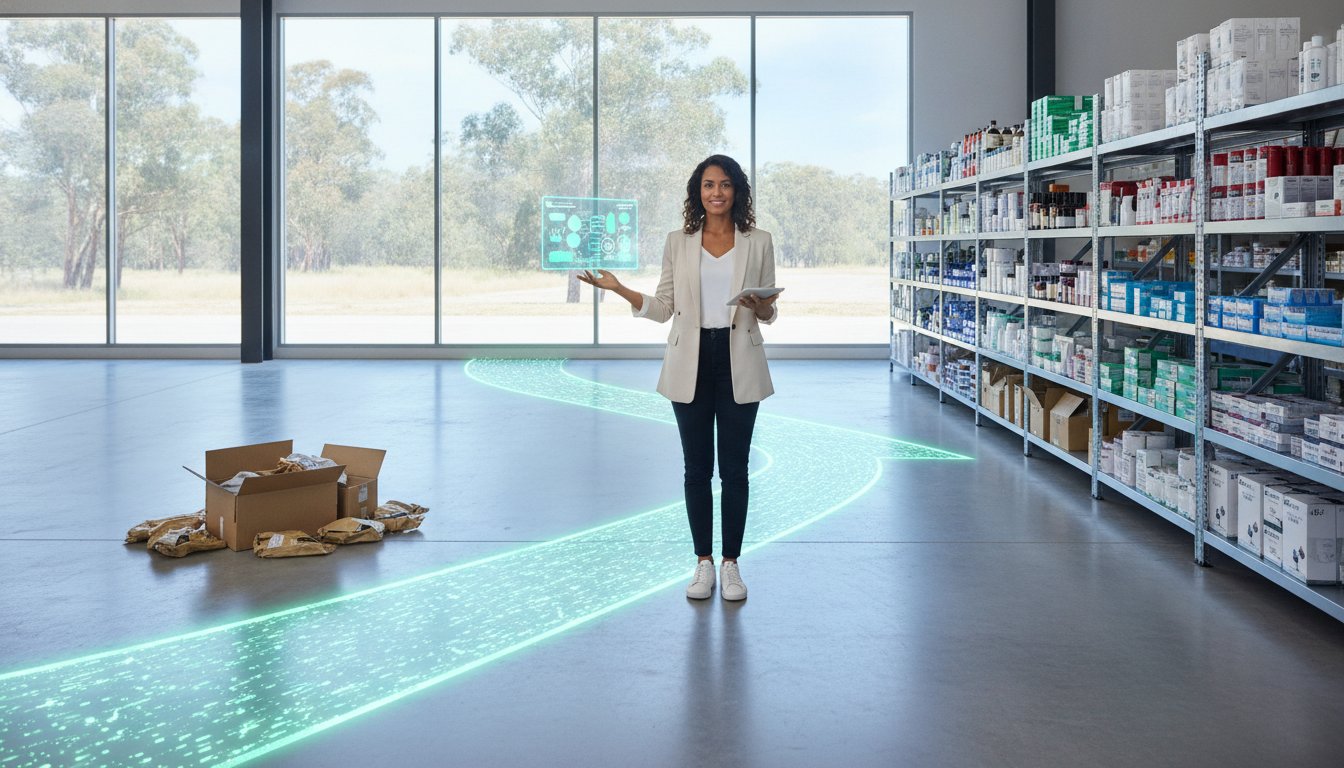
With return rates hitting as high as 30% in certain categories, your reverse logistics are likely costing you far more than just the price of a shipping label. For many local business owners, ecommerce returns management australia feels like a constant drain on both time and profit. High shipping costs across our vast landscape and the frustration of slow restock times often lead to inventory inaccuracies that hurt your bottom line. We know the stress of watching your margins shrink while customers wait impatiently for their refunds.
It doesn’t have to be this way. You can transform your returns process from a frustrating cost centre into a sharp competitive advantage that builds lasting brand loyalty. This guide shows you exactly how to master Australian reverse logistics to protect your margins and streamline your workflow. We’ll explore how to achieve faster “returns-to-resale” times, automate your customer communication, and eliminate the operational friction that slows you down. It’s time to reclaim your schedule and focus on scaling your business while your returns system runs with precision and ease.
Key Takeaways
- Understand the unique landscape of ecommerce returns management australia and how to navigate high last-mile shipping costs effectively.
- Master the five essential steps of reverse logistics to move items from the customer’s door back to your shelves with zero friction.
- Design a return policy that balances customer satisfaction with your profit margins while remaining fully compliant with Australian Consumer Law.
- Adopt an “asset recovery” mindset to increase inventory velocity and stop losing capital on unprocessed returns.
- Leverage automation and professional 3PL integration to reclaim your time and scale your business without the operational burden.
The State of eCommerce Returns Management in Australia for 2026
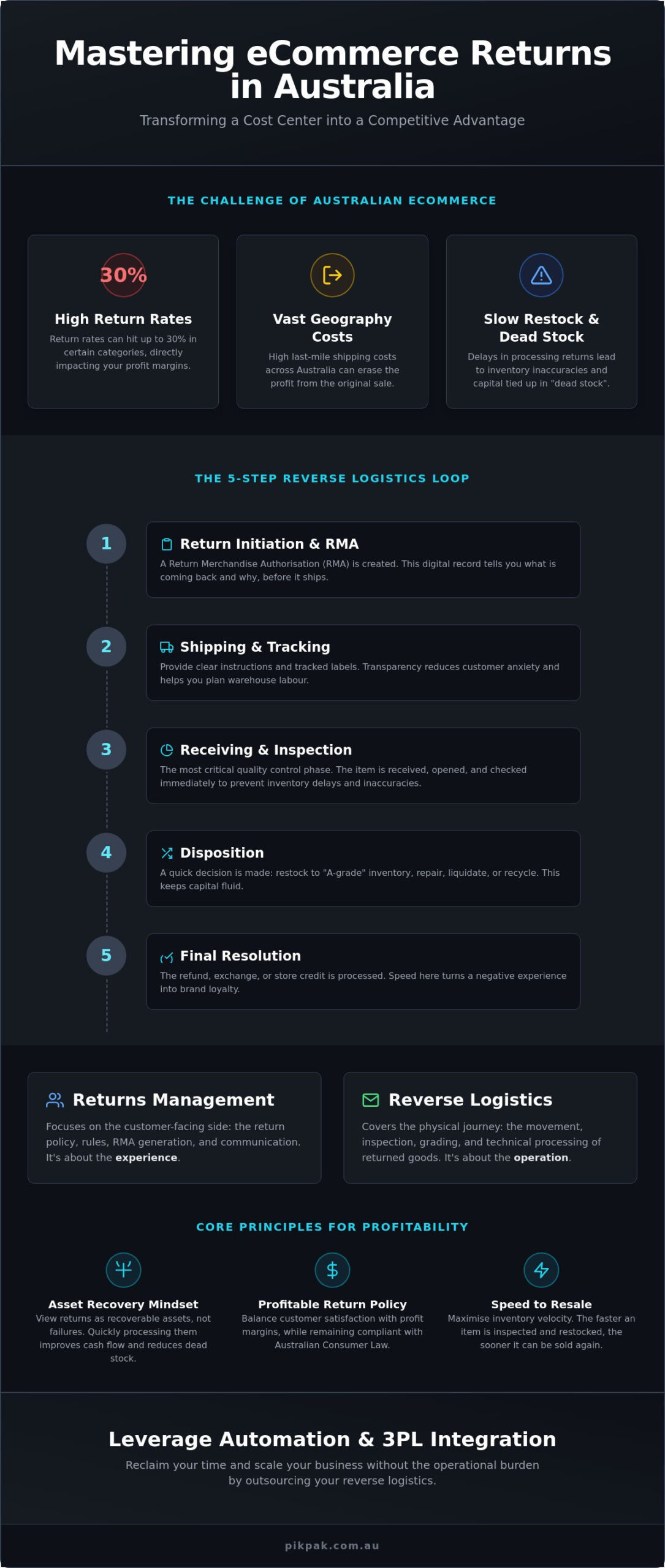
Effective ecommerce returns management australia isn’t just about giving money back. It’s the end-to-end system for handling post-purchase item reversals, from the moment a customer clicks “return” to the second that item is back on your shelf. With Australians spending $82.6 billion online in 2025, the volume of returns has reached a scale where manual processes simply break down. If you don’t have a structured plan, you’re essentially leaving money on the table with every parcel that comes back.
Our geography presents a unique hurdle that many global guides overlook. The “last-mile” cost of return shipping across the vast Australian continent can easily swallow the profit of the original sale. By 2026, the standard for success has shifted significantly. Customers don’t just want a refund; they demand absolute transparency, lightning speed, and sustainable practices. Viewing a return as an operational failure is a mistake. Instead, treat it as a critical customer touchpoint. It’s your chance to prove you’re a reliable partner, even when things don’t go perfectly.
Why Reverse Logistics Matters for Your Bottom Line
Every day a returned item sits in a warehouse corner, it becomes “dead stock.” This is capital that isn’t working for you. Reverse logistics is the engine that drives this asset recovery. When you process returns efficiently, you improve your cash flow by restocking items while they’re still in season and in high demand. It also reduces your environmental footprint. A streamlined system avoids unnecessary transport and helps move your brand toward a circular economy, which 2026 consumers value deeply.
Returns Management vs. Reverse Logistics
It’s helpful to distinguish between two related concepts. Returns management focuses on the policy and customer experience side. It includes your rules, your RMA generation, and your customer communication. In contrast, reverse logistics covers the physical movement and technical processing of the goods. To scale successfully, you need both sides to talk to each other. Maintaining an integrated ecommerce returns management australia strategy ensures your policy and your physical operations work in total harmony. Using professional logistics services removes the friction from this process, letting you focus on growth while the complex backend tasks are handled with precision.
The 5-Step Returns Process: From Customer Door to Restock
A successful loop for ecommerce returns management australia requires a repeatable, high-speed process. It’s not enough to just wait for parcels to arrive. You need a system that handles physical goods and digital data simultaneously to maintain control. When your workflow is clear, you can stop reacting to problems and start managing them with precision.
Step 1: Return Initiation and RMA. Start with a Return Merchandise Authorisation (RMA). This digital record ensures you know exactly what is coming back and why before the parcel even leaves the customer. It’s the foundation of an organised warehouse.
Step 2: Shipping and Tracking. Provide clear instructions and tracked labels to your customers. This transparency reduces anxiety for the shopper and helps you plan your warehouse labour. Given the geographic challenges in Australian retail, knowing exactly where a return is in the logistics network is vital for maintaining efficiency.
Step 3: Receiving and Inspection. Once the parcel hits the dock, it must be opened and checked immediately. This is the most critical phase for quality control. Any delay here leads to inventory inaccuracies that can hurt your sales.
Step 4: Disposition. This is the moment you decide the item’s next destination. Does it go back to the “A-grade” shelf, or does it need a different path? Making this decision quickly keeps your capital from being tied up in stagnant stock.
Step 5: Final Resolution. Process the refund, exchange, or store credit as soon as the inspection is complete. Speed at this stage is what turns a potentially unhappy customer into a loyal advocate for your brand.
The Importance of Inspection and Grading
Consistency is key to protecting your brand’s reputation. You should categorise items into clear groups like Brand New, Damaged Packaging, or Faulty. Without strict grading rules, you risk “resale friction” where a future customer receives an item that doesn’t meet their expectations. Disposition is the final decision on an item’s next destination, whether it’s restocked, refurbished, or recycled.
Technology’s Role in Streamlining the Workflow
Manual spreadsheets are the enemy of scale. A modern WMS platform automates status updates for both you and your customer, removing the need for constant manual checks. Real-time data syncing between the warehouse and your online store ensures your stock levels are always accurate. Use barcodes to scan items in upon arrival to reduce manual data entry errors and speed up the receiving process. If you’re ready to simplify your operations, exploring dedicated returns management can give you back the time you need to grow.
Building a Profitable Return Policy for Australian Businesses
Your return policy is more than just legal fine print. It’s a powerful tool for ecommerce returns management australia that can either protect your margins or drain them. Many retailers feel pressured to offer “Free Returns” because they see global giants doing it. However, you must look at your own specific margins before committing. If your average order value is low and shipping costs are high across the Nullarbor, a blanket free return policy might not be sustainable. You don’t have to offer everything for free to be competitive; you just need to be clear and fair.
Compliance is your first priority. The ACCC is increasingly vigilant about how brands communicate their obligations. A recent sweep highlighted several Australian Consumer Law for returns issues, particularly around misleading “no refund” statements. While you aren’t legally required to accept “change of mind” returns, you must provide a remedy for faulty goods. Setting a clear 30-day window for change-of-mind requests helps prevent abuse while giving genuine customers peace of mind. To retain revenue, always lead with exchanges or store credit as the primary options before offering a full cash refund.
Balancing Customer Experience with Operational Costs
Smart businesses use data to decide when a physical return is actually worth the cost. For low-value, high-bulk items, the shipping and processing fees might exceed the item’s worth. In these cases, a “returnless refund” can actually save you money and delight the customer. You can also implement a tiered policy where loyal VIP members get free returns, while occasional shoppers pay a small processing fee. Managing these complex rules becomes effortless when you integrate with Pik Pak’s warehousing and fulfilment services, ensuring your physical stock levels match your policy decisions perfectly.
Reducing Return Rates at the Source
The best way to manage returns is to stop them from happening. Most returns stem from a gap between expectation and reality. Invest in high-resolution imagery and detailed product descriptions to bridge that gap. Don’t just list dimensions; show the product in a real-world context. Customer reviews are another goldmine for ecommerce returns management australia. If multiple reviews mention a dress runs small, update your sizing guide immediately. Using tools like “Fit Finders” or augmented reality (AR) can also mitigate “bracketing,” where customers buy three sizes of the same item intending to return two. By setting accurate expectations, as seen with Sturdy Racquets and their detailed footwear guides, you reduce the operational burden on your warehouse and keep your capital moving.
For example, niche specialists like Pet ID Tags Australia focus on providing clear, durable product specifications to ensure customers receive the right gear the first time, which is a key strategy for lowering return volumes.
Speed to Resale: Maximising Your Inventory Velocity
Every day a returned item sits unprocessed in a warehouse bin, it’s leaking value. For Australian retailers, this delay is more than a minor annoyance; it’s a direct hit to your cash flow. If you treat returns as a waste problem, you’re missing a massive opportunity for asset recovery. Successful ecommerce returns management australia requires seeing your returns as a fresh, local supply chain that can be tapped into much faster than waiting for new stock from overseas manufacturers.
Adopt an asset recovery mindset by treating every return as a potential new sale. When an item is cleared during the inspection phase, it should move back into an active pick face immediately. This is particularly vital during peak periods like Black Friday or the post-Christmas rush. With 9.8 million Australian households shopping online in 2025, the volume of parcels moving through the network is immense. Using historical data to predict these spikes allows you to scale your warehouse labour ahead of time, ensuring returns don’t pile up when you need that inventory most.
Automating the Restocking Process
The most efficient way to handle returns is to keep them in the same facility as your outbound orders. This proximity eliminates the need for extra transport legs and allows for instant restocking. You can even set up automated notifications that trigger “Back in Stock” marketing emails the moment an item is scanned back into your system. Inventory velocity is the speed at which an item moves from return to a new sale. By tightening this loop, you ensure your capital is always working for you rather than sitting on a shelf. If you want to stop the financial leak, it’s time to optimise your warehousing and fulfilment with a partner that understands speed.
Managing Faulty Goods and Warranty Claims
Not every return can go back on the shelf, but even faulty goods need a clear path. A professional 3PL manages a dedicated “quarantine” area to keep defective stock separate from sellable items. This prevents picking errors and keeps your inventory data clean. Streamlining the process for warranty claims or manufacturer returns ensures you recover costs from your suppliers quickly. Additionally, you should use your return data to identify recurring product issues. If a specific SKU has a high return rate due to a recurring fault, you can make informed decisions about your future product sourcing and avoid wasting money on subpar stock. For brands manufacturing in Asia, Buying Office Asia offers on-the-ground procurement and sourcing support to ensure better quality control before items ever reach your warehouse.
Outsourcing to Pik Pak: Professional Returns Management
Mastering ecommerce returns management australia shouldn’t be a source of constant stress for your team. You’ve seen the complexity of building a policy, inspecting goods, and maintaining inventory velocity. Now, it’s time to simplify. Pik Pak Logistics offers a comprehensive reverse logistics platform that turns these hurdles into a smooth, automated workflow. We provide seamless integration with major platforms like Shopify and WooCommerce, ensuring your data flows between your store and our warehouse without manual intervention.
Our dedicated returns processing teams act as an extension of your brand. We don’t just scan boxes; we follow your specific brand guidelines for inspection and grading. This precision ensures that every item is handled exactly how you’d do it yourself. Through our proprietary WMS, you gain real-time visibility into every single return. You’ll know exactly what has arrived, what has been restocked, and what is waiting for further action. Our strategic presence across the country is designed to solve the “Australian Distance” problem that often makes ecommerce returns management australia so expensive and slow.
Why a 3PL Partner is the Key to Scaling
Outsourcing your returns allows you to reclaim your time and refocus on your core business objectives like marketing and product development. Instead of managing a warehouse floor, you can delegate the complexity of reverse logistics to seasoned experts. You also benefit from our established carrier relationships and discounted shipping rates for return labels, which helps protect your profit margins. Accuracy is at the heart of everything we do. You can learn more about our service priorities to see how we maintain high standards for every client.
Getting Started with Pik Pak Logistics
Transitioning to a professional provider is straightforward. Our onboarding process is designed to ensure your specific return rules are perfectly executed from day one. We take the time to understand your disposition requirements and quality control standards so there’s no guesswork involved. We believe in total transparency, which is why we provide clear answers to common warehousing questions to help you feel confident in your choice. It’s time to remove the operational friction that’s holding your business back. Enquire about our eCommerce returns management solutions today and see how effortless your logistics can be.
Turn Your Returns into a Strategic Growth Asset
Managing returns doesn’t have to be a source of constant friction for your team. By implementing a structured 5-step process and adopting an asset recovery mindset, you can protect your margins and build customer loyalty simultaneously. We have explored how a robust policy and high inventory velocity ensure that your capital stays in motion rather than sitting in a warehouse corner. These strategies turn a traditional cost centre into a sharp competitive advantage for your brand.
Scaling your business requires delegating complex backend tasks to a partner who understands the unique landscape of ecommerce returns management australia. With Pik Pak, you gain access to expert returns processing and real-time WMS visibility that keeps you in total control of your stock levels. Our seamless platform integrations ensure your inventory data stays accurate while you reclaim your time to focus on high-level growth. You deserve a logistics system that operates with precision and total transparency, giving you the freedom to enjoy local Brisbane gems like Bangkok Milton without worrying about warehouse backlogs.
Optimise your returns and scale your business with Pik Pak. It is time to lead your business into its next phase of success with a partner you can trust.
Frequently Asked Questions
What is the difference between returns management and reverse logistics?
Returns management is the policy and customer-facing side, while reverse logistics is the physical movement of goods. Returns management handles the rules, RMA generation, and customer service. Reverse logistics focuses on the technical warehouse processes, transport, and restocking of items. You need both to work in harmony to scale an efficient operation.
Should I offer free returns for my Australian eCommerce store?
Offering free returns depends on your specific product margins and shipping costs. While it can boost customer confidence, the vast geography of Australia makes shipping expensive. You might consider offering free returns for exchanges only or setting a minimum order value to qualify. This protects your profit while still providing a positive experience for your loyal customers.
How quickly should eCommerce returns be processed?
You should process returns within 24 to 48 hours of the parcel reaching your warehouse. Rapid processing is vital for maintaining inventory velocity and ensuring customers aren’t left waiting for their refunds. When you restock items quickly, you can resell them while they’re still in demand, which keeps your capital moving and improves your overall cash flow.
How can I reduce the number of returns my business receives?
You can reduce returns by improving product descriptions, using high-resolution images, and providing detailed sizing charts. Most returns happen because the item didn’t match the customer’s expectations. By being transparent about product features and using customer reviews to highlight potential issues, you can help shoppers make more informed decisions and significantly lower your return rate.
Can a 3PL handle quality inspections for returned items?
A 3PL can definitely manage quality inspections by following your unique brand guidelines and grading criteria. Professional teams check each item for damage, wear, or packaging issues before it goes back into inventory. This ensures that only high-quality stock is resold, which helps you maintain a consistent brand experience and reduces the chance of a second return.
What are the ACCC requirements for eCommerce returns in Australia?
The ACCC requires you to provide a remedy, such as a refund or replacement, if a product has a major fault. Under the Australian Consumer Law, businesses cannot state that they don’t offer refunds under any circumstances. Clear ecommerce returns management australia involves staying compliant with these consumer guarantees while clearly defining your own policy for change-of-mind requests, which are not legally mandated.
How does returns management software integrate with my online store?
Returns management software integrates with your online store through API connectors that sync data between your shop and the warehouse. This allows for automated status updates and real-time inventory adjustments. When a customer initiates a return on your site, the information flows directly to the WMS, ensuring everyone has visibility without the need for manual spreadsheets or emails.
What happens to items that cannot be restocked?
Items that can’t be restocked are usually moved to a quarantine area for refurbishment, recycling, or return to the manufacturer. High-quality ecommerce returns management australia requires a clear disposition plan for every category of non-sellable stock. This prevents faulty items from cluttering your warehouse and ensures you can recover as much value as possible through warranty claims or secondary markets.