
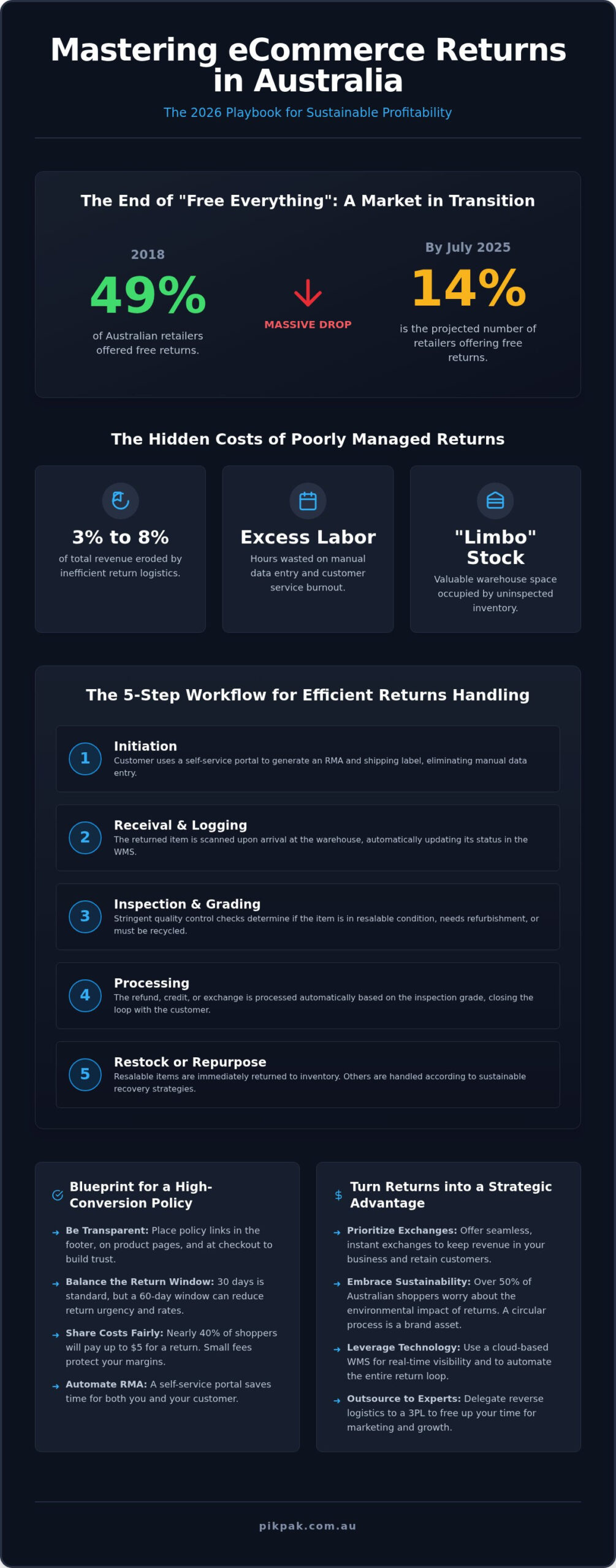
Did you know that as of July 2025, only 14% of Australian retailers still offer free returns? It’s a massive drop from the 49% we saw in 2018. This shift marks a new era for ecommerce returns management australia, where the focus has moved from “free everything” to sustainable profitability. If you’re feeling the sting of high shipping costs or watching your stock sit in “return limbo,” you aren’t alone. Most store owners find themselves buried in manual data entry and customer service burnout while their revenue takes a 3% to 8% hit from poorly managed logistics.
It’s frustrating to watch perfectly good inventory vanish from your digital shelves only to get stuck in a warehouse corner. We know you need a process that’s effortless, not another administrative headache. This guide will show you how to master reverse logistics to turn returns into a distinct competitive advantage for your online store. You’ll learn how to implement a streamlined, automated system that slashes turnaround times and boosts customer loyalty. We’ll explore the latest 2026 trends, from ACCC compliance to smart inventory recovery, so you can reclaim your time and focus on scaling your brand.
Key Takeaways
- Align your store with 2026 consumer expectations by creating a frictionless return journey from the customer back to your warehouse.
- Use transparency as a trust-builder by designing a high-conversion returns policy that clearly defines return windows and process steps.
- Streamline your physical workflow with a 5-step system that prioritizes stringent quality inspection and rapid re-grading of returned stock.
- Leverage cloud-based WMS technology to eliminate manual data entry and gain real-time visibility over every item in your return loop.
- Optimize your ecommerce returns management australia by delegating reverse logistics to experts, freeing you to focus on marketing and growth.
What is Ecommerce Returns Management in the Australian Market?
In simple terms, ecommerce returns management australia is the strategic process of handling products that move backward through your supply chain. This journey, professionally known as reverse logistics, starts the moment a customer initiates a return and ends only when the item is back on the shelf, refurbished, or responsibly recycled. In 2026, this isn’t just about shipping boxes; it’s about protecting your margins in a market where online shopping accounts for 22% of total retail spending.
Australian store owners must navigate a strict regulatory environment. The Australian Consumer Law (ACL) mandates that you provide a remedy for faulty or misrepresented goods, a right that cannot be signed away by a store policy. With the ACCC making industry compliance a top enforcement priority through 2026, your return process must be legally sound and transparent. While you aren’t legally required to offer refunds for a “change of mind,” the modern Australian shopper expects a frictionless experience. If the process is too difficult, they simply won’t return to your store.
Poorly managed returns carry heavy hidden costs that go far beyond the initial shipping label. Industry data shows that inefficient processes can erode between 3% and 8% of a company’s total revenue. These losses stem from excessive labor hours spent on manual data entry, valuable warehouse space occupied by “limbo” stock, and the missed opportunity of a lost sale while an item sits uninspected. Effective management turns these costs into recovered capital.
The Evolution of Reverse Logistics in 2026
The landscape has shifted from simple “return to sender” workflows to sophisticated, data-driven inventory recovery. Today, sustainability and “circularity” are major drivers for Australian consumers. Over half of local shoppers now express concern about the environmental impact of their returns. Partnering with a tech-forward 3PL allows you to handle seasonal peaks effortlessly while ensuring items are re-graded and re-entered into inventory with precision. This approach transforms a potential loss into a sustainable business practice.
Returns vs. Exchanges: Why Strategy Matters
Smart retailers are increasingly pushing for instant exchanges rather than straight refunds. This strategy keeps the revenue in your business and maintains the customer relationship. While you must respect the consumer’s right to a return under the ACL, offering a seamless exchange path often solves the customer’s problem faster. Reverse logistics is a strategic value-recovery process that focuses on recapturing the maximum worth of an item while minimizing operational waste. By delegating these complexities to professional logistics services, you can reclaim your time and focus on your next marketing campaign.
Designing a High-Conversion Returns Policy
Your returns policy is often the final hurdle before a customer clicks “buy.” In the context of ecommerce returns management australia, transparency acts as a silent salesperson. If customers can’t find your policy easily, they’ll assume the worst. Place links in your site footer, on product pages, and within the checkout flow to build immediate trust. When a shopper knows exactly how to fix a mistake, they’re far more likely to complete their purchase.
Defining your “Return Window” requires a balance between customer convenience and warehouse efficiency. While 30 days is the Australian retail standard, extending this to 60 days can actually lower return rates by reducing the “urgency” to send items back. Regarding costs, the tide has turned. As of July 2025, only 14% of local retailers offer free returns. Most Australian shoppers now accept small fees, with nearly 40% willing to pay up to $5 to return an item. This shift allows you to protect your margins without alienating your audience.
Automating the Return Merchandise Authorisation (RMA) process is the key to reclaiming your time. A self-service portal allows customers to generate their own labels and track their return status without emailing your support team. This eliminates manual data entry and ensures your team spends less time on admin and more on growth. It’s about creating a feeling of effortlessness for both you and your client.
Essential Elements of a 2026 Returns Policy
Your policy must be more than just legal jargon. It needs to provide clear instructions on packaging and carrier drop-off points to ensure items arrive safely. Clearly define what constitutes “resalable” stock, such as original tags and undamaged packaging. Finally, commit to specific timelines for processing refunds and store credits. Customers are much more patient when they know their refund will be processed within 3 to 5 business days of arriving at the 3PL warehouse.
Leveraging Policy to Reduce Return Rates
Preventing returns is always more profitable than managing them. Use detailed sizing guides and Augmented Reality (AR) tools to stop “bracketing,” which is the habit of buying multiple sizes just to try them on. Clear, high-resolution product descriptions and videos can significantly cut down on “not as described” complaints. Always encourage exchanges over refunds by making the exchange process one-click. By keeping the revenue in your business, you turn a potential loss into a retained sale and a loyal customer.
The Physical Workflow: 5 Steps to Efficient Returns Handling
A successful strategy for ecommerce returns management australia requires more than just a digital portal; it needs a disciplined physical workflow. When a package arrives at the warehouse, it enters a high-speed system designed to recover value and protect your bottom line. We break this down into five distinct stages that ensure no item is left in limbo.
- Step 1: Receiving and Sortation. The 3PL team identifies the package via the RMA and sorts it based on priority or product type.
- Step 2: Quality Inspection. Experts perform a stringent check to verify the item’s condition against your specific brand standards.
- Step 3: Value-Added Services. This stage involves cleaning, re-tagging, or re-bagging to ensure the item looks brand new.
- Step 4: WMS Reconciliation. Your cloud-based Warehouse Management System is updated instantly, giving you real-time visibility of recovered stock.
- Step 5: Rapid Re-shelving. The item is returned to its pick location, making it available for sale on your website immediately.
Rapid re-shelving directly improves your cash flow by transforming stagnant returns back into active, sellable assets that generate revenue rather than sitting as a loss on your balance sheet.
The Art of Re-Grading Stock
Professional re-grading is a cornerstone of modern ecommerce returns management australia, categorizing items so you can make informed decisions about your inventory:
- Grade A: Pristine items ready for immediate resale at full price.
- Grade B: Items with minor packaging issues that need kitting and assembly services to be restored.
- Grade C: Damaged stock that is better suited for liquidation or ethical disposal to clear space.
Why Professional Handling Protects Your Brand
Your brand’s reputation is built on the customer’s unboxing experience. If a shopper receives an item with a crinkled tag or a dusty bag, they’ll know it’s a return, and their trust in your brand will vanish. Professional handling ensures every customer receives a pristine product. By delegating this process, you ensure that even returned items meet your highest quality standards before they reach the next doorstep. This level of precision eliminates the friction of secondary returns and cements customer loyalty. You can reclaim your time by letting experts manage the boxes while you focus on scaling your store.
Technology Integration: Automating the Return Loop
Automation is the digital glue that holds your entire supply chain together. In the fast-paced world of ecommerce returns management australia, relying on manual spreadsheets is a recipe for disaster. When your online storefront connects directly to a 3PL Warehouse Management System (WMS), the process becomes effortless. You gain real-time visibility, knowing exactly where every piece of return stock is, from the moment it’s scanned at a post office to the second it’s back on your warehouse shelf. This precision allows you to manage your cash flow with confidence, as you’ll always know the true value of your inventory.
This integration does more than just track boxes; it proactively manages customer expectations. Automated notifications send updates at every milestone, which drastically reduces those time-consuming “Where is my refund?” enquiries that often clog up customer service channels. By keeping your shoppers informed without lifting a finger, you build long-term loyalty while freeing up your team to focus on high-value tasks. It’s about creating a seamless loop that benefits both your backend operations and your customer’s experience.
Seamless API and Platform Connectors
Modern logistics requires a “plug-and-play” approach to technology. Whether you operate on Shopify, WooCommerce, or Magento, your platforms must sync without friction to prevent data silos. Our specialized technology support eliminates the need for manual data entry by auto-syncing orders and returns across all your sales channels. A centralized dashboard provides a single source of truth for your omnichannel returns. This visibility ensures that whether an item is coming back from a marketplace or your own site, it’s accounted for instantly. You can reclaim your time by letting the software handle the heavy lifting of data reconciliation.
Predictive Analytics in Reverse Logistics
Data is your most valuable asset when refining your sourcing and marketing strategies. By analyzing return patterns through your WMS, you can identify high-return products and investigate quality issues before they erode your margins. Predictive analytics also help you forecast future inventory needs and identify “serial returners,” allowing you to adjust your marketing spend or shipping policies for specific customer segments. Automated label generation further reduces operational friction, ensuring the return loop is just as efficient as your outbound shipping. This data-driven approach turns a logistical challenge into a roadmap for future growth.
Ready to eliminate manual errors and scale your store? Discover how our WMS platform access can streamline your operations today.
Why Outsourcing Returns to an Australian 3PL is the Scalable Move
Scaling an online store is an exciting milestone, but it often brings a hidden burden: a mounting pile of return boxes. While you might manage 10 returns a week from a small office, handling 1,000 requires a dedicated team and significant floor space. Outsourcing your ecommerce returns management australia to a professional 3PL removes this operational ceiling. It allows you to focus on high-level strategy and marketing while experts handle the physical boxes. This transition isn’t just about moving tasks off your plate; it’s about building a foundation that supports unlimited growth without the need to hire more warehouse staff or lease more space.
Professional logistics partners also provide access to volume-based discounted shipping rates for return labels. These savings directly improve your margins, making the “cost of doing business” much more manageable. Beyond the numbers, outsourcing positions your brand as a sophisticated, reliable Australian retailer. Customers feel more secure when they see a structured return process backed by a national logistics network. It builds a level of trust that a manual, home-based operation simply can’t match, ensuring your brand remains competitive in a maturing market.
Cost Savings through Centralised Logistics
Centralising your reverse logistics significantly reduces the “cost per return” through warehouse efficiencies. Instead of wasting expensive retail space on non-resalable items or stock sitting in limbo, a 3PL manages every square meter for maximum recovery. This includes lowering storage overheads by quickly identifying which items should be re-sold, kitted, or disposed of ethically. You can explore Pik Pak’s service priorities to understand how an efficiency-first mindset turns a cost center into a streamlined asset. Every dollar saved in the warehouse is a dollar you can reinvest in customer acquisition and product development.
Partnering for Long-Term eCommerce Success
A 3PL acts as a seamless extension of your operations team, providing the precision and speed your customers expect in 2026. Utilizing a Melbourne-based warehouse gives your brand a strategic hub for national reach, ensuring returns from Perth to Sydney are processed with minimal delay. This partnership is designed to give you total control without the daily stress of manual logistics. By delegating these hurdles, you reclaim your time to focus on your core objectives: building your brand and driving sales. Ready to streamline your store? Get a quote for returns management with Pik Pak and start your next phase of growth today.
Future-Proof Your Logistics for 2026 and Beyond
Returns don’t have to be a drain on your profit margins or your team’s energy. By combining a transparent policy with automated technology and a disciplined physical workflow, you transform a logistical headache into a streamlined growth engine. Mastering ecommerce returns management australia allows you to reclaim your time and focus on scaling your brand while experts handle the heavy lifting. This shift in strategy turns reverse logistics from a cost center into a powerful tool for customer retention and inventory recovery.
With real-time WMS visibility, expert re-grading and kitting, and seamless integration with platforms like Shopify and WooCommerce, we make your backend operations feel effortless. You’ve built a great brand; now it’s time to support it with a world-class logistics partner that understands the Australian market. Ready to streamline your returns? Request a Pik Pak quote today and take the first step toward a more profitable, stress-free future for your online store. We’re ready to help you grow with confidence.
Frequently Asked Questions
What is the average return rate for eCommerce in Australia?
The general e-commerce return rate in Australia currently sits between 15% and 30%. For specific industries like fashion and footwear, these numbers can reach 40%. Understanding these benchmarks helps you forecast inventory needs and manage your bottom line more effectively. High return rates are a standard part of the modern Australian market, making a robust management system essential for maintaining your store’s profitability and ensuring long-term growth in a competitive environment.
How can I reduce the cost of shipping for customer returns?
You can reduce return shipping costs by leveraging the bulk volume discounts available through a professional 3PL provider. These partners negotiate lower rates with major carriers that individual store owners can’t access. Additionally, implementing a self-service portal encourages customers to use your preferred, cost-effective shipping methods. This centralized approach to ecommerce returns management australia ensures you aren’t overpaying for every item sent back to your warehouse while maintaining a professional experience.
What is the difference between a refund and a store credit in reverse logistics?
A refund returns the original payment to the customer’s bank account, while a store credit keeps the capital within your business for future purchases. From a logistics perspective, store credits are often preferred because they maintain cash flow and encourage customer loyalty. Many retailers offer “instant” store credits as an incentive to avoid a full refund. This strategy helps you retain revenue even when a specific product choice didn’t work out for the shopper.
How does a 3PL handle damaged items that can’t be resold?
When items arrive damaged, a 3PL uses a formal re-grading process to determine the best course of action. If an item is non-resalable, it’s flagged in the WMS for either liquidation or ethical disposal based on your pre-set instructions. This ensures that damaged stock doesn’t clutter your active inventory or incur unnecessary storage fees. You’ll receive real-time visibility on these items, allowing you to make quick, informed decisions about your physical assets.
Can I automate return labels for my Shopify store?
Yes, you can automate return labels by integrating your Shopify store with a cloud-based WMS platform. This connection allows customers to initiate returns through a portal that automatically generates a label based on your specific shipping rules. It eliminates the need for manual data entry and reduces the administrative burden on your customer service team. This level of automation is a key feature of modern ecommerce returns management australia, creating an effortless experience for everyone.
What are the legal requirements for returns under Australian Consumer Law?
Under the Australian Consumer Law (ACL), businesses must provide a remedy such as a repair, replacement, or refund if a product is faulty, not as described, or unfit for purpose. You aren’t legally required to offer a refund for a “change of mind” unless your own store policy states otherwise. The ACCC actively enforces these guarantees, so it’s vital that your policy is transparent and doesn’t mislead customers about their legal rights or impose unfair limits.
How long does it take for a 3PL to process a return?
Most professional 3PL providers process returns within 24 to 48 hours of the package arriving at the warehouse. This includes receiving, inspecting, re-grading, and updating the inventory status in your WMS. Rapid processing is crucial because it allows you to issue refunds or store credits faster, which directly improves customer satisfaction. Speeding up this loop also ensures that resalable items are back on your digital shelves and available for purchase as quickly as possible.
Is it better to offer free returns or a flat return fee?
The trend in 2026 has shifted heavily toward flat return fees to cover rising logistics costs. While free returns can boost initial conversion rates, only 14% of Australian retailers still offer them due to the impact on margins. Research shows that almost 40% of local shoppers are willing to pay a small fee to return a product. Choosing a flat fee often provides a sustainable balance between customer service expectations and your overall business profitability.