
What if the best place for your stock isn’t the one that gives you the most space, but the one that takes the right work off your hands? Choosing ecommerce inventory storage solutions australia businesses can rely on means balancing control, room to grow and the effort involved in handling orders.
If stock is crowding your home or workplace, or counts and packing are taking more time, it’s worth comparing your options. Self-storage, co-warehousing and a third-party logistics provider (3PL) each offer a different mix of space, support and day-to-day involvement.
This guide explains what inventory management involves and how to choose a storage model that fits your products and workload. You’ll learn how to keep records current as stock changes, compare managing fulfilment yourself with outsourcing it, and assess when services such as picking, packing, shipping and returns management can simplify operations. With a clear view of the options, you can free up space and time without taking on infrastructure your business doesn’t need.
Key Takeaways
- Compare self-storage, co-warehousing and 3PL by who manages stock access, order handling and daily workload, not just by the space available.
- Understand how ecommerce inventory storage solutions australia can support different stock and fulfilment needs, from self-managed dispatch to outsourced order processing.
- Map your stock types, SKU range, handling needs, order flow, returns and seasonal changes before choosing a storage model.
- A 3PL can connect warehousing with picking, packing, shipping and returns, shifting agreed operational tasks away from your team.
- Use live inventory and order-status visibility through Pik Pak’s cloud-based WMS to track stock as it moves.
Ecommerce Inventory Storage Solutions in Australia: What Are Your Options?
Ecommerce inventory storage is the space and the processes used to hold products until they’re sold and dispatched. It might be a shelf in a spare room, a rented storage unit, shared warehouse space or a managed warehouse. The key difference isn’t simply how much room you get. It’s who receives deliveries, records stock, finds products when orders arrive and prepares parcels for dispatch.
These tasks are part of inventory management: tracking what’s in stock and how quantities change as goods arrive and orders are fulfilled. For Australian online sellers, the right ecommerce inventory storage solutions australia offers depend on the products, order workflow and level of hands-on involvement the business wants to retain.
When does an online store need more than home storage?
Space pressure is one signal. Cartons may be filling work areas, or products may be difficult to locate because storage has grown without a consistent layout. But space and workload are separate problems. A temporary increase in stock for a promotion might call for extra room. If receiving goods, checking counts, locating items and packing orders interrupt other work week after week, the recurring fulfilment workload may need attention too.
Plan for stock changes, not just today’s footprint. A seasonal range or promotion can bring in extra products before demand rises, then leave you with less stock later. Consider where incoming cartons will go, how fast-moving items will be accessed, and whether the setup can adapt as stock levels change.
What is the difference between storage space and managed inventory storage?
Renting space gives you somewhere to keep stock, but it doesn’t necessarily include someone to receive deliveries, record quantities, pick products for orders or arrange shipping. With self-storage, the seller generally controls access and manages stock and dispatch. Co-warehousing can provide shared warehouse space, but sellers typically still handle their own inventory and daily order tasks.
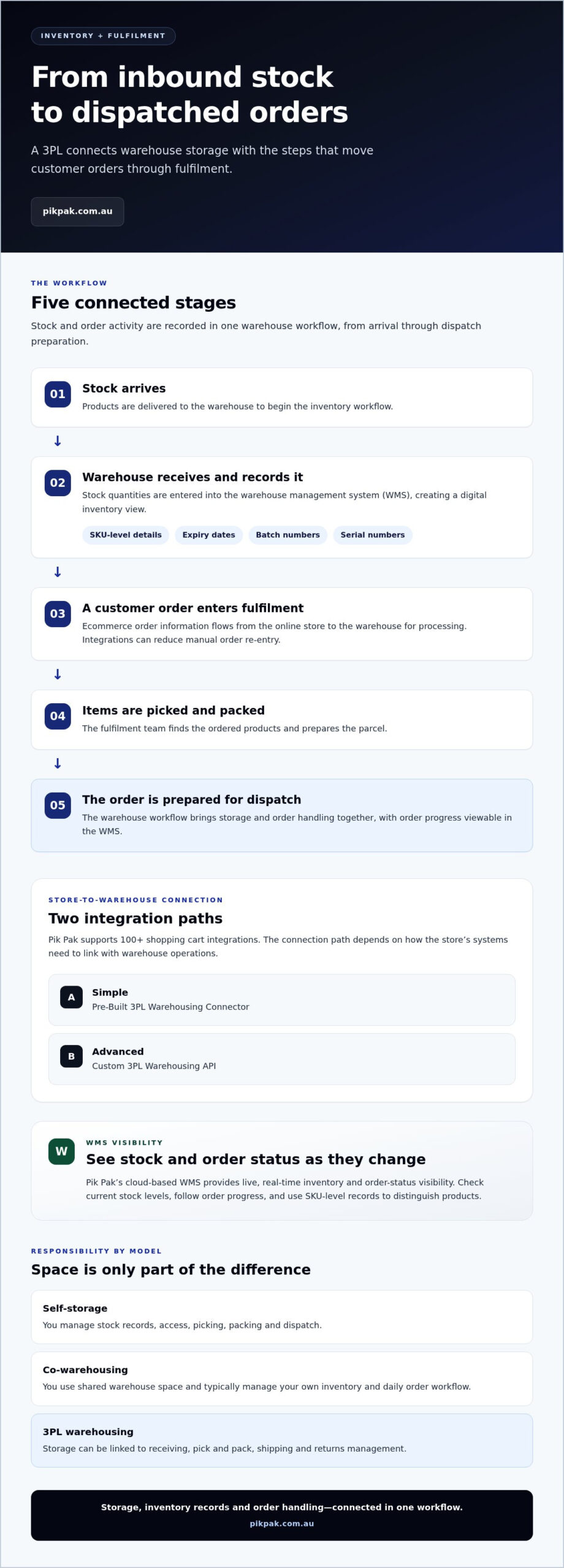
A 3PL, or third-party logistics provider, can connect warehousing with fulfilment services. The warehouse receives and records stock, then picks and packs orders and prepares them for dispatch. A warehouse management system (WMS) gives you a way to view inventory and order activity while your fulfilment tasks are handled.
Think of the models as different divisions of responsibility:
- Self-storage: You manage stock records, access, picking, packing and dispatch.
- Co-warehousing: You use shared warehouse space, while typically managing your stock and order workflow.
- 3PL warehousing: Storage can be linked to services such as receiving, pick and pack, shipping and returns management.
Choose based on the work you want your storage setup to handle, not just the floor space it provides. Pik Pak combines inventory storage with fulfilment, supported by a cloud-based WMS that provides live, real-time inventory and order-status visibility. Its warehousing and fulfilment services bring storage and order handling together, so your team can spend less time managing stock movements and more time on the business.
How Australian Ecommerce Inventory Storage Works with a 3PL
A 3PL brings stock storage and order fulfilment into one workflow. The process starts when stock arrives at the warehouse. Products are received and recorded in the warehouse management system (WMS), creating a digital inventory view. When a customer places an order, ecommerce order information flows into fulfilment, where items are picked, packed and prepared for dispatch.
That connected process matters because a stock count is only useful if it reflects what’s happening to orders. Pik Pak’s cloud-based WMS provides live, real-time inventory and order-status visibility, so you can see stock levels and follow an order’s progress through the system. Real-time inventory visibility means seeing current stock and order status as they change, rather than relying on an old spreadsheet or delayed report.
How do ecommerce platforms connect to inventory storage?
Pik Pak supports 100+ shopping cart integrations. There are two integration paths: Simple – Pre-Built 3PL Warehousing Connector and Advanced – Custom 3PL Warehousing API. Integrations can automate the flow of ecommerce order information into fulfilment, reducing the need to re-enter order details manually. The right path depends on how your store’s systems need to connect with warehouse operations.
Once connected, orders can flow from your online store to the warehouse for processing. This makes it easier for the fulfilment team to act on incoming orders and for you to check their status. To learn how the technology connects with warehouse processes, explore Pik Pak’s technology support information.
What inventory visibility can a WMS provide?
A WMS gives you a practical view of stock and order activity. If a product is selling quickly, current inventory information can help you decide whether to arrange more stock or adjust what you promote. If an order needs checking, its status is visible in the same web-based system. This helps replace guesswork with information you can use in day-to-day decisions.
Records can also include SKU-level details that distinguish items beyond a general product name. This can include expiry dates, batch numbers and serial numbers. Those details help keep different stock identifiable, particularly when similar products need to be tracked separately.
Access is web-based. You can use the system without installing software or purchasing hardware, keeping inventory and order information accessible through the online platform. For businesses comparing ecommerce inventory storage solutions australia, this visibility is an important part of the service: the storage model determines who handles stock, while the WMS helps you stay informed as stock and orders move through fulfilment.
Self-Storage, Co-Warehousing, or 3PL: Compare the Work, Not Just the Space
The right model depends on how much of the inventory workflow you want to keep in-house. A storage unit can solve a space problem, while shared workspace gives you room to work with stock. A 3PL can combine warehouse storage with fulfilment tasks. Compare the responsibilities each option leaves with your team, not just the room or access it provides.
| Consideration | Self-storage | Co-warehousing | 3PL warehousing |
|---|---|---|---|
| Space | Rented space for your stock. | Shared warehouse or work area. | Warehouse space as part of a logistics service. |
| Stock access | You access and organise your inventory. | You work with your stock at the shared facility. | Warehouse staff handle stock tasks agreed with your business. |
| Order handling | You pick, pack and dispatch orders. | You generally manage your own order workflow. | Fulfilment can include picking, packing and preparing orders for dispatch. |
| Systems | You maintain your stock records. | You typically manage your own records and workflow. | A WMS can provide inventory and order visibility. |
| Work retained by your team | Most daily stock and dispatch work. | Hands-on stock and order management. | Less warehouse handling, depending on the tasks assigned. |
Which storage model gives you the right level of control?
Choose self-storage if your priority is space and you want to manage stock and dispatch yourself. Co-warehousing also suits a hands-on approach, with shared workspace for businesses that want to work directly with their inventory. A 3PL is worth considering if you’d rather delegate agreed warehouse tasks and reduce the day-to-day handling your team takes on. No model is best for every store. Match the level of control to the work you want to own.
How should you think about storage costs and workload?
Look beyond the storage arrangement. Consider the space commitment, the staff time spent receiving goods and fulfilling orders, and whether those needs change during promotions or seasonal shifts. A lower-complexity setup may make sense if you have the time and people to handle the work. If fulfilment is pulling attention away from other priorities, include that workload in your comparison.
Pik Pak’s pricing is transparent and pay-as-you-go, with plans that scale with your business. This gives you an alternative to committing to dedicated warehouse space while connecting storage with fulfilment services. Compare the overall operating model: who handles the stock, what work stays with your team, and how the arrangement can adapt as your needs change. That’s a practical way to assess ecommerce inventory storage solutions australia without treating space as the only deciding factor.
If managed storage and fulfilment fit your priorities, explore Pik Pak’s logistics services as one way to bring those tasks together.
How to Choose Ecommerce Inventory Storage for Your Australian Business
Make the decision based on your actual stock and workflow, not an assumed “typical” online store. Use this framework to identify what your operation needs now, what changes over time and which tasks your team wants to keep or hand over. Your sales and stock records are more useful than broad averages.
- Describe your stock. List product types, SKU range, dimensions and handling requirements. Note whether items need batch, serial-number or expiry-date records, and flag products that need particular care during storage or picking.
- Map stock movement. Use your records to understand how much stock you hold, how often it arrives and how quickly different products move. Include access frequency: do you need to handle items yourself regularly, or mainly need reliable records and order fulfilment?
- Trace an order from sale to dispatch. Write down who receives the order, locates the item, picks and packs it, and arranges delivery. Mark any handoffs that create extra work or interruptions for your staff.
- Include returns and peaks. Map how returned products re-enter stock, along with promotions and seasonal periods that change inventory levels. Consider where incoming stock will go if a promotion or busy period overlaps with existing inventory.
- Assess people and access. Consider your team’s capacity for receiving, stock control, picking, packing and returns. Balance that against how often you need hands-on access to products and how deliveries will be coordinated.
- Compare visibility and responsibility. Decide what inventory and order information you need to see, and which fulfilment tasks you want handled internally. Compare each storage model by the work your team retains, not only by available space.
Start with your stock profile and daily workflow
Turn your stock list into an operating picture. For each product group, record identifying SKU details, any batch or expiry tracking needs, and handling considerations. Then review your records for changing stock patterns rather than relying on industry averages. Finally, identify which receiving, picking, packing and returns tasks consume the most staff time. For companies managing their own facility operations, automated packaging and palletising systems from Phoenix Handling Solutions Limited can streamline end-of-line bottlenecks, whereas for others, an outsourced storage setup may make the clearest operational difference.
Plan receiving, stock control, and operational handover
Clear inbound information helps a warehouse receive and record stock accurately. Prepare product identifiers and shipment details, and align incoming stock information with the records used to manage orders. A consistent handover gives the warehouse team the details needed to receive stock and keep inventory records useful.
Before changing models, write down the essentials:
- Product and SKU records, including relevant batch, serial or expiry details.
- How ecommerce orders connect to fulfilment and what inventory or order status you need to view.
- Who handles receiving, stock updates, picking, packing, dispatch and returns.
- How your team will coordinate inbound deliveries and communicate stock changes.
This preparation makes it easier to compare ecommerce inventory storage solutions australia against your real operating needs. If you’re ready to map those needs to storage and fulfilment, explore Pik Pak’s logistics solutions.
Pik Pak’s Ecommerce Inventory Storage: From Warehouse Stock to Customer Orders
For an Australian ecommerce business, Pik Pak connects warehouse storage with the work that moves products to customers. Stock is held in warehouses that are clean, safe and secure, located near major ports and logistics infrastructure. With 3PL warehousing, storage sits alongside pick, pack and ship services, so your team can hand over fulfilment tasks rather than managing every order from your own premises.
What happens when Pik Pak manages your inventory?
Inventory is managed through a cloud-based warehouse management system (WMS), which provides live, real-time visibility of inventory and order status. As orders move through fulfilment, you can see their status and keep a current view of stock. Pik Pak’s warehousing and fulfilment service brings storage and customer-order handling together, with warehouse handling, kitting and assembly, and repacking services to support relevant workflows.
Returns are part of the stock cycle too. Pik Pak handles returns and processes them competently, helping returned items rejoin the inventory workflow. Your business can focus on its product range, customer experience and growth while warehouse tasks are managed as part of the logistics operation.
Getting started is designed to be straightforward: Pik Pak can get your business set up in 48 hours. The system is web-based, so you can access inventory and order information online without installing software or purchasing hardware. Transparent, pay-as-you-go pricing and plans that scale with your business provide a flexible alternative to taking on dedicated warehouse infrastructure.
How can you explore a storage and fulfilment setup?
Start with a clear picture of the stock you sell, including SKU details and any handling needs. Then map how orders arrive, how fulfilment connects to your ecommerce systems, and which tasks you want your team to retain. Include returns, promotional changes and inbound stock coordination. This makes it easier to match the warehousing and fulfilment setup to your actual workload.
As you compare ecommerce inventory storage solutions australia, focus on the full operating model: where stock is held, what inventory information you can see, and who handles receiving, picking, packing, dispatch and returns. A well-defined handover lets your business stay informed while shifting agreed warehouse work away from your team.
If integrated storage and fulfilment fit your stock profile and workload, explore Pik Pak’s logistics service and start a tailored discussion about your requirements.
Make Your Next Storage Decision With Confidence
Your next step is to turn the storage choice into a clear operating plan. Decide which tasks your team should keep, which could be handed over, and what may need to change as stock or order patterns shift. That gives you a practical way to assess ecommerce inventory storage solutions australia against the way your business actually runs, rather than choosing space first and solving the workflow later.
Bring your stock profile, order process and current workload into the decision. A suitable setup should make responsibilities clear and leave your team room to focus on the work that moves the business forward. Start with the operational friction you can see now, then choose a model that can support your next stage.
Ready to explore a setup that brings storage and fulfilment together? Explore Pik Pak’s ecommerce warehousing and fulfilment and take the next step towards a more manageable stock workflow.
Frequently Asked Questions
How quickly can an Australian ecommerce business get set up with Pik Pak?
Pik Pak can get your business set up in 48 hours. To make onboarding more straightforward, prepare your product and SKU records, outline how orders move through your store, and identify the warehouse tasks you want handled. Those details give the setup a clear starting point and help connect inventory, orders and fulfilment around your business workflow.
Do I need to install software to manage inventory with Pik Pak?
No. Pik Pak’s inventory system is web-based, so you can access it online without installing software or purchasing hardware. For example, a team member working away from the warehouse can check stock or order progress while colleagues handle day-to-day tasks. This makes inventory information accessible without setting up a separate warehouse system on your own equipment.
What integration options does Pik Pak offer for an online store?
Pik Pak offers two routes: “Simple – Pre-Built 3PL Warehousing Connector” and “Advanced – Custom 3PL Warehousing API.” It supports 100+ shopping cart integrations. The connector provides a pre-built path for linking a store with fulfilment, while the API offers a custom integration path. The choice depends on how your ecommerce setup needs to exchange order information with warehouse operations.
What shipping options can be used for orders from stored inventory?
Pik Pak offers Standard Shipping, Regular Shipping and Express Shipping. S-Standard: Economy shipping, no tracking, no POD; delivery 2-4 days AUS and 5-8 days INT. R-Regular: Economy shipping, with tracking, with POD; delivery 2-4 days AUS and 3-8 days INT. E-Express: Express shipping, with tracking, with POD; delivery 1-2 days AUS and 2-4 days INT.
How does Pik Pak price ecommerce inventory storage and fulfilment?
Pik Pak’s pricing is transparent and pay-as-you-go. Outline the stock you expect to store and the fulfilment work your business needs, such as order handling or returns, to discuss a setup that fits your operation. Pricing is based on your requirements, so no specific price or per-unit fee should be assumed without details of the arrangement.
Does Pik Pak handle ecommerce returns as well as stored inventory?
Yes. Pik Pak handles ecommerce returns and processes them competently as part of its returns management service. Returns are a separate stock movement from new inbound products, so it helps to define how returned items should be recorded within your inventory workflow. Consider how returns affect stock records and order planning, especially when returned products may be sold again or need separate handling.