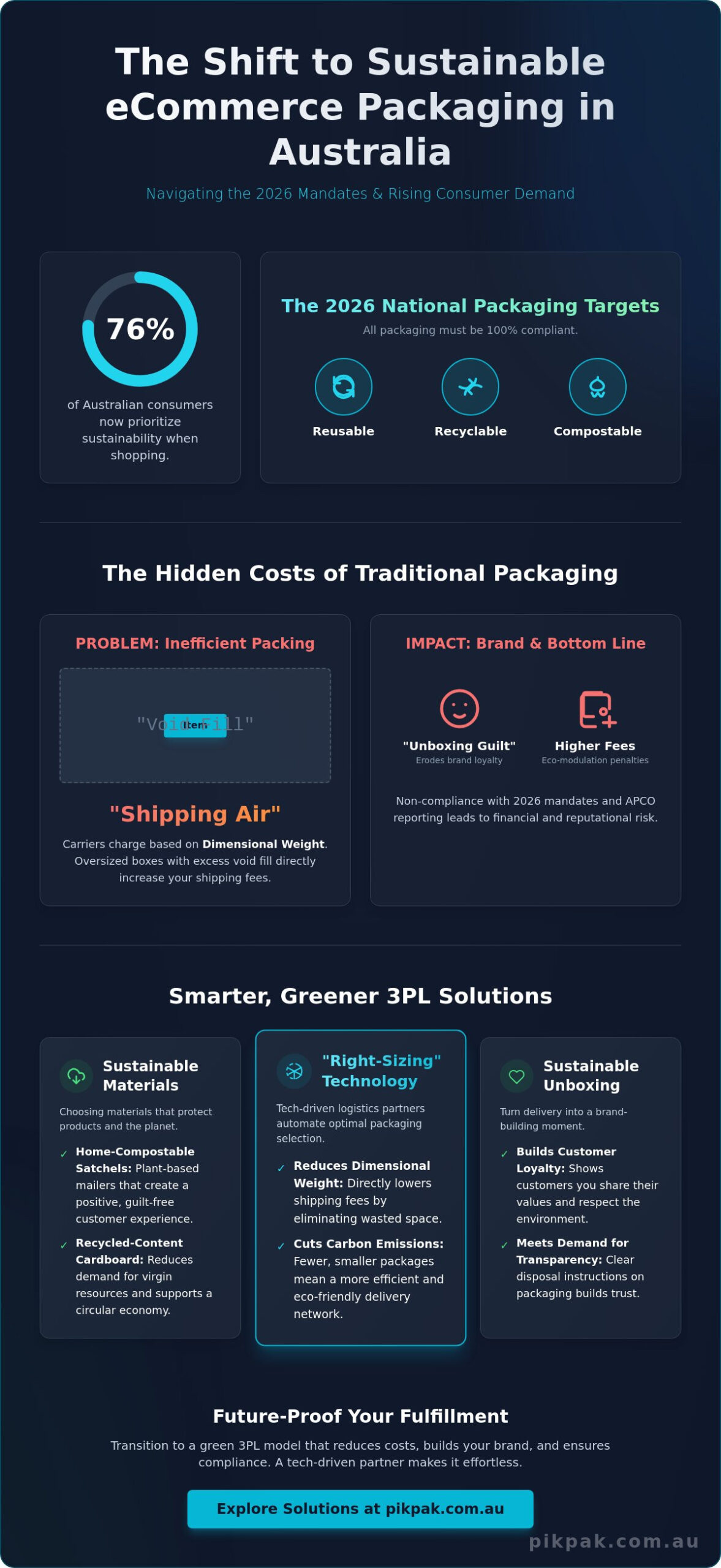
76% of Australian consumers now prioritize sustainability when they shop, which means your choice of mailer is no longer just a line item; it’s a brand statement. With 100% of packaging now required to be reusable, recyclable, or compostable under the 2026 mandates, the pressure to find viable eco-friendly packaging options 3pl partners can support has never been higher. You likely feel the sting of rising material costs and the headache of customer complaints regarding excessive plastic waste. It is a complex shift, but it doesn’t have to drain your margins or your time.
We agree that balancing environmental goals with a healthy bottom line is a major challenge for growing eCommerce brands. This guide will show you how to transition to sustainable materials while actually optimizing your shipping costs through better dimensional weight management. We will explore the latest in compostable satchels, recycled content, and the eco-modulation of fees that rewards smarter choices. You’ll learn how to choose a logistics partner that reduces your environmental footprint and turns your operations into a competitive advantage.
Key Takeaways
- Understand the 2026 Australian packaging mandates and how to audit your fulfillment workflow to eliminate unnecessary waste.
- Explore the most effective eco-friendly packaging options 3pl providers use to protect your products without relying on single-use plastics.
- Learn how “right-sizing” technology reduces dimensional weight, helping you lower shipping fees while cutting carbon emissions.
- Discover how a tech-driven logistics partner automates sustainable packaging selection to save you time and maintain operational consistency.
- Leverage sustainable unboxing experiences to build customer loyalty and meet the growing demand for environmental transparency.
The Rise of Eco-Friendly Packaging in Australian 3PL
Australian eCommerce is evolving at a rapid pace, with online spending reaching $82.6 billion in 2025. This scale brings a new level of scrutiny to the logistics industry. For years, the standard fulfillment model prioritized “one-size-fits-all” boxes, often resulting in excessive waste. Today, the focus has shifted toward a circular economy where materials are kept in use for as long as possible. The 2026 National Packaging Targets are the primary driver of this change, making it mandatory for all packaging to be 100% reusable, recyclable, or compostable. Choosing the right eco-friendly packaging options 3pl services provide is now a core business strategy rather than a secondary concern.
Consumer Demand and Brand Loyalty
Three in four Australian shoppers now choose sustainable options when they shop. This preference isn’t just about the product itself; it’s about the entire delivery experience. When a customer receives a small item in a massive box filled with plastic air pillows, it creates immediate “unboxing guilt.” This friction erodes brand loyalty and can lead to public complaints on social media. Moving toward a carbon-conscious model shows your customers that you respect their values. It transforms a simple delivery into a point of brand reinforcement. Using sustainable packaging sends a clear message that your brand is prepared for the future. It builds trust by proving you are taking tangible steps to reduce your environmental footprint.
The shift toward sustainability is also linked to the broader “Circular Economy” in logistics. This model aims to eliminate waste by design. Instead of the traditional “take-make-dispose” approach, a circular model focuses on materials that can be easily integrated back into the system. For eCommerce brands, this means selecting eco-friendly packaging options 3pl partners can reliably source, such as home-compostable mailers or FSC-certified cardboard. These choices ensure that your packaging doesn’t end up in a landfill, meeting both consumer expectations and upcoming legal standards.
The True Cost of Packaging Waste
Traditional 3PL models often lead to excessive “void fill” and oversized boxes because they lack the technology to optimize carton selection. This waste isn’t just bad for the planet; it’s expensive for your business. Carriers charge based on dimensional weight, which means shipping air directly increases your shipping fees. The importance of efficient warehousing extends to how items are packed and staged for delivery. Every extra centimetre of space in a box adds to your operational overhead.
Using non-biodegradable tape and plastic bubble wrap also adds to the environmental toll. Under the new 2026 regulations, businesses with an annual turnover exceeding $5 million must report their packaging usage. Organizations like APCO are implementing “eco-modulation” for membership fees. This means companies using high-impact packaging will likely face higher costs, while those using sustainable alternatives may be eligible for reduced fees. Transitioning to smarter packaging isn’t just a moral choice; it’s a pragmatic way to protect your margins and simplify your compliance requirements.
Essential Eco-Friendly Packaging Options for Modern 3PL
Selecting the right materials is the first practical step toward meeting the 2026 mandates and satisfying your customers. It isn’t just about replacing plastic with paper. It’s about choosing materials that maintain structural integrity throughout the rigours of the Australian shipping network. When evaluating eco-friendly packaging options 3pl partners can integrate into your workflow, you need to balance protection, cost, and end-of-life disposal. High-quality sustainable materials now perform as well as, or better than, their traditional counterparts while significantly reducing your brand’s environmental footprint.
Biodegradable and Compostable Solutions
Plant-based mailers have become a staple for apparel and non-fragile goods. However, there’s often confusion regarding how customers should dispose of them. Clear communication on your packaging is vital to ensure these materials don’t end up in the wrong waste stream. In logistics, compostable materials break down into nutrient-rich organic matter within a set timeframe, while biodegradable items eventually break into smaller components through biological processes without a guaranteed schedule. To be truly effective, prioritize “home compostable” satchels. These allow your customers to dispose of packaging in their own garden bins, creating a frictionless and positive brand experience.
Recycled-content cardboard remains the backbone of sustainable shipping. Most high-quality 3PL boxes now feature high percentages of post-consumer waste. To ensure your choices align with national standards, refer to the Sustainable Packaging Guidelines provided by APCO. These frameworks help you move beyond guesswork and select materials that are genuinely circular. Don’t overlook the smaller details like adhesives. Switching to water-activated tape (WAT) or paper-based labels makes the entire carton easily recyclable in a single step, removing the need for customers to strip off plastic tape before disposal.
Protective Packaging for Fragile Goods
Protecting delicate items no longer requires layers of plastic bubble wrap or polystyrene peanuts. Innovative eco-friendly packaging options 3pl providers now use honeycomb paper (often called hex wrap) and FSC-certified corrugated inserts. These materials provide excellent shock absorption and interlocking strength, ensuring your products arrive in perfect condition. For specialized industrial applications where standard paper isn’t sufficient, custom foam inserts for shipping provide precision-engineered protection for high-value components. For small gaps, cornstarch-based packing peanuts offer a pragmatic solution; they provide the same cushioning as foam but dissolve completely in water, leaving no microplastics behind.
Ensuring durability during the “last mile” is the ultimate test for any packaging choice. Sustainable materials must withstand humidity, stacking pressure, and multiple touchpoints across the domestic courier network. Optimising customer delivery starts with a pack that is as tough as it is green. If you’re ready to modernize your fulfillment strategy, you can explore our fulfillment services to see how we help brands transition to smarter, more sustainable operations without sacrificing speed or security.
Operational Sustainability: Beyond the Box
Real sustainability in fulfillment happens before the tape is even applied. While choosing the right materials is essential, the way those materials are used defines your operational efficiency. This is where the concept of “right-sizing” becomes a game-changer for eCommerce brands. By matching the box size perfectly to the order, you eliminate the need for excessive void fill and reduce the total carbon footprint of every delivery. It’s a pragmatic approach that aligns your environmental goals with your financial ones.
Right-Sizing and Dimensional Weight (DIM)
Most Australian carriers charge based on dimensional (DIM) weight. If your 3PL uses oversized boxes for small items, you’re effectively paying to ship air. This inefficiency directly conflicts with Australia’s National Packaging Targets, which aim to reduce unnecessary packaging across the supply chain. Pragmatic logistics means using data to ensure every order uses the smallest possible footprint. Reducing your average box size by just 20% can lead to significant savings in freight costs while ensuring your brand remains compliant with 2026 standards. It’s about precision; when you eliminate the “air” in your supply chain, you lower your costs and your carbon impact simultaneously.
Technology-Driven Waste Reduction
A modern Warehouse Management System (WMS) takes the guesswork out of packing. Instead of a packer choosing a box by sight, the system calculates the optimal eco-friendly packaging options 3pl staff should use based on the pre-recorded dimensions of your products. This automation ensures consistency and eliminates the human error that leads to material waste. It’s a simple, tech-led solution that keeps your operations lean and your packaging usage predictable.
Your Transport Management System then takes this efficiency further by selecting the most carbon-efficient route for the final mile. Operational sustainability also means accuracy. High inventory precision prevents the need for “re-shipping” items due to errors, which is one of the most hidden sources of carbon waste in logistics. By utilizing digital pick-slips and automated reporting, you can run a paperless warehouse that respects both your time and the environment. Furthermore, kitting and assembly services allow you to bundle multiple items into a single, optimized package. This consolidated approach reduces the number of touchpoints and individual packages in the network, making your entire delivery cycle more efficient and less resource-intensive.
How to Transition Your Brand to a Green 3PL Model
Moving from a traditional fulfillment setup to a sustainable one is a phased process that requires more than just a change in materials. It’s a strategic shift in how you view your supply chain. To start, you must audit your current workflow to identify exactly where waste occurs. This transition is much easier when you’re identifying the best eco-friendly packaging options 3pl partners provide, ensuring your environmental goals don’t clash with your operational needs. A successful shift relies on a partnership where your logistics provider acts as a proactive extension of your brand values.
The 3PL Sustainability Audit
Begin by asking your provider specific questions about their internal waste management. Do they have a clear strategy for recycling pallet wrap and used cartons? You should also verify that their supply chain includes FSC (Forest Stewardship Council) certifications for all paper-based materials. This ensures the wood used in your boxes comes from responsibly managed forests. Understanding logistics service priorities helps you align with a partner that values transparency and resource efficiency as much as you do. A thorough audit ensures you aren’t just “greenwashing” but are making a genuine impact on your carbon footprint.
Once you’ve verified the provider’s credentials, it’s time to test new eco-friendly packaging options 3pl staff can integrate into your daily orders. Start with a small batch and monitor the results. Send a few “green” orders to team members or loyal customers to gather feedback on the unboxing experience and the durability of the materials. When you’re confident in the performance, update your eCommerce store settings. Let your customers know that their order will arrive in sustainable packaging. This transparency builds trust and justifies the transition to your audience while setting a new standard for your brand’s delivery experience.
Implementing Sustainable Returns
Reverse logistics is a hidden source of carbon waste. When a customer returns an item, it travels the same distance again, often in a fresh set of packaging. You can mitigate this by designing your mailers with a second adhesive strip, allowing customers to reseal the original bag for its return journey. The recommerce trend in 2026 sees retailers integrating resale platforms directly into their reverse logistics to ensure returned items find a second life instead of a landfill. This closed-loop approach reduces waste and keeps products in circulation longer.
Measuring your wins is the final step in the transition. Track the reduction in your total packaging volume and the percentage of recycled materials used across your inventory. Share these statistics with your customers through your marketing channels to show tangible progress. If you’re ready to streamline your transition, you can partner with a tech-savvy 3PL that handles the heavy lifting for you. This allows you to refocus on growing your brand while we manage the complexities of green fulfillment and modern logistics.
Effortless Sustainability with Pik Pak Logistics
Integrating sustainable practices into your fulfillment workflow shouldn’t feel like a second job. At Pik Pak Logistics, we’ve designed our systems to make the transition to eco-friendly packaging options 3pl providers offer as seamless as possible. We handle the operational friction so you can focus on building your brand. Our approach is grounded in precision and the elimination of waste, ensuring your business scales efficiently without expanding its environmental footprint.
Our custom kitting and assembly services are a key part of this strategy. We work with you to design sustainable brand presentations that replace traditional plastic fillers with FSC-certified paper or biodegradable alternatives. By bundling items at the warehouse level, we reduce the total amount of packaging used and ensure every order is optimized for both protection and presentation. This level of detail ensures your customers enjoy a premium, waste-free unboxing experience that reflects your commitment to the planet.
Our Tech-Forward Approach
Efficiency starts with data. Our WMS platform provides real-time visibility into your inventory, which is essential for preventing overstocking. Overstocking often leads to dead stock and eventually, physical waste; our systems help you maintain lean, accurate inventory levels. We offer seamless integration with Shopify, WooCommerce, and other major platforms, ensuring that your orders flow directly into our optimized fulfillment process without manual intervention. Understanding what is order fulfilment in a modern context means leveraging these technologies to remove every possible inefficiency from your supply chain.
Reclaim Your Time and Focus on Growth
Outsourcing your logistics to a specialist is the fastest way to meet the 2026 sustainability standards. We take over the burden of sourcing compliant materials, managing complex recycling requirements, and optimizing dimensional weight. This allows you to reclaim your time and refocus on your core business objectives. You don’t need to become an expert in biodegradable polymers or national packaging targets; you just need a partner who is. Let us manage the backend while you prioritize growth and customer engagement. If you’re ready to simplify your operations, you can get a custom quote for sustainable 3PL services today and see how we can help your brand lead the way in eco-friendly eCommerce.
Future-Proof Your Fulfillment Strategy
Transitioning to a green model is about more than just swapping plastic for paper. It requires a tech-driven approach that eliminates waste through right-sizing and precise inventory management. By aligning with the 2026 National Packaging Targets, you protect your margins and satisfy the high percentage of Australian shoppers who value sustainability. Evaluating the variety of eco-friendly packaging options 3pl partners offer is a pragmatic step toward building long-term brand equity.
At Pik Pak, we specialize in Australian eCommerce fulfillment. We provide a state-of-the-art WMS for maximum accuracy and pragmatic solutions for complex logistics. We handle the operational friction so you don’t have to. Our goal is to make your transition to sustainable shipping effortless and efficient.
Scale your brand sustainably with Pik Pak’s expert 3PL services
The shift to sustainable logistics doesn’t have to be a burden. With the right partner, you can turn operational hurdles into a competitive advantage and refocus on your growth.
Frequently Asked Questions
Is eco-friendly packaging more expensive for 3PL users?
While material costs for items like compostable satchels can be higher than virgin plastic, the gap is narrowing as demand increases and traditional plastic faces environmental levies. You can often offset these costs by optimizing your dimensional weight and avoiding the higher “eco-modulation” fees introduced by regulatory bodies. Transitioning to eco-friendly packaging options 3pl providers support is a pragmatic way to avoid penalties while building brand value.
Can sustainable packaging survive international shipping from Australia?
High-quality sustainable materials are specifically designed to withstand the humidity and stacking pressures of long-distance transit. Reinforced recycled-content cardboard and industrial-strength bio-satchels offer comparable puncture resistance to traditional plastics. We ensure your goods remain secure across every touchpoint of the global courier network by using materials that meet international durability standards without compromising on environmental ethics.
What is the best eco-friendly alternative to plastic bubble wrap?
Honeycomb paper, often called hex wrap, is the most effective and professional alternative to plastic bubble wrap. It provides excellent interlocking protection and shock absorption for fragile items. For smaller gaps, cornstarch-based packing peanuts are a great choice; they offer the same cushioning as polystyrene but dissolve completely in water, leaving no microplastics behind.
How does right-sizing my packaging save me money on shipping?
Right-sizing reduces the “air” in your boxes, which directly lowers your dimensional (DIM) weight. Because Australian carriers charge based on the space a package occupies rather than just its actual weight, smaller boxes lead to lower shipping rates. Using a 3PL with an integrated WMS ensures the system selects the smallest possible carton for every order, protecting your margins and reducing material waste simultaneously.
Does Pik Pak offer custom eco-friendly kitting services?
Yes, we provide specialized kitting and assembly services designed to help you create a sustainable and premium unboxing experience. We can bundle your products using eco-friendly inserts and customized layouts that eliminate the need for traditional plastic fillers. This service allows you to maintain a high-end brand feel while adhering to the 2026 mandates for reusable or compostable packaging.
How do I tell my customers that my packaging is compostable?
The most effective way is to print disposal instructions directly on the packaging using eco-friendly inks. Clear labelling, such as the Australasian Recycling Label (ARL), helps customers distinguish between home compostable and industrially compostable materials. You can also include a QR code on your packing slip that leads to a digital guide, reinforcing your brand’s commitment to transparency without using extra paper.
What certifications should I look for in sustainable packaging materials?
Look for Forest Stewardship Council (FSC) certification for paper and cardboard to ensure responsible forest management. For compostable plastics, check for the AS 5810 (Home Compostable) or AS 4736 (Industrial Compostable) standards. These certifications provide verifiable proof that your eco-friendly packaging options 3pl materials meet strict environmental criteria, protecting you from greenwashing claims and ensuring compliance with Australian regulations.
Can I use my own custom eco-friendly boxes with a 3PL?
Most 3PL providers allow you to supply your own custom-branded eco-friendly boxes and mailers. You simply need to ensure they meet the warehouse receiving guidelines regarding dimensions and durability for storage and handling. Using your own materials gives you full control over the aesthetic and environmental impact of your packaging while leveraging our professional pick, pack, and ship infrastructure.