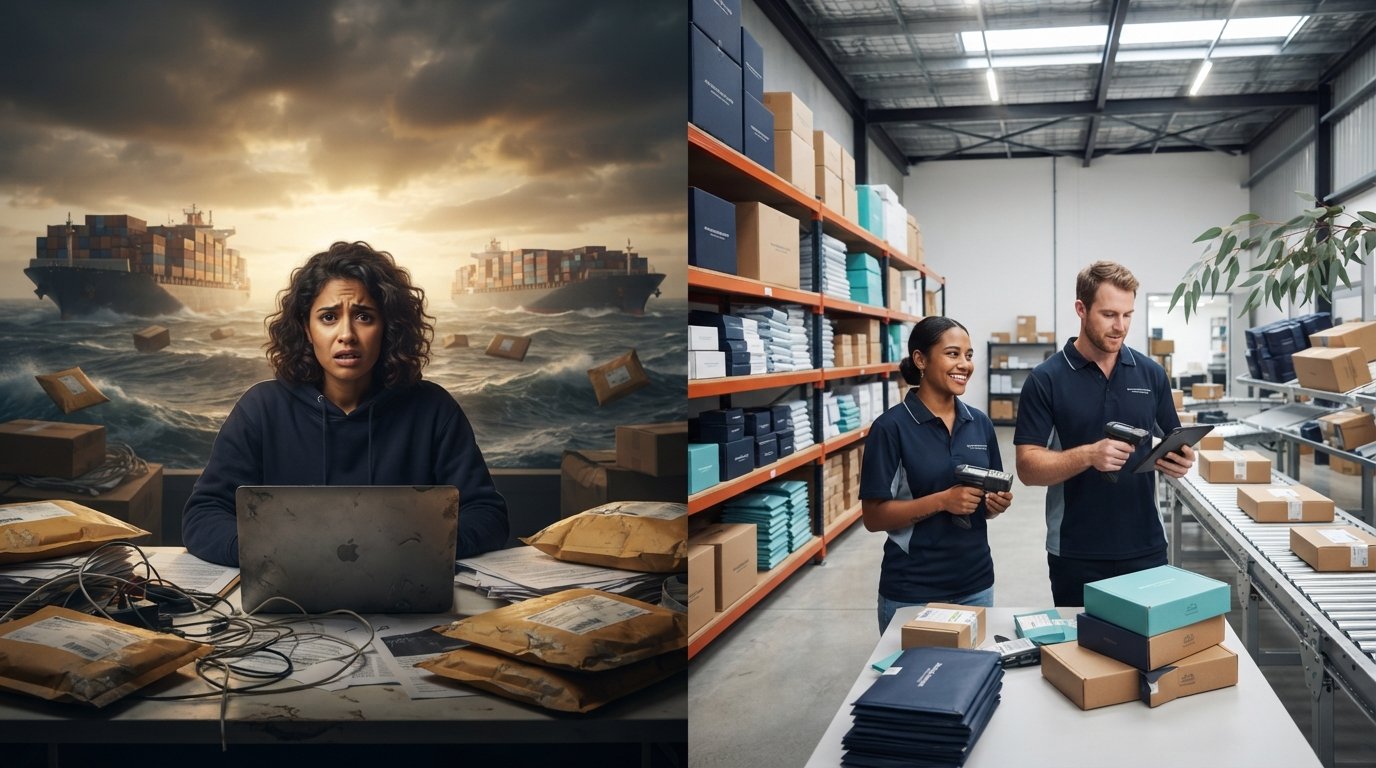
Dropshipping is a brilliant laboratory for testing new product ideas, but it’s a terrible engine for scaling a real business. If you’re weighing dropshipping vs 3PL fulfillment for your Australian eCommerce store, you’re probably asking the ultimate question: should you stick with zero inventory risk to save on overhead, or will shifting to a 3PL make you more profitable in the long run?
You already know the frustration of relying on overseas suppliers. Unpredictable multi-week shipping times, battered generic mailers, and chaotic return logistics quickly eat away at customer goodwill. Dealing with tracking inquiries shouldn’t dominate your working hours, nor should it restrict your net margins to the bare minimum.
In this guide, you’ll discover the critical operational differences between both models so you can protect your margins and scale sustainably. We break down the realities of delivery speeds, bulk procurement savings, and branded unboxing, showing you the exact operational tipping point to transition your logistics seamlessly.
Key Takeaways
- Learn how shifting from single-order overseas fulfillment to domestic inventory storage instantly slashes transit times and eliminates supplier dependency.
- Discover how custom kitting and branded packaging turn standard deliveries into high-retention customer experiences that dropshipping can’t match.
- Compare the real economics of dropshipping vs 3PL to see how wholesale purchasing and local distribution dramatically expand your net profit margins.
- Identify the critical customer support and order volume tipping points that indicate your eCommerce store is ready to transition models.
- See how partnering with an Australian fulfillment specialist and using a cloud WMS allows you to reclaim valuable hours to focus on marketing and growth.
Understanding the Core Mechanics: Dropshipping vs 3PL Fulfillment
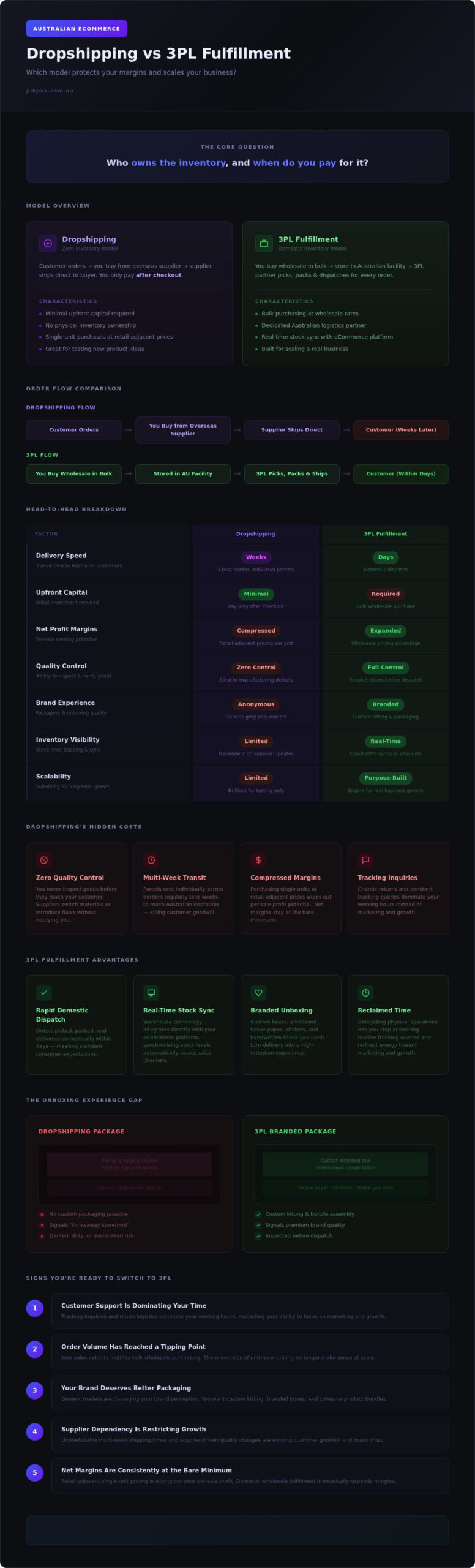
At a foundational level, the debate of dropshipping vs 3pl centers on a single operational question: who owns the inventory, and when do you pay for it? Both setups remove the physical burden of packing parcels in your living room, but they manage products through completely different workflows.
Dropshipping is a retail model where your store never touches physical stock. When an Australian customer places an order, you purchase the item from a third-party supplier who ships it directly to the buyer. You only pay for goods after a customer buys them.
A third-party logistics (3PL) provider, by contrast, manages fulfillment for inventory you already own. You procure products in bulk at wholesale rates, store them in a domestic facility, and delegate picking, packing, and dispatch to a dedicated logistics partner.
How the Dropshipping Model Operates
Dropshipping functions as a direct, single-order chain. Your customer buys an item online, your store routes that order to an overseas supplier, and that supplier ships a single package straight to your customer’s door.
Because you purchase inventory only after checkout occurs, upfront capital requirements remain minimal. That zero-inventory setup feels low risk initially. However, it quickly becomes a double-edged sword for ambitious brands:
- Zero quality control: You never physically inspect goods before they arrive in your customer’s hands.
- Lagging transit times: Parcels sent individually across borders regularly take weeks to reach Australian doorsteps.
- Compressed margins: Purchasing single units at retail-adjacent prices wipes out your per-sale profit potential.
How 3PL Logistics Streamlines Operations
A 3PL setup shifts physical handling to an Australian fulfillment centre. Instead of trickling individual parcels overseas, you ship wholesale batches into a local facility.
Leveraging a professional 3pl warehouse transforms how your eCommerce store operates day to day:
- Rapid domestic dispatch: Orders are picked, packed, and delivered domestically within days, meeting standard consumer expectations.
- Real-time inventory visibility: Warehouse technology integrates directly with your eCommerce platform, synchronising stock levels automatically across sales channels.
- Reclaimed time: Handing over physical operations lets you stop answering routine tracking queries and redirect your energy toward marketing and customer acquisition.
Ultimately, assessing dropshipping vs 3pl isn’t just about moving parcels; it’s about deciding whether your supply chain restricts your growth or acts as a competitive advantage.
The Brand Ownership Debate: Quality Control and Customer Experience
A customer’s physical encounter with your parcel shapes their long-term perception of your brand. In the dropshipping vs 3pl debate, this dynamic forms a stark dividing line. Dropshipping keeps your brand virtually anonymous, while a dedicated logistics setup turns delivery into a strategic touchpoint.
When an overseas factory dispatches an item, goods typically travel in flimsy grey poly-mailers covered in foreign customs declaration labels. If products arrive dented, dirty, or mislabelled, you only hear about it when an angry review appears. By contrast, housing stock domestically lets you set clear packaging standards and resolve quality issues before parcels reach letterboxes.
Owning the Unboxing Experience
First impressions carry immense psychological weight. Thoughtful presentation signals quality and encourages repeat orders, whereas generic packaging tells the customer they bought from a throwaway storefront.
Kitting transforms individual items into cohesive product bundles that elevate perceived retail value. With a domestic partner handling assembly, you can introduce custom boxes, embossed tissue paper, stickers, and handwritten thank-you cards. When looking to upgrade this post-purchase experience, exploring comprehensive logistics and kitting services ensures your packaging aligns with the premium image you want to project.
Reliability and Quality Assurance
Dropshipping carries the persistent risk of sending out mystery products. Suppliers switch raw materials, alter dimensions, or introduce flaws without notifying you, leaving you entirely blind to manufacturing defects.
Partnering with a professional pick and pack warehouse removes that uncertainty through disciplined operational checks:
- Inbound receiving verification: Bulk stock is counted and inspected upon arrival to catch supplier errors immediately.
- Precise picking: Barcode scanning systems confirm every selected SKU matches the order ticket exactly.
- Secure packing: Items are wrapped with appropriate protective void fill, preventing transit damage during final-mile delivery.
Then comes reverse logistics. Dropshipping makes returns painful; asking an Australian customer to post an unwanted dress back to an international depot is costly and drives friction. A local warehouse receives returns directly, restocks undamaged goods immediately, and keeps customer loyalty intact.
Financial Realities: Comparing the Cost and Profit Margins
Logistics isn’t just an operational preference; it determines your bottom line. Evaluating dropshipping vs 3pl through a financial lens reveals a clear trade-off between upfront cash flow flexibility and long-term earning power.
Dropshipping looks appealing because starting requires zero inventory investment. However, paying for goods one item at a time means paying top dollar for every single SKU. Factor in steep ad acquisition costs and international shipping markups, and net profit margins routinely slip into single digits. You absorb all the marketing risk while the overseas supplier pockets the manufacturing margin.
A third-party logistics model shifts that equation. While buying inventory upfront requires working capital, securing wholesale rates cuts your landed cost per unit substantially. That gap between wholesale cost and retail price creates the gross profit margin necessary to scale sustainably.
The Unit Cost Advantage
The core financial lever is bulk purchasing power. Buying 500 units from a factory drops your unit procurement cost far below what an individual dropship supplier charges for single-order dispatch.
Pairing bulk inventory with efficient 3pl logistics drives a predictable return on investment because the margin gained from wholesale volume discounts easily offsets storage and fulfillment expenses. Higher margins also give you room to outspend competitors on customer acquisition without burning through cash.
Shipping and Fulfillment Fees
Shipping single parcels from overseas into Australia creates compounding hidden expenses. Consider what actually happens behind the scenes:
- Inflated individual parcel rates: International courier fees on single items quickly surpass consolidated sea or air freight amortised over a large batch.
- High customer churn: Australian buyers expecting local delivery standards churn after enduring two-week waits, forcing you to constantly spend money acquiring new shoppers.
- Customer service overhead: Handling constant inquiries about delayed parcels drains hours of productive administrative time every week.
Transitioning to local domestic delivery standardises your costs. Orders dispatched from an Australian facility reach buyers in days through local carrier networks, dramatically reducing buyer friction.
Automated technology support eliminates manual data entry by routing orders instantly from your digital storefront to warehouse picking teams. You spend less time resolving tracking discrepancies and more time growing the business.
When you contrast dropshipping vs 3pl over a twelve-month horizon, holding stock locally consistently yields healthier profit margins and stronger cash flow predictability.
The Tipping Point: When to Switch from Dropshipping to 3PL
You don’t need millions in revenue to outgrow dropshipping. The decision to switch between dropshipping vs 3pl usually becomes clear when operational friction threatens your growth. When handling day-to-day logistics headaches consumes your focus, you lose the bandwidth needed to market and build your company.
Watch for these five definitive operational signals that tell you it’s time to upgrade:
- Overwhelmed inbox: Your customer support desk spends half its day answering “Where is my order?” tickets caused by overseas transit delays.
- Sluggish transit times: Deliveries routinely drag past 5 to 7 business days, driving away Australian shoppers who expect prompt domestic fulfillment.
- Proven bestseller SKUs: You have validated steady demand for specific products and need to secure your supply chain against sudden supplier stockouts.
- Omnichannel ambition: You plan to expand beyond a single online shop into wholesale, marketplaces, or retail distribution.
- A commitment to brand longevity: You want repeat customers and lifetime value rather than one-off arbitrage transactions.
Analyzing Your Growth Metrics
Take an honest look at your monthly numbers. Most Australian eCommerce stores hit the tipping point between 100 and 300 orders per month. At this sales volume, customer acquisition costs demand high retention rates. Slow international delivery damages customer lifetime value, while the cumulative processing fees of single-item shipping erode your cash flow.
Pinpoint your top-performing SKUs. If two or three products generate the bulk of your revenue, buying those items wholesale and placing them in a local warehouse immediately stabilizes your margins.
Operational Readiness for 3PL
Transitioning to a dedicated warehouse is much simpler than most founders expect. Modern cloud platforms connect directly to your digital storefront via API, routing orders to warehouse packing benches automatically without manual spreadsheet entry.
Before booking your first inventory freight shipment, consult your partner’s warehouse receiving guidelines. Proper carton labelling, packing slips, and barcode compliance ensure warehouse staff can check in and shelf your stock rapidly.
Select a partner capable of supporting you from 100 monthly dispatches right through to 10,000. Ready to eliminate fulfillment bottlenecks and reclaim your time? Connect with Pik Pak today to scale your Australian deliveries effortlessly.
Choosing Your Partner: Why Pik Pak is the Logical Step for Scaling
Moving past the dropshipping vs 3pl crossroad shouldn’t feel intimidating. Many third-party logistics providers cater exclusively to massive enterprise corporations, imposing rigid lock-in contracts and demanding thousands of monthly dispatches. Growing Australian businesses need a pragmatic logistics partner that meets them where they are today while building the foundation for where they’re heading tomorrow.
Operating from Melbourne, Pik Pak delivers local fulfillment expertise designed specifically for scaling Australian eCommerce merchants. We dismantle the friction of international supply lines by turning warehousing and dispatch into a clean, predictable workflow. You retain total control over your inventory without ever having to pack another box yourself.
Technology That Empowers Your Brand
Modern fulfillment runs on reliable software. Pik Pak’s cloud-based warehouse management system (WMS) connects directly with leading eCommerce platforms, including Shopify and WooCommerce, synchronising orders and inventory automatically.
Our digital infrastructure keeps your operation running smoothly around the clock:
- Automated tracking updates: Dispatched orders instantly push carrier tracking details directly to your customers, resolving delivery anxiety before it starts.
- Real-time stock alerts: Monitor warehouse volume from any device and receive automated notifications to reorder stock before running out.
- Multi-channel coordination: Manage sales across your website and digital marketplaces through one unified inventory source.
A Pragmatic Approach to Logistics
Reclaiming your time is the greatest operational benefit of outsourcing. Every hour spent coordinating with overseas suppliers, handling damaged goods, or packing parcels is an hour taken away from paid advertising, product sourcing, and brand development.
By delegating daily operations, you can concentrate on strategic growth while we handle end-to-end warehousing, pick-pack processing, and domestic customer delivery. Our Melbourne-based team provides transparent processes and direct, responsive support so you always know where your inventory stands.
If you’re ready to break free from the constraints of the dropshipping vs 3pl dilemma and build an enduring, profitable brand, let’s talk. Take control of your supply chain and request a quote from Pik Pak Logistics today.
Build a Resilient Supply Chain That Fuels Long-Term Growth
Testing concepts through dropshipping can launch an online store, but it can’t sustain brand equity. When deciding between dropshipping vs 3pl, the choice ultimately comes down to ownership: owning your product presentation, protecting your unit margins, and controlling how buyers perceive your brand.
Transitioning to dedicated fulfillment eliminates operational bottlenecks and gives your eCommerce business room to expand sustainably. With Melbourne-based secure fulfillment, seamless eCommerce integrations, and real-time WMS tracking, you maintain absolute visibility across your catalogue without the stress of manual warehouse management. You get to step away from daily fulfillment friction and refocus your energy entirely on marketing, product curation, and customer acquisition.
Take the next step toward operational freedom and higher margins. Scale your business with Pik Pak’s effortless 3PL services and build a delivery experience that keeps Australian shoppers coming back.
Frequently Asked Questions
Is 3PL more expensive than dropshipping for a startup?
Upfront, yes, because a 3PL requires purchasing wholesale inventory before making sales. Dropshipping avoids upfront inventory costs entirely. However, when comparing ongoing dropshipping vs 3pl operations, 3PL fulfillment provides significantly lower cost-per-unit rates. Those bulk savings generate healthier net profit margins that easily offset domestic warehousing expenses once sales start flowing.
Can I use a 3PL if I only sell a few items a day?
Yes, provided you choose a flexible fulfillment partner. While legacy warehouses enforce strict minimum order quotas, modern providers welcome growing brands dispatching just a handful of parcels daily. Look for pay-as-you-go providers without long-term contract lock-ins so your storage and handling costs scale naturally alongside your real sales volume.
How long does it take to switch from dropshipping to a 3PL?
Most eCommerce brands complete the technical transition in just a few days. Connecting your store platform via pre-built API integrations takes minimal technical effort and immediately syncs orders. The primary lead time is simply waiting for your initial wholesale inventory shipment to arrive, be checked in, and get placed onto warehouse shelves.
Who handles the returns when using a 3PL service?
Your 3PL partner manages reverse logistics on your behalf. Rather than forcing Australian customers to ship returns overseas, returns are sent straight to the domestic warehouse. Receiving teams inspect the items, verify product condition, restock undamaged goods into your active inventory, and notify your support team via the warehouse management platform.
Do I need my own warehouse to use 3PL logistics?
No, eliminating the need for your own facility is the primary purpose of outsourcing. A 3PL provides shared, secure warehouse space alongside dedicated picking and packing teams. You get enterprise-grade storage infrastructure and software visibility without signing commercial property leases, purchasing shelving, or managing warehouse floor staff yourself.
What happens if my inventory doesn’t sell in a 3PL warehouse?
Unsold stock simply remains securely stored in the facility, incurring ongoing monthly storage fees based on space used. To prevent slow-moving SKUs from eroding cash flow, monitor inventory velocity closely through your WMS platform. You can run promotional bundles or discount sales to clear stagnant units before bringing in fresh stock.
Is 3PL the same as Amazon FBA?
No, Amazon FBA is a specialized fulfillment service specifically designed for sales through the Amazon marketplace. Independent 3PLs fulfill multi-channel orders across your own independent digital storefronts, like Shopify or WooCommerce, as well as multiple online marketplaces. They also offer greater flexibility for custom branding, tailored packaging, and direct customer communication.
Can a 3PL help with custom packaging and branding?
Yes, reputable 3PLs specialize in custom kitting, assembly, and bespoke unboxing workflows. In the dropshipping vs 3pl comparison, this stands out as a massive benefit. You can supply custom-printed cartons, branded tape, tissue paper, promotional cards, or sample inserts, ensuring every package reinforces your brand identity rather than arriving in a generic mailer.