High shipping costs eroding your margins? Spending more time packing boxes than growing your business? If the daily grind of logistics feels like a major headache, you’re not alone. For many Australian eCommerce store owners, managing shipping is the biggest barrier to scaling. This is where understanding a smarter shipping strategy, like direct freight, becomes a complete game-changer. It’s about creating an efficient, direct line from your product to your customer’s front door, simplifying what seems complex.
In this guide, we make it easy. We’ll break down exactly what direct freight means for your Australian online business. You’ll discover how to create a fast, reliable, and cost-effective shipping strategy that not only protects your profit margins but also delights your customers with every delivery. It’s time to automate your process, eliminate the logistical headaches, and free up your time to focus on what truly matters: scaling your business.
What is ‘Direct Freight’ in eCommerce? (Beyond the Brand Name)
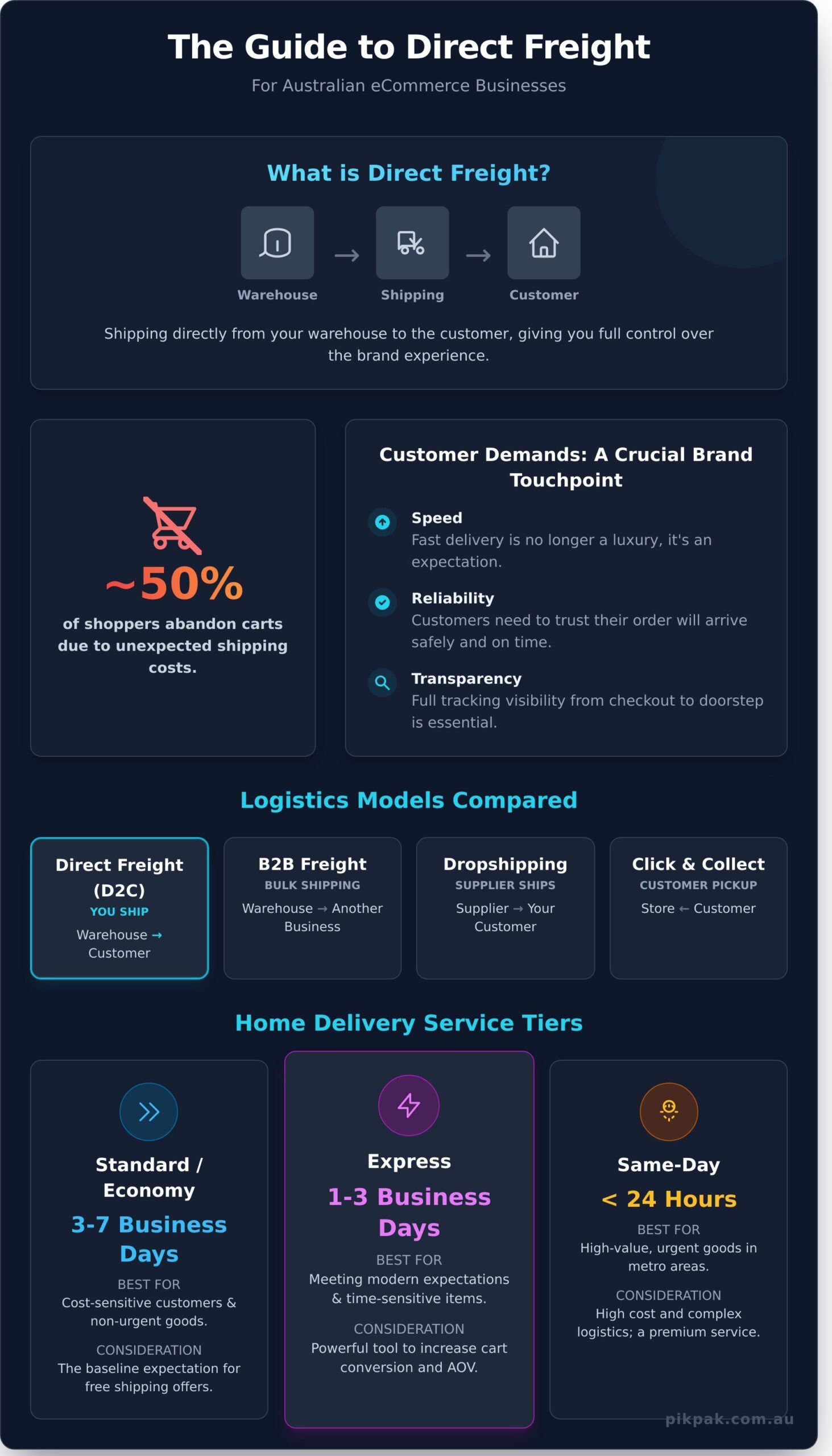
If you’re running an eCommerce business in Australia, the name ‘Direct Freight Express’ likely comes to mind. While they are a major player, the term direct freight in a broader logistics context refers to something more fundamental: the process of shipping an order directly from your warehouse or fulfilment centre to your end customer’s doorstep. It’s the final and most critical link in the supply chain. In the complex world of freight transport, this model is the engine that powers the modern direct-to-consumer brand.
Defining Direct-to-Consumer (D2C) Shipping
D2C shipping is the physical execution of your online promise. The flow is simple: a customer places an order on your website, your system processes it, and the product is picked, packed, and sent straight to their home. The key advantage? You own the entire customer relationship. Unlike selling on a marketplace like Amazon, where the delivery experience is controlled by a third party, D2C shipping means the delivery notification, the branded box, and the unboxing experience are all yours to shape.
Why a Solid Direct Freight Strategy is Non-Negotiable
Getting your products to customers isn’t just a task; it’s a crucial brand touchpoint that can make or break customer loyalty. Today’s shoppers demand speed, reliability, and full transparency with tracking. A poor delivery experience reflects directly on your brand. Furthermore, unexpected shipping costs are a primary driver of lost sales. Studies consistently show that nearly 50% of shoppers abandon their carts at checkout because of high extra costs like shipping fees. A streamlined shipping strategy isn’t an expense-it’s an investment in customer satisfaction and retention.
Direct Freight vs. Other Logistics Models
To understand what D2C freight is, it helps to know what it isn’t. Here’s how it compares to other common models:
- B2B Freight: This involves shipping large quantities, often on pallets, to another business, such as a retail store or a distribution centre. The end recipient is a company, not an individual consumer.
- Dropshipping: In this model, you act as the digital storefront, but a third-party supplier holds the inventory and ships products directly to your customer. You never physically handle the goods.
- Click and Collect: This hybrid model allows customers to buy online and pick up their order from a physical location, like a retail store or a collection point, bypassing home delivery entirely.
The Core Types of Home Delivery Shipping Services
Choosing the right shipping options is more than just a line item on your budget; it’s a critical part of your customer experience strategy. The key is to offer a balanced mix that meets customer expectations without eroding your profit margins. Navigating Australia’s vast delivery network presents unique challenges, a reality acknowledged in the government’s National Freight and Supply Chain Strategy. This makes choosing the right shipping partners and services a simple, yet crucial, decision for your eCommerce success.
Standard & Economy Shipping: The Cost-Effective Baseline
This is the workhorse of eCommerce delivery. With a typical timeframe of 3-7 business days across Australia, it’s the perfect option for non-urgent items where your customers prioritise low-cost or free shipping over speed. What seems like a basic service can be optimised; a 3PL partner like Pik Pak leverages its high shipping volume to secure better economy rates than a single business ever could, turning a standard service into a competitive advantage for you.
Express Shipping: Meeting the Need for Speed
For customers who want their products sooner, express shipping is essential. Typically delivered within 1-3 business days in metro areas, this service is vital for competing with larger retailers and boosting customer satisfaction. A smart strategy is to offer free express shipping on orders over a certain value, such as A$100, which can significantly increase your average order value while delighting your customers.
Same-Day & On-Demand Delivery: The Ultimate Convenience
This premium service is the peak of customer convenience but comes with significant logistical complexity and cost. Generally restricted to major metropolitan areas, same-day delivery is best reserved for high-value goods, last-minute gifts, or essential items where the customer is willing to pay a premium for immediacy. Managing this in-house is a headache; outsourcing makes it a manageable, high-impact offering.
| Service Type | Typical Speed | Best For | Key Consideration |
|---|---|---|---|
| Standard/Economy | 3-7 business days | Cost-sensitive customers, non-urgent goods | The baseline expectation for free shipping. |
| Express | 1-3 business days | Meeting modern expectations, time-sensitive items | A powerful tool to increase cart conversion. |
| Same-Day | Under 24 hours | High-value or urgent goods in metro areas | High cost and complex logistics. |
Ultimately, a successful eCommerce business doesn’t just pick one option. It builds a flexible and cost-effective shipping framework that serves different customer needs. Optimising your direct freight strategy means offering this blend of services seamlessly, which is made simple with the right fulfilment partner handling the complexity for you.
The Hidden Challenges of Managing Direct Freight In-House
As your eCommerce business grows, the DIY approach to fulfilment that once felt empowering can quickly become a major bottleneck. The hours you used to spend on marketing and product development are suddenly consumed by taping boxes and printing labels. What seems like a simple task on the surface hides a web of operational complexity and costs that can stifle your growth. Managing your own direct freight isn’t just about shipping; it’s a full-time job in itself.
The Time Sink: Picking, Packing, and Labeling
Consider the real-time cost. If it takes an average of 10 minutes to pick an item, pack it securely, and print the correct label, just 30 orders a day consumes five hours of your time. That’s time you’re not spending on strategy. This manual process is also prone to human error-a wrong item or an incorrect address leads to costly returns and unhappy customers. Beyond time, there are the physical requirements: dedicated space for inventory, and a constant supply of boxes, mailers, tape, and filler material that you must source and manage.
Carrier Management and Cost Negotiation
Without the high shipping volume of a major enterprise, securing competitive rates from Australian carriers is nearly impossible. You’re left paying standard consumer rates, which directly impacts your profit margins or forces you to pass high costs onto your customers. Managing multiple carrier accounts to find the best price for each delivery is a complex and time-consuming task. This is a well-documented issue; academic research into the challenges of last-mile delivery highlights the immense operational costs and complexities involved in the final stage of getting a parcel to a customer’s door, a burden that falls squarely on your shoulders when you self-fulfil.
Handling Customer Service, Tracking, and Returns
The operational workload doesn’t end once the package is sent. You become the primary point of contact for every “Where Is My Order?” (WISMO) query. Then there’s the entire reverse logistics process-managing returns, inspecting products, and processing refunds or exchanges adds another layer of complexity. Providing the proactive, transparent tracking customers now expect requires constant monitoring. These tasks pull you away from your core business, turning you into a logistics manager instead of a business owner. This is precisely why savvy businesses turn to a 3PL partner to handle their direct freight and reverse logistics, freeing them to focus on growth.
How a 3PL Partner Makes Direct Freight Easy
Managing the complexities of shipping, especially returns, can feel like a full-time job. A third-party logistics (3PL) partner is the ‘easy button’ for your eCommerce fulfilment. By outsourcing your inventory management, picking, packing, and shipping, you instantly solve the challenges of warehouse space, labour costs, and carrier negotiations. It’s about transforming a major operational headache into a streamlined, automated process that saves you time, reduces costs, and allows your business to scale without limitations.
Gain Access to Better Shipping Rates
As a standalone business, securing competitive shipping rates is tough. 3PLs like Pik Pak ship thousands of parcels every day, giving us significant leverage with major Australian carriers. We pass these volume-based discounts directly to you. This means you immediately save money on every order you ship, without needing to negotiate or manage multiple carrier contracts. It’s instant access to enterprise-level rates, no matter your size.
Automate Your Entire Shipping Process
Imagine your orders being fulfilled without you lifting a finger. Our advanced Warehouse Management System (WMS) integrates directly with your eCommerce platform, like Shopify, WooCommerce, or BigCommerce. When a customer places an order, it flows automatically to our system. We pick, pack, and ship it, and the tracking information is sent straight back to your store and your customer. The entire process is hands-free, eliminating manual errors and delays.
Focus On Your Business, Not Your Boxes
Your time is best spent on marketing, product development, and customer engagement-not printing labels and taping boxes. Handing over your logistics lets you focus on the activities that actually grow your brand. Let the experts manage the complexities of warehousing and direct freight so you can reclaim your time and energy. We handle the hard work, so you can get back to business. See how Pik Pak can streamline your shipping today.
Choosing the Right Direct Freight Partner in Australia
Selecting the right third-party logistics (3PL) provider is more than just outsourcing shipping; it’s about choosing a partner to help your business scale. The right direct freight partner can transform your returns management from a costly headache into a streamlined, efficient process that builds customer loyalty. Here’s a simple checklist to help you make the right choice for your eCommerce store.
Technology & Integration Capabilities
Your partner’s technology should make your life easier, not more complicated. The goal is seamless automation that lets you focus on your business. Before committing, ask these key questions:
- Does their software connect easily with your eCommerce platform? Look for simple, point-and-click integrations with major platforms like Shopify, WooCommerce, and eBay.
- Do they provide a real-time dashboard? Complete visibility over inventory levels, order status, and returns processing is non-negotiable.
- Is the system easy to use? You shouldn’t need to be a computer geek to manage your logistics. An intuitive interface is essential.
Warehouse Location and Network
In a country as vast as Australia, location is everything. A strategically placed warehouse minimises shipping times and reduces costs, which is crucial for both outbound orders and inbound returns. A centrally located fulfillment centre in a major hub like Melbourne can reach over 80% of Australia’s population within days, ensuring your customers experience a fast and affordable service.
Pricing Model and Scalability
Your logistics costs should align with your sales volume, not hold you back. Look for a partner who offers a transparent, flexible pricing structure that supports your growth. Avoid hidden fees and rigid contracts.
- Look for a transparent, ‘pay-as-you-go’ pricing model so you only pay for what you use.
- Avoid partners with high monthly minimums or long-term, lock-in contracts that stifle flexibility.
- Ensure they have the capacity and systems to handle your order volume as you grow, especially during peak seasons.
Finding a partner who ticks all these boxes ensures your entire fulfillment and returns process will run like clockwork. When your direct freight and logistics are made easy, you build a stronger brand and create happier, more loyal customers. Ready to find a partner that simplifies it all? Learn how Pik Pak can help you scale.
Make Direct Freight Your Competitive Advantage
Mastering home delivery is no longer just an option for Australian eCommerce stores-it’s essential for customer loyalty and growth. As we’ve explored, managing the complexities of shipping in-house can quickly become a drain on your time and resources. The key to success lies in transforming this challenge from an operational headache into a streamlined, reliable part of your brand experience.
This is where a dedicated 3PL partner makes all the difference. Pik Pak takes the complexity out of direct freight, allowing you to focus on what you do best. With seamless integration for all major eCommerce platforms, transparent pay-as-you-go pricing, and expert support to help you scale, we make world-class logistics easy and accessible.
Stop letting logistics hold you back. It’s time to deliver excellence. Get a free quote and see how easy direct freight can be.
Frequently Asked Questions
What’s the difference between a freight company and a courier?
The main difference is scale. Couriers, like Australia Post or Sendle, are designed to handle smaller, individual parcels and documents quickly. They are perfect for delivering single orders directly to your customers. A freight company specialises in moving large, bulky, or heavy shipments, often palletised goods. Think of it as sending one shoebox (courier) versus sending a thousand shoeboxes on a pallet from a factory to a warehouse (freight).
How can I reduce my business’s direct freight shipping costs?
Reducing your direct freight costs in Australia starts with efficiency. Consolidate shipments to send fewer, larger loads and always optimise your packaging to minimise dimensional weight, as this is what carriers use to calculate costs. While you can negotiate rates, partnering with a 3PL like Pik Pak gives you immediate access to our bulk shipping discounts. We leverage our high volume to secure lower rates, making your shipping more affordable without the hassle.
At what point should my small business consider outsourcing to a 3PL?
It’s time to consider a 3PL when logistics starts consuming more time than you spend on growing your business. If you’re shipping more than 15-20 orders a day, running out of storage space, or finding that packing boxes is your main job, outsourcing is the smart move. A 3PL partner lets you focus on marketing and product development while we handle the fulfilment. It’s the simple way to scale without the operational headache.
How does a 3PL partner handle returns (reverse logistics)?
A 3PL makes your returns process effortless. When a customer sends an item back, it arrives at our fulfilment centre. We inspect the product based on your predefined quality standards. Items in perfect condition are immediately restocked into your available inventory. Damaged goods are quarantined or disposed of as you direct. This entire workflow is tracked in our system, giving you full visibility and ensuring your inventory levels are always accurate and up-to-date.
Can a 3PL help with international direct freight?
Absolutely. Expanding your business globally is a significant step, and a 3PL partner makes it simple. We manage the complexities of international direct freight, from handling complex customs documentation and tariffs to selecting the most reliable and cost-effective carriers for each destination. You can leverage our established global networks and expertise to reach new markets without becoming a logistics expert yourself. We turn a major challenge into a streamlined process for growth.
What is the ‘last mile’ of delivery and why is it so important?
The ‘last mile’ is the final, critical step of the delivery process: getting a package from a local distribution hub to the customer’s doorstep. It is the most expensive part of the shipping journey and has the biggest impact on customer satisfaction. A fast, reliable last-mile experience results in a happy customer and positive reviews. Conversely, any delays or issues at this final stage can damage your brand’s reputation, regardless of your product’s quality.