

Craft supplies and hobby products need fulfilment that can handle varied item sizes, small components, fragile materials and seasonal demand. A 3PL for craft supplies and hobby products can store inventory, pick and pack each order, ship it to customers and manage returns. The right setup also helps keep stock and orders organised as your range grows.
It’s easy to focus on the pick-and-pack fee, but the full cost depends on the work involved: storage needs, order volume, product dimensions, packaging, shipping destinations, kitting and returns. Seasonal peaks can add pressure too. A 3PL for craft supplies and hobby products should fit the way your products are stored, packed and shipped throughout the year.
This guide explains how craft and hobby fulfilment works, which factors shape 3PL pricing in Australia, and how ecommerce integrations connect orders with inventory workflows. You’ll also learn how kitting and returns fit into the process, and what to look for when assessing craft supplies and hobby products 3PL fulfilment. With the moving parts made clear, you can plan your next step with more confidence and spend less time managing day-to-day logistics.
Key Takeaways
- Organise small, similar-looking items with clear variant identifiers and inventory controls to make picking more accurate.
- Compare fulfilment costs by looking at storage, handling, packaging, shipping, seasonal demand and returns together.
- Connect your ecommerce store to fulfilment workflows so orders and inventory are easier to manage.
- Set a clear returns process for receiving items, assessing their condition and updating stock records.
- Choose a fulfilment model that matches your operation, from individual logistics functions to ecommerce-focused order fulfilment.
What is arts, crafts, and hobby supply fulfillment?
Arts, crafts, and hobby supply fulfilment covers receiving stock, storing it, picking ordered items, packing them, and dispatching parcels. A customer order might combine embroidery thread, needles, and a hoop. Each component must match the product variant selected online, so accurate inventory records and clear pick instructions matter. A craft supplies and hobby products 3PL provider coordinates these steps around the range’s storage and handling needs.
High-SKU ranges need controls that distinguish similar items quickly. Craft brands managing many small SKUs benefit from barcode scanning at each step, clearly labelled bin locations sized for small items, and cycle counts. Scanning confirms the selected item before packing, while cycle counts can reveal differences between recorded and physical stock. Together, these controls support accuracy across receiving, storage, picking, and returns.
Variant identification is especially important for fabric, yarn, and notions. Record each sellable variation by its distinguishing attributes, such as colour, material, size, weight, or pack quantity. For example, two yarns may share a product name but differ in colour and fibre content. Store variations in separate, clearly labelled locations, and make sure the product description, barcode, and inventory record match.
For Shopify orders, consistent SKU mapping links each online variant to its warehouse inventory record. Match every colour or size to its SKU, then test an order from checkout through fulfilment. Inventory synchronisation should carry stock changes back to the store after orders and returns. This reduces the risk of selling a variant the warehouse record shows as unavailable. A craft supplies and hobby products 3PL workflow should keep these records aligned.
Packaging should suit each item’s material and shape. Glass beads and ceramic pieces need protective handling to help prevent breakage in transit. Separate small components so they do not spill or mix, and choose packaging that keeps items stable. Packing instructions can flag fragile products and show where protective materials should go.
Aerosols and flammable paints need a separate storage review. A 3PL should review each product’s safety data sheet before approving dangerous-goods storage. Keep product identity and handling information accessible, so receiving and picking instructions reflect each item’s requirements.
Seasonal inventory planning helps match stock locations and order volume to changing demand. Craft supplies may fluctuate with holiday-themed products and materials linked to crafting trends. In Australia, Click Frenzy takes place in May, while Black Friday, Cyber Monday, and the Christmas run-up bring seasonal order peaks. Use previous order patterns to identify likely fast-moving variants and plan replenishment before demand rises.
Protect inventory with accurate records, suitable packaging, and clear handling steps. Define how to identify fragile items, record stock discrepancies, and assess returns before restocking. If you offer a service guarantee, state its scope, the event it covers, and the remedy. Clear terms make commitments understandable without treating every product or shipment as identical.
Fulfillment cost components and pricing comparisons
An Australian craft business should compare the full fulfilment workflow, not just the per-order charge. When choosing or switching to a 3PL, assess storage, product dimensions, order volume, packaging, integrations, returns, and capacity for seasonal peaks.
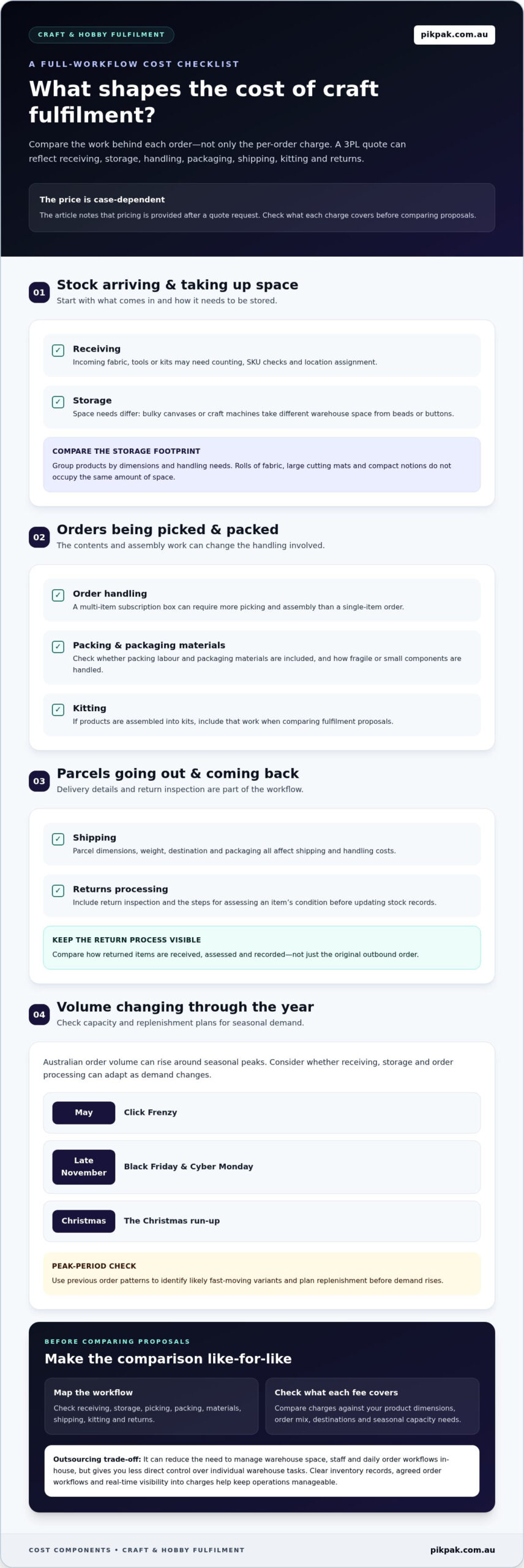
Fulfilment costs can cover receiving, inventory storage, picking, packing, packaging materials, shipping, kitting, and returns processing. The price depends on the case and is given after a quote request; the main cost factors include how much stock arrives, how much space it occupies, how orders are picked, and where parcels travel. Compare what each charge covers before evaluating proposals.
- Receiving: Incoming fabric, tools, or kits may need counting, SKU checks, and location assignment.
- Storage: Bulky canvases or craft machines take different warehouse space from beads or buttons.
- Order handling: A multi-item subscription box can require more picking and assembly than a single-item order.
- Shipping and returns: Parcel dimensions, weight, destination, packaging, and return inspection all affect handling.
Outsourcing can reduce the need to manage warehouse space, staff, and daily order workflows in-house. It also gives your business a defined process for receiving, storage, fulfilment, and returns. You have less direct control over individual warehouse tasks, so clear inventory records, agreed order workflows, and real-time visibility into charges help keep operations manageable.
Oversized products need a separate cost comparison. Storage requirements and parcel dimensions can affect warehouse handling and delivery costs. A roll of fabric, a large cutting mat, and a compact pack of notions each take up different amounts of space. Group products by dimensions and handling needs, then compare how the fulfilment model handles each category.
Capacity planning matters because Australian order volume can rise around Click Frenzy in May and the late-November Black Friday and Cyber Monday period. The Christmas run-up can bring another seasonal peak. Consider how receiving, storage, and order processing adapt when demand changes, and plan replenishment before fast-moving products run low.
For a fair comparison, model ordinary orders and peak-period orders using the same product mix. Include a small order, a multi-item order, a fabric parcel, and a subscription kit. Check how the proposed cost structure treats each example, including packaging and returns. A warehouse receiving workflow also helps clarify how incoming stock is handled before it becomes available for orders.
Ecommerce platform integrations
An ecommerce integration connects a sales channel with fulfilment records, moving order details between systems without repeated manual entry. For a craft business selling through Shopify and Etsy, key tasks include mapping products, importing orders, updating inventory counts, and returning dispatch information. Define the workflow before launch, then test it with product variants and order scenarios.
Start with the product catalogue. Each channel listing should map to the correct warehouse SKU, including colour, size, material, and pack quantity. A Shopify listing for blue cotton yarn must not map to a similar shade or fibre. Etsy listings need the same care, particularly when one listing offers several customisable variations. Confirm that each selectable option points to its matching inventory record.
Next, define which system controls each data field. Your store may manage product descriptions and retail prices, while the warehouse system records available stock and pick locations. Set one source of truth for inventory counts. Otherwise, a sale on Etsy could leave Shopify showing stock already allocated to another order.
Order flow needs clear status rules. Decide when orders transfer, which orders pause for review, and how to handle cancellations or edits. For example, an address change after an order enters packing may need a controlled exception process. Set delivery and dispatch updates to return to the correct sales channel, so the customer record reflects the order’s progress.
- Map variants: Match each channel option to its exact SKU and unit of sale.
- Set inventory ownership: Decide which system sends available stock counts to each storefront.
- Define exceptions: Document handling for cancellations, address edits, bundles, and split orders.
- Test the cycle: Place a sample order, follow it through packing, then check stock and status updates.
A broader ecommerce integration may also connect accounting, customer service, and warehouse tools. Keep exchanged data relevant: order lines, quantities, shipping details, stock changes, and fulfilment status. For a bundle containing paint, brushes, and paper, confirm that the bundle’s components are deducted correctly. This prevents the system from treating a kit as unrelated individual retail products.
Before changing systems, export product mappings and current inventory records. Compare a sample of Shopify and Etsy listings with warehouse SKUs, then resolve duplicates or missing variants. During the transition, reconcile orders and stock updates so each system starts with consistent records. Integration quality depends on accurate product data, clear ownership, and tested exception handling, not simply on connecting two platforms.
Returns management
For a craft order, a return involves more than putting an item back on a shelf. A returned paint set may be unopened, missing a brush, or damaged in transit. Define how to record each condition, who can approve restocking, and how inventory status changes. A clear process protects stock accuracy and helps ensure the next customer receives a reliable product.
Use a consistent inspection sequence for every parcel. Match the return to its original order, record the customer’s reason, inspect the item and packaging, then assign a disposition. Keep sellable stock separate from items awaiting review. For example, an intact, unopened sketchbook may return to available inventory, while a water-damaged one should remain unavailable until assessed.
- Identify: Match the return to its order and SKU.
- Inspect: Record missing components, damage, or signs of use.
- Decide: Mark the item for restocking, repair, or removal from sellable stock.
- Update: Adjust inventory and send the return status to the relevant platform.
A warehouse management system (WMS) can connect return handling with order records and inventory updates. Use distinct status codes such as “received,” “under inspection,” and “restocked,” rather than treating every returned unit as sellable. Integration with an ecommerce platform can keep stock counts aligned. Link each return record to its order, SKU, reason, and final disposition so staff can trace each decision.
Craft kits need an additional completeness check. Assess a returned kit containing thread, needles, and a pattern against its bill of materials, the list of components required for the kit. During assembly, scanning and spot audits can help verify the bill of materials. Apply the same checks to returned kits before restoring them to available inventory. Missing components can otherwise create a fulfilment problem for the next order.
Order management and tracking should make a return’s progress easy to follow. Connect the return reference to the original order, then record key events such as return authorised, parcel received, inspection completed, and inventory updated. Clear status messages help customer service answer questions without searching separate records. Return reasons can also reveal recurring handling issues, such as fragile packaging or unclear product descriptions.
Plan for demand changes, too. Seasonal product ranges can create different return patterns, such as incomplete holiday kits after a promotion ends. Review return reasons alongside orders and stock adjustments, then update inspection instructions when an issue recurs. Returns Management (Reverse Logistics) can organise the process from receipt through disposition, while documented workflows help keep decisions consistent across products and staff.
Types of 3PL providers, including ecommerce specialists
Australian craft brands can choose providers focused on specific logistics tasks or partners that coordinate broader fulfilment. The right fit depends on how well the processes support ecommerce orders, varied products, and seasonal demand.
Ecommerce-Focused 3PL Providers
An ecommerce-focused 3PL handles the flow from online order to picking, packing, and delivery. For a craft brand selling through its own store, assess how the provider connects orders with inventory and manages exceptions, such as an edited order. Look for clear workflows that support direct-to-customer sales, rather than assuming every logistics operation is designed around individual online parcels.
Providers for Craft and Hobby Products
Australian businesses should look for 3PL providers whose processes suit craft supplies and hobby products, rather than relying on a general “specialist” label. Ask how their workflows handle small, varied items, fragile goods, kits, and returns. The useful distinction is operational fit: a provider should explain how its storage, picking, and order processes accommodate the product range and its seasonal changes.
How 3PL Models Differ
The logistics model also matters. Third-party logistics providers emerged in the 1980s, initially offering outsourced functions such as transport and public warehousing. In the model described here, a 2PL handles specific fulfilment activities, such as deliveries or warehousing. A 3PL can coordinate fulfilment functions, while a 4PL strategically manages a business’s supply chain and coordinates fulfilment through multiple outsourced providers.
A 5PL manages supply chains for different businesses and combines clients’ freight volumes to seek better rates from third-party providers. These labels describe different scopes, not automatic levels of service quality. A craft business primarily needing ecommerce order handling may value direct control over inventory and parcel processes more than broad supply-chain coordination.
Match the Provider to Your Processes
Compare providers using examples from your own operation. Describe a standard online order, a multi-item craft kit, a fragile product, and a seasonal sales surge. Then assess how each provider would receive, store, pick, pack, and dispatch those orders. Include returns and inventory updates, since they affect the accuracy of stock available for sale.
Also map out which activities stay with your team and which move to the provider. A 3PL arrangement can reduce internal warehouse tasks, but it adds hand-offs that need clear records and communication. Review how order information moves between your sales platform and fulfilment operations, and whether the proposed process fits your product mix as it changes.
Explore ecommerce fulfilment options to understand how outsourced order handling can fit your operation.
Pik Pak Logistics: Pick, Pack, and Ship Services
Pik Pak Logistics helps craft and hobby businesses move online orders from stored inventory to customers. Its Pick, Pack, and Ship Services cover order preparation and dispatch, with home delivery shipping options. Inventory Storage and Returns Management (Reverse Logistics) can also bring stock handling and returns into your fulfilment workflow.
This service can suit a business spending too much time storing products, preparing orders, or processing returns instead of developing its range and serving customers. Bringing these logistics tasks into an organised workflow can make day-to-day operations easier to manage as the business grows.
To discuss fulfilment for your craft or hobby business, visit Pik Pak Logistics online.
Make Fulfilment Easier to Scale
Your next step is to decide which logistics tasks should stay in-house and which could be managed externally. As your range, order mix, or seasonal demand changes, a suitable 3PL for craft supplies and hobby products can help keep fulfilment aligned with how your business operates.
Pik Pak Logistics offers Pick, Pack, and Ship Services, Inventory Storage, and home delivery shipping options. These services bring stock handling and customer orders into a more organised workflow, giving you more time to focus on product development and growing your business.
Share your fulfilment priorities and explore a practical next step for your operation. Contact Pik Pak Logistics to discuss your needs, and move forward with a clearer plan for fulfilment.
Frequently Asked Questions
3PL technology: What systems do 3PL providers use?
3PL providers commonly use a warehouse management system (WMS) to coordinate inventory, receiving, orders, and dispatch. Ecommerce connections pass order details into fulfilment workflows and return stock or shipment updates to sales channels. Some operations also connect accounting or customer-service tools. For example, matching an order number across systems helps staff investigate a missing item without searching unrelated records.
Do craft and sewing 3PLs serve both individual makers and craft-store wholesale accounts?
How are delicate craft materials like yarn, trim, and dye-sensitive fabric packed and stored?
Protect delicate materials by matching packaging and storage to their specific vulnerabilities. Keep yarn and trim contained to prevent tangling or snagging, and separate fabric from items that could transfer colour, dust, or moisture. Use product labels to flag handling instructions, then include them in picking and packing workflows. For dye-sensitive stock, limit unnecessary exposure to direct light and keep colour variants clearly separated.
How do 3PLs manage high SKU-variant fabric, yarn, and notions catalogs?
Each product needs a record that distinguishes every sellable variation, not just the parent design. Record identifiers such as colour, material, size, and pack configuration consistently across listings and warehouse records. For example, fabric offered in different widths should have separate variant records if customers order those widths independently. Clear naming rules also help staff spot duplicate listings and correct catalogue errors.
How should craft brands handle thousands of small SKUs?
Build a reliable catalogue before adding more products. Give every sellable item a unique identifier, use consistent product names, and document pack quantities so a single unit cannot be confused with a multipack. Organise replenishment around actual order activity, and review exceptions such as repeated stock mismatches. For small components, use closed containers and readable location labels to reduce picking errors.
What craft and hobby products can Australian 3PLs store and fulfil?
Depending on handling and storage requirements, craft and hobby ranges can include yarn, fabric, thread, beads, paper, paints, tools, sewing notions, and DIY kits. Product dimensions and fragility affect storage and packing workflows. Aerosols or flammable paints need a separate review: a 3PL should review each product’s safety data sheet before approving dangerous-goods storage. Product descriptions and handling instructions help classify stock correctly.
How do Australian 3PLs handle small parts, kits, fragile items, and oversized craft supplies?
Use product-specific handling instructions for each category. Small parts need a clear component count, kits need a defined bill of materials, and fragile pieces need protective packing that limits movement. Oversized items, such as large cutting mats, may need separate storage locations and packaging suited to their dimensions. Record exceptions, such as a damaged component or incomplete kit, before dispatch or restocking.
What are typical Australian 3PL storage, pick-and-pack, and shipping prices?
There’s no single typical price that applies to every Australian craft business. The price depends on the case and is given after a quote request; key factors include inventory volume and space, order complexity, packaging, product dimensions, shipping destinations, and returns. Compare the same order examples across proposals, including a single-item parcel, a multi-item kit, and an oversized product, to understand which activities shape the total.