
Did you know that 67% of Australian shoppers say easy returns directly influence their decision to hit the “buy” button? In a market valued at over A$69 billion, your backend infrastructure is no longer just a support role; it’s the engine of your growth. Many founders find themselves trapped in the warehouse, manually entering data between their store and couriers while stock levels lag behind reality. Mastering ecommerce logistics integration australia is the only way to move from reactive firefighting to proactive scaling.
It’s exhausting to watch your marketing efforts succeed only to have your operations crumble under the weight of new orders. You want a system that works while you sleep, providing real-time visibility of every SKU across every channel. This article reveals how to unite your digital inventory with physical fulfillment agility to create a seamless, automated workflow. We’ll show you how to build a backend that scales effortlessly. You’ll learn how to reclaim your time and focus on the big picture without constantly hiring more staff to manage the manual load.
Key Takeaways
- Understand the dual nature of a scalable backend, combining digital software with physical execution to support rapid growth.
- Master ecommerce logistics integration australia to eliminate manual data entry and ensure your stock levels are always accurate across all sales channels.
- Identify the essential tools, such as a cloud-based WMS, needed to automate order routing and warehouse operations.
- Explore how delegating storage and fulfillment helps you avoid the high costs of warehouse leases and seasonal labor management.
- Learn to build a “click-to-delivery” workflow that frees up your time to focus on brand strategy and customer acquisition.
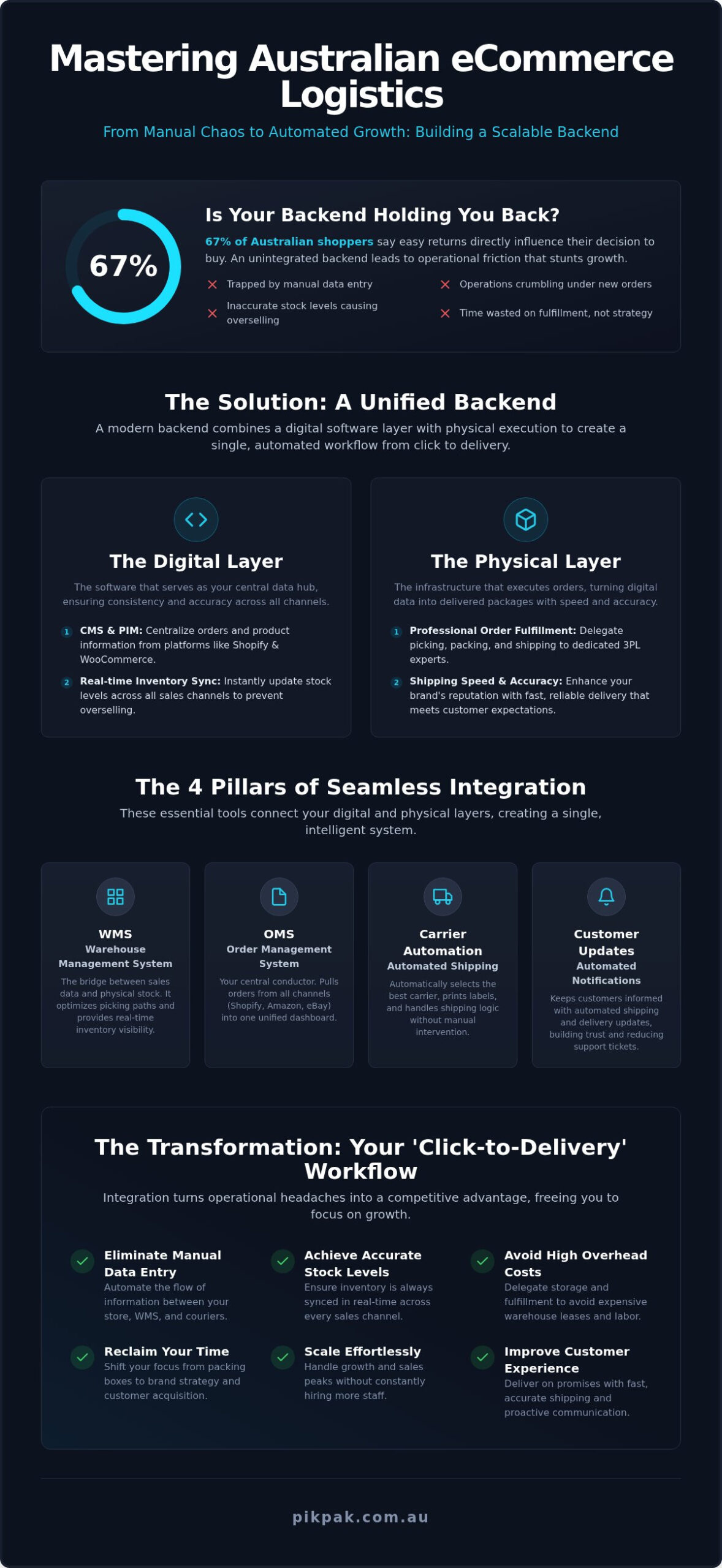
What is an eCommerce Backend? The Foundation of Logistics Integration
Your eCommerce backend is the silent engine room that powers your entire business. While your storefront attracts customers, the backend ensures you actually deliver on your promises. In 2026, successful e-commerce depends on moving away from manual spreadsheets and fragmented data. To scale, you need a unified system where every click on your website triggers a precise physical action in the warehouse. This synergy is the core of ecommerce logistics integration australia, turning complex operational friction into a streamlined, automated workflow.
Many founders treat the backend as an afterthought. They focus on front-end design and marketing, only to find themselves drowning in manual data entry once the orders start flowing. A true backend isn’t just a single piece of software. It’s the complete infrastructure that manages everything from the moment a customer pays to the second the package arrives at their door. By automating these connections, you eliminate the inventory lag that causes overselling and the manual errors that eat into your profit margins.
The Digital Layer: CMS and Inventory Management
Software alone cannot ship a parcel. Your physical warehouse is just as much a part of your backend as your website’s code. Many Australian businesses start with “garage fulfillment,” but this model quickly becomes a bottleneck as order volumes grow. You can’t scale a business if you’re spending your days packing boxes instead of planning your next marketing campaign. Transitioning to professional order fulfilment allows you to delegate the heavy lifting to seasoned experts. Your physical logistics directly impact your digital reputation. Shipping speed and accuracy are the metrics customers use to judge your brand. By integrating your physical operations with your digital platform, you ensure that the engine room remains efficient even during peak sales periods. This holistic approach to ecommerce logistics integration australia removes the ceiling on your growth, allowing you to reclaim your time and focus on the big picture.
The Core Components of eCommerce Logistics Integration
Your Order Management System (OMS) acts as the central conductor. It pulls orders from Shopify, eBay, Amazon, or any other sales channel into one unified dashboard. This eliminates the “tab-switching” fatigue that leads to missed shipments and frustrated buyers. By centralising your orders, you gain a clear view of your total demand, making it easier to manage the competitive Australian eCommerce market without losing track of a single parcel.
The Power of a Cloud-Based WMS
A Warehouse Management System (WMS) is the bridge between sales data and physical stock. It does far more than just count items on a shelf. It maps out your warehouse to find the most efficient picking paths, which drastically reduces the time spent processing each order. With modern technology support, you can access this data from anywhere. Whether you’re at the warehouse or working remotely, you’ll have real-time visibility into your inventory levels. This transparency is vital for preventing overselling and ensuring your physical stock always matches what your customers see online.
API Integrations: The Glue of Your Store
APIs allow your store to talk to your logistics partner in real-time. You don’t have time to download CSV files and manually upload them to a courier’s portal every afternoon. Pre-built connectors for popular platforms like Shopify and Magento make this connection nearly instantaneous. Once integrated, your backend can automatically generate shipping labels and select the best courier based on the customer’s location. This automation ensures your customers receive tracking numbers the moment a package is scanned. It’s a simple way to reduce “where is my order” enquiries and build long-term trust. Finding a logistics service that provides this infrastructure out of the box lets you skip the technical headache and focus on your next marketing campaign.
Software vs. Physical Execution: Why Code Isn’t Enough
You can have the most sophisticated website in the world, but code cannot pack a box or drive a delivery van. Many business owners fall into the trap of thinking that a great Shopify setup is all they need for ecommerce logistics integration australia. The reality is that your digital backend must eventually collide with physical execution. If your physical operations aren’t as agile as your software, your growth will hit a hard ceiling. This complexity is even more evident in specialized sectors; for example, imexshipping.com provides insights into the safety protocols required for handling oversized and heavy project cargo. Managing your own warehouse brings hidden costs that eat into your margins, from long-term commercial leases and insurance to the constant headache of managing casual labor during peak seasons.
The latest data on online retailing sales from the Australian Bureau of Statistics shows that while the sector is growing, consumer demand can be volatile. This volatility makes fixed overheads dangerous. If you’re paying for a large warehouse space during a quiet month, you’re losing money. True scalability comes from turning these fixed costs into variable ones. Smart operators use 3PL services to bridge the gap between their digital store and the physical package, ensuring that their execution capacity always matches their order volume.
When to Move Beyond Your Own Warehouse
Identifying the tipping point where manual fulfillment stunts your growth is vital. If you’re spending more than two hours a day packing boxes or dealing with courier pickups, you’re no longer the CEO; you’re a warehouse manager. This is time stolen from marketing, product development, and brand building. In the Australian market, the financial benefit of moving to a variable cost model is clear. You only pay for the storage you use and the orders you ship. Reclaiming your time allows you to focus on the high-level strategy that actually moves the needle for your business, while the “engine room” runs itself in the background.
Evaluating Backend Security and Reliability
Uptime isn’t just a metric for your website; it applies to your warehouse floor too. You need to ensure your warehousing and fulfilment partner operates with 99.9% accuracy and reliability. Data security is equally important in your customer delivery pipeline. Your backend must handle sensitive customer information with care while ensuring that tracking data flows back to the buyer without delay. A professional integrated backend also simplifies the most stressful part of logistics: returns. By having a clear framework for reverse logistics, you turn a potential customer service nightmare into a smooth, automated process that protects your brand’s reputation.
Step-by-Step: Building Your Integrated Logistics Stack in Australia
Building a scalable backend requires a logical, step-by-step approach to ensure every piece of your technology stack talks to the next. Transitioning to a fully automated ecommerce logistics integration australia isn’t about overnight transformation. It’s about creating a series of digital handshakes that eliminate manual intervention. When your systems are properly aligned, an order flows from your storefront to the warehouse floor without a single human needing to type a customer’s address into a courier portal.
- Step 1: Choose a commerce platform with robust API access. Your store is the central nervous system. Platforms like Shopify or BigCommerce are ideal because they allow external logistics systems to pull order data and push tracking updates back in real-time.
- Step 2: Integrate a WMS for real-time visibility. Connect your store to a Warehouse Management System. This ensures that your stock levels update the moment a sale is made, preventing the dreaded overselling scenario.
- Step 3: Connect shipping carriers. Link your backend directly to your preferred Australian couriers. This allows for the automatic generation of shipping labels based on weight, dimensions, and destination.
- Step 4: Audit your data flow. Run test orders to ensure no manual data entry is required at any point. If you find yourself copying and pasting information, your integration isn’t finished.
- Step 5: Test the returns loop. Ensure your system can handle reverse logistics. A smooth return process is just as important for customer retention as the initial delivery.
Choosing Your Integration Partners
When selecting a logistics provider, look closely at their technology stack. You need a partner that offers more than just shelf space; they must provide the digital infrastructure to support your growth. Local Australian support is vital here. If a sync error occurs during a peak sales event like Black Friday, you can’t afford to wait for a support team in a different time zone to wake up. Reach out to experts who offer dedicated technology support to ensure your data transfer remains seamless and your bottlenecks are identified before they impact your customers.
Optimizing for Mobile and Real-Time Tracking
Modern shoppers expect to track their parcels from their phones. Your backend must support high-quality customer delivery tracking that looks great on mobile devices. Automated push notifications or SMS updates significantly reduce “Where is my order?” enquiries, freeing up your customer service team for more complex tasks. Automation also eliminates human error in label creation and shipping, ensuring the right package always reaches the right doorstep. By delegating these technical hurdles to a proven system, you can finally refocus on the brand strategy that drives your business forward.
Pik Pak: Your All-in-One Backend for Australian Growth
Pik Pak Logistics serves as the physical and technological foundation your brand needs to thrive. We provide a plug-and-play backend that removes the operational hurdles standing between you and your next growth milestone. By choosing our platform, you gain access to a sophisticated web-based WMS that offers real-time inventory tracking. You’ll always know exactly what’s in stock without ever needing to step foot in a warehouse. This level of ecommerce logistics integration australia allows you to scale your operations instantly without the stress of managing your own facility or hiring additional staff.
Our system integrates directly with major eCommerce platforms like Shopify and WooCommerce. This ensures that the digital and physical components of your store are always in sync. When a customer makes a purchase, the data flows seamlessly into our system, triggering immediate action. For developers building bespoke tools to manage these workflows, you can explore Monthly and Hourly Cloud Infrastructure Subscriptions to secure a high-performance VPS environment. You can stop worrying about technical sync errors and start trusting a backend that was built specifically for the Australian market. We handle the complexity so you can focus on the results.
Precision in Pick, Pack, and Ship
We understand that every order is a promise to your customer. Our team is committed to delivering precision in every pick, pack, and ship task we perform. We don’t just handle standard orders; we specialise in complex projects like kitting, bundling, and promotional labelling. This flexibility allows you to run diverse marketing campaigns without worrying about whether your fulfillment team can keep up. If you have specific concerns about how your stock is handled, you can get your warehousing questions answered by our local experts. Having a seasoned partner means you can rest easy knowing your logistics are in capable hands.
Reclaim Your Time and Focus on Growth
The most valuable asset you have as a business owner is your time. Every hour you spend packing boxes or chasing couriers is an hour taken away from brand building and customer acquisition. By leveraging our state-of-the-art facilities across Australia, you can reduce shipping times and improve your digital reputation. We act as your enabling force, removing the major operational hurdles that often stunt growing brands. It’s time to delegate the operational burden so you can prioritise your core objectives. Request a quote from Pik Pak Logistics today and automate your backend for a seamless, scalable future.
Future-Proof Your Growth with an Automated Backend
Building a scalable foundation for your online store is no longer a luxury; it’s a requirement for success. You’ve seen how uniting your digital platform with a physical fulfillment engine eliminates the manual bottlenecks that stunt your progress. By mastering ecommerce logistics integration australia, you move from reactive packing to proactive brand building. You gain the freedom to focus on your customers while your backend handles the heavy lifting with surgical precision. This transition ensures your business remains agile, accurate, and ready for any seasonal surge.
Pik Pak Logistics offers the tools you need to stay ahead of the competition. Our cloud-based WMS provides real-time visibility, while our seamless API integrations connect directly to your favorite sales channels. You get expert Australian fulfillment services that scale with your order volume, ensuring your reputation remains spotless as you grow. It’s time to stop spending your days in the warehouse and start leading your company toward its full potential. You don’t have to manage the chaos alone when a reliable partner is ready to take the wheel.
Automate your eCommerce backend with Pik Pak Logistics today. Your business deserves an engine room that never sleeps.
Frequently Asked Questions
What does “backend” mean for an online store?
The backend is the internal infrastructure that powers your operations after a customer clicks the buy button. It includes your inventory management software, warehouse systems, and the physical fulfillment process. Essentially, it’s the bridge that connects your digital storefront to the real-world delivery of products. A strong backend ensures that order data flows correctly to the people picking items off shelves, which prevents shipping delays and costly errors.
Do I need a developer to set up my eCommerce backend?
You don’t always need a developer because many modern logistics providers offer pre-built connectors for platforms like Shopify. These plug-and-play integrations allow you to sync your store with a warehouse management system without writing custom code. While complex custom setups might require technical help, most growing brands can achieve ecommerce logistics integration australia by using established API links provided by their seasoned logistics partner.
How does a 3PL integrate with my Shopify or WooCommerce store?
Integration happens through an API that allows your store to talk directly to the 3PL’s warehouse management system. When an order is placed, the details are automatically pushed to the fulfillment center for picking and packing. Once the item ships, the system sends the tracking number back to your store. This automation eliminates manual data entry and ensures your customers receive immediate updates on their delivery status without any delay.
What is a Warehouse Management System (WMS) and do I need one?
A WMS is the software brain that manages everything inside a fulfillment center, from stock locations to picking efficiency. You need one to maintain real-time visibility of your inventory across all sales channels. Without a WMS, you’re forced to rely on manual spreadsheets, which lead to stock inaccuracies and overselling. Using a provider’s cloud-based WMS gives you professional-grade tools without the high cost of purchasing and maintaining your own software.
Can I manage my own backend as a small business?
You can manage it yourself initially, but it often becomes a bottleneck as you scale. Small business owners frequently start by packing orders from home, but this takes time away from marketing and growth. Moving to a professional backend allows you to delegate storage and shipping tasks to experts. This shift helps you reclaim your schedule and ensures your logistics remain efficient even during busy seasonal periods or sudden sales spikes.
How much does it cost to automate an eCommerce backend?
Costs vary based on your order volume, storage needs, and the specific services you require. Instead of fixed overheads like warehouse rent and staff salaries, most providers use a variable pricing model. This means you only pay for the space you use and the orders processed. This approach makes ecommerce logistics integration australia more affordable for growing brands by turning large upfront investments into manageable operational expenses that match your revenue.
What is the difference between a frontend and a backend in eCommerce?
The frontend is the digital storefront that customers see, including your website design and product listings. The backend is everything that happens behind the scenes to fulfill those orders. While the frontend handles the sale, the backend manages inventory, order processing, and shipping. A successful business requires both to work in harmony; a beautiful website won’t save a brand if the fulfillment process is slow, inaccurate, or lacks transparency.
How does a professional backend improve customer satisfaction?
A professional backend ensures speed, accuracy, and transparency in the delivery process. When your systems are integrated, orders are processed faster and tracking information is sent to the customer instantly. This reduces anxiety and limits the number of where is my order inquiries. Accurate inventory syncing also prevents the frustration of ordering an out-of-stock item, which is a major factor in building long-term customer loyalty and trust in your brand.