
Imagine losing 21% of your potential sales this month simply because your website displayed a red “Out of Stock” message while your actual inventory sat untouched on a receiving dock. For many Australian eCommerce brands, this isn’t a nightmare; it’s a daily reality that drains the bottom line and frustrates loyal customers. You work hard to drive traffic to your store, so seeing a buyer bounce because of a data lag is a headache you don’t need. Mastering the strategy of avoiding stockouts with a 3pl is no longer a luxury for the big players; it’s the baseline for survival in the 2026 retail market.
We understand the frustration of the constant guessing game between what your Shopify store shows and what’s actually on the warehouse shelf. You deserve a logistics partner that just works, allowing you to focus on your business while the heavy lifting happens behind the scenes. This guide reveals how the right 3PL uses real-time tech and streamlined processes to eliminate stock gaps and protect your A$ revenue. We’ll explore how to implement automated replenishment alerts and achieve total inventory visibility so your operations finally run like clockwork.
Key Takeaways
- Understand why out-of-stock messages cost global retailers over A$1.5 trillion and how to protect your Australian business from preventable revenue loss.
- Learn the secrets to avoiding stockouts with a 3pl by leveraging cloud-based technology that syncs your storefront directly to the warehouse floor in real-time.
- Discover how to eliminate the “receiving black hole” by optimizing dock-to-stock speed and preventing your inventory from becoming stranded.
- Master strategic inventory calculations for 2026 shipping lead times to ensure your high-velocity “Hero” products are always ready for dispatch.
- See how a local Australian partner makes scaling effortless, allowing you to focus on your business while we ensure your operations run like clockwork.
The High Cost of Stockouts in the 2026 E-commerce Landscape
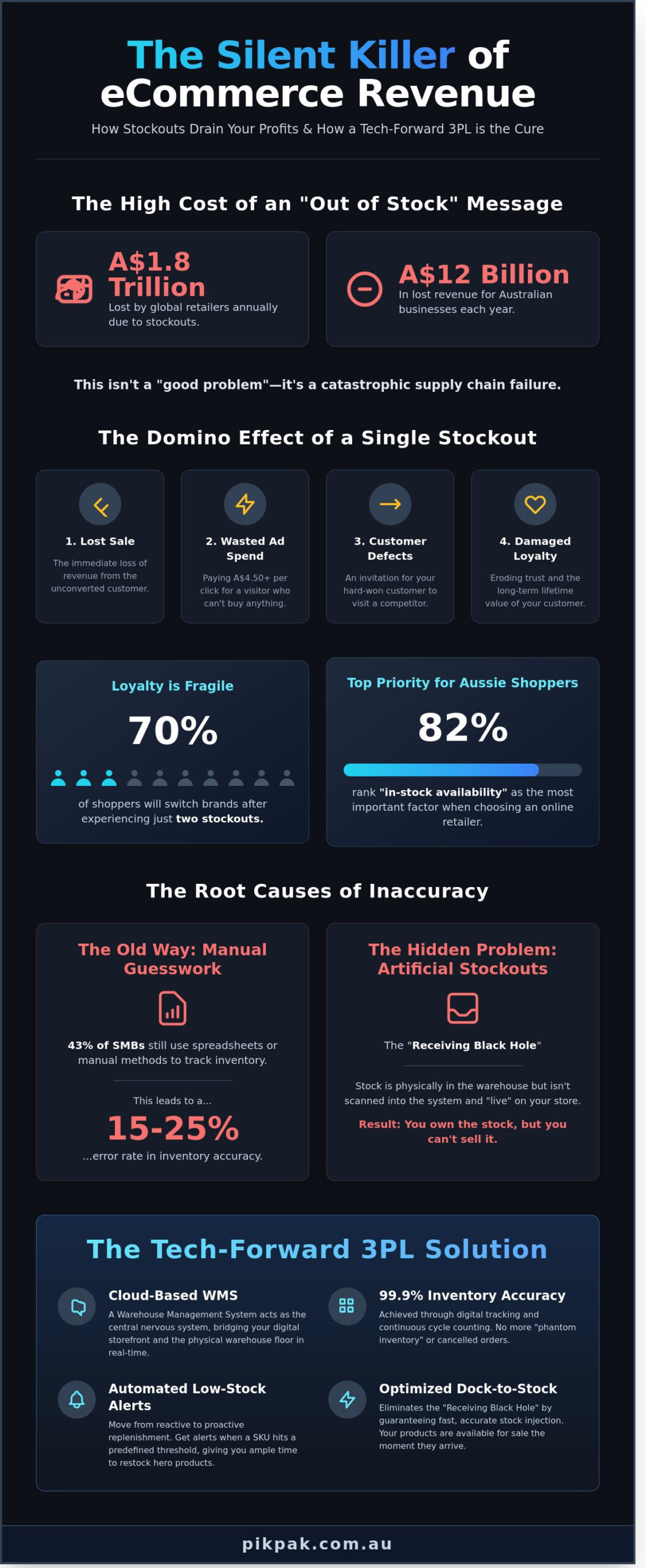
A stockout occurs simply when customer demand exceeds your available on-hand inventory. While some founders view it as a “good problem” because it signals high demand, it’s actually a catastrophic failure in your supply chain. IHL Group reports that out-of-stocks cost global retailers approximately A$1.8 trillion annually. In the Australian market, this translates to roughly A$12 billion in lost revenue every single year. For a growing brand, these aren’t just abstract figures; they represent lost growth and wasted potential that could have been captured with better systems.
Relying on traditional, manual warehousing is the primary driver of these losses. Statistics show that 43% of small to medium e-commerce businesses still use manual processes or spreadsheets to track their stock. This leads to a 15% to 25% error rate in inventory accuracy. When your records say you have ten units but the shelf is empty, you’re flying blind. Partnering with a professional third-party logistics (3PL) provider eliminates this guesswork by using real-time data and automated scanning. Avoiding stockouts with a 3pl isn’t just about storage; it’s about protecting your marketing investment and your bottom line.
Stockouts destroy your Customer Acquisition Cost (CAC) efficiency. If you’re spending A$4.50 per click on Instagram ads to drive traffic to a product page that displays “Out of Stock,” you’re effectively throwing that money away. Your marketing ROI drops to zero instantly. You’ve paid for the lead, but you’ve lost the conversion and the chance to recoup that cost through a sale. This makes your overall business much more expensive to run.
The Psychology of the “Out of Stock” Message
An “Out of Stock” message is a direct invitation for your customer to visit a competitor. Data shows that 70% of shoppers will switch brands after encountering just two stockouts. In Australia, 82% of online shoppers rank “in-stock availability” as the most important factor when choosing a retailer. When you fail to deliver, you don’t just lose one sale; you lose the lifetime value of that customer. Brand loyalty is hard to build but incredibly easy to break with poor inventory management.
Real vs. Artificial Stockouts: Knowing the Difference
It’s vital to distinguish between real and artificial stockouts. A real stockout happens when your manufacturer hasn’t delivered or you didn’t order enough units. However, artificial stockouts are often more frustrating. This occurs when the stock is physically inside the warehouse but hasn’t been scanned into the system or made “live” on your website. 3PL process failures, such as slow receiving times or backlogs in the “goods-in” area, are usually to blame. Avoiding stockouts with a 3pl requires a partner that guarantees fast, accurate stock injection so your products are available for sale the moment they hit the dock.
How a Tech-Forward 3PL Prevents Stockouts Through Data
Logistics isn’t just about moving boxes; it’s about managing information. At the heart of avoiding stockouts with a 3pl is a cloud-based Warehouse Management System (WMS). This technology acts as the central nervous system of your supply chain. It bridges the gap between your digital storefront and the physical warehouse floor. When a customer in Melbourne clicks “buy” at 3:00 PM, the system registers that sale instantly. There is no lag, no delay, and no room for human error. This real-time synchronisation ensures that your website never sells a product that isn’t actually on the shelf.
While a high-quality 3PL partner manages this technology for you, understanding the software that powers these operations is crucial. For those interested in the specifics of cloud-based inventory and ERP solutions, it can be helpful to discover Peach Software and see what features a modern system offers.
Traditional warehouses often struggle with “phantom inventory.” This happens when your records say you have ten items, but the shelf is empty. It’s a nightmare that leads to cancelled orders and frustrated customers. A tech-forward 3PL eliminates this through digital tracking and rigorous cycle counting. Instead of shutting down once a year for a massive stocktake, we perform small, frequent counts. This maintains a 99.9% inventory accuracy rate. Research from the Harvard Business Review highlights the significant impact of stockouts, noting that nearly 50% of shoppers will purchase from a competitor if their first choice is unavailable. In the Australian market, where brand loyalty is hard-won, you can’t afford that risk.
We move your business from reactive to proactive replenishment. Automated low-stock triggers send alerts the moment a SKU hits a predefined threshold. If you know it takes 14 days to restock a popular item, the system flags it at the 21-day mark. This buffer protects your revenue and your reputation. It’s about working smarter, not harder.
The Power of API Integrations
Manual data entry is the death knell for inventory accuracy. Typing orders into a spreadsheet leads to an average error rate of 1 in 300 keystrokes. Our technology support solves this by using API integrations to link Shopify, WooCommerce, or eBay directly to our WMS. Your stock levels update across all sales channels simultaneously. If you sell your last unit on eBay, your Shopify store reflects that change in seconds. This automation is how you scale without the headache of overselling.
Inventory Transparency and Real-Time Visibility
Transparency shouldn’t be a luxury. Through the Pik Pak portal, you get a “bird’s eye view” of your entire operation. You don’t need to call a warehouse manager to ask what’s in stock; you simply log in and see it. This data allows you to identify high-velocity SKUs that require higher safety stock levels. For example, if a specific SKU sees a 25% spike in sales every November, the data will show you exactly how much extra to order. This level of insight makes logistics feel like an “easy game” rather than a constant struggle. When you have total control over your data, you simplify your logistics and free up your time to focus on growing your brand. Avoiding stockouts with a 3pl becomes a predictable, automated process that runs like clockwork while you focus on the big picture.
Eliminating the “Receiving Black Hole” and Inbound Delays
The gap between a truck arriving at the warehouse and your products appearing as “in stock” online is the most dangerous period for your cash flow. This is the dock to stock window. If this process takes three days instead of four hours, you’re losing money every minute. Stranded inventory is a silent killer. It’s stock that you’ve already paid for, which is physically present in the building, but remains unsellable because it hasn’t been scanned into the system. Avoiding stockouts with a 3pl requires a partner that treats receiving as a high-priority event, not a secondary warehouse chore.
A common hurdle for Australian business owners is the fear of losing control. You might think that if you can’t touch the pallets yourself, you won’t know what’s happening. The opposite is true. When you manage your own space, inventory often disappears in corners or gets buried under newer shipments. With Pik Pak, every single SKU is tracked from the moment it hits the bay. You gain a level of visibility that manual systems simply can’t match. You aren’t losing control; you’re gaining a professional system that eliminates the “where is my stock?” headache.
Consider the cost of a delay. For a brand generating A$5,000 in daily revenue, a two-day delay in processing a restock represents A$10,000 in missed opportunities. We focus on shortening that window so your capital isn’t sitting idle on a concrete floor.
Standardising Your Inbound Shipments
To keep things moving like clockwork, we rely on clear, repeatable protocols. Following our warehouse receiving guidelines ensures your stock doesn’t get sidelined for manual investigation. When shipments arrive with clear labelling and a pre-advised ASN (Advanced Shipping Notice), our team knows exactly what’s coming before the truck driver even unbuckles their seatbelt. Data shows that properly labelled shipments are processed 40% faster than “blind” deliveries. At Pik Pak, we aim to get your goods from the truck to the shelf within a 24-hour window. This speed is vital for maintaining momentum during peak sales periods like Black Friday or EOFY sales.
- ASN Notifications: These digital alerts tell our system what’s arriving so we can allocate shelf space in advance.
- Clear Labelling: Prevents the “mystery box” syndrome that leads to stock being set aside for weeks.
- Predictable Scheduling: We coordinate with carriers to prevent bottlenecks at the loading dock.
Quality Control and Accuracy Audits
Accuracy is the only real enemy of the stockout. We implement regular cycle counting to catch discrepancies early. If your system says you have 50 units but the shelf only has 48, we catch it and fix it before a customer hits a “sold out” wall at your checkout. This level of precision is the secret to avoiding stockouts with a 3pl during high-volume seasons. We also handle damaged goods immediately. If 5% of a shipment arrives crushed, we log it and move it to a non-sellable location instantly. This keeps your sellable inventory counts 100% accurate so you never accidentally sell a broken product. We formalise these expectations through Service Level Agreements (SLAs), giving you a 99.9% accuracy guarantee that your operations will run smoothly.
By formalising these processes, we turn the chaotic receiving dock into an automated entry point for your business growth. We do the heavy lifting so you can stay focused on your next marketing campaign.
Strategic Inventory Management: Best Practices for Brand Owners
Calculating your safety stock for 2026 requires looking at extended shipping lead times. Current logistics data from late 2024 shows sea freight from major hubs like Ningbo to Melbourne can fluctuate between 28 and 52 days. By adding a 20% buffer to these lead times, you protect your bottom line against unexpected port strikes or weather events. Avoiding stockouts with a 3pl becomes a numbers game that you can actually win when you account for these variables early.
Don’t treat every item the same. Segment your SKUs by velocity using the 80/20 rule. Your top 20% of products usually generate 80% of your revenue. These are your “Hero” products. If your Hero product is out of stock for just three days, you might lose A$4,200 in revenue based on average Australian eCommerce conversion rates. Keep a closer eye on these than your slow-movers. High-velocity items require more frequent reorder points to ensure the momentum of your brand doesn’t stall.
The Australian calendar has three massive peaks that can break an unprepared supply chain. EOFY sales in June, Black Friday in November, and the Christmas rush are non-negotiable dates. During these periods, order volumes often spike by 320% compared to a standard Tuesday in March. Planning your inventory arrivals at least 12 weeks before these dates ensures you aren’t left with empty shelves when customers are ready to spend. A proactive approach turns these seasonal rushes into growth opportunities rather than logistical nightmares.
Forecasting Demand in a Volatile Market
Smart forecasting starts with data. Use historical reports from your 3PL warehousing dashboard to identify month-on-month growth. Don’t just look at what you sold; look at what you could have sold if you hadn’t run out of stock during previous peaks. Remember that overstocking is a silent profit killer. Holding too much inventory can tie up A$65,000 in capital that could be better spent on marketing or product development. It’s about finding that Goldilocks zone where your stock levels are just right to meet demand without draining your cash flow.
Communication Protocols and Partnership
Your 3PL shouldn’t be a black box. Establish a constant feedback loop with your account manager to keep operations running like clockwork. If you’re planning a viral TikTok campaign or a flash sale, tell your partner 14 days in advance. This allows the warehouse to scale up labor and prepare for the surge. When you treat your 3PL as a strategic consultant, you gain insights into shipping efficiencies that save you money. This partnership lets you focus on your business growth while we handle the heavy lifting. Avoiding stockouts with a 3pl is much easier when everyone is aligned on your promotional calendar and growth targets.
Ready to streamline your inventory and stop losing sales? Partner with Pik Pak today to keep your stock moving and your customers happy.
Scale Without Stress: The Pik Pak Advantage
Growth is the ultimate goal for every Australian eCommerce brand, but it often brings a hidden tax: operational complexity. When your order volume jumps from 50 to 500 per day, the manual systems that worked last month will likely break. Pik Pak’s “Pick, Pack & Ship Made Easy” philosophy is built to stop these bottlenecks before they start. We treat logistics as a solved problem so you don’t have to. By partnering with us, avoiding stockouts with a 3pl becomes a standard operational result rather than a lucky break. Our systems are designed to keep your inventory moving, ensuring that every SKU is accounted for and every order is processed with 99.9% accuracy.
One of the biggest hurdles for growing stores is the financial burden of traditional warehousing. Most providers demand long-term commitments or fixed monthly fees that eat into your margins during slower periods. We do things differently. Our “Pay as you go” model ensures your costs scale exactly with your inventory needs. If you have a quiet month, you pay less. When your seasonal peak hits, you have the space and staff ready to handle the surge without hiring a single person. This flexibility transforms your supply chain into a lean, responsive asset that protects your cash flow while preventing the dreaded “out of stock” notification on your website.
Seamless Integration for Australian Stores
We’ve built our logistics services specifically for the unique demands of the Australian market. Our Melbourne-based team understands the local direct freight landscape better than anyone. We know that a delivery to a metro hub in Sydney requires a different approach than a shipment heading to regional Queensland. This local expertise allows us to optimise shipping routes and reduce transit times by up to 35% compared to generic providers. By automating the fulfilment process, we help you reclaim over 15 hours of your week. That is time you can reinvest into high-level marketing strategies and product innovation while we handle the heavy lifting in the warehouse.
Ready to Stop the Stockout Cycle?
The journey from inventory chaos to streamlined fulfilment doesn’t have to be a struggle. You’ve likely felt the sting of lost sales and frustrated customers when stock levels fail to meet demand. Transitioning to a professional partner changes the narrative. Avoiding stockouts with a 3pl like Pik Pak means you can finally trust your data and stop second-guessing your reorder points. We’ve seen clients reduce their stockout incidents by 48% within the first 90 days of joining our platform. Logistics is an easy game when you have the right technology and a dedicated team in your corner. It’s time to stop managing boxes and start managing your brand’s future. Get started with Pik Pak Logistics today and see how simple scaling can be.
Future-Proof Your Inventory Strategy Today
Inventory management in 2026 doesn’t have to be a guessing game. Research shows that Australian e-commerce brands lose up to 4% of annual revenue simply by being out of stock when customers are ready to buy. Success now depends on 100% stock accuracy and eliminating the “black hole” delays that keep your products sitting on a loading dock for 48 hours or more. Transitioning to a tech-first approach is the most effective strategy for avoiding stockouts with a 3pl while maintaining a lean overhead.
Pik Pak Logistics delivers the infrastructure you need to win. You get real-time WMS visibility into every SKU and seamless API integrations that connect to your Shopify or WooCommerce store in under 5 minutes. Our Melbourne-based expert support team ensures your inbound shipments are processed with precision so you never miss a sale. It’s about making logistics run like clockwork so you can get back to what matters most.
Free up your time and scale your business with Pik Pak Logistics. You’ve built something great, and we’re here to help you take it to the next level.
Frequently Asked Questions
How does a 3PL help me avoid stockouts during peak seasons like Black Friday?
Pik Pak helps you manage peak demand by scaling warehouse staff and floor space instantly to meet order surges. During the 2023 Black Friday period, Australian retail spend hit A$9.36 billion; we ensure your orders keep moving through these high-pressure windows. We use advanced forecasting and flexible staffing models to prevent bottlenecks. This lets you focus on your marketing while we handle the heavy lifting of fulfillment.
What is “Phantom Inventory” and how can my 3PL help me eliminate it?
Phantom inventory occurs when your digital system shows stock that isn’t physically on the shelf, leading to “ghost” sales or missed opportunities. Pik Pak eliminates this through real-time barcode scanning and regular cycle counts. By maintaining 99.9% inventory accuracy, we assist in avoiding stockouts with a 3pl partnership. You won’t lose sales to data errors because our system reflects the physical reality of the warehouse at all times.
Will I still have visibility of my stock levels if I use a 3PL?
You have 100% visibility of your stock levels through our cloud-based Warehouse Management System. Our dashboard updates in real-time, 24 hours a day, so you know exactly what’s on hand in our facility. You can set low-stock alerts to trigger when items hit a specific threshold. This transparency means you’re never left guessing about your inventory status or replenishment needs.
How long does it typically take for a 3PL to receive and “go live” with new stock?
We typically receive and process new stock within 24 to 48 hours of arrival at our warehouse. This fast turnaround ensures your products are available for sale on your website almost immediately. Our team prioritizes inbound shipments to maintain your cash flow and keep items in stock. Once scanned into our system, the inventory syncs across your sales channels instantly.
Can a 3PL help me calculate how much safety stock I should keep?
Pik Pak provides the historical data and reporting tools you need to calculate precise safety stock levels. We look at your average daily sales and lead times from suppliers to suggest a buffer that protects against 15% demand spikes. Having this data at your fingertips removes the guesswork from your procurement. You can maintain enough stock to stay safe without tying up too much capital in excess inventory.
What happens if my 3PL makes an inventory error that causes a stockout?
If an error occurs on our end, we take immediate responsibility to rectify the situation for your brand. We maintain a 99.9% accuracy rate, but if a discrepancy causes a stockout, we conduct a root-cause analysis within 24 hours. We work with you to expedite replacement stock or update your store listings to reflect true levels. Our goal is to keep your customers happy and your brand reputation intact.
Is it possible to integrate my Shopify or WooCommerce store directly with Pik Pak?
You can integrate your Shopify or WooCommerce store with Pik Pak in just a few clicks. Our “point, click, and connect” system automates the flow of orders and inventory levels between your store and our warehouse. This automation reduces manual data entry errors by 100%. It’s a simple setup that lets you focus on your business while we handle the technical side of fulfillment.
What are the most common 3PL process failures that lead to artificial stockouts?
The most common failures include delayed inbound processing and infrequent cycle counting. When a warehouse takes 5 days to “receive” a shipment that is already sitting at the dock, it creates an artificial stockout. Pik Pak avoids this by enforcing strict 48-hour receiving windows. We also perform regular audits to ensure the digital count matches the physical stock, preventing unexpected “out of stock” messages on your storefront.