Is your returns pile growing faster than your sales? For many Australian eCommerce owners, handling returns feels like a constant battle-a drain on time, a hit to the bottom line, and a major source of customer frustration. It’s a logistical headache that distracts you from the core tasks of marketing and growing your business.
But what if that entire process could be transformed from a costly problem into a powerful engine for customer loyalty? A streamlined ecommerce returns management system is no longer a ‘nice-to-have’; it’s a critical tool for operational efficiency and sustainable growth in today’s competitive market.
In this ultimate guide, we’ll show you how to build a simple, automated, and cost-effective returns process. You’ll learn how to win back customers, get sellable stock back on your virtual shelves quickly, and free up your time to focus on what truly matters: building your brand.
What is eCommerce Returns Management (And Why It’s More Than Just Refunds)?
Let’s be clear: handling customer returns is much more than just hitting ‘refund’ on an order. Effective ecommerce returns management is the complete, end-to-end process of managing products sent back by your customers. It’s a non-negotiable part of running an online store in Australia, and ignoring it is a direct path to lost revenue and unhappy customers.
The operational engine behind this process is known as reverse logistics-essentially, the entire journey a product takes from your customer’s doorstep back into your inventory. This includes everything from the customer initiating the return, to shipping, receiving the item at the warehouse, inspection, and finally, deciding whether to restock, repair, or dispose of it. Getting this flow right is the key to turning a potential headache into a streamlined, efficient system.
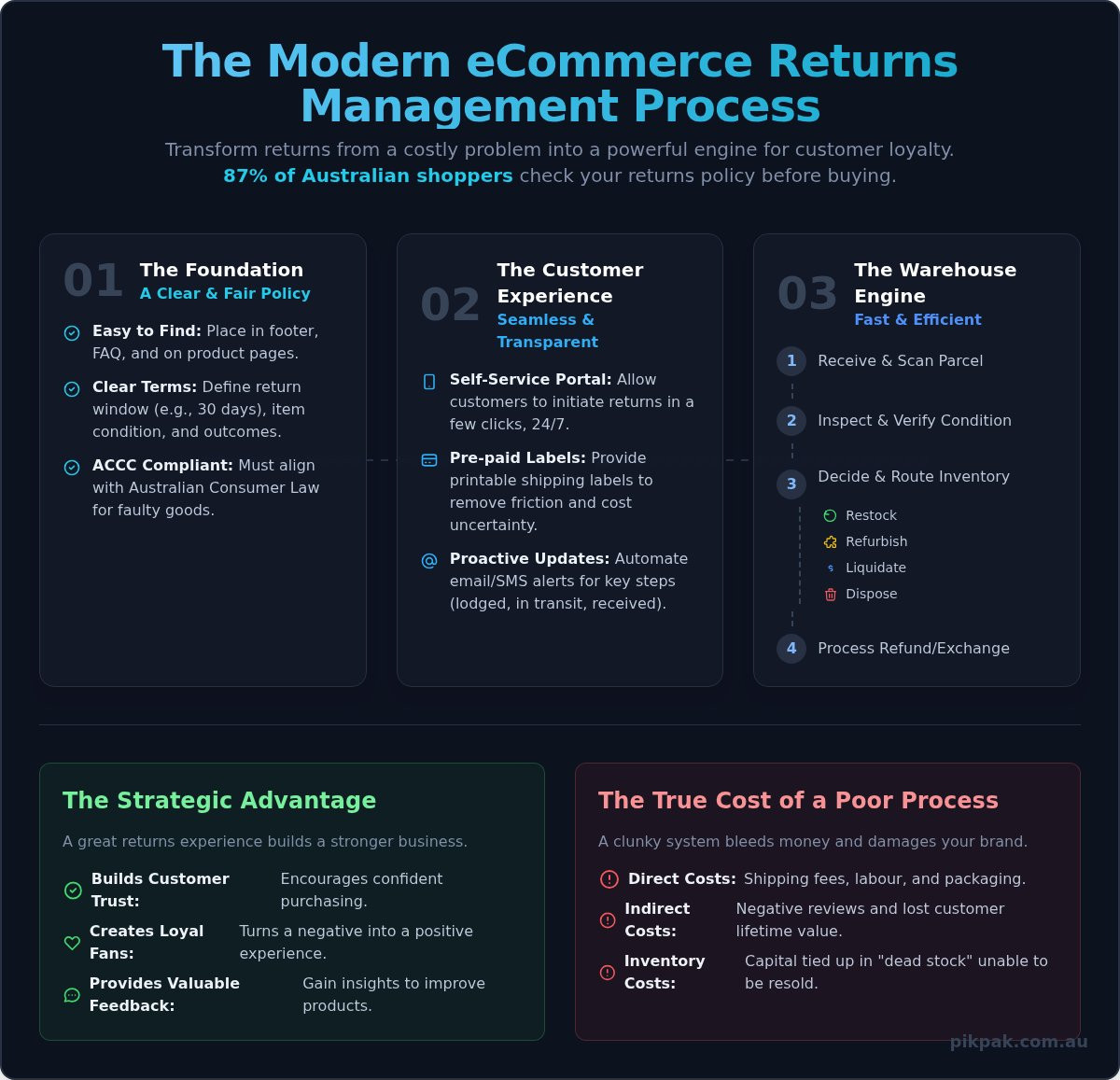
Think of it this way: returns are not a failure, but a powerful touchpoint. With recent data showing that 87% of Australian online shoppers check a returns policy before buying, a clear and easy process isn’t just a service-it’s a sales tool. It’s your chance to prove your brand is trustworthy and customer-focused, securing loyalty long after the initial purchase.
The True Cost of a Poor Returns Process
A clunky returns system bleeds money and damages your brand in ways you might not see immediately. The costs go far beyond the refund amount itself and can quickly add up:
- Direct Costs: Return shipping fees (which can range from A$10-A$25+ per parcel), labour for warehouse staff to inspect and process items, and costs for new packaging materials.
- Indirect Costs: The long-term damage from negative reviews, lost customer lifetime value, and a tarnished brand reputation that scares away new buyers.
- Inventory Costs: Capital tied up in “dead stock” that can’t be resold, plus the warehousing space it occupies while waiting for a decision.
The Strategic Advantage of a Great Returns Experience
What seems like a logistical challenge is actually a golden opportunity to strengthen your business. A seamless ecommerce returns management strategy gives you a significant competitive edge:
- Builds Customer Trust: A simple, no-hassle return policy gives customers the confidence to click “buy,” knowing you have their back if things don’t work out. This trust is the foundation for repeat business.
- Creates Loyal Fans: A positive return experience can turn a disappointed customer into a loyal advocate for your brand. They’ll remember the great service, not the faulty product.
- Provides Valuable Feedback: Every return tells a story. By tracking reasons for returns (e.g., “wrong size,” “not as described”), you gain priceless insights to improve product descriptions, sizing charts, and even product quality.
The Core Components of a Winning Returns Management Process
A winning ecommerce returns management process isn’t just about handling unwanted products; it’s a powerful tool for building customer loyalty. When a return is fast, easy, and transparent, you turn a potential disappointment into a positive brand experience. The key is to map out the entire journey-from the customer’s decision to the final refund-with a focus on speed and clear communication at every touchpoint. Let’s break down the process into simple, manageable steps.
Step 1: Creating a Clear and Fair Returns Policy
Your returns policy is the foundation. It must be easy to understand and even easier to find on your website-think the footer, FAQ, and on product pages. A strong policy clearly outlines the return window (e.g., 30 days), the condition of returned goods (e.g., unworn, with tags), and the available outcomes (refund, store credit, or exchange). Critically, your policy must align with the Australian Consumer Law, which protects customers’ rights for faulty or misrepresented products. Balance generosity with business protection to build trust.
Step 2: The Customer-Facing Returns Experience
Making the return process effortless for the customer is non-negotiable. Replace clunky email threads with a self-service online portal where customers can initiate a return in just a few clicks. Provide printable, pre-paid shipping labels and simple packing instructions to remove any friction. Proactive communication is vital here. Automate email or SMS updates to let them know their return has been lodged, is in transit with Australia Post, and has been received at your warehouse. This transparency eliminates customer anxiety and reduces support tickets.
Step 3: The Back-End Warehouse Process (Reverse Logistics)
Once the item arrives, your internal process needs to run like clockwork. The moment a parcel is received, it should be scanned and logged to trigger a “received” notification to the customer. Next, inspect the product to verify its condition. Based on the inspection, you’ll decide on its final destination:
- Restock: If in perfect condition, return it to sellable inventory.
- Refurbish: Minor issues that can be fixed for resale.
- Liquidate: Sell to a third-party liquidator for a reduced price.
- Dispose: If damaged beyond repair.
The final, crucial action is to process the customer’s refund or ship their exchange immediately. Speed here is what customers remember most.
In-House vs. Outsourced Returns Management: A Critical Decision
As your Australian eCommerce business grows, so does the complexity of your operations. The way you handled returns when you were packing orders in your garage simply won’t work when you’re shipping hundreds of orders a week. Deciding whether to keep your returns process in-house or outsource it to a specialist is one of the most critical decisions you’ll make. It’s the tipping point between being bogged down by logistics and being free to scale your brand. A smooth process is key, as this guide to eCommerce returns from Australia Post highlights, impacting everything from customer loyalty to your bottom line.
The Pros and Cons of In-House Management
Managing returns yourself gives you complete control, which is comforting at the start. However, this control comes with hidden costs that quickly add up. Beyond the obvious expenses, you face a significant drain on your most valuable resources: time and space. Every hour spent inspecting a returned item, processing a refund, and restocking inventory is an hour you’re not spending on marketing, product development, or customer acquisition.
- Pros: Full control over the process and lower direct costs at very low volumes.
- Cons: Extremely time-consuming, requires dedicated physical space, lacks scalability during peak seasons, and distracts you from core business growth activities.
The Benefits of Outsourcing to a 3PL Partner
Partnering with a Third-Party Logistics (3PL) provider for your ecommerce returns management turns a logistical headache into a streamlined, professional operation. A 3PL transforms your returns from a fixed cost (like paying for warehouse space you might not always use) into a variable cost that aligns directly with your order volume. You pay for what you use, making your expenses predictable and scalable.
- Pros: Access expert efficiency, scale effortlessly, leverage cheaper shipping rates, and most importantly, free up your time to focus on your business.
- Cons: Involves a direct service cost and requires placing trust in an external partner to represent your brand.
Checklist: When Is It Time to Outsource?
What seems like a challenge is an easy game with the right partner. If you find yourself nodding along to several of these points, it’s a clear sign that your business is ready to benefit from outsourcing.
- You spend more than a few hours every week inspecting products, processing refunds, and communicating with customers about returns.
- Your storage space, office, or home is cluttered with returned stock waiting to be processed and restocked.
- You’re starting to receive customer complaints about slow refund times or a confusing returns process.
- You want to offer a seamless, professional post-purchase experience that rivals major retailers but lack the internal resources.
Feeling overwhelmed? That’s a sign of growth, not failure. Let Pik Pak make returns easy for you.
How a 3PL Partner Like Pik Pak Streamlines Your Returns
Managing returns can feel like a full-time job, but it doesn’t have to be. What seems like a complex challenge is an easy game with the right partner. A dedicated Third-Party Logistics (3PL) provider transforms your ecommerce returns management from a costly headache into a streamlined, efficient, and even profitable part of your business. Let Pik Pak do the hard work for you.
We integrate powerful technology with expert hands-on processing to handle the entire reverse logistics chain. This means you get a seamless, automated system that saves you time, reduces costs, and keeps your customers happy.
Technology and Integration: The Brains of the Operation
Our advanced Warehouse Management System (WMS) is the core of our simple solution. It integrates directly with your eCommerce platform-whether it’s Shopify, WooCommerce, or another major system-with a simple point-and-click connection. This gives you complete, real-time visibility of every returned item from the moment it’s scanned at our facility. We also automate customer notifications, providing tracking and status updates that reduce your customer service workload.
Expert Handling and Processing: The Hands-on Work
Once a return arrives at our Australian warehouse, our trained team takes over. We don’t just put boxes on a shelf; we inspect each item according to your specific quality control rules. Based on the item’s condition, we manage the disposition process for you:
- Restock: Mint-condition items are immediately processed and returned to your active inventory, ready for the next sale.
- Quarantine: Items needing minor repairs or repackaging are set aside for your review.
- Recycle/Dispose: Damaged goods are handled according to sustainable practices.
The Bottom Line: Saving You Time and Money
Partnering with Pik Pak for your ecommerce returns management delivers tangible benefits that directly impact your profitability. You immediately reduce overheads by eliminating the need for dedicated warehouse space and staff for processing returns. We leverage our high-volume relationships with Australian carriers to secure better return shipping rates, passing those savings on to you. Most importantly, we free up your time so you can stop managing boxes and focus on what you do best: growing your brand.
Ready to turn your returns process into a competitive advantage? Discover how Pik Pak makes it easy.
Best Practices for Reducing Your eCommerce Return Rate
While a smooth returns process is essential, the ultimate goal is to prevent returns from happening in the first place. Shifting your focus from reactive management to proactive prevention is the key to protecting your profit margins and building a loyal customer base. A lower return rate means more satisfied customers, fewer logistical headaches, and a healthier bottom line. What seems like a challenge is an easy game with the right strategy.
Optimise Your Product Pages
The single biggest cause of returns is a mismatch between customer expectation and reality. Your product page is your first and best line of defence. Set crystal-clear expectations by providing comprehensive and accurate information. This isn’t just about selling; it’s about ensuring the customer is confident in their purchase.
- Use High-Quality Visuals: Showcase products with high-resolution images and videos from multiple angles. Show the product in use to provide scale and context.
- Write Detailed Descriptions: Go beyond the basics. Explain the benefits, use cases, and what makes the product unique. Be honest about its features.
- Include Precise Specifications: For apparel, provide a detailed size chart with measurements. For other goods, list exact dimensions, weight, materials, and care instructions.
Leverage Customer Feedback and Reviews
Your customers are a valuable source of data. Analysing their feedback is a crucial component of effective ecommerce returns management. Pay close attention to the reasons they provide for returns. If multiple customers return a shirt because it’s “smaller than expected,” it’s time to update your size chart or product photos. Encouraging public reviews and Q&As also builds social proof, allowing potential buyers to make more informed decisions based on the experience of others.
Improve Order Accuracy and Packaging
Receiving the wrong item or a product damaged in transit is frustrating for customers and guarantees a return. Implementing strict quality control checks before an order leaves your warehouse is non-negotiable. Double-check that the item, size, and colour are correct. Furthermore, invest in durable, protective packaging to ensure your products arrive in perfect condition, no matter how far they travel across Australia.
This is where partnering with a professional 3PL can make all the difference. At Pik Pak, our warehouse management system ensures picking and packing accuracy runs like clockwork, eliminating human error. We handle the professional packing for you, so you can focus on your business and free up your time, confident that every order is perfect.
Turn Your Returns from a Cost Centre into a Customer Loyalty Engine
As we’ve explored, a strategic approach to returns is no longer just a cost of doing business for Australian eCommerce brands-it’s a critical opportunity. Every return is a touchpoint that can either frustrate a customer or build lasting loyalty. By establishing a clear, efficient, and customer-friendly process, you transform a potential negative into a powerful positive. Mastering your ecommerce returns management is the key that unlocks this potential and frees you up to focus on growing your business.
But making it all run like clockwork doesn’t mean you have to handle the complexity alone. With decades of experience in Australian eCommerce logistics, the dedicated team at Pik Pak uses an advanced Warehouse Management System (WMS) to handle your products with care, offering you and your customers real-time tracking and complete peace of mind. We make the difficult parts easy.
Ready to make returns simple? Get a free quote from Pik Pak today and let us turn your reverse logistics into a seamless, stress-free operation.
Frequently Asked Questions
What is reverse logistics in eCommerce?
Reverse logistics is simply the process of managing products as they move from your customer back to your business. What seems like a challenge is an easy game with the right system. It covers every step after a customer initiates a return: shipping the item back, inspecting its condition, and deciding what to do next. This could mean restocking it for resale, repairing it, or responsibly disposing of it. It’s the entire journey of a product in reverse.
What is a good return rate for an online store in Australia?
There’s no single “good” number, as rates vary widely by industry. In Australia, a general eCommerce return rate sits between 15-30%. However, fashion and footwear can see rates as high as 40% due to sizing issues, while categories like electronics are often much lower, around 5-10%. The key is using effective ecommerce returns management to track your specific rate and understand the reasons behind each return, allowing you to reduce it over time.
How do I write a customer-friendly return policy?
Simplicity and clarity are your best tools. A customer-friendly policy avoids confusion and builds trust. Clearly state the return window (e.g., 30 days), the required condition of the item (e.g., unworn with tags), and the exact steps a customer needs to take. Use a simple list or bullet points to outline the process. Make it easy to find on your website and ensure there are no hidden fees or surprises. A straightforward policy turns a potential headache into a positive experience.
How can returns management improve customer loyalty?
A hassle-free return process is a powerful tool for building trust and encouraging repeat business. When a customer knows they can return an item easily, they feel more confident making a purchase. A positive return experience can even turn a dissatisfied customer into a loyal advocate for your brand. It’s a critical touchpoint that proves you value your customers even after the initial sale is complete, making them far more likely to shop with you again.
Does outsourcing returns mean I lose control of my inventory?
Quite the opposite. Partnering with a modern 3PL provider gives you more control, not less. Through an advanced Warehouse Management System (WMS), you get complete, real-time visibility of every returned item. You can track when a product arrives, its inspected condition, and the moment it’s ready for resale. This automates the process and provides valuable data, freeing you up to focus on growing your business while we handle the logistics.
How much does it cost to outsource returns management?
The cost is typically broken down into a few simple components, making it a flexible, pay-as-you-go service. In Australia, you can expect a processing fee of around A$3 to A$7 per item returned. This covers receiving, inspecting, and restocking the product. On top of this is the cost of the return shipping label, if you choose to provide one. This model eliminates fixed overheads and ensures you only pay for the services you actually use.