
Is your living room starting to look more like a warehouse? As your Australian eCommerce brand grows, the excitement of new sales can quickly be replaced by the headache of packing boxes, managing inventory, and navigating complex shipping costs that eat into your margins. You didn’t start a business to become a logistics expert, but finding a reliable partner you can trust with your brand’s reputation feels like a monumental task. This is the critical moment when successful founders look for professional support from 3 party logistics companies.
But how do you choose the right one? This guide makes it simple. We will break down everything you need to know to select the perfect 3PL partner in Australia, saving you time, money, and stress as you scale. Forget the fulfilment headaches. It’s time to free up your schedule and get back to focusing on what truly matters-growing your business.
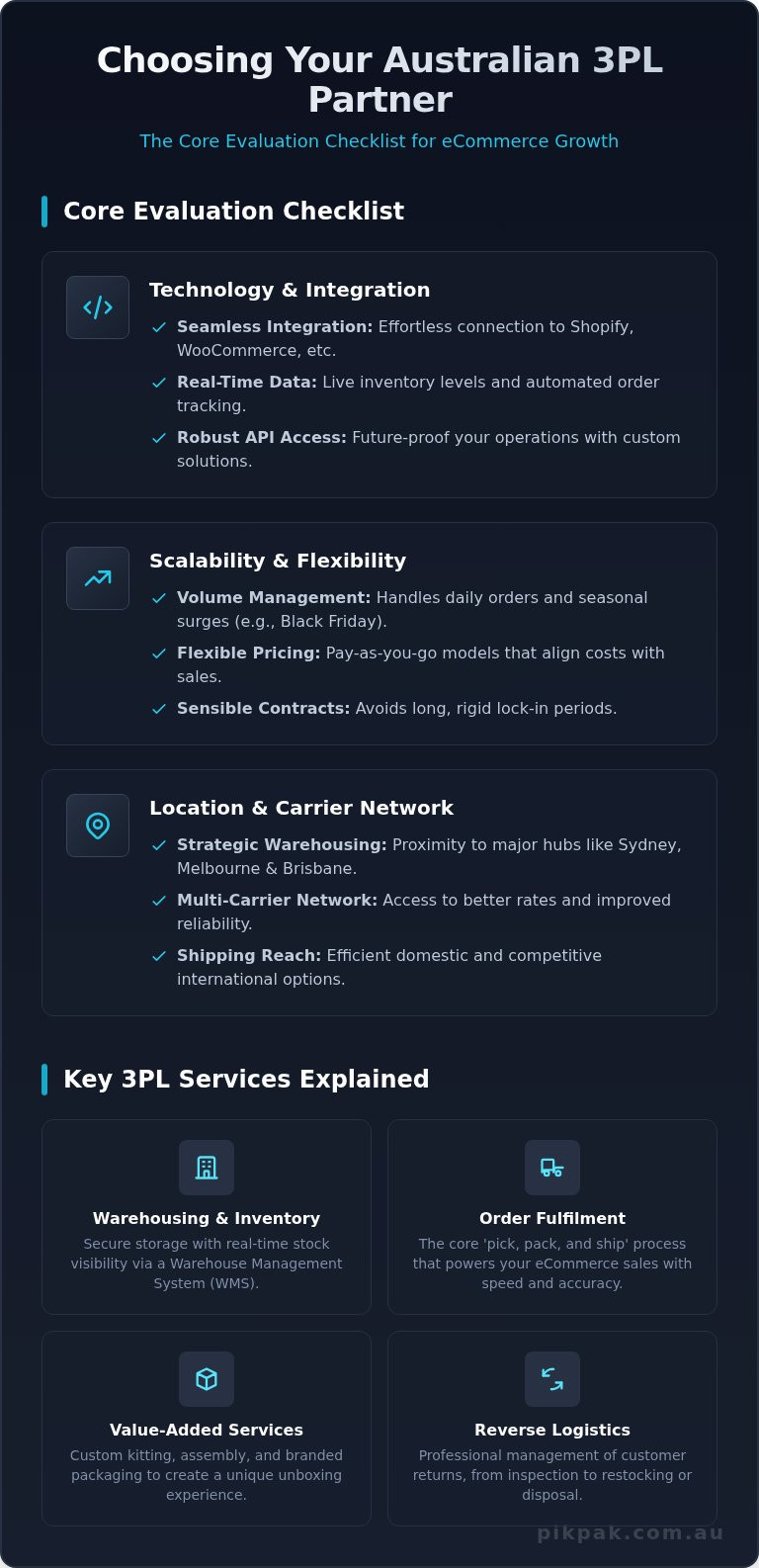
What to Look For in a 3PL Partner: The Core Evaluation Checklist
Before you start comparing quotes, it’s crucial to understand the fundamentals of what is third-party logistics (3PL)? and define what a successful partnership looks like for your eCommerce business. Choosing the right partner from the many 3 party logistics companies available isn’t just about the cheapest price; it’s about finding an extension of your team that can support your growth. This core evaluation checklist helps you focus on what truly matters.
A mismatch in foundational areas like technology, scalability, or location can lead to costly operational headaches and damage your customer experience. Getting these right from the start ensures your fulfilment runs like clockwork, freeing you up to focus on your business.
Technology & Integration Capabilities
In today’s fast-paced market, your 3PL’s technology must make your life easier, not more complicated. Look for a system designed for seamless automation and complete visibility, giving you control without the technical stress.
- Seamless Integration: Does their Warehouse Management System (WMS) connect effortlessly with your eCommerce platform, like Shopify, WooCommerce, or Magento? The process should be simple point-and-click.
- Real-Time Data: You need instant access to live inventory levels and automated order tracking from the moment a customer buys to the final delivery.
- Future-Proof API: Robust API access is crucial for building custom solutions and future-proofing your operations as your business evolves.
- User-Friendly Portal: An intuitive client portal is essential for managing your stock, orders, and returns without needing a complex user manual.
Scalability and Flexibility
Your business won’t stand still, and your logistics partner shouldn’t either. The best 3 party logistics companies are those that can handle your orders today and scale with you tomorrow. Rigidity is the enemy of growth; look for a partner who offers flexibility as a standard feature.
- Volume Management: Can they easily manage your current order volume and your projected growth? Ask specifically how they handle seasonal demand surges like Black Friday and Christmas.
- Flexible Storage & Pricing: A pay-as-you-go model is ideal for growing brands, ensuring your costs align directly with your sales. You shouldn’t have to pay for empty shelf space.
- Sensible Contracts: Avoid getting locked into long, rigid contracts that penalise you for natural business fluctuations. Your agreement should support your journey.
Location and Carrier Network
Where your products are stored has a direct impact on your shipping costs and delivery speed. In a vast country like Australia, strategic warehouse locations are key to keeping customers happy and shipping fees down. A partner with a limited network can quickly become a bottleneck.
- Strategic Warehousing: Are their fulfilment centres located close to the majority of your Australian customers in major hubs like Sydney, Melbourne, or Brisbane?
- Multi-Carrier Network: A strong network with multiple carriers provides access to better shipping rates and adds a layer of reliability, especially during peak periods.
- Shipping Reach: Can they efficiently handle all domestic orders and provide competitive international shipping options for when you’re ready to expand globally?
Decoding the Services: What Do 3rd Party Logistics Companies Actually Do?
Thinking a logistics partner just stores your products and ships them out? That’s only the beginning. The best 3 party logistics companies in Australia offer a full suite of services designed to automate your operations, delight your customers, and free you up to focus on growth. Understanding these services is the first step toward building a resilient supply chain that can handle whatever comes next. Let’s break down what a great 3PL partner actually does for your business.
Core Function 1: Warehousing and Inventory Management
This is more than just a storage unit. It starts with professionally receiving your inbound stock and securing it in an optimised warehouse. A sophisticated Warehouse Management System (WMS) gives you real-time visibility, so you always know your exact stock levels. This accurate data is crucial for preventing overselling and frustrating stockouts. If you sell products that need special care, ask about climate-controlled or high-security storage options.
Core Function 2: Order Fulfilment (Pick, Pack, and Ship)
This is the engine of your eCommerce business, made simple. When a customer places an order, the 3PL’s team ‘picks’ the correct items from the shelves, ‘packs’ them securely in the right packaging, and ‘ships’ them out through their network of carriers. The speed and accuracy of this process directly impact your customer satisfaction and reviews. A reliable 3PL ensures this runs like clockwork, every time.
Value-Added Services: Kitting, Assembly, and Customisation
These services help your brand stand out. A 3PL can take on tasks that would otherwise consume your time, allowing you to offer a more unique customer experience. This includes:
- Kitting: Bundling multiple products (SKUs) into a single package, like a gift set or subscription box.
- Assembly: Performing simple product preparation before shipping.
- Customisation: Adding branded inserts, thank you notes, or gift wrapping to create a memorable unboxing experience.
Reverse Logistics: Managing Customer Returns
Let’s be honest-handling returns is a major headache. A professional 3PL partner transforms this process. They manage the entire returns journey: receiving the item, inspecting it based on your criteria, and processing it accordingly. Whether the product is restocked, quarantined for review, or disposed of, it’s all handled for you. This turns a potential customer service issue into a smooth, loyalty-building experience.
The Vetting Process: A Step-by-Step Guide to Making Your Choice
You know what separates a good 3PL from a great one. Now, it’s time to actively find the right partner for your business. Choosing from the many 3 party logistics companies can feel overwhelming, but a structured process makes it simple and ensures you find a long-term fit. Following the best practices for selecting a 3PL involves a methodical approach that takes you from initial research to final sign-off, eliminating stress and giving you confidence in your decision.
Step 1: Research and Create a Shortlist
The goal of this first step is to narrow the field to a handful of strong contenders. Don’t try to evaluate everyone; focus on finding the specialists who are already equipped to help you succeed. Here’s how to start:
- Use specific online searches like ‘3PL providers Australia’ or ‘eCommerce fulfilment Melbourne’ to find local experts.
- Ask for recommendations from other business owners in your professional network or industry groups.
- Review company websites, paying close attention to their case studies, client testimonials, and technology offerings.
- Create a shortlist of 3-5 companies that appear to specialise in your product niche and business size.
Step 2: The Discovery Call & Key Questions to Ask
With your shortlist ready, it’s time to schedule initial calls. This is your opportunity to understand their operational capabilities and see if their culture aligns with yours. Treat it like an interview and come prepared with key questions:
- What does your onboarding process look like, and what is the typical timeline from signing to going live?
- Can you share your accuracy rates for order picking and inventory management?
- What is your customer support structure? Will we have a dedicated account manager or point of contact?
Step 3: Requesting Quotes and Comparing Apples-to-Apples
To get a true comparison, you must provide every potential partner with the exact same data. This ensures the quotes you receive are based on the same scope of work. Be prepared to share details on your average monthly order volume, total number of SKUs, and specific storage requirements (e.g., pallet space, shelving). Insist that each quote provides a clear and complete breakdown of all potential fees, from receiving and storage to pick-and-pack and shipping. This transparency is crucial for avoiding surprise costs down the line.
Ready to see how it works? Request a transparent quote from Pik Pak.
Step 4: Checking References and Site Visits
The final step is about verifying claims and seeing the operation for yourself. A reputable 3PL will be happy to provide references and welcome you for a tour. This is your chance to confirm that they run their business as professionally as they present it.
- Ask for contact information for 2-3 current clients with businesses similar to yours.
- When speaking to references, inquire about their real-world experience with communication, order accuracy, and problem resolution.
- If possible, arrange a visit to the warehouse. A clean, organised, and efficient facility is one of the strongest indicators of a professional operation.
Understanding 3PL Pricing Models: How to Read a Quote
At first glance, a quote from a 3PL provider can seem complex. But what looks like a challenge is actually quite straightforward once you know what to look for. Demystifying these costs is the key to budgeting accurately, avoiding surprises, and choosing a partner whose model truly aligns with your business growth. When you compare quotes from different 3 party logistics companies, understanding the structure is everything.
Let’s break down the most common fees you’ll encounter, so you can read any quote with confidence.
Common Service Fees Explained
Most fulfilment costs fall into four main categories. A transparent quote will itemise these clearly so you know exactly what you’re paying for.
- Onboarding/Setup Fee: A one-time cost to get started. This typically covers integrating your eCommerce store with the 3PL’s software and the initial process of receiving and organising your first shipment of stock.
- Receiving/Inbounding Fee: A charge for accepting and storing new inventory as it arrives at the warehouse. This might be a flat fee per delivery, an hourly rate (e.g., A$50/hour), or a per-pallet cost.
- Storage Fees: The ongoing cost to store your products. This is usually calculated monthly and can be priced per pallet, per storage bin, or per cubic metre of space your goods occupy.
- Pick & Pack Fees: This is the labour cost for physically retrieving items for an order and packing them for shipment. It can be a flat fee per order, a smaller fee per item in the order, or a combination of both.
Shipping Costs and Account Management
It’s crucial to separate fulfilment fees from postage costs. Shipping is the actual cost charged by carriers like Australia Post or Sendle to deliver a parcel. Because they ship in massive volumes, 3PLs secure significant postage discounts and pass these savings on to you.
Always ask if you will be using their shipping account or if you can use your own. Additionally, some providers charge a recurring monthly fee for software access or account management, so be sure to clarify if this is included or an extra charge.
Beware of Hidden Costs
The best 3 party logistics companies are upfront about all potential charges. To ensure complete clarity, always ask about costs that might not be immediately obvious on a standard quote.
- Packaging Materials: Are boxes, satchels, tape, and void-fill included in the pick & pack fee, or are they billed separately?
- Minimum Spending: Are there any minimum monthly spending commitments or order volume requirements? This is critical for new or seasonal businesses.
- Returns Processing: How are customer returns (reverse logistics) handled, and what are the associated costs for receiving, inspecting, and restocking an item?
A trustworthy partner will happily provide a complete and clear fee schedule. This transparency is the foundation of a great partnership, allowing you to focus on your business while they handle the logistics.
Partnering for Growth: Making Your Final 3PL Decision
Choosing a partner to handle your fulfilment is one of the most critical decisions for your Australian eCommerce brand. As this guide has shown, the right choice goes beyond cost-it’s about finding a strategic ally for growth. A thorough vetting process, a clear understanding of pricing, and a focus on seamless technology are the non-negotiables when comparing 3 party logistics companies. The right partner won’t just ship your orders; they’ll help you scale efficiently.
At Pik Pak, we make that choice simple. As specialists in eCommerce fulfilment for Australian brands, we turn logistics from a headache into a competitive advantage. With seamless integrations for Shopify, WooCommerce, and more, plus transparent, pay-as-you-go pricing that grows with you, we provide the foundation for your success. It’s time to stop managing boxes and start building your brand.
Ready to simplify your logistics and focus on growth? Get a custom quote from Pik Pak.
Frequently Asked Questions About 3PL Logistics
What’s the difference between a 3PL and a freight forwarder?
Think of a freight forwarder as a travel agent for your goods-they arrange transportation from point A to point B, often for large, international shipments. A 3PL (Third-Party Logistics) provider is your complete operational partner. We manage the entire fulfilment process for your eCommerce orders: receiving inventory, securely storing it, picking and packing orders, and shipping them directly to your customers. It’s the difference between simply moving freight and managing your end-to-end supply chain.
How much inventory do I need to have before I should partner with a 3PL company?
There is no magic number. The right time to partner with a 3PL is when logistics starts to slow down your growth. If you’re spending more time packing boxes than marketing your products, or if your garage is overflowing with stock, it’s time to make the switch. It’s less about hitting a specific order volume and more about freeing up your time to focus on what you do best-building your business and delighting your customers.
Can third-party logistics companies handle international shipping for my eCommerce store?
Absolutely. Capable 3 party logistics companies make international shipping simple. They handle the complexities you don’t have time for, like navigating customs documentation, calculating duties and taxes, and leveraging their networks of global carriers to find the most cost-effective routes from Australia. This ensures your products reach customers worldwide without the logistical headaches, allowing you to tap into new markets with confidence and ease. It’s global expansion, made easy.
What is a WMS (Warehouse Management System) and why is it so important?
A WMS is the technology that powers a modern fulfilment centre-think of it as the brain of the entire operation. It tracks every single item from the moment it arrives at the warehouse to the second it ships out to your customer. For you, this is crucial because it provides complete, real-time visibility into your inventory levels and order statuses. A powerful WMS ensures near-perfect accuracy, prevents stockouts, and gives you the control you need to run your business effectively.
How long does it typically take to onboard with a new 3PL provider?
Onboarding is designed to be a swift and simple process. While timelines can vary slightly, most eCommerce businesses can be fully integrated and operational in just one to two weeks. This typically involves connecting your online store (like Shopify or WooCommerce) to the 3PL’s system, setting up your product information, and sending your first shipment of inventory to the warehouse. A good partner makes this a guided, hassle-free experience so you can start shipping quickly.
Will I lose control over my branding and packaging if I use a 3PL?
Not at all-in fact, it’s the opposite. A great 3PL acts as an extension of your brand. You retain full control over your customer’s unboxing experience by providing your custom-branded boxes, mailers, tissue paper, and any promotional inserts or thank-you notes. The 3PL’s job is simply to execute your vision perfectly, ensuring every single package that leaves the warehouse reinforces the unique brand identity you’ve worked so hard to build.