Your sales are climbing, but are you spending more time wrestling with packing tape than you are with your marketing plan? For many growing eCommerce businesses, the search for a reliable 3pl australia partner can feel overwhelming. It’s a maze of confusing quotes, hidden costs, and the nagging fear of choosing a provider that can’t keep up with your growth. This logistical headache shouldn’t be holding your business back; it should be the key that unlocks your next level of success.
That’s why we’ve made it simple. This guide cuts through the noise and gives you a clear, step-by-step framework to confidently select the perfect logistics partner. We’ll provide you with an actionable checklist and the crucial questions to ask so you can find a provider that saves you time and money. It’s time to stop packing boxes and start focusing on what you do best: building your brand.
5 Signs Your Australian Business is Ready for a 3PL Partner
Your business is growing-that’s fantastic news. But with that growth comes new challenges. Is your living room starting to look more like a warehouse? Are your evenings spent printing labels instead of planning your next move? These aren’t just growing pains; they are clear signals that it’s time to work smarter, not harder. Partnering with a third-party logistics (3PL) provider is a strategic step to reclaim your time and scale effectively. If you’re new to the concept and asking ‘What is a 3PL‘, think of it as your dedicated operations team, ready to handle the pick, pack, and ship process so you can focus on your business.
Scaling Pains: When Orders Outgrow Your Living Room
Remember when five orders a day felt like a huge win? Now, fifty feels like a logistical nightmare. The tipping point for many eCommerce owners is when the time spent on fulfilment outweighs the time spent on growth activities. Every hour you spend finding the right box, printing labels, and driving to the post office is an hour you’re not dedicating to marketing, product development, or customer engagement. Soon, your inventory takes over the spare room, the garage, and is creeping into the hallway. This is the classic sign you’ve outgrown your current setup.
The True Cost of In-House Fulfilment
Managing logistics yourself goes far beyond the price of a postage stamp. The true cost includes:
- Packing Materials: The ongoing expense of boxes, mailers, tape, and labels adds up quickly.
- Storage Space: Whether it’s your home or a small storage unit, that space has a real-world cost.
- Opportunity Cost: This is the biggest hidden expense. Time spent packing is time you could have used to land a new wholesale client or run a successful ad campaign.
- Cost of Errors: A single wrong address or incorrect item leads to costly returns, negative reviews, and a damaged reputation.
Expanding Your Reach Across Australia
Shipping from Perth to Sydney is no small feat. Promising fast, affordable delivery nationwide is a major challenge when you manage it all from one location. A strategic 3PL Australia provider solves this problem with a network of fulfilment centres in key metro areas like Melbourne and Sydney. Storing your products closer to your customers dramatically cuts down delivery times and shipping costs. Furthermore, 3PLs ship thousands of parcels daily, giving them access to bulk courier rates you simply can’t get on your own-a saving you can pass directly to your customers.
Core 3PL Services: What to Look for in Australia
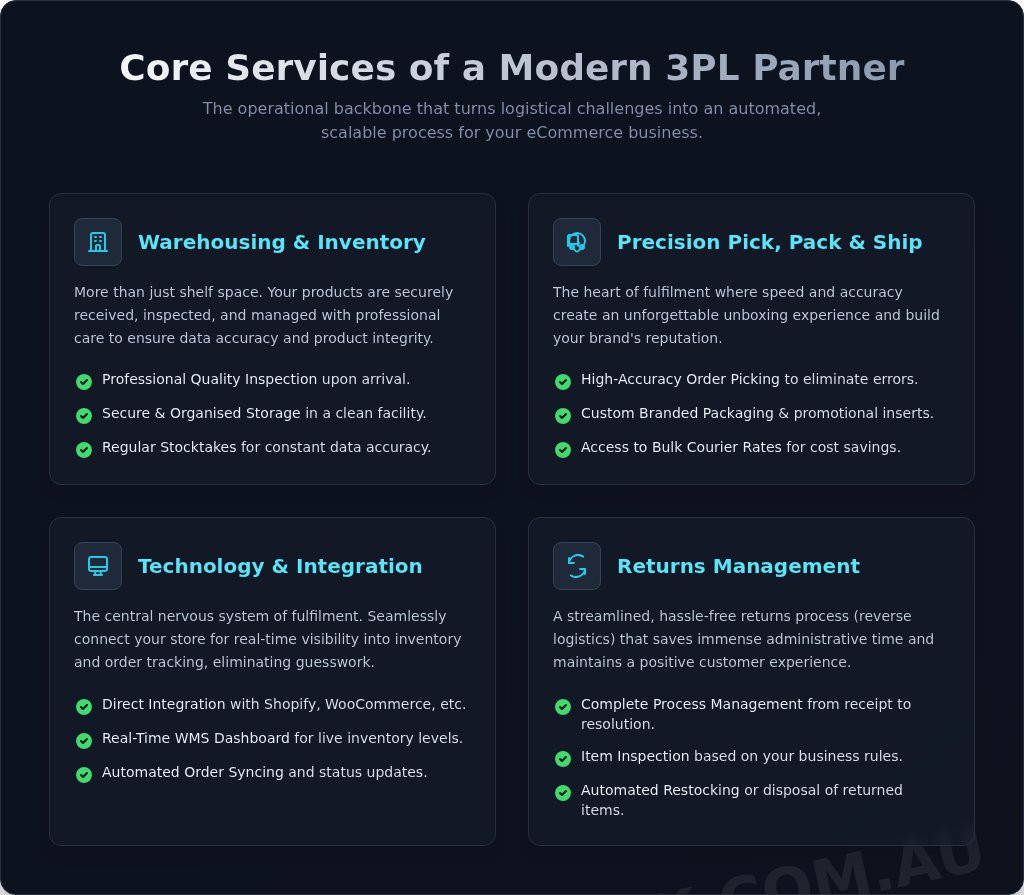
Once you move beyond your garage, a 3PL partner becomes your operational backbone. But not all providers offer the same level of service. A great 3pl australia partner provides a complete, end-to-end solution that makes fulfilment feel effortless. Let’s break down the core services that should be on your non-negotiable checklist, turning logistical challenges into a simple, automated process.
Warehousing & Secure Inventory Management
This is more than just renting shelf space. True inventory management means your stock is received, inspected for quality, and securely stored in a clean, organised facility. Look for providers who offer active management, including regular stocktakes, to ensure data accuracy. Their processes should align with professional Australian logistics industry standards, guaranteeing your products are handled with care from the moment they arrive.
Precision Pick, Pack, and Ship Services
This is where the magic happens for your customer. When an order comes in, the 3PL’s team accurately picks the correct items, packs them securely, and ships them out. The best partners offer custom packaging options-like branded boxes or promotional inserts-to create a memorable unboxing experience. Speed and accuracy here are not just metrics; they are the foundation of customer satisfaction and positive reviews.
Technology & Platform Integration
In today’s eCommerce landscape, technology is the central nervous system of fulfilment. Your 3PL must integrate seamlessly with your online store (like Shopify, WooCommerce, or Magento). This is powered by a Warehouse Management System (WMS) that gives you real-time visibility. You should be able to see live inventory levels and track orders from your own dashboard, eliminating guesswork and manual updates. It should be a simple, point-and-click connection.
Reverse Logistics (Returns Management)
Returns are an unavoidable part of eCommerce, but they don’t have to be a headache. A comprehensive 3pl australia provider will manage the entire returns process for you. This includes receiving the returned item, inspecting it, and then either restocking it for sale or disposing of it based on your rules. This service saves you immense administrative time and helps maintain a positive customer experience, even when a purchase doesn’t work out.
Your Due Diligence Checklist: Key Questions for Any 3PL Partner
Once you have a shortlist, the real work begins. Choosing the right 3PL in Australia isn’t about finding the cheapest quote; it’s about finding a strategic partner who can eliminate headaches and help you grow. The key is to turn the abstract process of evaluation into a concrete set of questions. Use this framework to conduct your due diligence and find a partner who truly fits your business.
Location: Proximity to Your Customers
In a country as vast as Australia, warehouse location directly impacts shipping costs and delivery speed. A single, centrally located warehouse (e.g., in Melbourne or Sydney) can reach the majority of the population efficiently. Multiple warehouses can reduce delivery times to customers in WA or QLD but may add complexity. Ask potential partners:
- Where are your fulfilment centres located?
- Which carriers do you use (Australia Post, StarTrack, couriers), and can you leverage your volume for better rates?
Specialisation: Do They Understand eCommerce?
Not all logistics are the same. A general warehouse that handles B2B pallets operates very differently from a specialist eCommerce fulfilment centre. You need a partner who understands the unique demands of direct-to-consumer shipping. Ask them directly: “Do you have experience shipping products similar to mine in size, weight, and fragility?” Ensure they are experts in B2C fulfilment, from pick and pack accuracy to managing returns.
Scalability and Flexibility
Your business won’t stand still, and your 3PL partner shouldn’t hold you back. A key fear for many founders is being trapped by a provider who can’t handle growth. With recent Australian 3PL market analysis showing sustained industry growth, you need a partner built for scale. Inquire about their process for handling seasonal peaks like Black Friday, whether they enforce minimum order quantities (MOQs), and if they can seamlessly scale with you from 50 orders a month to 500 and beyond.
Customer Support & Communication
When an order issue arises, the last thing you want is an anonymous support ticket system. Strong communication is the foundation of a successful partnership. Ask who your dedicated point of contact will be and what their standard response times are for support issues. Look for testimonials or case studies that specifically mention service quality. A responsive, local support team turns logistical problems into simple, manageable tasks. See how our Australian-based support makes logistics easy.
Understanding 3PL Pricing Models in Australia
Navigating the costs of outsourcing your fulfilment can feel like a major headache, but it doesn’t have to be. A transparent 3PL Australia partner will provide a clear, easy-to-understand fee structure, eliminating surprises so you can budget effectively and focus on growth. Understanding the components of a 3PL invoice is the first step to finding a partner who offers real value, not just a low sticker price.
Let’s break down what you can expect to see, so you can make a confident and strategic decision for your business.
Breaking Down the Core Costs
Most 3PL invoices are built from a few core service fees. While the exact names may vary, the functions are generally the same. Here’s a simple rundown of the key charges:
- Onboarding/Setup Fee: A one-time cost to integrate your eCommerce store with the 3PL’s software and set up your account.
- Receiving/Inbound Fees: The cost to receive your inventory, count it, and put it away in the warehouse. This is often charged per pallet, per carton, or at an hourly rate.
- Storage Fees: The monthly rent for the space your products occupy. This is typically calculated per pallet, per shelf, or per cubic metre (CBM).
- Pick & Pack Fees: This is the labour cost for physically picking items for an order and packing them for shipment. A common structure is a base fee per order (e.g., A$2.80) plus a small fee for each additional item in that order (e.g., A$0.50).
- Shipping Costs: The actual cost of postage from carriers like Australia Post or Aramex. A key benefit of using a 3PL is gaining access to their bulk shipping discounts, which are passed on to you.
Common Pricing Structures
Providers package these core costs into different models. The right one for you depends on your sales volume and predictability. The most common structures you’ll encounter with a 3pl australia provider include Pay-As-You-Go, ideal for startups where you only pay for the services you use, and Flat-Rate models, which offer a fixed monthly fee for a set number of orders, providing predictable costs for stable businesses.
Beware of Hidden Fees: What to Ask About
True partnership is built on transparency. To avoid unexpected charges that can quickly erode your margins, you need to ask the right questions upfront. Don’t be afraid to dig deeper.
Before signing any contract, make sure you ask about:
- Account Management or Software Fees: Are there monthly charges for using their platform or having a dedicated account manager?
- Packaging Materials: Are standard boxes, satchels, tape, and void-fill included in the pick & pack fee, or are they billed separately?
- Long-Term Storage Fees: What are the penalties for slow-moving inventory that sits in the warehouse for extended periods (e.g., over 6-12 months)?
Pro Tip: The single best way to ensure clarity is to request a sample invoice. This shows you exactly how you will be billed and reveals any fees that weren’t obvious in the initial quote. At Pik Pak, we believe in making fulfilment easy, and that starts with clear, upfront pricing.
Why Pik Pak Makes 3PL Simple and Scalable for You
You’ve seen the complexities involved in choosing a logistics partner. The technical hurdles, confusing pricing, and the risk of a poor fit can be daunting. Pik Pak was built to eliminate these headaches. We provide a streamlined, powerful, and refreshingly straightforward 3pl australia solution designed specifically for ambitious eCommerce brands like yours.
Seamless Tech Integration, No Geek Required
Connecting your online store shouldn’t require a degree in computer science. Our platform features simple, point-and-click integrations with major eCommerce platforms like Shopify, WooCommerce, and Magento. Once connected, our user-friendly Warehouse Management System (WMS) gives you a real-time, 24/7 view of your inventory, orders, and shipments. We handle the entire technical setup, so you can skip the stress and get back to business from day one.
Transparent ‘Pay-As-You-Go’ Pricing
Budgeting for growth should be predictable, not painful. We’ve replaced complex fee structures and scary long-term contracts with a simple ‘pay-as-you-go’ model. You only pay for the storage you use and the orders we ship. There are no high minimums or lock-in periods, making our service accessible for businesses at every stage. This flexibility means our fulfilment services scale perfectly with your sales, whether you’re shipping 10 orders a day or 1,000.
A True Partner to Help You Focus on Growth
Our core promise is simple: we handle the logistics so you can focus on building your brand. From inventory management to pick, pack, and ship, our operations are designed to run like clockwork, ensuring your customers receive their orders accurately and on time. And if you ever have a question, our dedicated, Australian-based support team is here to help. We aren’t just a service provider; we are the strategic partner invested in your success.
Ready to see the difference? Get a clear quote and see how easy logistics can be.
Take the Complexity Out of Fulfilment and Scale Your Business
Choosing the right 3pl australia partner is a pivotal moment for any growing eCommerce business. It’s not just about finding warehouse space; it’s about securing a strategic ally who understands the local market and can help you deliver an exceptional customer experience. By understanding when you’re ready to outsource and what to look for in a provider, you are empowered to make a smart, scalable decision for your brand’s future.
At Pik Pak, we turn this complex decision into a simple one. We eliminate the headaches of logistics with our seamless Shopify & eCommerce integrations, transparent pay-as-you-go pricing, and dedicated, Australian-based support. There are no complex contracts or hidden fees-just a clear, straightforward path to growth.
Stop letting logistics slow you down. Request a free, no-obligation quote from Pik Pak today and see how easy it is to get started.
It’s time to focus on what you do best-building your brand. Let us handle the rest.
Frequently Asked Questions About 3PL in Australia
What is the minimum number of orders I need to work with a 3PL in Australia?
There’s no single magic number, as minimums vary between providers. However, most eCommerce businesses find it becomes cost-effective to partner with a 3PL when they are shipping 100+ orders per month. Some flexible providers cater to startups with as few as 50 orders, while larger networks may require several hundred. The key is to find a partner whose model allows you to scale, so you aren’t penalised for starting small and can grow without headaches.
How much does 3PL cost per month in Australia on average?
Monthly 3PL costs in Australia are variable and depend on your specific needs. Costs are typically broken down into receiving, storage (e.g., A$25-A$40 per pallet), pick and pack fees (e.g., A$3-A$5 per order), and shipping. For a small business with one pallet of inventory sending 150 orders a month, you might expect to pay between A$700 and A$1,500+, depending on order complexity and shipping destinations. Always ask for a clear, itemised quote.
Can I use my own branded boxes and packaging with a 3PL?
Absolutely. Most modern 3PL providers understand that your branding and unboxing experience are crucial to customer retention. You can ship your custom boxes, mailers, and marketing inserts directly to their warehouse. They will store this packaging for you and use it exclusively for your orders as instructed. This ensures your brand identity remains consistent, even when you’re not the one packing the box. It’s a simple way to keep your brand front and centre.
How does 3PL integration with my Shopify or WooCommerce store work?
It’s simpler than you think. Modern 3PLs use software that connects directly to your eCommerce platform like Shopify or WooCommerce via an app or API. Once connected, your customer orders flow automatically and securely to the 3PL’s warehouse management system. When your order is picked, packed, and shipped, the tracking information is automatically sent back to your store and shared with your customer. It’s a seamless process designed to run like clockwork without any manual work from you.
What’s the difference between a 3PL provider and a freight forwarder?
Think of it this way: a freight forwarder is like a travel agent for your bulk inventory, managing the shipment from your manufacturer to Australia. Their job is done once your goods clear customs. A 3PL Australia provider handles everything after that. They receive your stock, store it, and then pick, pack, and ship individual orders directly to your customers across the country. One manages bulk import logistics; the other manages your day-to-day customer fulfilment.
How long does it take to get set up with a 3PL partner?
The setup timeline can be surprisingly fast. For a straightforward integration with a platform like Shopify, you can be onboarded and ready to send your first batch of inventory in as little as one to two weeks. This process typically includes initial consultation, signing agreements, integrating your sales channels, and setting up your product information in their system. A good partner will guide you through each step to make the transition smooth and effortless, getting you back to focusing on your business quickly.