
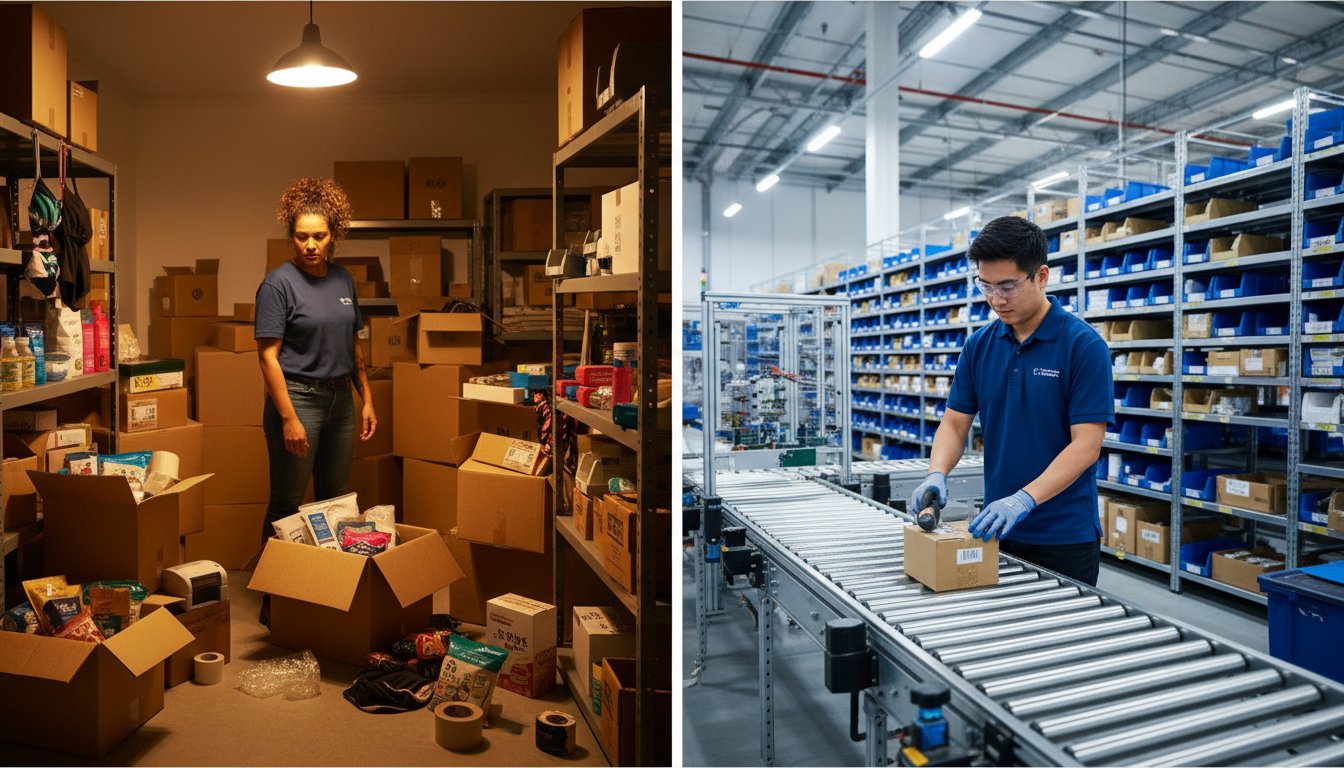
Are you spending more time wrestling with packing tape than you are with your marketing strategy? For many growing Aussie businesses, the daily grind of picking, packing, and shipping can feel like a major roadblock, not a path to success. As warehouse rent and staff wages climb, the question of the 3pl vs in-house fulfillment cost becomes less of a ‘what if’ and more of a critical business decision. It’s the headache that keeps you from focusing on what truly matters.
Getting a straight answer can be tough. The ‘true’ cost of self-fulfillment is often buried under hidden expenses like packaging supplies, software subscriptions, and the invaluable cost of your own time. We’re here to make it simple. This honest, side-by-side comparison breaks down every expense, giving you the clarity to make a confident, financially sound decision. Let’s find out if outsourcing is your key to saving money, eliminating stress, and reclaiming your time to grow your business.
The Real Cost of In-House Fulfilment: Uncovering the Hidden Expenses
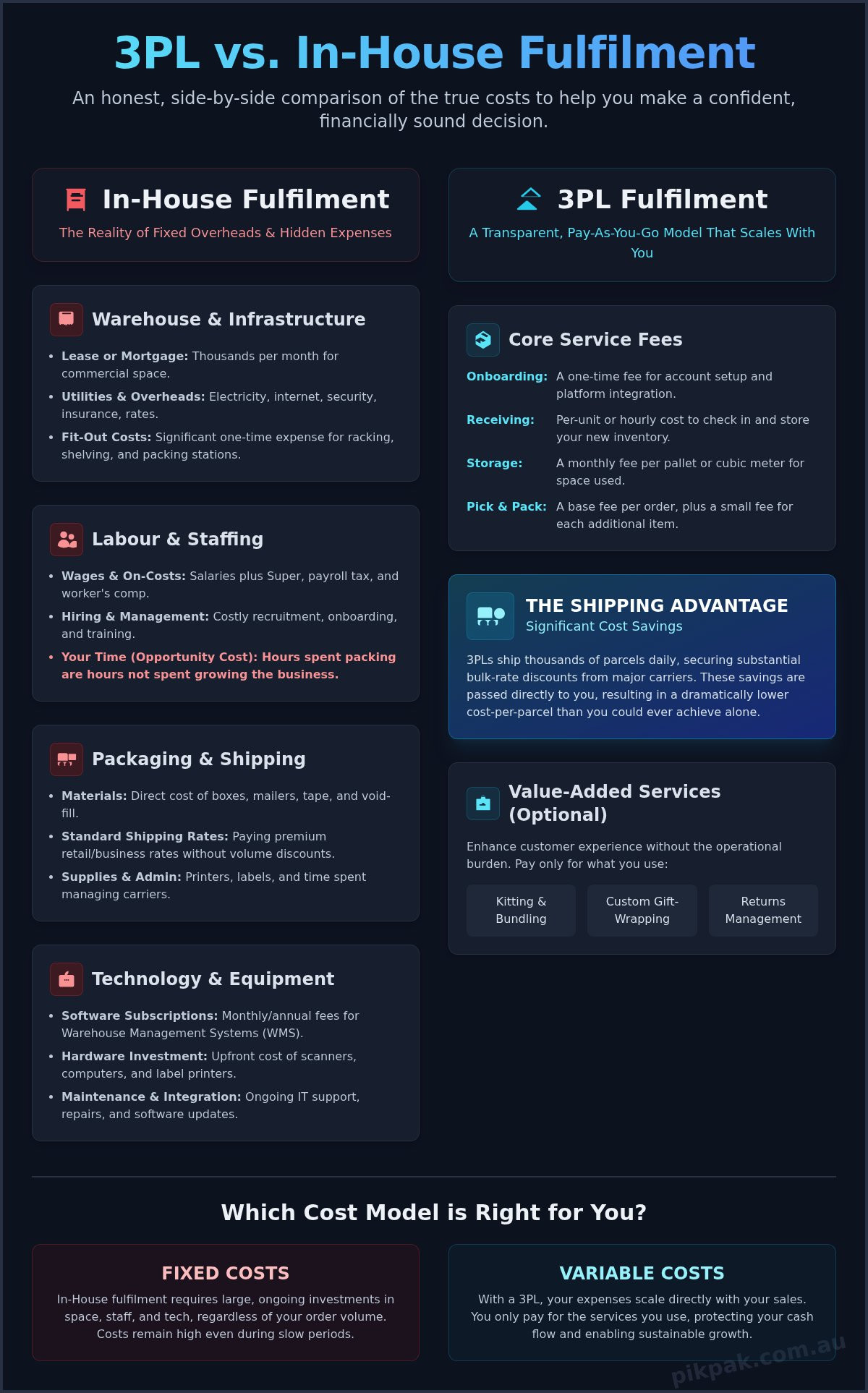
When you’re running an eCommerce business, it’s easy to think you’re saving money by managing logistics yourself. But the reality is often very different. The true 3pl vs in-house fulfillment cost isn’t just about what you pay Australia Post; it’s a web of hidden expenses that quietly eat into your profits and, more importantly, your time. Many businesses significantly underestimate these costs.
Let’s make this simple. We’ll break down the four main cost categories you’re likely already paying for. Use this as a practical checklist to perform a realistic audit of your current spending. This gives you a powerful baseline to compare against quotes from a Third-party logistics (3PL) provider, so you can make a decision based on real numbers, not guesswork.
Warehouse & Infrastructure Costs
Your “spare room” or garage might work initially, but as you grow, so do your space requirements. This is where the first major expenses appear, often including fixed costs that you pay regardless of order volume.
- Lease or Mortgage: Commercial rent or mortgage payments for your warehouse space, which can run into thousands of dollars per month in cities like Sydney or Melbourne.
- Utilities & Overheads: Monthly bills for electricity, heating, cooling, internet, security systems, insurance, and council rates.
- Fit-Out: The one-time (but significant) cost of industrial racking, shelving, packing stations, and safety equipment.
Labour & Staffing Costs
Time is money, and fulfilment is incredibly time-intensive. Whether you’re paying staff or doing it all yourself, there is a significant labour cost that goes far beyond a simple hourly rate.
- Wages & On-Costs: Salaries for staff who pick, pack, and ship, plus mandatory Superannuation, payroll tax, and workers’ compensation insurance.
- Hiring & Management: The cost of recruiting, onboarding, and training new warehouse staff, not to mention the time spent managing them.
- Your Time: The most valuable cost. Every hour you spend packing boxes is an hour you’re not spending on marketing, product development, or growing your business.
Packaging & Shipping Costs
Beyond the label itself, the costs associated with preparing and sending an order add up quickly. Without the scale of a 3PL, you’re often paying a premium for both materials and postage.
- Materials: The direct cost of shipping boxes, mailers, tape, bubble wrap, and other void-fill materials.
- Standard Shipping Rates: Paying retail or standard business rates for shipping without the significant volume discounts that 3PLs negotiate with carriers.
- Supplies & Admin: The cost of printers, labels, and shipping documents, plus the time spent managing multiple carrier relationships.
Technology & Equipment Costs
Efficient fulfilment runs on technology, and the required hardware and software represent a major investment. These systems are essential for accuracy and speed but come with hefty price tags and ongoing fees.
- Software Subscriptions: Monthly or annual fees for a Warehouse Management System (WMS) to track inventory and manage orders.
- Hardware: The upfront cost of barcode scanners, computers, label printers, and other essential warehouse equipment.
- Maintenance & Integration: Ongoing costs for IT support, equipment repairs, software updates, and ensuring your systems integrate seamlessly with your eCommerce platform.
Demystifying 3PL Fulfilment Costs: A Transparent Guide to Pricing
Understanding 3PL pricing doesn’t have to be a headache. In fact, it’s designed to be simple and transparent once you know what to look for. The biggest shift when evaluating the 3pl vs in-house fulfillment cost is moving from large, fixed overheads to a flexible, pay-as-you-go model. This structure means your logistics expenses scale directly with your sales volume-you only pay for the services you use, when you use them. It’s a smarter way to manage cash flow and grow your business without being locked into long-term leases or staff costs.
Core 3PL Pricing Components Explained
While every 3PL partner has a slightly different structure, most quotes are built from the same four core service fees. What seems complex is actually a straightforward, itemised process. Here’s what you can expect:
- Onboarding/Setup Fee: A one-time charge to integrate your eCommerce platform with the 3PL’s warehouse management system (WMS), set up your account, and prepare for your first inventory shipment.
- Receiving Fee: An hourly or per-unit cost to receive your incoming stock, inspect it for accuracy and damage, and place it into storage.
- Storage Fee: A recurring monthly cost for the space your products occupy in the warehouse, typically charged per pallet or per cubic metre.
- Pick & Pack Fee: The cost to retrieve items for an order and pack them for shipping. This is often charged as a base fee per order, plus a small additional fee for each item in the order.
Shipping Costs: The 3PL Advantage
This is where partnering with a 3PL delivers one of its most significant financial wins. Because 3PLs ship thousands of parcels daily, they negotiate substantial bulk-rate discounts with major Australian carriers like Australia Post, Aramex, and Toll. These savings are passed directly on to you, resulting in a much lower cost-per-parcel than you could ever secure on your own. This factor alone can dramatically tip the scales when comparing 3pl vs in-house fulfillment cost, all while removing the hassle of managing carrier accounts and relationships.
Additional Value-Added Service Costs
Need more than just the basics? Most 3PLs offer a suite of optional services to help your brand stand out. These are only charged when you use them and can include kitting for subscription boxes, custom gift-wrapping, or managing the entire returns (reverse logistics) process for you. It’s an easy way to enhance your customer experience without the operational burden.
Confused by pricing? Talk to our experts for a simple, clear quote. We make it easy to understand exactly what you’re paying for.
In-House vs. 3PL: A Practical Cost Scenario for an Aussie Business
Theory is one thing, but seeing the numbers side-by-side makes the decision clear. To truly understand the 3pl vs in-house fulfillment cost, let’s analyse a real-world scenario for a growing Australian eCommerce business. This is where the hidden expenses of self-fulfilment become obvious.
Scenario: ‘Sydney T-Shirts Co.’ Shipping 500 Orders/Month
Imagine a typical Shopify store based in Sydney, shipping 500 t-shirt orders across Australia each month. To manage this in-house, they rent a small industrial unit, employ one part-time staff member for picking and packing, and use standard Australia Post shipping rates. It’s a lean setup, but the fixed costs quickly add up.
The Cost Breakdown: In-House vs. Outsourced
Here’s how the monthly expenses compare. Notice how fixed costs like rent and wages for the in-house model are replaced by flexible, pay-as-you-go fees with a 3PL partner.
| Cost Component | In-House Fulfilment (Monthly) | 3PL Fulfilment (Monthly) |
|---|---|---|
| Warehouse Rent & Utilities | A$1,800 | A$0 |
| Staff Wages (1x Part-Time) | A$2,600 | A$0 |
| Packaging Supplies | A$750 | Included in Pick/Pack |
| Shipping (500 orders @ A$12 avg) | A$6,000 | A$4,500 (Discounted Rates) |
| Software & Admin | A$50 | Included |
| 3PL Fees (Storage, Pick/Pack) | A$0 | A$1,950 |
| Total Monthly Cost | A$11,200 | A$6,450 |
Note: Figures are estimates for illustrative purposes. Your actual costs may vary.
Identifying Your Breakeven Point
The table shows a clear winner, but what’s your magic number? The breakeven point is where the high fixed costs of an in-house setup are overtaken by the scalable, variable costs of a 3PL. For most growing businesses, this tipping point happens between 10-20 orders per day. Once you cross this threshold, outsourcing your logistics isn’t just easier-it’s smarter for your bottom line. It frees up your time and capital, so you can stop packing boxes and start growing your brand. Ready to see what your numbers look like? Pik Pak Logistics makes it simple.
Beyond the Balance Sheet: Factoring in Time, Growth, and Peace of Mind
The final calculation in the 3pl vs in-house fulfillment cost debate isn’t about finding the cheapest option; it’s about finding the most profitable one. A simple spreadsheet might show one path as less expensive, but it won’t show the hidden costs of stress, missed opportunities, and stunted growth. The real value lies in what outsourcing your logistics frees you up to do: build your business.
The True Value of Your Time (Opportunity Cost)
Every hour you spend printing labels, packing boxes, or managing warehouse staff is an hour you’re not spending on marketing, product development, or sales. Think about it: if you reclaimed 10 hours a week, could you generate an extra A$1,000 in sales? For most eCommerce owners, the answer is a resounding yes. Letting go of the day-to-day logistics grind allows you to stop working in your business and start working on it again. It lets you be the CEO.
The Power of Scalability and Flexibility
Growth brings challenges. A sudden surge in orders during Black Friday can cripple an in-house operation, leading to delays and unhappy customers. A 3PL partner is built for this. Their infrastructure is designed to handle dramatic fluctuations in order volume, giving you the power to scale instantly without the headache.
- Handle seasonal peaks effortlessly without hiring and training temporary staff.
- Expand into new markets across Australia without signing expensive new warehouse leases.
- Avoid the painful process of outgrowing your space and managing a disruptive move.
- Your capacity grows with you, ensuring your fulfillment keeps pace with your success.
Gaining a Team of Logistics Experts Instantly
Partnering with a 3PL means you’re not just renting shelf space; you’re onboarding an entire team of logistics professionals. You gain immediate access to advanced Warehouse Management System (WMS) technology and streamlined processes that have been perfected over thousands of orders. This expertise translates directly into fewer picking errors, faster delivery speeds, and a better experience for your customers, strengthening your brand with every package sent. What seems to be a challenge is an easy game with the right partner.
Ready to focus on growth? See how Pik Pak can handle the rest.
Your Final Verdict: Choosing Growth Over Gridlock
The debate over 3pl vs in-house fulfillment cost is about more than just numbers on a spreadsheet. While managing your own logistics seems straightforward, it comes with a mountain of hidden expenses and time-consuming tasks that can stall your growth. A strategic 3PL partner transforms these unpredictable fixed costs into a simple, variable expense, freeing up your capital and, more importantly, your time. It’s the difference between being trapped in your warehouse and being free to focus on what you do best: growing your brand.
Ready to see what that freedom looks like for your Aussie business? With our pay-as-you-go pricing that scales with you, seamless integration with major eCommerce platforms, and access to discounted shipping rates across Australia, Pik Pak makes logistics easy. Discover how much you could save and how much time you could reclaim.
Get a Free, No-Obligation Quote and See Your Potential Savings. Let us handle the pick, pack, and ship, so you can focus on your next big move.
Frequently Asked Questions
What is the typical cost of a 3PL in Australia?
In Australia, 3PL costs are typically broken down into key services. You can expect an initial setup fee (A$200-A$1000+), receiving fees (around A$40/hour or per pallet), storage (A$25-A$50 per pallet/month), and pick & pack fees (A$3-A$5 per order). Shipping costs are then added, often at discounted carrier rates. This “pay as you go” model makes it a flexible alternative when comparing the 3pl vs in-house fulfillment cost, eliminating the fixed overheads of your own warehouse.
Is there a minimum number of orders I need to have to use a 3PL?
This varies between providers. Some traditional 3PLs in Australia may require a minimum of 500-1000 orders per month to be cost-effective. However, modern, tech-focused partners are built for flexibility. We understand that businesses need to scale. Our model is designed to support you whether you’re shipping 50 orders a month or 5,000, ensuring you only pay for what you use. This makes professional logistics accessible from day one, so you can focus on growth.
Will I lose control over my inventory and branding if I outsource to a 3PL?
Not at all. A modern 3PL acts as your partner, giving you more control, not less. Through a sophisticated Warehouse Management System (WMS), you get real-time visibility of your stock levels, order status, and reporting. For branding, we can use your custom-branded boxes, mailers, and inserts. This ensures your customer’s unboxing experience remains uniquely yours while we handle the complex logistics. You get the control without the headache.
How much does it cost to store my products in a 3PL warehouse?
In Australia, 3PL storage costs are typically calculated per pallet or per cubic metre (CBM) per month. You can expect to pay between A$25 to A$50 per pallet per month, depending on the location (e.g., Sydney vs. Adelaide) and the type of storage required. Some 3PLs also offer bin or shelf storage for smaller items, often costing a few dollars per month. This flexible model means you only pay for the exact space you occupy, which is a key advantage over fixed warehouse rent.
How does a 3PL handle customer returns?
We make returns simple. When a customer sends an item back to our warehouse, our team inspects it based on your predefined criteria. We check if it’s in a saleable condition, process the return in our system, and update your inventory levels in real-time. The item can then be restocked for resale or quarantined if damaged. This entire reverse logistics process is managed for you, turning a potential headache into a smooth, automated operation.
What’s the difference between a 3PL and a freight forwarder?
Think of it this way: a freight forwarder is a travel agent for your cargo, arranging the transportation of your goods from one point to another, like from your manufacturer to Australia. A 3PL, on the other hand, is your complete logistics department. We receive that cargo, store it, manage your inventory, and then pick, pack, and ship individual orders directly to your customers. A freight forwarder handles the large-scale move; a 3PL manages the daily fulfilment.