
Your eCommerce store is booming. Orders are flying in faster than you can pack them, and what was once a passion project is now taking over your living room. While this growth is exciting, it brings a new set of challenges. The question is no longer *if* you can handle fulfilment, but for how much longer. This is the critical moment when you need to figure out how to choose a 3PL partner in Australia without risking your brand’s reputation.
The thought of handing over your inventory and customer experience can be daunting. You’re worried about hidden costs, losing control, and choosing a partner who can’t keep up. We get it. That’s why we’ve created this simple, step-by-step guide. We’ll break down the entire process, from understanding pricing to asking the right questions, so you can confidently select the perfect logistics partner. It’s time to free up your time, eliminate the operational headache, and focus on what you do best: scaling your business.
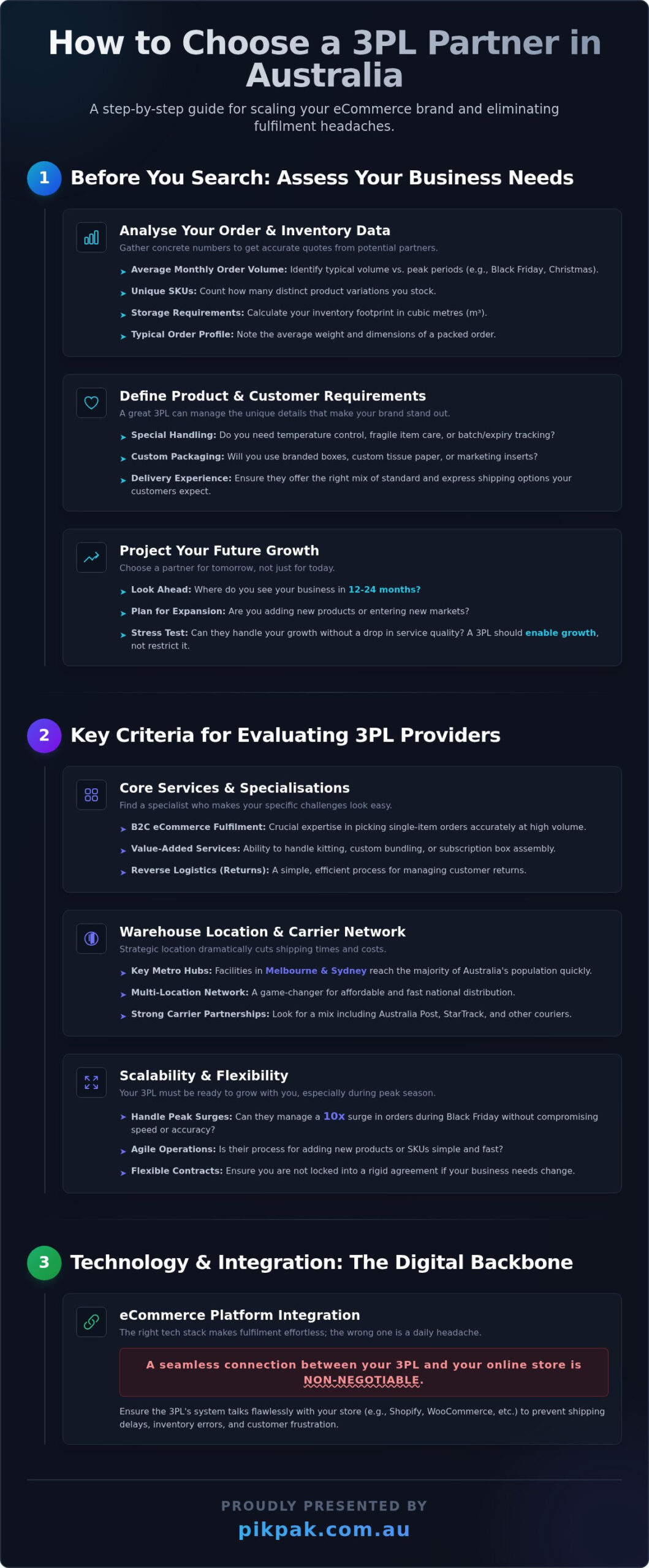
Step 1: Before You Search – Assess Your Business’s Fulfilment Needs
The journey of finding the perfect third-party logistics provider doesn’t start with endless Google searches. It starts with a clear, honest look at your own operations. Before you can effectively evaluate what a potential partner offers, you must first understand exactly what your business needs. This internal audit is the most critical part of learning how to choose a 3pl partner in australia, preventing the costly mistake of partnering with a provider that simply doesn’t fit your model.
Taking the time to define your requirements transforms a complicated decision into a straightforward process. It gives you a precise checklist to measure potential partners against, ensuring you find a solution that removes logistical headaches and lets you focus on what you do best: growing your business.
Analyse Your Order and Inventory Data
Your business data tells a story about your fulfilment needs. Compiling these numbers gives you the concrete information required to get accurate quotes and find a partner equipped to handle your specific volume. Start by gathering the following:
- Average Monthly Order Volume: Calculate your typical volume and identify your busiest periods, like the lead-up to Christmas or Black Friday sales.
- Unique SKUs: How many different product variations do you currently stock?
- Storage Requirements: Determine your current inventory storage footprint in cubic metres.
- Order Profile: Note the average weight and dimensions of a typical customer order for accurate shipping cost estimates.
Define Your Product and Customer Requirements
Not all products are created equal, and neither are customer expectations. A great 3PL partner can manage the unique details that make your brand stand out. Consider if your business requires:
- Special Handling: Do you sell fragile items, products requiring temperature control, or goods that need batch and expiry tracking?
- Custom Packaging: Do you use branded boxes, custom tissue paper, or include marketing inserts with your orders?
- Delivery Experience: What do your customers expect? Make sure your partner can offer the right mix of standard and express shipping options across Australia.
Project Your Future Growth
The right 3PL partner isn’t just for today; they are for your future. Choosing a provider that can’t scale with you will create a massive operational bottleneck down the road. Ask yourself where you see your business in the next 12-24 months. Are you planning to expand your product range or enter new markets? The key to a successful long-term partnership is ensuring your 3PL can seamlessly handle your growth without any degradation in service quality. This foresight is a crucial element in how to choose a 3pl partner in australia for sustainable success.
Step 2: Key Criteria for Evaluating 3PL Providers in Australia
Now that you have a clear picture of your fulfilment needs, you can move from ‘what’ to ‘who’. The next step in how to choose a 3pl partner in australia is creating a scorecard to evaluate potential providers. This isn’t just about finding the cheapest quote; it’s about finding a partner who adds real value and resilience to your operations. A key part of this involves understanding and assessing supply chain risks, ensuring your chosen partner can navigate challenges effectively. Focus your evaluation on four core pillars: their services, warehouse locations, scalability, and proven track record.
Core Services and Specialisations
Not all 3PLs are created equal. A provider focused on B2B pallet shipping won’t have the finesse for direct-to-consumer eCommerce orders. You need a specialist who makes your specific challenges look easy. Confirm they have deep experience in:
- B2C eCommerce Fulfilment: Expertise in picking single-item orders accurately and at high volume.
- Value-Added Services: The ability to handle kitting, custom bundling, or subscription box assembly to enhance your customer experience.
- Reverse Logistics: A simple, efficient process for managing customer returns that protects your brand reputation.
- Product-Specific Experience: Ask if they’ve handled products like yours, whether they’re fragile, require batch tracking, or have other special requirements.
Warehouse Location and Carrier Network
In a country as vast as Australia, warehouse location is everything. A strategically placed fulfilment centre dramatically cuts down shipping times and costs, delighting your customers. Look for a partner with a network that gives you a competitive edge. Do they have facilities in key hubs like Melbourne and Sydney to reach the majority of the population quickly? A multi-location network can be a game-changer for affordable national distribution. Also, investigate their carrier partnerships-a strong mix including Australia Post, StarTrack, and other couriers ensures you have flexible and reliable shipping options for both domestic and international orders.
Scalability and Flexibility
Your business is built for growth, and your 3PL partner must be ready to grow with you. The real test of a provider isn’t how they perform on a quiet Tuesday, but how they manage the chaos of your Black Friday sale. Can they scale their operations to handle a 10x surge in orders without compromising speed or accuracy? Ensure their process for adding new products or SKUs is simple and fast, allowing you to stay agile. Finally, review their contracts for flexibility, so you’re not locked into a rigid agreement if your business needs change. Your 3PL should enable your growth, not restrict it.
Step 3: Technology and Integration – The Digital Backbone of Fulfilment
In today’s fast-paced eCommerce market, technology isn’t just a feature of a 3PL-it’s the entire engine. A clunky, slow, or disconnected system creates shipping delays, inventory errors, and customer frustration. When considering how to choose a 3pl partner in australia, their technological capability should be a top priority. The right tech stack makes fulfilment effortless, while the wrong one becomes a daily operational headache you don’t have time for.
eCommerce Platform Integration
Your 3PL’s system must talk to your online store flawlessly. This isn’t a “maybe”; it’s a non-negotiable. A seamless connection means orders flow from your site to the warehouse automatically, and tracking information is pushed back to your customers without you lifting a finger. Before signing on, confirm:
- Do they have pre-built, reliable connectors for your platform (e.g., Shopify, WooCommerce, Magento)?
- How quickly do orders and inventory levels sync? Near real-time is the standard.
- Is the process for sending tracking details back to your store and customers fully automated?
Warehouse Management System (WMS) Functionality
The Warehouse Management System (WMS) is your window into the entire fulfilment operation. It’s the central hub where you can see exactly what’s happening with your products. A powerful WMS gives you complete visibility and control, eliminating guesswork. You should be able to log in and instantly see real-time stock levels, track order statuses, and access reports on picking accuracy and returns. A complex, hard-to-use platform defeats the purpose. The goal is to simplify your workload, not add to it. See how our easy-to-use platform gives you full control.
Reliability and Support
Even the best technology is useless if it’s unreliable. Ask potential partners about their system’s uptime guarantee and performance history. Leading business resources list technological stability as one of the key criteria for evaluating 3PL providers, because downtime directly translates to lost sales and a damaged reputation. Find out if their support team is readily available to help with integration issues. It’s also wise to ask if their technology is developed in-house. In-house tech often means faster updates and more knowledgeable support, as they built the system from the ground up.
Step 4: Understanding 3PL Pricing Structures in Australia
3PL pricing can seem like a complex puzzle, but it doesn’t have to be. At its core, you simply pay for the services you use. The challenge is ensuring you know exactly what those services cost. Navigating the financial side is a critical step in how to choose a 3pl partner in australia, so always start by requesting a detailed rate card. A transparent partner will happily provide one, with no hidden fees or nasty surprises. For growing businesses, a clear ‘pay-as-you-go’ model offers the ultimate flexibility, ensuring costs scale directly with your sales.
Common Fulfilment Fees Explained
These are the standard charges you’ll see from most Australian 3PL providers. Here’s a simple breakdown:
- Onboarding/Setup Fees: A one-time cost to integrate your eCommerce store with the 3PL’s system and set up your account.
- Receiving Fees: The cost to receive your inventory, unpack it, count it, and add it to the warehouse management system. This is often charged per hour or per pallet.
- Storage Fees: Your monthly “rent” for warehouse space, typically charged per pallet or per cubic metre (CBM).
- Pick & Pack Fees: The cost to retrieve items for an order and pack them for shipping. This is usually a fee per order plus a smaller fee for each additional item.
Shipping and Other Costs to Consider
Beyond the basics, a few other costs can impact your total spend. Make sure to clarify:
- Shipping Costs: How does the 3PL bill for postage? Do they pass on their bulk-rate carrier discounts to you? This can be a major source of savings.
- Account Management Fees: Some providers charge a fixed monthly fee (e.g., A$100-A$300) for a dedicated support person or general account services.
- Packaging Materials: Are standard boxes, satchels, and void fill included in the pick & pack fee, or are they charged as an extra line item?
How to Compare Quotes Accurately
To make a true “apples-to-apples” comparison, don’t just look at the individual fees. Use your average order data (e.g., items per order, monthly volume) to model your total expected cost with each provider. Ask for a sample invoice to see how charges are presented. Finally, always clarify exactly what is and isn’t included in their per-order fee. A low per-order fee might be attractive, but not if it excludes essentials like packaging.
The right partner makes this process easy and transparent, eliminating the headache of complex billing. They give you the clarity needed to focus on growing your business.
Step 5: The Vetting Process – Making Your Final Decision
You’ve done the research and narrowed your list to two or three promising candidates. Now comes the most critical phase: due diligence. This final step is less about comparing features and more about verifying claims and understanding the people you’ll be working with. A true fulfilment partner is invested in your success, not just your order volume. Making the right choice here is the final piece of the puzzle in learning how to choose a 3PL partner in Australia.
This stage is about moving beyond the sales pitch to see how they truly operate. A great partner makes the complex world of logistics feel simple, and that starts with transparency and a solid operational foundation.
Ask the Right Questions
Their website might promise perfection, but the reality of daily operations is what impacts your customers. It’s time to get specific and ask the questions that reveal their true performance and accountability. Don’t be afraid to dig into the details:
- What is your average order accuracy rate? The industry benchmark is high for a reason. You should be looking for a rate of 99.5% or higher to protect your brand’s reputation.
- What is your documented process for handling picking errors or damaged goods? Mistakes happen, but a professional 3PL has a clear, efficient system to resolve them quickly, minimising customer impact.
- Who will be my dedicated account manager or point of contact? Having a single, responsive contact person who understands your business is crucial for a smooth and stress-free partnership.
Check References and Reviews
A confident 3PL will have no problem providing references from happy clients. Go a step further and do your own independent research. Ask for references from businesses similar in size and product type to yours to get a relevant perspective. Look for online reviews on Google or industry forums to see unfiltered feedback. A low staff turnover rate can also be a great sign of a stable, well-run company culture that values consistency.
Understand the Onboarding Process
The transition to a new 3PL can be a major headache or a seamless experience. A clear, well-structured onboarding process shows they respect your time and are organised. Ask them to walk you through the exact steps, from system integration to your first order being shipped. A vague answer is a red flag. Find out how long it typically takes and what training your team will receive to use their systems. The goal is to have a partner who makes this transition easy, not another challenge for you to manage. Ready to simplify your logistics? Let’s talk about an easy onboarding.
Make the Right Choice: Partner with a 3PL Built for Australian Growth
Choosing a third-party logistics provider is one of the most important decisions you’ll make for your eCommerce business. As we’ve covered, the key is to first conduct a deep assessment of your own fulfilment needs before evaluating partners on critical criteria like technology, transparent pricing, and their ability to scale. Mastering how to choose a 3PL partner in Australia isn’t just about outsourcing tasks; it’s about finding a true extension of your team that is genuinely invested in your success.
The process doesn’t have to be a headache. At Pik Pak Logistics, we make the choice easy by eliminating the complexity. We offer seamless, point-and-click integration with all major eCommerce platforms and a refreshingly simple, pay-as-you-go pricing model with no hidden fees. Our dedicated, Australian-based team is here to help you scale efficiently, handling the pick, pack, and ship process so you can focus on what matters most-growing your brand. Ready to simplify your logistics? Get a quote and see how Pik Pak Logistics makes fulfilment easy.
Make the smart move towards effortless scalability and give your customers the seamless delivery experience they deserve.
Frequently Asked Questions About Choosing a 3PL Partner
When is the right time for an eCommerce business to switch to a 3PL?
The right time is when fulfilment starts becoming a major headache. If you’re spending more time packing boxes than growing your business, or if your garage is overflowing with stock, it’s a clear sign. Typically, when you’re consistently shipping 10-20 orders per day, partnering with a 3PL can free up your time, reduce errors, and let you focus on what you do best: building your brand and selling your products.
How much do 3PL services cost in Australia on average?
3PL costs in Australia vary, but are typically broken down into four key areas. You can expect to pay for receiving goods (around A$40-A$60 per hour), storage (A$25-A$40 per pallet per month), pick and pack fees (A$3-A$5 per order + A$0.50 per additional item), and shipping. While this seems complex, it’s often more cost-effective than leasing a warehouse and hiring staff yourself. Look for transparent, ‘pay-as-you-go’ models to avoid surprises.
What’s the difference between a 3PL and a freight forwarder?
Think of it this way: a freight forwarder is like an international travel agent for your products, managing the logistics of moving bulk inventory from your manufacturer to a warehouse. A 3PL partner, on the other hand, handles everything *after* the stock arrives. They store your products, pick and pack individual customer orders, and manage the final delivery to your customer’s doorstep. One moves bulk, the other manages individual orders.
Can I still use my own custom packaging with a 3PL partner?
Absolutely. Your branding is crucial, and a good 3PL partner understands that. You simply ship your custom boxes, mailers, or marketing inserts to their warehouse along with your inventory. When an order comes in, they will use your specified packaging to create that unique unboxing experience for your customers. This ensures your brand identity remains strong and consistent, even when you’re not packing the orders yourself. It’s a simple process to get set up.
How do I manage inventory levels when it’s stored at a 3PL warehouse?
This is where a tech-savvy 3PL makes things easy. Top providers give you access to a Warehouse Management System (WMS). This software syncs with your eCommerce store, giving you a real-time view of stock levels, tracking inbound shipments, and setting low-stock alerts. It automates inventory management so you always have full visibility and control. Knowing their tech capability is a key part of how to choose a 3PL partner in Australia.
What level of customer support should I expect from a 3PL partner?
You should expect more than just a helpline; you should expect a partnership. A reliable 3PL will provide a dedicated account manager who understands your business and acts as your single point of contact. Support should be accessible via phone, email, and live chat for quick resolutions. A great support structure is a critical factor when you’re deciding how to choose a 3PL partner in Australia, so prioritise providers who are proactive and communicative.