

Tired of your inbox flooding with ‘Where is my order?’ emails while negative reviews about slow shipping sting your brand? For many Australian eCommerce businesses, the struggle to improve customer delivery experience can feel like a constant headache, eating into your profits and, more importantly, your time. What happens after the ‘buy’ button is clicked is your final, and most memorable, interaction with a customer. Getting it wrong costs you more than just postage; it costs you loyalty.
But what if you could turn this logistical challenge into your biggest competitive advantage? This guide makes it simple. We’re sharing 7 actionable strategies to transform your shipping process from a necessary cost into a powerful tool for building a professional, reliable brand. You’ll learn exactly how to reduce those frustrating support tickets, earn glowing 5-star reviews, and secure the repeat business that fuels sustainable growth. Let’s get your products to your customers, perfectly.
1. Set Expectations Before the Click: The Pre-Purchase Experience
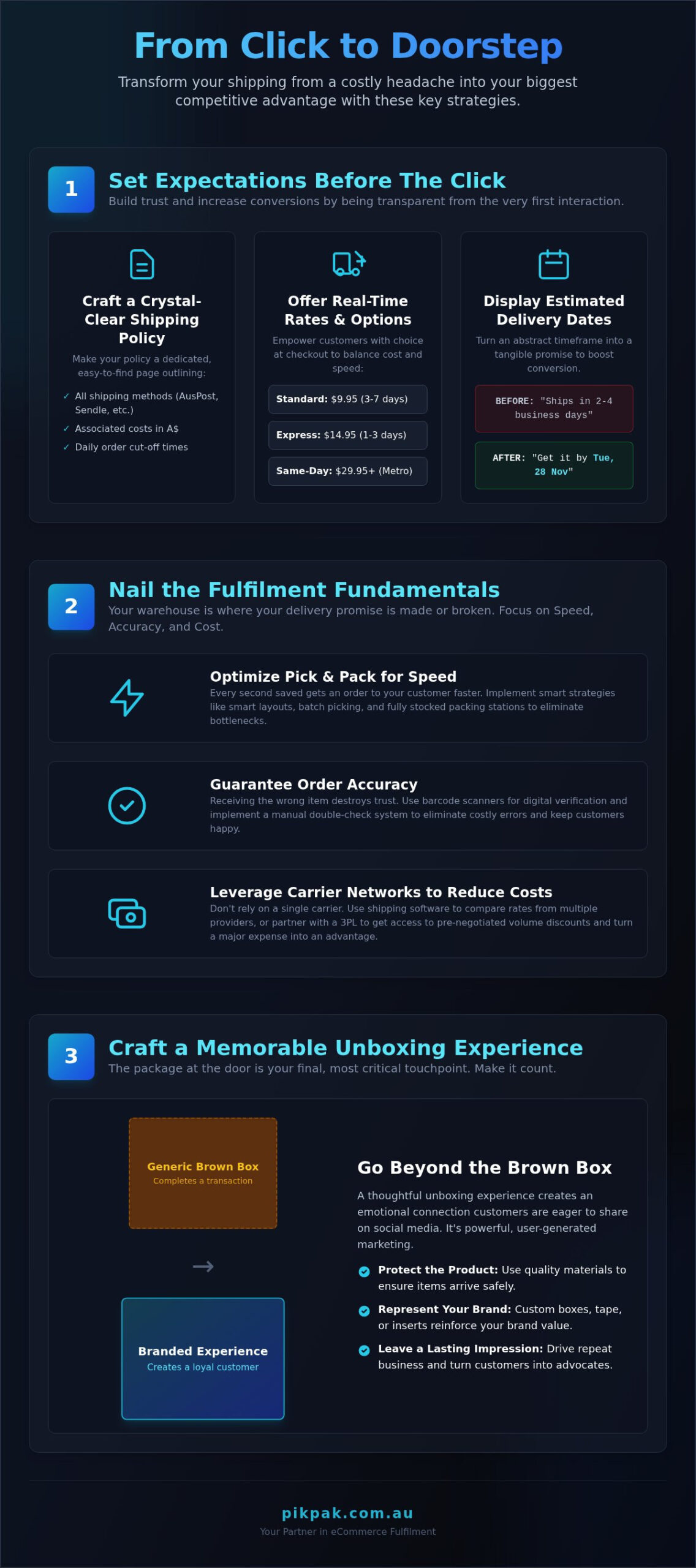
Many eCommerce businesses believe the delivery experience starts when an order leaves the warehouse. That’s a mistake. To truly improve customer delivery experience, you must manage expectations long before the ‘buy now’ button is ever clicked. This pre-purchase stage is your first, and best, opportunity to build trust. Clear, upfront information about shipping costs and timelines is non-negotiable for today’s savvy Australian shoppers. It’s how you turn a potential sale-killer-unexpected shipping costs-into a tool for conversion and showcase your reliability from the very first interaction.
Craft a Crystal-Clear Shipping Policy
Your shipping policy shouldn’t be buried in the footer; it must be a dedicated, easy-to-find page that acts as your operational promise to the customer. This document should clearly detail all available shipping methods (like Australia Post, Sendle, or express couriers), their associated costs in A$, and daily order cut-off times. A transparent policy that explains how you handle potential delays demonstrates you have mastered the fulfilment fundamentals and can be trusted to handle their order professionally.
Offer Real-Time Shipping Rates and Options at Checkout
Say goodbye to flat-rate surprises that cause cart abandonment. Integrating your online store with carrier APIs to show live rates is no longer a luxury; it’s an expectation. Give your customers control by offering a range of choices at checkout, allowing them to balance cost against speed. A typical setup for an Australian store might include:
- Standard Shipping: A cost-effective option (e.g., A$9.95) with a 3-7 day delivery window.
- Express Post: For customers who need it faster, typically 1-3 business days to major cities.
- Same-Day Courier: A premium service for metro areas like Sydney or Melbourne.
Display Estimated Delivery Dates (EDDs)
An Estimated Delivery Date (EDD) is one of the most powerful conversion tools on your product and checkout pages. Instead of a vague “ships in 2-4 business days,” showing “Get it between Tuesday, 28 Nov – Thursday, 30 Nov” turns an abstract timeframe into a tangible promise. This simple piece of information is a key factor in the purchase decision, reassuring the customer that you’re not just selling a product; you’re selling a reliable and predictable service.
2. Nail the Fulfilment Fundamentals: Speed, Accuracy, and Cost
Before a package ever reaches a courier, its journey begins in your warehouse. This is the engine room of your eCommerce business, where your delivery promise is either made or broken. Getting this stage right isn’t a logistical headache; it’s about focusing on three simple fundamentals that directly impact your bottom line and customer loyalty. Inefficiencies in your pick and pack process lead directly to delays, errors, and unhappy customers. To truly improve customer delivery experience, you need an operation that runs like clockwork. Optimising this stage is crucial for managing costs and customer expectations. While Australian Consumer Law provides local guidance, it’s also wise to understand global best practices for Setting Expectations, which highlight the importance of shipping orders when promised.
Optimise Your Pick and Pack Process for Speed
Every second saved in the warehouse is a second closer to your customer’s doorstep. Speed starts with a smart, organised layout that minimises travel time for your pickers. Place your most popular products in easily accessible locations close to the packing stations. From there, implement an efficient system to handle multiple orders simultaneously. Simple strategies like batch picking-where a picker gathers items for several orders in one trip-can dramatically boost productivity. Finally, ensure your packing stations are ergonomic and fully stocked with boxes, tape, and void fill to prevent bottlenecks. It’s not about working harder; it’s about working smarter.
Guarantee Order Accuracy to Prevent Disappointment
There is nothing more damaging to customer trust than receiving the wrong item. An incorrect order isn’t just a hassle; it’s a costly mistake that involves return shipping, sending a replacement, and significant customer service time. Worse, it can lose you a customer for life. You can eliminate these errors with simple, effective safeguards. Using barcode scanners to verify each item during the picking process provides an instant digital check. For an even higher level of quality control, implement a manual double-check system where a second team member reviews the order contents before the box is sealed. These steps are a small investment to prevent a major business problem.
Leverage Carrier Networks to Reduce Costs
High shipping costs can quickly erode your profit margins, but you have more control than you think. Don’t rely on a single carrier. By negotiating rates with multiple providers like Australia Post, Aramex, and others, you can create a flexible network that offers the best value for different package sizes, weights, and destinations. Modern shipping software can automate this process, instantly comparing carrier rates and selecting the most cost-effective option for every single order. The simplest way to achieve this? Partnering with a 3PL gives you immediate access to pre-negotiated volume discounts, turning a major expense into your competitive advantage.
3. Beyond the Brown Box: Crafting a Memorable Unboxing Experience
In eCommerce, the moment a package arrives at your customer’s door is often your first and only physical interaction with them. This isn’t just a delivery; it’s the final, critical touchpoint of the sale. A generic brown box completes a transaction, but a thoughtful unboxing experience creates a memorable event. It’s an emotional connection that customers are eager to share on social media, turning a simple delivery into powerful, user-generated marketing. Investing in this final step is a simple, high-impact way to improve customer delivery experience and build lasting loyalty.
Thinking about the unboxing experience shows you care about more than just the sale-it proves you value your customer and your product. It’s an opportunity to reinforce your brand value and leave a lasting impression that drives repeat business.
Use Branded and Protective Packaging
Your packaging has two critical jobs: protect the product and represent your brand. First and foremost, it must be durable enough to prevent damage during transit. Choosing the right box and filler material is foundational; it ensures your product arrives safely, which is a key factor in improving delivery success rates and avoiding the customer frustration of a broken item. Beyond protection, use custom-printed boxes, branded tape, or even simple logo stickers to make your package instantly recognisable. For Australian consumers, choosing recyclable or compostable materials also sends a powerful message that your brand is modern and conscientious.
Include Personalised Inserts and Marketing Materials
What’s inside the box-besides the product-is your chance to directly communicate with your customer and make them feel valued. This doesn’t have to be a complex or costly exercise. Small, personal touches transform the delivery from a simple drop-off into a delightful surprise and are a proven way to improve customer delivery experience. Simple additions can make all the difference:
- A personalised thank-you note: A printed card that includes the customer’s first name shows you see them as an individual, not just an order number.
- A future-use discount code: Encourage a second purchase by including an exclusive offer or coupon for their next order.
- A small gift or product sample: Delight customers with an unexpected extra, like a free sample of a complementary product or a small, branded item like a sticker or keychain.
4. Master Proactive Communication: Keep Customers Informed and Happy
The moment a customer completes their purchase is critical. Radio silence after checkout creates anxiety and leads to the one question every eCommerce business wants to avoid: “Where Is My Order?” (WISMO). Answering these queries manually drains your resources and signals a gap in your service. The solution is simple: proactive, automated communication.
By keeping your customers informed at every key stage of the delivery journey, you replace uncertainty with confidence. This is a non-negotiable strategy to improve customer delivery experience and build the kind of trust that earns repeat business. You can automate the entire process, freeing up your time to focus on growing your business while your customers enjoy a seamless, reassuring journey.
Automate Key Status Notifications
Automation is your key to providing timely, accurate updates without lifting a finger. These notifications are the backbone of a great post-purchase experience. At a minimum, your system should automatically send:
- An Instant Order Confirmation: Sent via email or SMS the moment an order is placed. This confirms their payment was successful and you’re on the job.
- A Shipping Notification: The most anticipated update. This should go out as soon as the shipping label is created, and it must include the tracking number and a direct link to the tracking page.
Provide Real-Time, Branded Tracking
Don’t send your hard-won customers to a generic Australia Post or Aramex tracking page. Instead, create a branded tracking page on your own website. This simple step keeps customers within your ecosystem, reinforcing your brand identity at a crucial moment. It also transforms a functional touchpoint into a powerful marketing opportunity, allowing you to display promotions, related products, or a sign-up for your newsletter.
Confirm Successful Delivery and Ask for Feedback
The job isn’t finished until the customer has their product. Close the loop by sending a final notification confirming their package has been successfully delivered. This reduces claims of lost parcels and provides peace of mind. A few days later, follow up with an automated email asking for a product review. This shows you care about their satisfaction and helps you gather valuable social proof to attract future customers.
5. Close the Loop: Engineer a Painless Returns Process
The delivery experience doesn’t end when the package arrives. In fact, what happens after delivery can make or break customer loyalty. A clunky, difficult, or expensive returns process can lose a customer forever. Considering nearly 70% of Australian shoppers check a store’s returns policy before even adding an item to their cart, this final touchpoint is non-negotiable. Don’t view a return as a lost sale; frame it as a second chance to create a positive brand interaction and truly improve customer delivery experience.
The goal is to make returning an item as simple, clear, and convenient as receiving it. What seems like a logistical headache is an easy game when you have the right systems in place. By making the process effortless for the customer, you build trust and encourage them to shop with you again, confident that you’ll support them no matter what.
Offer a Self-Service Returns Portal
Empower your customers and free up your team’s time by automating the process. A self-service returns portal integrated into your website allows customers to initiate a return and print a shipping label in minutes, without ever needing to contact your support staff. This removes friction, puts the customer in control, and turns a potential support ticket into a seamless, automated task. Let technology do the hard work for you.
Communicate Clearly Throughout the Return Journey
Maintain the same high standard of communication for returns as you do for purchases. Automated notifications should be triggered at key stages to keep the customer informed and reduce their anxiety. A simple, proactive communication plan includes:
- Confirmation of receipt: An email or SMS to let them know their returned item has arrived safely at the warehouse.
- Processing update: A notification to confirm their refund has been issued or their exchange has been dispatched.
This level of transparency shows respect for the customer’s time and money, reinforcing that they made the right choice in trusting your brand. A smooth returns process is a critical, often overlooked, component to improve customer delivery experience and secure long-term loyalty. At Pik Pak, we help businesses streamline their entire fulfilment cycle, including effortless reverse logistics, so you can focus on growth.
6. The Smart Shortcut: How a 3PL Partner Elevates Your Delivery Experience
Implementing a world-class fulfilment strategy is a full-time job. It demands specialist expertise, a significant investment in technology, and the physical infrastructure of a warehouse. For most growing eCommerce businesses in Australia, managing this in-house is a major distraction from what you do best: building your brand and selling great products.
This is where a Third-Party Logistics (3PL) partner becomes your ‘easy button’. Outsourcing your fulfilment isn’t just about handing off boxes; it’s a strategic move to instantly upgrade your capabilities and improve customer delivery experience without the operational headaches.
Gain Instant Access to a Professional Logistics Network
Partnering with a 3PL like Pik Pak immediately connects your business to a high-performance logistics machine. Instead of building from scratch, you benefit from an established system designed for efficiency. This means you can:
- Secure competitive shipping rates: Leverage our pre-negotiated, bulk-rate discounts with major Australian carriers, passing the savings on to your customers or your bottom line.
- Ensure speed and accuracy: Our optimised warehouse processes minimise errors and get orders out the door faster, delighting your customers with every delivery.
- Scale on demand: Effortlessly handle seasonal peaks like Black Friday or sudden growth spurts without being locked into fixed overheads like long-term warehouse leases or permanent staff.
Leverage Advanced Technology Without the Investment
A premium delivery experience is powered by great technology, but the cost of developing or licensing a robust Warehouse Management System (WMS) can be prohibitive. A 3PL gives you complete access to cutting-edge tools from day one. Seamlessly integrate your eCommerce store (like Shopify or WooCommerce) for automated, real-time order processing. You gain complete visibility over your inventory, and your customers get the accurate, reliable tracking information they expect.
Focus on Your Brand, Not on Logistics
Stop spending your valuable time buried in inventory counts, printing labels, and packing boxes. Let logistics experts manage the complex dance of picking, packing, and shipping. By handing over the operational burden, you free up your most critical resource-your time-to reinvest in marketing, product development, and connecting with your customers.
What seems to be a challenge is an easy game with the right partner. Let us do the hard work for you, so you can focus on growth. See how easy it is to Get Started with Pik Pak.
Turn Your Delivery into Your Biggest Advantage
As we’ve seen, the journey to improve customer delivery experience is about more than just speed. It’s a holistic process that begins with clear expectations before the purchase and extends through proactive communication and a memorable unboxing. Mastering these elements turns a simple transaction into lasting customer loyalty.
But managing all these moving parts is a major headache, pulling you away from what you do best: growing your brand. Pik Pak makes world-class logistics simple. With access to our state-of-the-art Warehouse Management System (WMS), flexible pay-as-you-go pricing that scales with you, and seamless integration with major eCommerce platforms like Shopify, we eliminate the complexity so you can get back to business.
Stop wrestling with boxes and start building your empire. Let us handle the logistics so you can focus on growth. Get a free quote today!
Frequently Asked Questions
What is last-mile delivery and why is it crucial for customer experience?
Last-mile delivery is the final step of the shipping process, moving a package from a local transport hub to the customer’s doorstep. It’s the most critical stage because it’s the direct, physical touchpoint your customer has with your brand. A delay or damaged parcel at this stage can ruin an otherwise perfect shopping experience. Nailing this final step is essential to improve customer delivery experience, build trust, and encourage repeat business.
How can a small eCommerce business afford to offer free or flat-rate shipping?
Offering competitive shipping doesn’t have to break the bank. A common strategy is to set a minimum order value, such as free shipping for orders over A$100, which encourages larger purchases. You can also strategically incorporate a portion of the shipping cost into your product prices. Partnering with a 3PL provider also gives you access to bulk shipping rates from couriers, significantly lowering your per-parcel cost and making affordable shipping a simple reality.
What are the most important delivery metrics (KPIs) my business should track?
To ensure your logistics run like clockwork, focus on a few key metrics. Track your On-Time Delivery Rate to see if you’re meeting customer expectations, and your Order Accuracy Rate to minimise errors. Also, monitor your Average Transit Time to understand delivery speed and Shipping Cost Per Order to manage profitability. Measuring these KPIs gives you the clear data needed to make smart decisions and continuously refine your fulfilment process.
How does a good returns policy actually help increase sales and customer loyalty?
A clear and hassle-free returns policy removes a major barrier to purchase. When customers know they can easily return an item, they feel more confident buying from you, which directly boosts conversion rates. A smooth returns process also demonstrates that you stand behind your products and value customer satisfaction. This builds powerful trust, turning a simple transaction into a loyal customer relationship that pays dividends long-term.
What’s the difference between using a direct courier and a 3PL provider?
Using a direct courier means you handle all the logistics yourself-storing inventory, picking, packing, and booking shipments. A Third-Party Logistics (3PL) provider, like Pik Pak, takes all of this off your hands. We store your products, professionally pick and pack orders, and manage shipping for you. This automates your fulfilment and leverages our shipping volume for better rates, freeing you up to focus on growing your business, not packing boxes.
Is investing in branded packaging really worth the cost for a small business?
Absolutely. Branded packaging turns a simple delivery into a memorable unboxing experience. It’s a powerful and cost-effective marketing tool that reinforces your brand identity the moment the package arrives. For a small business, this creates a premium feel, elevates the perceived value of your products, and makes a lasting impression that encourages social sharing and repeat purchases. It’s a small investment for a significant impact on customer perception.
How can I reduce the number of customer support questions about order status?
The key is proactive communication. Implement automated email or SMS notifications that alert customers at every key stage: order confirmed, item shipped, out for delivery, and delivered. Providing a branded, easy-to-use tracking page on your website also empowers customers to find the information themselves. This transparency manages expectations, dramatically reduces “Where Is My Order?” (WISMO) enquiries, and frees up your customer service team’s valuable time.