
That sinking feeling when a customer wants your top-selling product, but it’s out of stock again. The frustration of seeing your capital tied up in slow-moving items gathering dust. The endless hours spent wrestling with spreadsheets instead of growing your sales. If this sounds familiar, you’re not alone. For many Australian eCommerce owners, what seems like a major headache is actually a solvable puzzle. The key is mastering effective inventory management for ecommerce.
This guide is designed to turn that chaos into clockwork. We’ll break down the essential techniques, tools, and strategies you need to gain real-time visibility of your stock levels. You’ll learn how to automate reordering to prevent costly stockouts, stop losing money on overstock, and build a scalable system that grows with you. It’s time to stop letting logistics dictate your schedule and finally have the freedom to focus on what truly matters: scaling your business.
Key Takeaways
- Understand how mastering your inventory directly protects your cash flow and boosts profitability by preventing costly stockouts and overstock.
- Implement proven inventory control techniques to find the perfect balance between stock levels and customer demand, ensuring you always have the right products ready to ship.
- Find the right system for your stage of growth, from simple spreadsheets to powerful software, to scale your inventory management for ecommerce effectively.
- See how partnering with a 3PL provider can completely automate your inventory headaches, freeing up your time to focus on growing your business.
Why Mastering eCommerce Inventory Management is Non-Negotiable
At its core, inventory management is the art of balancing two critical forces: meeting customer demand without tying up too much cash in stock. It’s the process of ordering, storing, and selling your products, but getting it wrong is one of the fastest ways to hurt your profitability. Effective inventory management for ecommerce isn’t just about counting boxes; it’s about making your capital work smarter for you. Understanding foundational inventory management concepts is the first step to transforming this operational headache into a competitive advantage.
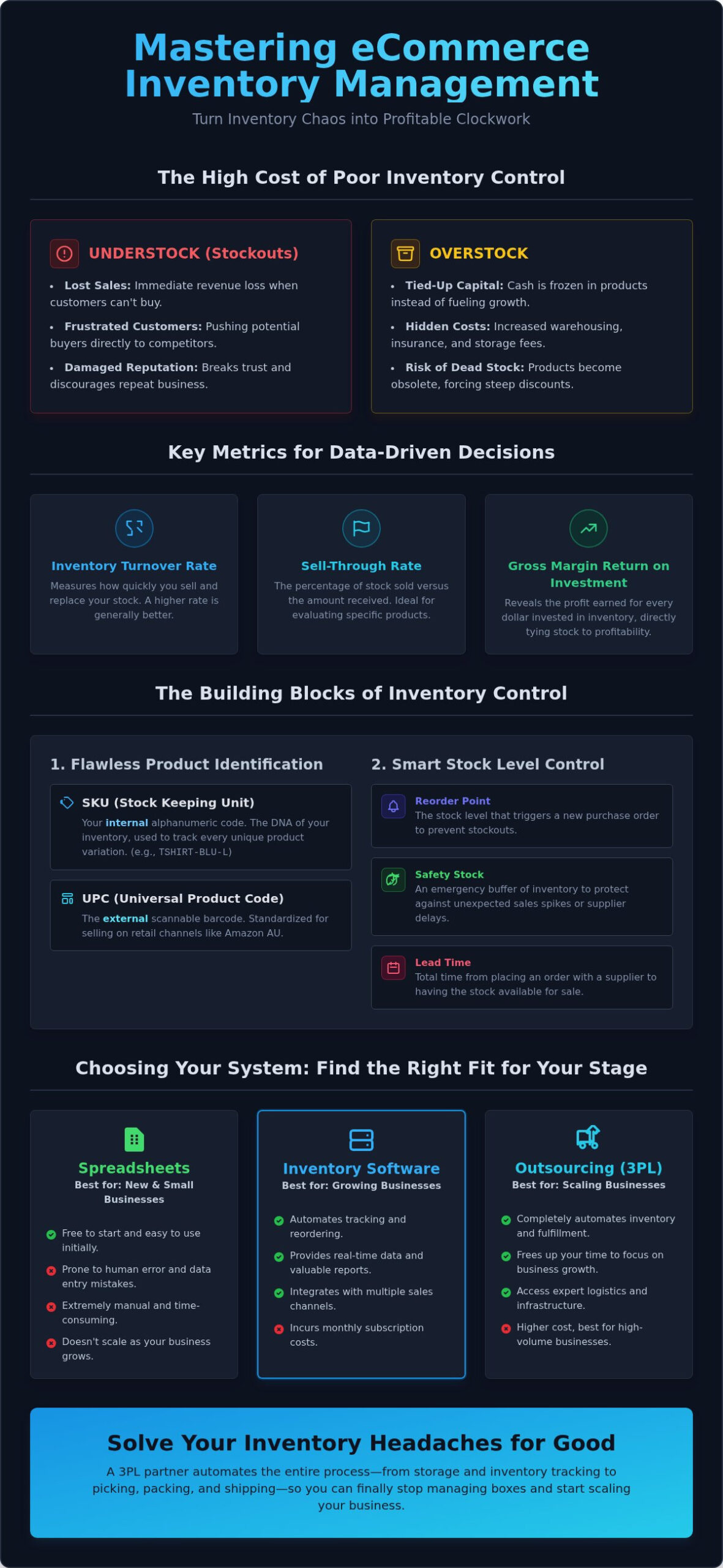
The consequences of poor control are severe. Understock, and you face stockouts-losing immediate sales and pushing frustrated customers to your competitors. Overstock, and you’re hit with hidden costs that drain your cash flow. Think warehousing fees in Melbourne, insurance costs, and the risk of “dead stock” that you eventually have to sell at a steep loss, sometimes for cents on the A$.
For Australian online stores, the challenge is amplified. You might be selling across multiple channels like Shopify, The Iconic, and Amazon AU, all while managing a complex reverse logistics process for returns. This complexity makes a robust system non-negotiable.
The Link Between Inventory and Customer Experience
In today’s fast-paced market, stock availability is customer experience. When a customer clicks “buy,” they expect the product to be in stock and on its way. Backorders and cancelled orders don’t just cause refunds; they break trust and damage your brand’s reputation. Accurate, real-time inventory data is what allows you to offer reliable, fast shipping promises that build customer loyalty and drive repeat business.
Key Metrics to Track for Healthy Inventory
Running your inventory on guesswork is a recipe for failure. To make informed decisions, you need to track key performance indicators (KPIs). These metrics turn raw data into actionable insights, making your inventory management for ecommerce a data-driven process. They help you understand what’s selling, what’s not, and how efficiently your stock is generating profit. Key metrics include:
- Inventory Turnover Rate: How quickly you sell and replace your stock.
- Sell-Through Rate: The percentage of stock sold in a given period.
- Gross Margin Return on Investment (GMROI): The profit you make for every dollar invested in inventory.
The Building Blocks: Core Inventory Management Concepts Explained
Navigating the world of logistics can feel like learning a new language. But what seems like a challenge is an easy game once you understand the key terms. Mastering these core concepts is the first step toward building a system that runs like clockwork, freeing you up to focus on growing your business. Let’s break down the essential jargon of inventory management for ecommerce into simple, practical terms.
Identifying Your Products
Before you can manage your stock, you need to be able to identify every single item flawlessly. This is where product identifiers come in-think of them as a unique fingerprint for each product variation.
- SKU (Stock Keeping Unit): This is your internal product DNA. A SKU is a unique alphanumeric code you create to track products internally. For example, a large, blue t-shirt might have the SKU
TSHIRT-BLU-L. A well-structured SKU system is the non-negotiable foundation of efficient inventory tracking. - UPC (Universal Product Code): This is the external, scannable barcode used in retail. While SKUs run your internal operations, UPCs are the standard for selling through external channels like major retailers or Amazon Australia.
Controlling Your Stock Levels
The goal here is simple: have enough product to meet demand without tying up your cash in excess stock. These metrics help you strike that perfect balance.
- Reorder Point: This is the inventory level that automatically triggers an order for more stock. For instance, when your best-selling candles drop to 50 units, it’s time to reorder. Setting this up correctly is a key part of using auto-fulfillment for replenishing inventory, which prevents stockouts and lost sales.
- Safety Stock: Think of this as your emergency buffer. It’s the extra inventory you keep on hand to guard against unexpected events, like a sudden sales spike from a viral social media post or a shipping delay from your supplier.
- Lead Time: This is the total time between placing an order with your supplier and having that stock arrive in your warehouse, ready for sale. Knowing your lead time is crucial for calculating an accurate reorder point.
Managing Your Warehouse
An organised warehouse is an efficient one. These practices prevent lost items and costly picking errors, ensuring customers get the right product, every time.
- Bin Location: A specific “address” for each product within your warehouse (e.g., Aisle C, Shelf 04, Bin 02). Using bin locations eliminates guesswork and dramatically speeds up the time it takes to pick and pack an order.
- Cycle Counting vs. Physical Counts: A physical count is the traditional, often disruptive, annual stocktake. Cycle counting is a modern, more efficient method where you count small sections of your inventory on a rotating, regular basis. This provides greater accuracy with minimal interruption to your daily operations.
Proven Inventory Management Techniques for Online Stores
Understanding inventory is one thing; controlling it is how you grow. Once you grasp the core inventory management concepts, applying the right techniques is a simple, game-changing step. These proven methods move you from theory to action, helping you reduce costs, prevent stockouts, and focus your capital where it matters most. Making smart inventory management for ecommerce a priority isn’t about complex formulas-it’s about choosing the right system for your business.
ABC Analysis: Prioritizing Your Best-Sellers
The 80/20 rule often applies to inventory: roughly 80% of your revenue comes from just 20% of your products. ABC analysis helps you identify these MVPs (Most Valuable Products) and manage them accordingly. It’s a simple way to focus your energy.
- A-Items: Your superstars. The top 15-20% of products that generate the most revenue. Monitor them closely.
- B-Items: The middle-ground. Products with moderate sales and value. Require standard monitoring.
- C-Items: The rest. Low-value items that sell less frequently. These can be managed with less scrutiny.
Example: An Aussie online store sells custom phone cases. Their premium leather cases (A-Items) priced at A$70 are best-sellers. They track this stock daily. Their A$10 screen protectors (C-Items) are ordered in large quantities with less frequent stocktakes, freeing up time to focus on the products that actually drive profit.
FIFO and LIFO: Managing Perishable and Non-Perishable Goods
This technique dictates the flow of your goods. For nearly all online stores, one method is the clear winner.
- FIFO (First-In, First-Out): You sell the oldest stock first. This is non-negotiable for businesses selling products with an expiry date, like skincare, supplements, or food items. It ensures product freshness and prevents costly waste.
- LIFO (Last-In, First-Out): You sell the newest stock first. This is primarily an accounting method and is impractical for physical fulfilment. The Australian Taxation Office (ATO) also does not permit LIFO for valuing inventory.
The verdict is simple: Default to FIFO. It’s the most logical and compliant approach for ecommerce fulfilment.
Just-in-Time (JIT) and Dropshipping
The JIT method is about ordering inventory from suppliers only as you need it to fulfil customer orders, aiming to minimise holding costs. It’s a lean approach that requires absolute confidence in your supply chain. Dropshipping is the most extreme form of JIT, where you don’t hold any stock at all-the supplier ships directly to your customer. While this lowers barriers to entry, it also reduces your control over the customer experience, from shipping times to packaging quality.
Choosing Your System: Spreadsheets vs. Software vs. Outsourcing
Your approach to inventory management will evolve as your business grows. What works for a startup with 10 orders a month will quickly become a bottleneck at 100 orders a day. Understanding your current stage is key to choosing a system that supports, rather than hinders, your growth. Let’s break down the three common stages so you can find the right fit.
Stage 1: Manual Tracking with Spreadsheets
Almost every eCommerce store starts here. A simple spreadsheet is a straightforward way to list your SKUs and manually update stock levels as orders come in and new stock arrives. It’s a practical first step, but its limitations appear quickly.
- Pros: No cost to start and simple to set up for a handful of products.
- Cons: Highly prone to human error, impossible to scale, and offers zero real-time data, often leading to overselling.
Ideal for: Brand new businesses testing the waters with a very small product catalogue.
Stage 2: Adopting Inventory Management Software
When spreadsheets become a source of stress, it’s time for dedicated software. These platforms automate tracking and sync data across your sales channels, providing a single source of truth for your stock levels. This is a crucial step in professionalising your inventory management for ecommerce.
- Pros: Drastically reduces manual errors, syncs stock across multiple channels (like your website and eBay), and provides valuable sales forecasting data.
- Cons: Incurs monthly costs (often starting from A$50+), requires a learning curve, and you still manage the physical warehousing and staffing yourself.
Ideal for: Growing businesses ready to invest in accuracy but still handling their own fulfilment.
Stage 3: Outsourcing to a 3PL Partner
For businesses focused on serious scaling, managing physical inventory becomes the biggest roadblock. Outsourcing to a Third-Party Logistics (3PL) partner means you hand over the entire physical operation-receiving, storing, picking, packing, and shipping-to experts who run it like clockwork.
- Pros: Eliminates warehouse rent and staffing costs, leverages expert efficiency and advanced Warehouse Management Systems (WMS), and frees you to focus entirely on marketing and growth.
- Cons: Best suited for businesses with established and consistent order volumes to maximise cost-effectiveness.
This isn’t just outsourcing a task; it’s adopting a complete logistics infrastructure. What seems like a challenge becomes an easy game. See how a 3PL can simplify your entire operation.
How a 3PL Partner Solves Your Inventory Headaches for Good
Managing stock can feel like a full-time job you never signed up for. But what if you could offload the entire operational burden while gaining more control and insight than ever before? Partnering with a third-party logistics (3PL) provider isn’t about losing control; it’s about gaining the freedom to focus on growth. It transforms the complex puzzle of inventory management for ecommerce into a simple, streamlined process that runs like clockwork.
Get Real-Time Visibility Without the Work
Forget clunky spreadsheets and endless manual stock-takes. A modern 3PL like Pik Pak Logistics provides access to a powerful Warehouse Management System (WMS) through a simple online dashboard. From one screen, you get a live, accurate view of your inventory levels across all your sales channels-whether it’s Shopify, Amazon AU, or wholesale. This real-time data sync means the risk of overselling a popular product and dealing with unhappy customers is eliminated, permanently.
Seamless Integration and Automation
What seems like a technical challenge is an easy game with the right partner. Our system connects directly to all major ecommerce platforms, including Shopify, WooCommerce, and BigCommerce, with just a few clicks. The moment a customer places an order, it flows automatically to our fulfilment centre. We handle the rest:
- Orders are picked, packed, and dispatched accurately.
- Tracking information is sent back to your store.
- Your customer is automatically notified.
No manual data entry, no delays-just a seamless, automated workflow that builds customer trust.
Scale Effortlessly as You Grow
Your business is growing, and your logistics should grow with it, not hold it back. With a 3PL, you can stop worrying about running out of warehouse space or the headache of leasing a larger facility. We handle seasonal peaks like Black Friday and holiday rushes without you needing to hire and train temporary staff. Best of all, our pay-as-you-go model means your costs align directly with your revenue. You only pay for the space you use and the orders we ship, making your cash flow predictable and your growth limitless.
It’s time to trade operational stress for strategic growth. Let us handle the hard work so you can get back to what you do best.
Stop managing boxes. Start growing your business with Pik Pak Logistics.
Take Control of Your Inventory and Reclaim Your Time
As we’ve covered, effective inventory management for ecommerce is the engine that drives your online store’s success, influencing everything from cash flow to customer satisfaction. While you can start with spreadsheets or dedicated software, scaling your business means moving beyond manual tasks and reclaiming your valuable time to focus on growth.
Stop letting stock control dictate your schedule. Let Pik Pak handle the hard work with a solution built for ambitious Australian brands. We provide real-time inventory visibility through our advanced WMS, seamless integration with all major eCommerce platforms, and flexible pay-as-you-go pricing that grows with you. What seems like a challenge becomes simple with the right partner.
Ready to focus on your business, not your boxes? Get a free quote and see how Pik Pak can solve your inventory challenges. Your path to effortless growth is just a click away.
Frequently Asked Questions About Ecommerce Inventory Management
What is the difference between inventory management and warehouse management?
Think of it this way: inventory management is the “what” and “when,” while warehouse management is the “where” and “how.” Inventory management is the strategic process of tracking stock levels, forecasting demand, and deciding when to reorder products. Warehouse management is the physical, day-to-day operation of receiving, storing, picking, packing, and shipping those products from a specific location. One is about data and decisions; the other is about logistics and movement.
How do I calculate my safety stock level?
Calculating safety stock doesn’t have to be a headache. A simple formula is: (Maximum Daily Sales x Maximum Lead Time in Days) – (Average Daily Sales x Average Lead Time in Days). For example, if you sell a maximum of 20 units a day and supplier delivery can take up to 10 days, that’s 200. Subtract your average (e.g., 12 units x 7 days = 84), and your safety stock is 116 units. This buffer protects you from unexpected sales spikes or shipping delays.
How much does inventory management software typically cost?
In Australia, the cost varies based on your business size and complexity. Basic plans for small businesses, often as add-ons for platforms like Shopify, can start from around A$50 to A$100 per month. More robust, standalone systems with features like multi-channel syncing and advanced reporting typically range from A$300 to A$600+ per month. Always check what’s included, as costs can scale with order volume or the number of users you need.
At what point should my business switch from spreadsheets to software?
Switching is less about a specific number and more about pain points. If you’re spending hours each week manually updating spreadsheets, experiencing frequent stockouts because of human error, or struggling to track inventory across multiple sales channels, it’s time to upgrade. The goal of effective inventory management for ecommerce is to automate tasks and free up your time. When your spreadsheet becomes a source of stress instead of a tool for clarity, it’s time to switch.
How does a 3PL handle product returns and update my inventory?
We make returns simple and automated. When a customer sends a product back, it arrives at our fulfilment centre. Our team inspects the item based on your predefined rules to check its condition. If it’s resellable, we place it back into your available stock. The key is that our system automatically updates your inventory levels in real-time, ensuring the product is immediately available for the next customer. You see everything happen without ever touching a box.
Can I still sell on multiple channels like Amazon and my own site with a 3PL?
Absolutely. In fact, this is one of the biggest advantages of using a 3PL partner. Our technology integrates directly with all your sales channels, including your Shopify store, Amazon Australia, eBay, and more. This creates a single, centralised pool of inventory. When an item sells on any channel, the stock level is updated across all of them automatically. This completely eliminates the risk of overselling and simplifies your multi-channel inventory management for ecommerce.