

That thick contract from a potential 3PL partner can feel more like a minefield than a roadmap to success. You’re left wondering: Are there hidden fees lurking in the fine print? What are the industry standards for performance in Australia? And what happens if things go wrong? This uncertainty is a major headache for growing eCommerce businesses, turning what should be an exciting step into a source of stress.
It’s time to make the complex simple. A great fulfillment partnership is built on clarity and trust, not confusing jargon. That’s why we’ve developed the ultimate 3PL service level agreement checklist. This is your practical, step-by-step guide to confidently review every critical detail of your contract, from defining key performance metrics to understanding liability and spotting potential costs in A$. Use it to create a foundation of accountability and ensure your logistics run like clockwork, freeing you up to focus on growing your business.
Key Takeaways
- Your 3PL SLA is the single most important document for a stress-free partnership, setting clear, simple rules and expectations from day one.
- Vague promises don’t work. Learn which specific, measurable KPIs for order accuracy and shipping speed are non-negotiable for protecting your brand.
- Avoid surprise invoices by using our 3pl service level agreement checklist to clearly define every potential cost, from receiving to returns.
- Protect your business and inventory with essential clauses covering liability, insurance, and data security-the safeguards you need when issues arise.
Table of Contents
- What is a 3PL SLA and Why is it Your Most Important Document?
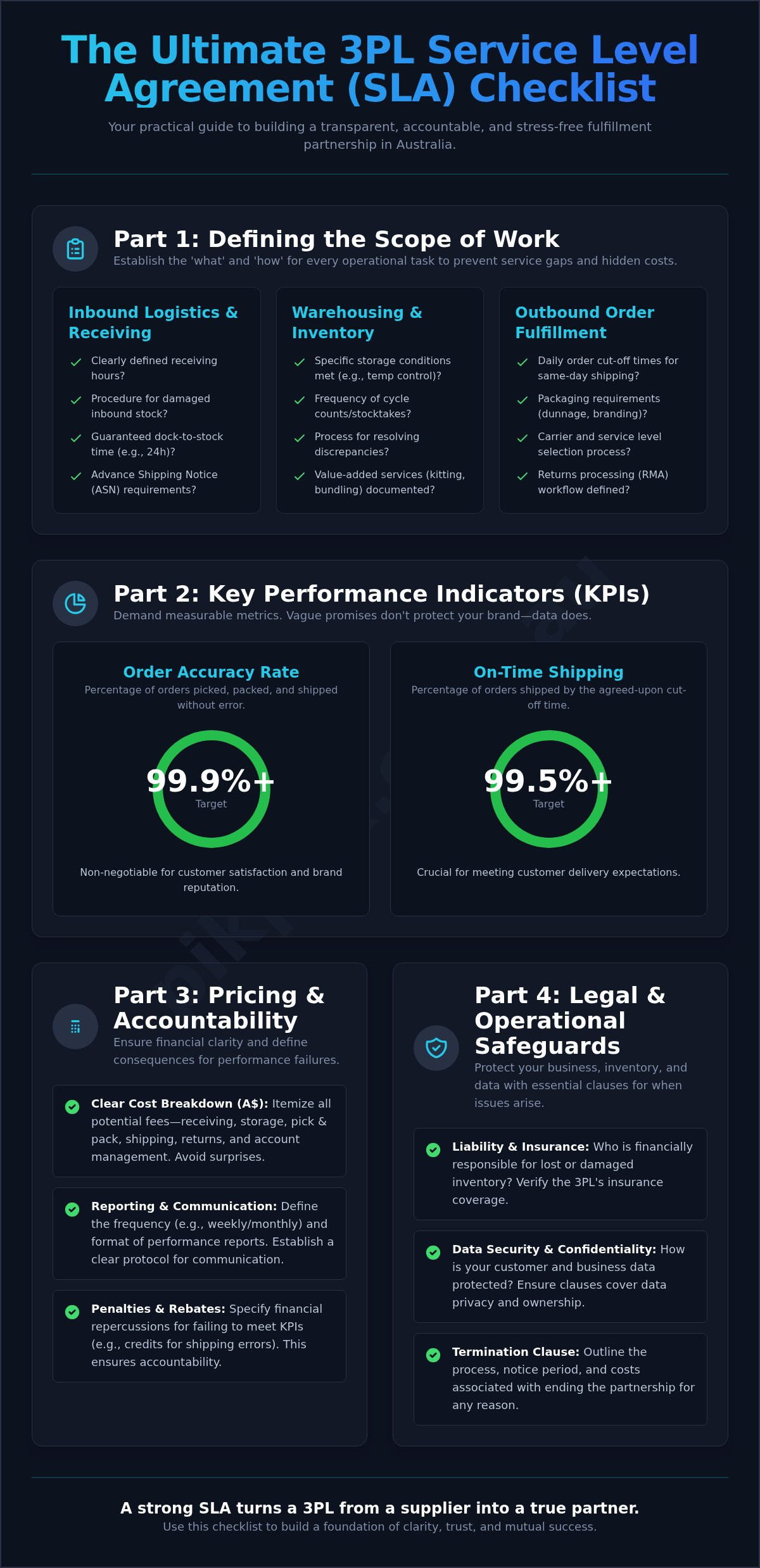
- Checklist Part 1: Defining the Scope of Work
- Checklist Part 2: Key Performance Indicators (KPIs)
- Checklist Part 3: Reporting, Pricing & Penalties
- Checklist Part 4: Legal & Operational Safeguards
What is a 3PL SLA and Why is it Your Most Important Document?
When you’re running a busy eCommerce business in Australia, the last thing you need is a logistics headache. You need a partner who handles the pick, pack, and ship process seamlessly so you can focus on growth. This is where a Service Level Agreement (SLA) becomes your most critical document. Forget vague handshake deals; a 3PL SLA is the official rulebook for your partnership.
In simple terms, a Service Level Agreement is a contract that defines the level of service you expect from your 3PL provider. It moves your partnership from assumptions to absolutes, setting crystal-clear expectations and establishing the metrics used to measure performance. It’s the foundation for a transparent, accountable, and scalable fulfilment operation that runs like clockwork.
The Goal of Your SLA: Accountability, Not Punishment
A strong SLA isn’t about catching your partner out; it’s about keeping everyone aligned. Think of it as a tool for continuous improvement. It clarifies responsibilities for both you and your provider, ensuring there are no grey areas. When issues inevitably arise, the SLA provides a clear, pre-agreed framework for resolving them quickly and professionally, preventing minor hiccups from becoming major problems.
Key Areas Every 3PL SLA Must Cover
A comprehensive SLA is the cornerstone of any good partnership, and it makes up the bulk of a complete 3pl service level agreement checklist. While we’ll dive deeper into these areas later in the article, every effective agreement is built on a few core pillars:
- Scope of Services: What specific tasks will the 3PL perform? (e.g., receiving, storage, order fulfilment, returns processing).
- Performance Metrics: How will success be measured? This includes quantifiable targets for things like order accuracy, dock-to-stock time, and shipping speed.
- Reporting & Communication: How and when will performance be reported? What is the protocol for communication?
- Pricing & Penalties: A clear breakdown of all costs (in AUD, of course) and the financial repercussions if performance targets are not met.
It’s also important to understand the difference between a Master Services Agreement (MSA) and an SLA. The MSA governs the overall legal and commercial relationship, while the SLA focuses specifically on the day-to-day performance standards. Both are essential for a secure and productive partnership.
Checklist Part 1: Defining the Scope of Work
This is the foundation of your partnership. Think of the Scope of Work as the detailed instruction manual for your 3PL. Any ambiguity here can lead to unexpected charges, service gaps, and major operational headaches. This section of your 3pl service level agreement checklist defines exactly what your partner will do, from the moment your stock arrives to the moment an order reaches your customer. Getting these details right is crucial, as they form the basis for the essential clauses in 3PL contracts that protect your business.
Let’s break down the core services to ensure nothing is left to chance, making the entire process simple and clear.
Inbound Logistics & Receiving
A smooth operation starts with a flawless receiving process. Your SLA must clearly outline expectations for how your inventory is handled upon arrival. Key questions to answer include:
- Receiving Hours: Are the 3PL’s operating hours for receiving goods clearly defined?
- Damaged Shipments: What is the exact procedure for documenting and reporting damaged inbound stock?
- Dock-to-Stock Time: Is there a guaranteed timeframe for inventory to be received, checked, and made available for sale (e.g., within 24 hours)?
- Advance Shipping Notices (ASNs): Are ASNs required from your suppliers, and what information must they contain?
Warehousing & Inventory Management
Once your products are on the shelves, how will they be stored and managed? This is about protecting your assets and ensuring inventory accuracy runs like clockwork. Define the following:
- Storage Environment: Do your products require specific conditions, like temperature control or high-security areas?
- Inventory Counts: What is the agreed frequency of cycle counts or annual stocktakes to ensure accuracy?
- Discrepancy Resolution: How will inventory discrepancies be investigated, reported, and rectified?
- Value-Added Services: If you require kitting, bundling, or other special projects, are these processes and costs clearly documented?
Outbound Order Fulfillment
This is where your 3PL directly impacts your customer experience. Precision is non-negotiable. Your agreement should specify:
- Order Cut-Off Times: What is the daily deadline for orders to be eligible for same-day shipping (e.g., 1 PM AEST)?
- Packaging Requirements: Are instructions for using branded boxes, marketing inserts, or specific protective materials included?
- Shipping Carriers: Which carriers (e.g., Australia Post, Aramex) and service levels (e.g., Express, Standard) will be used?
- Exception Handling: How are backorders and split shipments managed to keep the customer informed?
Returns Management (Reverse Logistics)
An easy returns process is key to customer loyalty. Don’t let this be an afterthought in your 3pl service level agreement checklist. Clarify the entire reverse logistics flow:
- Inspection Process: What are the steps for receiving, inspecting, and grading returned items?
- Restocking Criteria: What specific conditions must a product meet to be put back into sellable inventory?
- Processing Speed: How quickly will returns be processed and reflected in your inventory system (e.g., within 48 hours of receipt)?
- Customer Communication: Who is responsible for notifying the customer once a return has been received and processed?
Checklist Part 2: Key Performance Indicators (KPIs)
This is where the promises meet the pavement. A 3PL service level agreement without clear, measurable Key Performance Indicators (KPIs) is just a collection of nice words. Vague goals like “fast turnaround” are useless; you need specific targets that define success and hold your partner accountable. This section of your 3pl service level agreement checklist is non-negotiable.
The best practice is to have these KPIs feed directly into a shared, real-time dashboard. This transparency eliminates guesswork and ensures both you and your 3PL partner are looking at the same data, making performance reviews simple and data-driven. We’ve included common industry benchmarks to help you set realistic and effective goals.
Receiving & Putaway KPIs
How efficiently your stock becomes available for sale is the first critical step. Delays here can lead to stockouts and missed revenue. Your SLA should demand precision from the moment your goods arrive at the loading dock.
- Dock-to-Stock Time: The time from when inventory is received to when it’s put away and available for fulfillment. Target: < 24 business hours.
- Receiving Accuracy: Ensures the correct items and quantities are scanned and recorded without error. Target: > 99.5%.
- ASN Accuracy: Your 3PL should track the accuracy of Advance Shipping Notices (ASNs) from your suppliers, helping you manage supplier compliance.
Inventory Management KPIs
Your inventory is your biggest asset. These KPIs ensure it’s tracked, stored, and managed with near-perfect accuracy, giving you the confidence to focus on growing your business instead of worrying about stock levels.
- Inventory Accuracy Rate: The agreement between your physical stock count and the data in the warehouse management system (WMS). Target: > 99.8%.
- Inventory Shrinkage: The value of lost, stolen, or damaged stock as a percentage of your total inventory value. Target: < 0.5%.
- Cycle Count Accuracy: Measures the precision of ongoing, regular stock checks, which prevents large discrepancies during annual counts.
Order Fulfillment KPIs
This is the moment that matters most to your customers. The accuracy and speed of order fulfillment directly impact your brand reputation, reviews, and customer loyalty. These are some of the most important metrics in your entire 3pl service level agreement checklist.
- Order Accuracy Rate: The percentage of orders picked, packed, and shipped with the right items to the right address. Target: > 99.8%.
- On-Time Shipping Rate: The percentage of orders dispatched from the warehouse by the agreed-upon deadline or cut-off time. Target: > 99.5%.
- Order Fill Rate: The percentage of orders shipped completely in the first shipment, without any items on backorder. Target: > 98%.
Not sure how to track all this without adding to your workload? The right partner makes it easy. Pik Pak’s platform gives you real-time visibility into every one of these metrics, so you always know exactly how your operations are performing.
Checklist Part 3: Reporting, Pricing & Penalties
This part of your 3pl service level agreement checklist is all about financial transparency and accountability. Getting this right means no invoice surprises and a clear, fair process for when things don’t go to plan. A truly reliable 3PL partner will be upfront about every cost and have a straightforward system for remedies. This isn’t a difficult conversation; it’s the foundation of a strong partnership that lets you focus on growth.
Reporting & Communication
Consistent, clear communication ensures your operations run like clockwork. You need total visibility without having to chase for information. Your SLA should define exactly how and when you’ll get performance updates.
- Reporting Frequency: Will you receive performance data daily, weekly, or monthly?
- Dedicated Contact: Is there a dedicated account manager assigned to you for fast and simple problem-solving?
- Business Reviews: Is there a formal process for Quarterly Business Reviews (QBRs) to align on strategy and performance?
- Interruption Alerts: How will your 3PL communicate system downtimes or service disruptions that could impact your customers?
Pricing & Fee Structure
A simple, transparent fee structure is non-negotiable. Your goal is to understand every potential charge on your invoice before it arrives. Eliminate the headache of hidden costs by asking these questions upfront.
- Itemised Fees: Is every service-receiving, storage, pick/pack, and shipping-listed as a separate line item?
- Minimums: Are there minimum monthly fees or order volumes you need to commit to?
- Surcharges: How are variable costs like fuel surcharges or other carrier fees calculated and passed on?
- Price Changes: What is the notice period and official process for any future price adjustments?
SLA Remedies & Penalties
Even the best partners can have a bad day. What matters is how they make it right. A solid section on remedies in your 3pl service level agreement checklist ensures accountability and protects your bottom line.
- Service Credits: Is there a system of credits for failing to meet KPIs? For example, a 5% credit on the month’s fulfilment fees if On-Time Shipping falls below 99.5%.
- Error Reimbursement: How are you compensated for costly errors? This should cover the full cost of a mis-picked item (e.g., A$50) plus the redelivery fee.
- Escalation Process: What is the defined process for escalating repeated service failures to senior management?
Having these financial and accountability measures clearly defined makes logistics easy and predictable. To see how a transparent partnership can help you scale, visit us at pikpak.com.au.
Checklist Part 4: Legal & Operational Safeguards
We’ve reached the final, and arguably most critical, part of your 3pl service level agreement checklist. While discussing legal terms and exit plans isn’t as exciting as order fulfilment metrics, these clauses are your business’s safety net. They provide clarity and protection when unforeseen issues arise, turning a potential disaster into a manageable process. Getting this right ensures peace of mind, letting you focus on growth.
We always recommend having a legal professional review your final agreement, but understanding these key points will ensure you’re prepared for that conversation.
Liability & Insurance
Your inventory is your most valuable asset, and it needs to be protected. Your SLA must clearly define who is responsible if stock is lost, stolen, or damaged. Don’t leave this to chance; ask these direct questions:
- What is the 3PL’s liability limit? Is it calculated per item, per kilogram, or is there a maximum cap per incident? Ensure this value adequately covers your cost of goods.
- Does the 3PL have sufficient insurance? Ask for a Certificate of Currency for their warehouse and public liability insurance. This is standard practice and provides proof of coverage.
- Are you required to hold your own insurance? Many agreements require you to maintain your own insurance policy for goods while they are stored in the 3PL’s facility.
Confidentiality & Data Security
In the digital age, your data is as valuable as your physical stock. A solid SLA protects your business intelligence and your customers’ trust by outlining data handling protocols. Ensure the agreement covers:
- A clear confidentiality clause. This should protect your sensitive business information, including supplier details, sales data, and customer lists.
- Customer data protection. How does the provider secure personally identifiable information (PII) and comply with the Australian Privacy Act? Look for details on data encryption and access controls.
- Data ownership. The agreement should state that you own all data related to your business and customers generated within their Warehouse Management System (WMS).
Term, Termination & Transition
Every partnership has a lifecycle. A well-defined agreement provides a clear roadmap for the entire journey, from the start date to a potential conclusion. This prevents you from getting locked into a partnership that no longer serves your business.
- What is the contract term and renewal process? Understand the initial length of the agreement and if it renews automatically.
- What are the conditions for termination? Clarify the process for ending the contract, both “for cause” (due to performance failures) and “without cause” (if you simply choose to leave), including required notice periods.
- Is there a defined exit plan? A smooth transition is vital. The SLA should detail the process, timeline, and any associated costs for transferring your inventory to a new provider.
A good partnership starts with a fair agreement. Talk to Pik Pak about our partner-focused approach.
Make Your 3PL SLA Work For You
A comprehensive Service Level Agreement is the foundation of a successful logistics partnership. It’s not just a legal document; it’s your roadmap to accountability and predictable performance. By using this 3pl service level agreement checklist, you’ve taken the first critical step: defining clear expectations around KPIs, reporting, and operational scope. This clarity protects your business and ensures your fulfilment partner is aligned with your growth goals.
Now, it’s time to find a partner who lives by that transparency. At Pik Pak, we make fulfilment easy by putting you in control. Track your performance with our real-time WMS dashboard, get answers from our dedicated Australian support team, and enjoy simple, pay-as-you-go pricing with no hidden fees. Ready for a partnership built on trust and results? Get a quote from a 3PL partner who believes in transparent SLAs.
Let us handle the logistics, so you can get back to focusing on what you do best: growing your business.
Frequently Asked Questions
What is a realistic order accuracy rate to expect from a 3PL?
For a reliable Australian 3PL partner, an order accuracy rate between 99.5% and 99.9% is a realistic and achievable standard. This translates to just one to five errors for every 1,000 orders shipped. A top-tier provider using robust technology and streamlined processes should consistently hit the higher end of this range. This level of precision eliminates fulfillment headaches and ensures your customers get exactly what they ordered, every single time.
How often should I review the SLA with my 3PL partner?
We recommend a formal review of your SLA on a quarterly basis. These check-ins are perfect for assessing performance metrics, discussing any challenges, and ensuring the partnership is running like clockwork. Beyond this, a more comprehensive annual review is wise to re-evaluate pricing, service levels, and long-term goals. Regular communication ensures your 3PL continues to support your growth, freeing you up to focus on your business.
Can I negotiate the terms in a 3PL’s standard SLA template?
Absolutely. A standard SLA template is just a starting point, not a final document. A true logistics partner will be willing to negotiate terms to better fit your unique business needs. It’s crucial to use your 3pl service level agreement checklist as a guide to discuss and define metrics like receiving times, order accuracy, and shipping deadlines. A flexible agreement is the foundation of a strong, successful partnership.
What’s the difference between an SLA and a Master Services Agreement (MSA)?
Think of it this way: the Master Services Agreement (MSA) is the overall rulebook for your relationship. It covers broad legal terms like confidentiality, liability, and payment conditions. The Service Level Agreement (SLA), on the other hand, is the daily performance scorecard. It defines the specific, measurable targets your 3PL must hit-like “orders must be dispatched within 24 hours.” The MSA governs the partnership, while the SLA measures the performance.
What are the biggest red flags to watch for in a 3PL agreement?
The biggest red flags are vagueness and a lack of accountability. Watch out for ambiguous performance metrics like “timely processing” instead of a concrete timeframe (e.g., “within 4 hours”). Another major red flag is the absence of clear penalties or service credits for failing to meet SLA targets. Also, be wary of complex fee structures with potential hidden costs for services like receiving or returns processing. A clear, transparent agreement prevents future headaches.
How do service credits for SLA failures typically work?
Service credits are a simple and effective way to ensure accountability. They are pre-agreed financial rebates you receive when your 3PL misses a specific performance target. For example, your agreement might state you receive a A$20 credit on your next invoice for every order shipped after the 24-hour deadline. Defining these credits in your 3pl service level agreement checklist turns performance promises into tangible, guaranteed commitments.