
You’ve just received a quote from a 3PL provider in Australia that seems too good to be true. The price is right, and you’re ready to free up your time to focus on growing your business. But a nagging feeling persists: what’s the catch? This is a common fear, and for good reason. Trying to compare quotes filled with confusing jargon can feel like a full-time job, and that lack of clarity is where the hidden costs of third party logistics thrive, turning a promising partnership into a source of unexpected A$ invoices and budget stress.
At Pik Pak, we believe logistics should be simple and transparent. What seems to be a challenge is an easy game when you know what to look for. This guide is designed to take the guesswork out of your decision. We’ll pull back the curtain on the unexpected fees lurking in 3PL contracts, giving you a clear checklist so you can ask the right questions. You’ll gain the confidence to read any pricing sheet, accurately forecast your monthly expenses, and choose a logistics partner who is truly on your team.
Key Takeaways
- Understand that initial setup, software integration, and account management fees are common one-off costs not always included in a standard quote.
- Go beyond the per-order fee to uncover the hidden costs of third party logistics, such as charges for packing materials, complex inventory receiving, and carrier surcharges.
- Clarify all technology-related costs, including access to the Warehouse Management System (WMS) and fees for custom data reports, to ensure your tech stack is truly cost-effective.
- Protect your business from unexpected bills by requesting a fully itemised pricing sheet, not just a summary quote, before signing any 3PL agreement.
The Tip of the Iceberg: Standard 3PL Fees vs. Hidden Costs
When you first receive a quote from a logistics provider, the pricing structure can seem refreshingly simple. You see clear line items for storing your goods, picking orders, and shipping them out. However, what looks like a straightforward expense can quickly become complicated. The key is understanding the difference between predictable, recurring fees and the genuine hidden costs of third party logistics that can derail your budget.
A great Third-party logistics (3PL) partnership is built on transparency, not surprises. What seems like a complex challenge is actually an easy game when you know what to look for. Let’s break down the standard fees from the unexpected charges so you can focus on your business, not on deciphering invoices.
What Your Initial Quote Usually Covers
These are the core operational costs you can expect to see on any 3PL rate card. They are the essential, everyday services required to get your products from the warehouse shelf to your customer’s door.
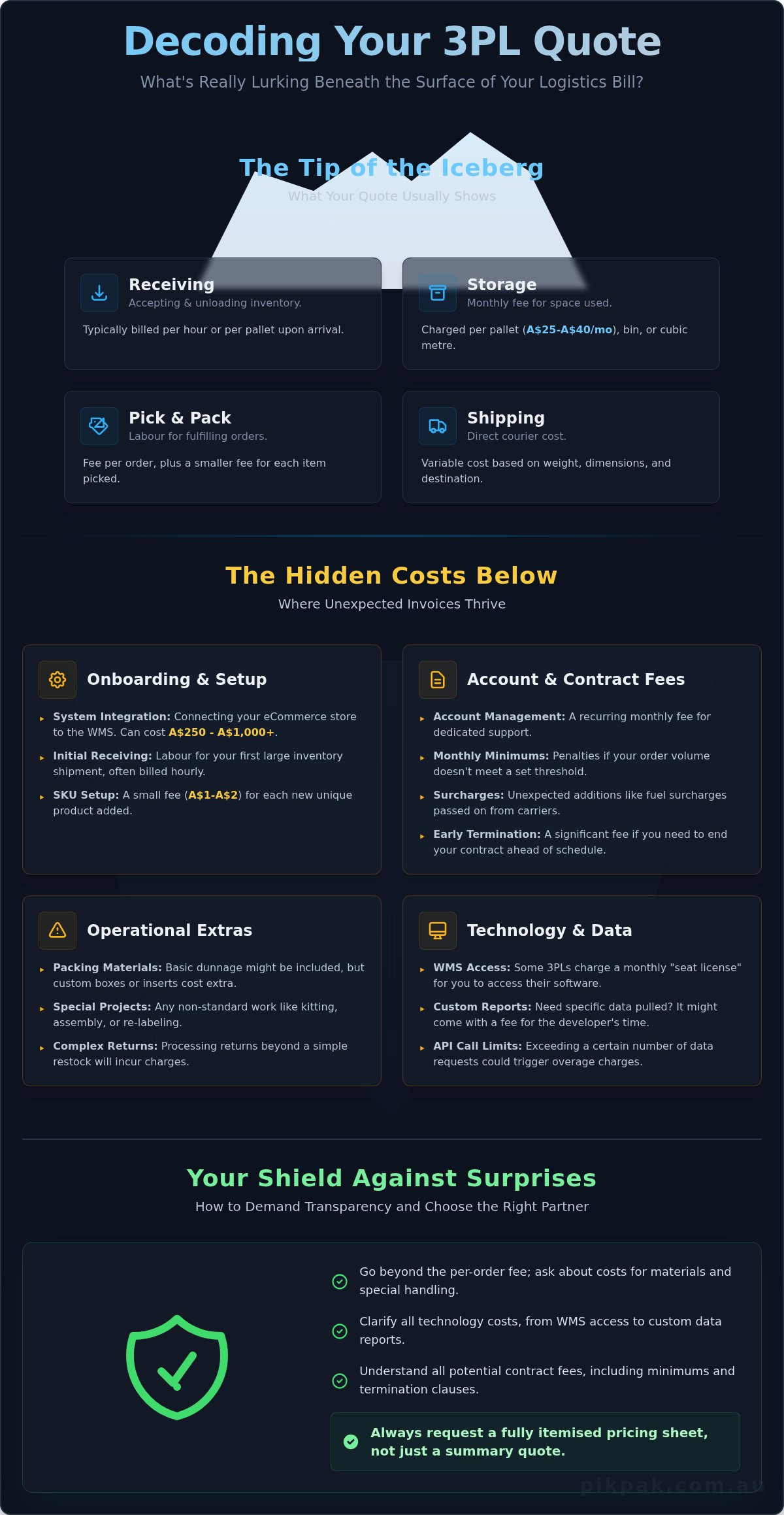
- Receiving: The one-off cost to accept, unload, and check your inventory as it arrives at the warehouse. This is often billed per hour or per pallet.
- Storage: A recurring monthly fee for the space your products occupy. In Australia, this is commonly charged per pallet (e.g., A$25-A$40/month), per storage bin, or per cubic metre.
- Pick & Pack: The labour cost for fulfilling an order. It’s typically structured as a fee per order, plus a smaller fee for each individual item picked within that order.
- Shipping: The direct cost of the courier service used to deliver the parcel. This is a variable cost that changes based on weight, dimensions, and destination.
Where the Unexpected Charges Hide
While the core fees are predictable, the hidden costs of third party logistics often lurk in the fine print and non-standard activities. These are the charges that turn a clear budget into a costly headache if they aren’t discussed upfront.
- Onboarding & Setup: A one-time fee for integrating your eCommerce platform with the 3PL’s warehouse management system (WMS).
- Account Management: Some providers charge a recurring monthly fee for dedicated customer support or account management services.
- Special Projects: Tasks outside standard fulfilment, like assembling kits, applying new labels, or handling complex returns, will always incur extra charges.
- Contract Clauses: Watch out for penalties for not meeting monthly order minimums, fuel surcharges, or fees for early contract termination.
A reliable 3PL partner lays all these potential costs on the table from day one. Full transparency isn’t just good practice-it’s the foundation of a partnership that lets you scale confidently and keep your operations running like clockwork.
Initial Hurdles: Uncovering Onboarding & Account Management Fees
You’ve found a 3PL partner and you’re ready to go. It’s an exciting step toward automating your operations and freeing up your time. But before your first shipment arrives at their warehouse, it’s crucial to look at the initial setup and ongoing account fees. What seems like a simple startup process can often contain some of the most common hidden costs of third party logistics.
Many 3PL providers in Australia charge one-off fees to get your account running and integrated, plus recurring charges just to maintain your account. Getting clarity on these costs upfront is simple, and it ensures your partnership starts on a transparent and predictable foundation.
One-Time Setup and Integration Fees
Think of these as the one-time investments to get your business plugged into your 3PL’s system. They cover the initial labour and technical work required to get you ready for your first order. Be sure to ask about:
- System Integration: This is the fee for connecting your eCommerce platform (like Shopify, WooCommerce, or BigCommerce) to the 3PL’s warehouse management system (WMS). This can range from a simple, free plug-in to a more complex API integration costing anywhere from A$250 to A$1,000+.
- Initial Receiving & Onboarding: Your first large shipment requires significant labour to receive, count, inspect, and put away. Many 3PLs charge for this initial inbound processing, often at an hourly rate.
- SKU Setup: Some providers charge a small fee, perhaps A$1-A$2, for every new and unique Stock Keeping Unit (SKU) you add to their system. If you have a large catalogue, this can add up quickly.
Recurring Account & Support Charges
Beyond the one-off costs, some fees can appear on your invoice every single month. These are critical to uncover, as they directly impact your ongoing operational expenses.
- Monthly Account Fee: This is a flat administrative fee you pay just for being a client, sometimes called a “platform fee.” It can range from A$50 to A$200+ per month and is charged regardless of your order volume.
- Customer Support Tiers: Don’t assume phone support is standard. Many 3PLs offer tiered support. A basic plan might be email-only, while a premium plan with a dedicated account manager and phone access comes at an extra cost. Clarify what level of support is included in your base rate.
- Minimum Spend Commitments: This is one of the most important hidden costs of third party logistics for growing businesses. If your total monthly fees don’t reach a certain threshold (e.g., A$500), the 3PL may charge you the difference to make up for it. This protects them but can be a costly surprise during slower months.
Warehouse Operations: Hidden Costs in Storage and Receiving
Your 3PL quote probably highlights a simple per-pallet storage fee, but what happens before and after your goods are sitting on the shelf? The daily operations within the warehouse are a primary source for the hidden costs of third party logistics. What seems like a straightforward process can quickly add unexpected charges to your monthly invoice. Don’t worry – understanding these costs is the first step to controlling them. Let’s make it simple.
The price for simply occupying space is just the starting point. How your inventory arrives, how it’s managed, and how long it stays can all trigger additional fees. A transparent 3PL partner will outline these clearly, but you need to know what to ask.
Beyond the Per-Pallet Storage Rate
The fee for occupying a pallet space is often just the beginning. Look deeper into your agreement for these common charges:
- Unloading Fees: If your stock arrives from overseas in a floor-loaded container, the 3PL needs to manually unload it onto pallets. This labour-intensive process, known as “container devanning,” is often billed at a flat rate (e.g., A$350-A$600 per container) or an hourly rate.
- Long-Term Storage Fees: Warehouses are designed for flow, not static storage. If your inventory doesn’t sell and sits for too long (typically over 90 days), expect to pay a premium. These aging inventory fees can be 25-50% higher than your standard rate.
- Inventory Audits: While your 3PL’s system provides digital tracking, if you require a full physical stocktake or frequent cycle counts beyond their standard procedure, this will be charged as a separate service, usually by the hour.
Value-Added and Reverse Logistics Fees
Any task that goes beyond the standard “receive, store, pick, pack, ship” process will almost certainly come at an extra cost. These services are crucial for many eCommerce businesses but are rarely included in base pricing.
- Kitting & Assembly: Need to bundle a few products into a promotional gift set? That’s kitting. This value-added service is billed per kit assembled and is essential for promotions, but it’s a line item you must budget for.
- Returns Processing: Managing returns (reverse logistics) is a detailed process. Each returned item must be received, inspected, graded, and either restocked or disposed of. Expect a per-item fee (e.g., A$4-A$7) for this handling.
- Special Handling: Selling fragile glassware, heavy furniture, or items classified as hazardous goods? These require special care, materials, or storage conditions, all of which come with surcharges to cover the extra risk and labour.
The Money Pits: Picking, Packing, and Shipping Surcharges
Once your inventory is safely stored, the real action begins: fulfilling customer orders. The ‘pick and pack’ fee might seem straightforward, but this is where many of the most common hidden costs of third party logistics can catch you by surprise. A simple ‘per order’ fee rarely tells the whole story. To truly understand your costs, you need to look at the line items for materials, special handling, and the variable world of shipping surcharges. Let’s make it simple.
Packing Material and Labour Costs
The price you’re quoted for picking an item and putting it in a box often excludes the box itself-and everything that goes in it. These costs are small individually but add up fast. Your 3PL partner should be transparent about these charges:
- Box & Dunnage Fees: Expect separate charges for every carton, mailer, piece of bubble wrap, or void fill used to protect your products. A good 3PL will optimise packaging to minimise these costs and waste.
- Custom Packaging: Using your own branded boxes creates a great unboxing experience, but it can increase costs. It may require extra storage space and non-standard handling processes, which often carry a small premium.
- Promotional Inserts: Want to add a thank-you card, flyer, or product sample? Every touch is a task. This is usually billed as a small ‘per-insert’ fee, adding anywhere from A$0.20 to A$0.50 per order.
Navigating Shipping Carrier Surcharges
Your 3PL doesn’t set shipping rates; carriers like Australia Post, Aramex, and Toll do. Your provider passes these costs-and any surcharges-on to you. Staying ahead of these variables is key to protecting your profit margin.
- Fuel Surcharges: A variable percentage added to the base shipping cost by all major carriers in Australia. It fluctuates with fuel prices and is completely unavoidable.
- Residential & Rural Delivery Fees: Carriers charge extra (often A$2.50 – A$4.00) to deliver to residential addresses. Given Australia’s vast landscape, rural and remote delivery surcharges can be even more significant.
- Dimensional (DIM) Weight: This is a big one. You pay for the space your package takes up, not just its weight. A large, light item (like a pillow) can cost more to ship than a small, heavy one (like a book) because it occupies more room in the delivery van.
- Peak Season Surcharges: During busy periods like Christmas and Black Friday, carriers add a temporary surcharge to nearly all shipments to manage the increased volume.
A proactive 3PL partner helps you navigate these complexities, ensuring there are no shocks on your monthly invoice. The goal is to make fulfilment run like clockwork, so you can focus on growing your business.
Digital Dollars: The Hidden Costs of Technology and Data
In today’s eCommerce world, a 3PL’s technology is the central nervous system of your fulfilment operation. But while a slick dashboard looks great during a sales pitch, the underlying costs can be a major source of frustration. These “digital dollars” are some of the most common hidden costs of third party logistics, turning a powerful tool into a financial drain if you’re not careful.
A truly modern logistics partner shouldn’t nickel-and-dime you for the tools you need to run your business. The goal is to automate and simplify, freeing you up to focus on growth, not on deciphering complex tech invoices.
Software and Platform Access Fees
Gaining access to your inventory and order data is essential, but it can come at a price. Before signing a contract, ask about these specific charges:
- WMS License Fees: Some providers charge a monthly fee per user (e.g., A$50/user) simply to access their Warehouse Management System (WMS). As your team expands, this cost scales directly with it.
- API Access Charges: For high-volume businesses, this is critical. Many 3PLs will charge you for exceeding a certain number of API calls-the data transfers between your online store and their system.
- Lack of Self-Service: If you need to pay a fee every time you want to create a product bundle or update an SKU, you’re paying for inefficiency. A great platform empowers you to manage simple tasks yourself, instantly and for free.
Reporting and Support Costs
Data visibility and technical help are non-negotiable, but some 3PLs treat them as billable extras. This is another area where the hidden costs of third party logistics can surprise you.
- Custom Reports: Need a report that isn’t a standard template? Many providers will charge a one-off development fee, which can run into hundreds of dollars, just to get the specific data you need.
- IT Support Tickets: While basic customer service should be included, some 3PLs bill for technical support on a per-ticket or hourly basis. A small integration hiccup can quickly become a costly affair.
At Pik Pak, we believe technology should be an enabler, not a cost centre. Our platform is designed to give you complete control and crystal-clear visibility without the extra fees. It’s all part of making logistics easy. See how Pik Pak simplifies logistics.
Your Shield Against Surprises: How to Demand Transparency
The best defence against unexpected invoices is a strong offence. Before you sign any agreement, it’s your right to demand complete clarity. A reliable 3PL partner won’t just tolerate your questions; they’ll welcome them as an opportunity to build trust. Don’t settle for a simple price summary. Insist on a detailed, itemised pricing sheet and ask for a sample invoice. This lets you see exactly how charges are structured and presented, turning potential surprises into predictable expenses.
The Ultimate Checklist: Questions to Ask Any Potential 3PL
Arm yourself with these essential questions to cut through the jargon and get to the facts. Getting clear, direct answers is the first step in avoiding the common hidden costs of third party logistics.
- Can you provide a complete schedule of all potential accessorial fees, from oversized items to fuel surcharges?
- What specific services are included in my monthly account management or software fee?
- How are packaging materials billed? Is it a flat rate per order, or a per-item cost for boxes, tape, and void fill?
- What are your policies and any associated fees if my business doesn’t meet minimum monthly order volumes?
Red Flags to Watch For in a 3PL Contract
A contract should be a document of partnership, not a minefield of vague terms. Watch for these warning signs that suggest a provider may not be fully transparent about their costs and service commitments.
- Vague language: Phrases like ‘standard fees apply’ or ‘miscellaneous charges’ without a corresponding price list.
- Restrictive terms: Long-term contracts with steep penalties for early termination.
- No clear SLA: A lack of a defined Service Level Agreement (SLA) detailing performance metrics for receiving, picking, and shipping.
- Resistance to detail: Any hesitation or refusal to provide a detailed cost breakdown or a sample invoice.
Choosing a 3PL is one of the most critical decisions for your eCommerce business. By demanding transparency, you’re not being difficult; you’re being a smart business owner. This diligence ensures you find a true partner dedicated to helping you scale, not one who profits from confusion. It’s about building a foundation where you can focus on growing your brand, confident that your logistics are running like clockwork. At Pik Pak, we make this simple with clear, pay-as-you-go pricing, so you always know where you stand.
Swap Hidden Fees for Simple, Transparent Fulfilment
As we’ve explored, the initial quote from a 3PL provider is often just the tip of the iceberg. Behind that number lies a maze of charges for everything from onboarding and account management to storage overages and unexpected shipping surcharges. These hidden costs of third party logistics don’t just inflate your expenses; they create uncertainty and steal focus from your core business. Demanding transparency is your best shield against surprises.
At Pik Pak, we believe logistics should be simple, not stressful. We’ve engineered the headache out of fulfilment with our all-in-one solution, built on a clear, pay-as-you-go pricing model. You only pay for what you use, with no hidden software fees or confusing contract clauses. It’s one easy-to-understand price, so you can free up your time and get back to scaling your Australian brand with complete confidence.
Ready for a better way? Get a Transparent Quote and See How Simple Logistics Can Be. It’s time to partner with a 3PL that works for you, not against you.
Frequently Asked Questions
Are setup fees a normal part of working with a 3PL provider?
Yes, many traditional 3PLs in Australia charge a one-time setup fee. This typically covers integrating your eCommerce store with their warehouse management system (WMS) and setting up your products (SKUs) in their inventory. These fees can range from a few hundred to several thousand dollars. However, modern, tech-focused 3PLs often waive these fees to make getting started simple and accessible, removing a common barrier for growing businesses.
How are returns (reverse logistics) typically priced by 3PLs?
Returns are usually priced on a per-return or per-item basis. This fee covers the labour for receiving the package, inspecting the item’s condition, and processing it for either restocking, quarantine, or disposal. Be aware of extra charges for new packaging or special handling. A transparent 3PL partner will provide a clear breakdown of these costs so you can manage your reverse logistics budget without any nasty surprises on your monthly invoice.
What is dimensional weight and how can it cause hidden shipping costs?
Dimensional (or cubic) weight is a pricing formula used by couriers like Australia Post. It calculates a theoretical weight based on a package’s length, width, and height. You are charged for whichever is greater: the actual weight or the dimensional weight. This can lead to significant hidden costs of third party logistics if you sell large but lightweight items, as you’re paying for the space the item occupies in a van, not just how heavy it is.
Should I be worried about a 3PL that requires a long-term contract?
A long-term contract isn’t always a red flag, but it does reduce your flexibility. It can lock you into a pricing structure that may not suit your business as it scales or changes. For eCommerce businesses with fluctuating sales, a “pay as you go” model without long-term commitments is often a safer, more agile choice. This allows you to scale your fulfilment up or down without penalty, ensuring your logistics costs always align with your revenue.
How can I accurately forecast my monthly 3PL costs with so many variables?
Forecasting is made easy with a transparent partner. The key is to demand a detailed rate card that itemises every potential charge: receiving, storage (per pallet/bin/SKU), order fulfilment (per order and per item), and shipping. A great 3PL provides access to a real-time dashboard where you can monitor these expenses as they occur. This data-driven approach removes the guesswork and helps you avoid the hidden costs of third party logistics.
Does using my own custom branded packaging always cost more?
It doesn’t have to. While you are responsible for the cost of producing your custom boxes and materials, a good 3PL partner should not charge you extra labour fees just to use them. The main potential cost is storage; your 3PL will charge you for the warehouse space your packaging occupies. The best approach is to discuss this upfront to ensure your branding goals can be met efficiently and affordably, without surprise handling fees.