
What if that A$15,000 monthly 3PL quote isn’t an expense, but your ticket to scaling past seven figures in 2026? It’s a tough conversation. Your team sees a big new number, the finance department flags the expense, and your operations manager worries about losing control over the customer experience. Getting everyone on the same page can feel like a major headache, and we get it.
That’s why we built this strategic guide. We’ll make justifying the cost of a 3pl to my team a simple, data-driven process. You’ll learn how to shift the focus from a line-item cost to a powerful growth strategy, armed with a clear framework for calculating your true total cost of ownership and a roadmap that reassures your team. Let’s turn that difficult conversation into your company’s next big win.
Key Takeaways
- Uncover the true price of in-house fulfilment by calculating its Total Cost of Ownership (TCO), from labour to the real A$ cost of warehouse space in Australian cities.
- Learn how to convert fixed operational costs into a flexible, ‘Pay-As-You-Go’ model that scales with your sales volume and protects your profit margins.
- Get a specific framework for justifying the cost of a 3PL to my team by tailoring your pitch to address the unique goals of your Finance, Marketing, and Operations departments.
- Discover how to successfully counter the “we can do it cheaper ourselves” argument by exposing the hidden expenses and time sinks that hold your business back.
The Internal Hurdle: Why Justifying 3PL Costs Feels Like an Uphill Battle
You’ve run the numbers. You know that outsourcing fulfilment is the next logical step for your growing eCommerce brand. Yet, when you bring it up, you’re met with concerned looks and hesitant questions. This isn’t a failure of your logic; it’s a clash with human nature. The real challenge in justifying the cost of a 3pl to my team isn’t about spreadsheets; it’s about shifting a mindset from the comfort of ‘managing tasks’ to the ambition of ‘managing growth’.
This resistance often stems from the ‘Control Fallacy’-the deep-seated belief that doing everything in-house is safer and more reliable. Your team has perfected your pick-and-pack process. They know your products inside and out. Handing that responsibility over to an external partner feels like a loss of control. It triggers completely valid anxieties:
- Job Security: “If a company is handling our shipping, what will my role be?”
- Quality Control: “Will they pack our orders with the same care and attention to detail that we do?”
- Data Visibility: “Will we be flying blind, unsure of our own inventory levels or order statuses?”
The key is to address these fears head-on by framing a third-party logistics (3PL) provider not as a replacement, but as a strategic partner. They don’t take over jobs; they absorb the repetitive, time-consuming tasks that are holding your most valuable people back. They provide the operational muscle, freeing up your team to focus on marketing, customer service, and product innovation-the activities that actually build your brand.
The ‘DIY’ Trap in the Australian eCommerce Market
Australian brands are famously resourceful, but this can lead to waiting too long to outsource. The tipping point often arrives suddenly. When your daily order volume surpasses what 3-4 people can comfortably manage, or when fulfilment consumes more than 25% of your team’s weekly hours, you’ve outgrown your manual capacity. Pushing past this point with in-house resources means signing expensive warehouse leases and hiring more staff, a risky move given the Reserve Bank of Australia’s projections for economic adjustments leading into 2026.
Defining Your Goal: Growth vs. Maintenance
The most effective way to start the conversation is to redefine the goal. Is your team’s primary function to pack boxes (maintenance) or to grow a multi-million dollar brand (growth)? Shifting this perspective turns logistics from a cost center into a strategic asset. You’re not just paying for a service; you’re investing in scalability, efficiency, and the freedom for your team to focus on high-value work. This sets the stage for a data-driven conversation where the cost of a 3PL is weighed against the massive opportunity cost of not using one.
Uncovering the ‘Hidden’ Price Tag of In-House Logistics
The monthly 3PL invoice is a clear, predictable number. Your in-house fulfillment costs are not. The real challenge in justifying the cost of a 3pl to my team is helping them see beyond the warehouse lease and staff wages to uncover the full, often surprising, expense of doing it yourself. This requires a shift in thinking from simple line items to the Total Cost of Ownership (TCO).
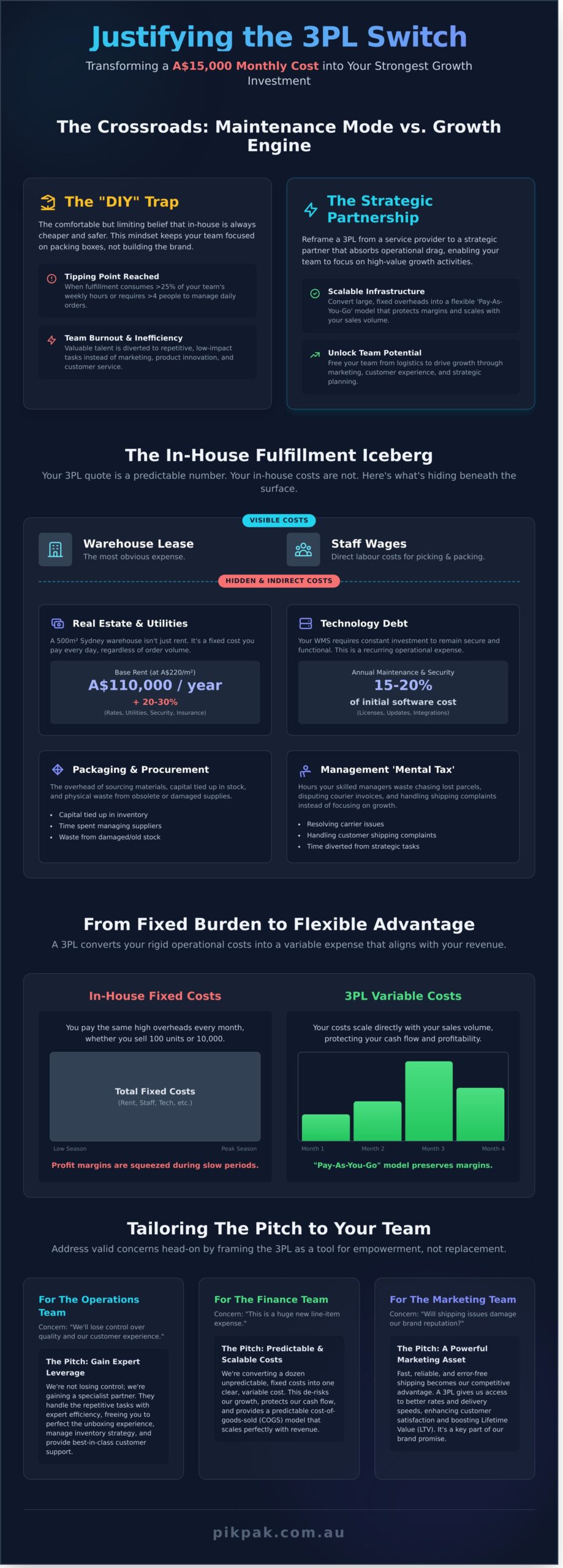
Let’s start with the most obvious expense: space. A modest 500-square-metre warehouse in a prime Sydney or Melbourne logistics hub doesn’t just cost rent. With prime industrial rents in Western Sydney exceeding A$220 per square metre as of early 2024, you’re looking at A$110,000 annually before you’ve even switched on a light. Add council rates, utilities, security systems, and mandatory public liability insurance, and that figure easily swells by another 20-30%. That’s a fixed cost you pay every single day, whether you ship 10 orders or 1,000.
Then there’s the technology. A functional Warehouse Management System (WMS) isn’t a one-time purchase. It’s a commitment. You’re responsible for software licenses, server maintenance, security updates to prevent data breaches, and the developer costs of maintaining integrations with your eCommerce platform. This ongoing “technology debt” can quietly consume 15-20% of the initial software cost each year, all just to keep things running smoothly.
The ‘Invisible 5’ Costs of In-House Fulfillment
Total Cost of Ownership (TCO) is the sum of all direct and indirect logistics expenses required to get a product to your customer. Many of these indirect costs are easy to miss, but they drain your resources daily. Here are five that often fly under the radar:
- Packaging Procurement: The overhead of sourcing boxes, satchels, and void-fill. This includes the cost of capital tied up in holding months of stock and the physical waste from damaged or obsolete materials.
- Management ‘Mental Tax’: The hours your managers spend chasing lost parcels, disputing courier invoices, and handling customer complaints about shipping. If a manager on an A$85,000 salary spends just five hours a week on these tasks, that’s over A$10,000 a year in lost productivity.
- Opportunity Cost: Every minute you spend managing logistics is a minute you aren’t spending on marketing, product development, or sales. This is the single biggest hidden cost.
- Delayed Shipping Churn: A 2023 report by Australia Post revealed that 41% of online shoppers will abandon their cart if the delivery estimate is too long. Slow, inefficient in-house picking can directly reduce your revenue.
- Technology Bottlenecks: When your system can’t keep up, you can’t scale. This isn’t just an inconvenience; it’s a cap on your growth potential. Viewing fulfillment as a strategic component of the supply chain is essential for long-term success.
Labor and Compliance in 2026
Managing a warehouse team isn’t just about paying wages; it’s about managing significant financial risk and complexity. WorkCover premiums are on the rise across Australia, with states like NSW increasing the average rate to 1.83% of wages for 2024-25. This, combined with escalating warehouse insurance costs, places a heavy compliance burden on your business.
Seasonal peaks present another challenge. Hiring temporary staff through an agency can cost up to 25% on top of their hourly rate. Training them eats into your permanent team’s time, and their initial error rate is often higher, leading to costly returns. The alternative, overworking your core team, increases the risk of burnout and workplace accidents, a serious financial and ethical liability in a self-managed facility. When you are justifying the cost of a 3pl to my team, highlighting the removal of this risk and administrative headache is a powerful argument. You can explore a simplified fulfillment cost structure that flexes with your sales volume, eliminating these headaches for good.
Beyond the Invoice: Quantifying the Strategic ROI of Outsourcing
The monthly 3PL invoice is often the first, and sometimes only, number your finance team sees. But focusing solely on that figure is like judging a car by its monthly payment instead of its fuel efficiency, safety rating, and repair costs. The real value is hidden in the costs you stop paying and the growth you unlock. Truly justifying the cost of a 3pl to my team means looking beyond the line items to the strategic return on investment (ROI).
Consider shipping rates alone. As a single business, you might pay Australia Post A$12 to ship a standard parcel. A high-volume 3PL, however, negotiates rates based on hundreds of thousands of parcels, potentially getting that same shipment for A$8.50. On just 1,000 orders a month, that’s a direct saving of A$3,500. Then there’s the cost of errors. A typical in-house operation might see a 2-3% error rate. For an A$60 average order, a 2% error rate costs you far more than the A$1.20 it seems. It’s the cost of the wrong item, the A$10+ for reshipping, the customer service hours spent fixing it, and the potential loss of a customer for life. A 3PL’s 99.9%+ picking accuracy, driven by technology and process, nearly eliminates this financial drain.
And what about growth? When Black Friday hits and your orders spike 500%, an in-house warehouse means chaos: hiring temps, paying overtime, and burning out your core team. With a 3PL, it’s just another Tuesday. They have the staff, space, and systems to absorb the surge. Your costs increase variably with order volume, not exponentially with stress and frantic hiring.
Fixed vs. Variable Cost Structures
Running your own warehouse saddles you with massive fixed costs. Think A$6,000 a month for a small industrial space in metro Sydney, plus staff wages, insurance, and utilities. You pay that every month, whether you ship 100 orders or 10,000. This creates the “dead space” expense, where you’re paying for empty shelves during your slow season. Partnering with a 3PL converts these fixed burdens into a predictable variable cost. You only pay for the pallet space you use and the orders you ship. This flexibility protects your cash flow and makes your business more resilient. It’s why 3PLs like Pik Pak offer transparent, scalable pricing that grows with you, not ahead of you.
The Tech Dividend: WMS and API Integrations
Modern 3PLs are technology companies as much as logistics experts. Their Warehouse Management System (WMS) and API integrations create a powerful efficiency engine. When a customer clicks “buy” on your Shopify store, the order is automatically sent to the warehouse, a pick list is generated, and a shipping label is printed without any human data entry. This level of automation is a key driver for improving supply chain efficiency and directly reduces labour costs and errors.
This tech stack also pays dividends in customer experience. Real-time inventory syncing prevents overselling, while automated tracking information slashes “Where is my order?” (WISMO) queries by up to 40%. Your customer service team is freed from repetitive tasks to handle more complex issues, boosting satisfaction and loyalty. This isn’t just an expense; it’s an investment in a smarter, smoother, and more profitable operation.
The Pitch: How to Present the 3PL Transition to Every Department
You’ve done the research and you know a 3PL is the right move. Now comes the real challenge: justifying the cost of a 3PL to your team. Each department views the business through a different lens, with its own unique goals and concerns. A one-size-fits-all pitch won’t work. To get buy-in, you need to speak their language and show them exactly how outsourcing fulfilment makes their job easier and the business stronger.
For the founder or CEO, the pitch is simple: stop working in the business and start working on it. Every hour spent managing warehouse staff or troubleshooting a shipping error is an hour not spent on product innovation, strategic partnerships, or market expansion. A 3PL isn’t an expense; it’s an investment in reclaiming your most valuable asset: your time.
Winning Over the Finance Director
Your Finance Director lives in a world of spreadsheets, margins, and risk. To get their approval, you need to present a clear, data-driven business case. Forget vague promises and focus on the numbers.
- Present a Breakeven Analysis: Show them the point where in-house fulfilment becomes a liability. For example, once you pass 400 orders per month, your fixed costs for a small warehouse space (A$4,000/month rent) and one part-time staff member (A$2,500/month) push your cost-per-order above A$16. A 3PL’s pay-as-you-go model can often bring that cost down by 30% or more.
- Highlight CapEx Reduction: Remind them that scaling in-house requires significant capital expenditure. You’re not just renting a space; you’re buying racking (A$10,000), a forklift (A$25,000), and a Warehouse Management System (A$15,000). A 3PL eliminates this A$50,000+ upfront investment, freeing up cash for inventory or marketing.
- Show the ROI of Bulk Shipping: This is the easiest win. Your current Australia Post rate might be A$9.80 for a standard parcel. A major 3PL shipping hundreds of thousands of parcels gets a deeply discounted rate, often closer to A$7.50. That A$2.30 saving per order goes directly to your bottom line.
Reassuring the Operations Team
Your Operations team is on the front line. Their initial reaction might be fear of redundancy or losing control. Your pitch must frame the 3PL as a powerful tool that empowers them, not replaces them.
Position the 3PL as a partner that absorbs the tedious, manual labour. No more taping boxes until 9 PM during a flash sale. Their roles can now evolve from reactive problem-solving to proactive, value-adding strategy. They can focus on exciting new projects like designing custom kitting for gift bundles or managing a complex subscription box launch. The transition itself is also designed to be seamless. The simple, tech-driven Pik Pak onboarding process ensures your systems are integrated in days, not weeks, with a dedicated specialist guiding your team every step of the way.
For your marketing team, the benefits are all about the customer experience. With a 3PL’s multi-centre network, you can offer 1-2 day shipping to over 80% of Australians, a powerful conversion tool that can decrease cart abandonment. They can also rely on the 3PL to perfectly execute a memorable unboxing experience with custom-branded materials, driving customer loyalty and social media shares. Successfully justifying the cost of a 3PL to my team meant showing marketing how it directly improves their core KPIs.
Ready to build your custom pitch with hard numbers? Get a transparent, itemised quote from Pik Pak and see exactly how much you can save.
Making the Switch: Why Pik Pak is the Logical Choice for Your Team
You’ve done the analysis. You know that outsourcing fulfilment is the key to unlocking growth, improving customer satisfaction, and freeing up your team’s valuable time. Now comes the final hurdle: convincing your stakeholders. The process of justifying the cost of a 3PL to my team becomes simple when the partner’s value is clear, direct, and designed to remove friction, not add it. That’s the core of our ‘Pick, Pack & Ship Made Easy’ philosophy.
We built Pik Pak from the ground up to be the logical choice for Australian eCommerce businesses. As a local partner, we offer the security and expertise that overseas providers simply can’t match. We understand the nuances of Australia Post and local couriers, ensuring your parcels are handled with care and delivered on time, a factor that 82% of Australian online shoppers consider important. Your team gets same-time-zone support, not a call centre on the other side of the world.
Perhaps the biggest internal roadblock is your IT department, often wary of complex, months-long software integrations. Our ‘No Software’ approach eliminates this concern entirely. There’s no proprietary software to install or maintain. We connect directly to your existing platform, like Shopify or WooCommerce, with a simple point-and-click process. What could be a six-month headache for your tech team becomes a 15-minute task, allowing you to go from quote to shipping your first order in as little as 72 hours.
The Pik Pak Advantage: Simplicity and Transparency
Our entire model is built to make your decision easy and risk-free. Our ‘Pay as you go’ pricing means you have zero upfront capital expenditure and no lock-in contracts. This is the ultimate risk-mitigator, aligning your logistics costs directly with your sales volume. It’s a powerful point when you’re justifying the cost of a 3PL to my team’s finance lead. You also give every department the data they need through our cloud-based Warehouse Management System (WMS). It provides a single source of truth for:
- Marketing: Real-time inventory levels for planning promotions.
- Customer Service: Instant order tracking to answer customer queries.
- Management: A clear, top-level view of your entire fulfilment operation.
Finally, we don’t just work for you; we work with you. Think of our dedicated support staff as an extension of your own team-a logistics expert on call without the A$95,000+ average annual salary.
Taking the First Step Toward Freedom
Building internal consensus starts with clear, undeniable data. We make it easy to get a custom, transparent quote that details every line item. You can present this directly to your board, showing a clear comparison against your current in-house costs. To build confidence across the team, we recommend a ‘Test Run’ approach. Start by sending us a single best-selling product line or a small portion of your inventory. This allows your team to see the efficiency, speed, and simplicity of our process firsthand, turning sceptics into advocates before you make a full commitment.
Stop letting logistics dictate your growth. It’s time to focus on your business and let us handle the hard work. Get a transparent 3PL quote from Pik Pak today and take the first step toward effortless fulfilment.
From Justification to Growth: Make Your 3PL Pitch a Reality
The conversation about logistics doesn’t have to be an uphill battle. You now have the data to show that the ‘real’ cost of in-house fulfilment goes far beyond payroll and rent; it includes lost time, missed growth opportunities, and the daily operational headaches that pull your team away from what they do best. Partnering with a 3PL isn’t just an expense. It’s a strategic investment in efficiency, scalability, and customer satisfaction. Ultimately, justifying the cost of a 3pl to my team becomes simple when you frame it as a direct path to smarter, more profitable growth.
Pik Pak makes that transition seamless. With Australian-based support and warehousing, you get local expertise you can trust. Our seamless API integration with major e-stores like Shopify and WooCommerce means you’re connected in minutes, not weeks. Plus, our transparent ‘Pay as you go’ pricing model eliminates financial surprises, so you only pay for what you use.
Ready to free up your team? Get a Pik Pak quote today.
Stop managing boxes and start scaling your business. Let’s make logistics your competitive advantage.
Frequently Asked Questions
Is a 3PL really cheaper than managing my own small warehouse?
Yes, a 3PL is often cheaper once you calculate the total cost of self-fulfilment. Beyond the obvious A$150+ per square metre for commercial rent in Sydney or Melbourne, you have hidden expenses. These include staff wages (the national minimum wage is A$23.23 per hour as of July 2023, plus 11% superannuation), insurance, utilities, and packaging materials. A 3PL’s “pay as you go” model converts these fixed overheads into a single, variable cost that scales with your sales.
How do I explain potential job changes to my current warehouse staff?
Explain the shift by focusing on redeploying their valuable skills into growth-oriented roles. Instead of spending 20 hours a week picking and packing, a team member could be managing digital marketing campaigns, refining supplier relationships, or enhancing customer support. Frame it as an investment in their professional development and the company’s future. This transition allows your best people to focus on scaling the business, leaving the repetitive tasks to a specialist partner.
What is the typical ROI timeframe when switching to a 3PL?
Most Australian eCommerce businesses see a positive return on investment within 6 to 9 months. This ROI is driven by two key factors: the elimination of fixed costs like rent and labour, and access to heavily discounted shipping rates. A 3PL can secure shipping rates up to 40% lower than standard commercial prices. For a business shipping just 500 orders a month, that can easily translate to over A$2,000 in monthly savings on freight alone.
Will my team lose visibility of our inventory if we move to a 3PL?
No, you’ll actually gain more precise, real-time control over your inventory. Modern 3PLs provide access to a sophisticated Warehouse Management System (WMS) through a simple online dashboard. Your team can view live stock levels, track inbound shipments, and monitor order status 24/7. This technology provides inventory accuracy of over 99.9%, eliminating the need for manual stocktakes and giving you more control than ever before. It’s inventory management made easy.
How does a 3PL help with customer returns and reverse logistics?
A 3PL simplifies your entire returns process, making it a painless experience for both you and your customers. We manage the whole workflow: receiving the returned item, performing a quality check, restocking it for resale, and triggering the refund or exchange in your system. This process is typically completed within 48 hours of receipt. A streamlined returns policy can increase customer loyalty by up to 30%, according to research from the Australian Retailers Association.
What happens if our order volume fluctuates wildly throughout the year?
A 3PL is specifically designed to handle fluctuations, allowing you to scale your operations up or down instantly. You only pay for the storage and labour you use, so you aren’t stuck paying for empty warehouse space during slow months or scrambling to hire temporary staff during peak season. This flexibility is a core benefit when you’re justifying the cost of a 3pl to my team, as it ensures your expenses always align with your revenue.
Can a 3PL integrate with my specific eCommerce platform like Shopify or WooCommerce?
Yes, seamless integration with all major eCommerce platforms is a standard feature. A quality 3PL partner offers simple, one-click integrations for Shopify, WooCommerce, BigCommerce, and others. Once connected, your orders flow directly into our system for automated fulfilment without any manual entry. There’s no complex coding needed; we’ve made it a point, click, and connect solution so you can be live in under 10 minutes and focus on your business.
How do I calculate the ‘Opportunity Cost’ of my team doing fulfillment?
Calculate opportunity cost by valuing the time your team spends on logistics against the revenue they could generate instead. First, add up the total hours your team spends picking, packing, and shipping each week. Multiply those hours by their average wage (including superannuation). Now, ask what that same budget, invested in marketing or product development, could achieve. That difference is your opportunity cost, and it makes justifying the cost of a 3pl to my team a simple, data-driven conversation.