
That feeling of chaos-boxes piling up, best-sellers sold out, and cash tied up in slow-moving stock-is a familiar headache for many growing Aussie business owners. You’re spending more time in the stockroom than you are on strategy, and the dream of a smooth, scalable operation feels miles away. The good news? The thought, “I need a better way of getting control of my inventory,” doesn’t have to lead to more complexity. What seems like a challenge is an easy game when you have the right playbook.
This 2026 guide is that playbook. We’re moving beyond the limitations of spreadsheets to show you the two core paths for mastering your stock. We’ll give you a simple framework to help you choose the right model for your business, so you can get a crystal-clear view of what you have and where it is. It’s time to eliminate the guesswork, stop losing sales, and finally free up your time to focus on what truly matters-building your brand.
Key Takeaways
- Identify the five key signs that your inventory chaos is a signal of business growth, and it’s time to upgrade from spreadsheets.
- Discover the two core paths for managing stock-in-house (DIY) or outsourced (3PL)-to find the right fit for your Aussie business.
- For those choosing the DIY path, getting control of my inventory starts with powerful techniques like ABC analysis to prioritise your most valuable products.
- Understand how partnering with a 3PL provider can eliminate the daily grind of logistics, freeing you up to focus on scaling your brand.
- Access a clear framework to weigh the true opportunity cost of managing your own warehouse versus the strategic benefits of outsourcing.
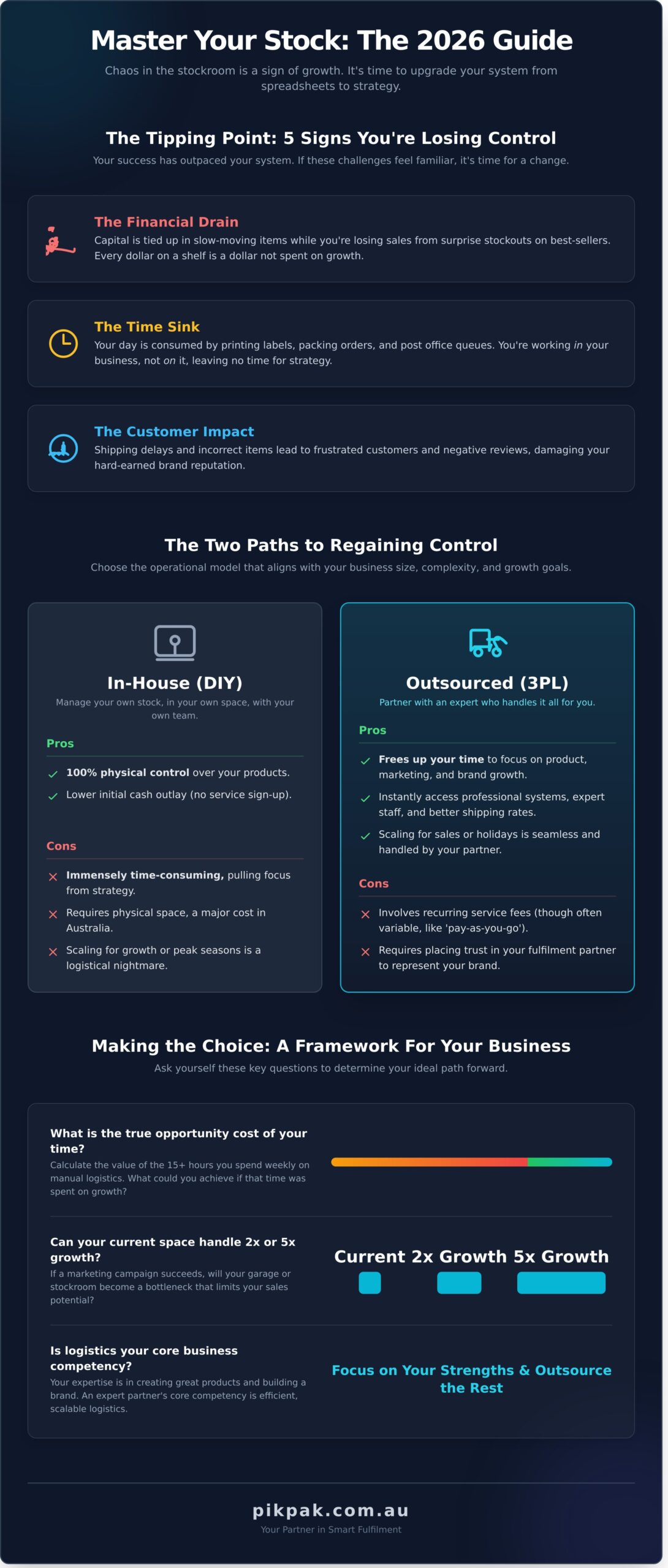
The Tipping Point: 5 Signs You’re Losing Control of Your Inventory
Does your garage look more like a distribution centre than a place to park your car? Are you unsure what you actually have in stock without a frantic search through boxes? That feeling of chaos isn’t a sign of failure; it’s a sign of growth. But it’s also a clear warning that the methods that got you here won’t get you to the next level. If you’re thinking, “I need a better way of getting control of my inventory,” you’re already on the right track.
From ‘Side Hustle’ to ‘Serious Headache’
What started as a passion project with 10 orders a week is now a thriving business shipping 100. The spreadsheet and Post-it notes that once worked perfectly are now the source of your biggest headaches. This isn’t your fault-it’s a classic growth problem. Your success has simply outpaced your system, and it’s time for a solution that lets you focus on your business, not just your boxes.
If you’re juggling these challenges, you’re at a critical tipping point:
- The Financial Drain: You’re constantly walking a tightrope between lost sales from surprise stockouts and capital being tied up in products that just won’t sell. Every dollar stuck on a shelf is a dollar you can’t invest in marketing or new products.
- The Time Sink: Your calendar is dominated by printing labels, packing orders, and queueing at the post office. You’re spending more time working in your business than on it, leaving no room for strategy or growth.
- The Customer Impact: Shipping delays, incorrect items, and a lack of clear tracking are leading to frustrated customer emails and negative reviews, damaging the brand reputation you’ve worked so hard to build.
Calculating the True Cost of Chaos
The disorganisation has a real price tag, often higher than you think. Understanding basic inventory control principles helps reveal the true cost. Try this simple exercise: estimate your lost sales from recent stockouts and add the carrying costs (storage, insurance) of your overstocked items. Now, put a value on your time-what’s 15 hours a week of manual logistics worth to you? A$500? A$1,000? This is the real cost of not getting control of my inventory.
The Two Paths to Regaining Control: In-House vs. Outsourced
When you’re focused on getting control of my inventory, the first major decision is an operational one. You have two clear paths: manage everything yourself, or partner with an expert to do it for you. There is no single “right” answer-the best choice depends entirely on your business’s size, complexity, and growth goals. One path offers total hands-on control, while the other offers freedom and scalability. Let’s break them down.
The In-House Management Model
The In-House or “DIY” model is exactly what it sounds like: you manage your own stock in your own space, using your own team. This is a common starting point for startups, businesses with low order volumes, or those requiring highly specialised, custom packing. Managing this yourself means you are responsible for every detail, from accurate stocktakes to implementing efficient picking processes. For a deeper dive, the Australian government guide to inventory provides a solid framework for these hands-on tasks.
- Pros: You have 100% physical control over your products and may have a lower initial cash outlay compared to signing up for a service.
- Cons: It’s immensely time-consuming, demands physical space (a major cost with Australian commercial rent), and scaling becomes a costly, logistical headache.
The Outsourced Fulfilment Model
Outsourcing means partnering with a Third-Party Logistics (3PL) expert like Pik Pak Logistics. We handle the entire physical process: receiving your stock, securely storing it, and then picking, packing, and shipping orders directly to your customers. This model is designed for ambitious businesses that want to focus their energy on what they do best-developing products and growing their brand.
- Pros: Free up your time to focus on your business. Instantly access professional systems, expert staff, and better shipping rates. Scaling for peak seasons is seamless.
- Cons: It involves recurring service fees (though models like ‘pay-as-you-go’ keep costs variable) and requires placing trust in your fulfilment partner.
To make the choice clearer, here’s a high-level comparison:
Ultimately, the path you choose will define how you grow. The key is to honestly assess where your time is best spent: managing boxes in a warehouse, or building the business of your dreams.
The DIY Toolkit: Mastering Inventory Control In-House
For many Australian eCommerce businesses, managing stock from your garage or a small warehouse is the most practical first step. It gives you complete oversight and can be highly cost-effective when you’re starting out. The key isn’t to overcomplicate things; it’s to implement a simple, powerful framework from day one. Successfully getting control of my inventory begins with mastering a few essential techniques and choosing the right tools for your current scale.
This DIY toolkit is about putting you in the driver’s seat, using straightforward methods to prevent stockouts, reduce waste, and ensure your capital is working for you, not sitting on a shelf.
Essential Techniques for Self-Management
Before you even think about software, ground your operations in these proven principles. They are the foundation of efficient inventory management.
- ABC Analysis: This is the 80/20 rule for your stock. Your ‘A’ items are the top 20% of products that generate roughly 80% of your revenue. Focus most of your management effort here. ‘B’ items are of moderate importance, and ‘C’ items are your low-turnover goods. This simple prioritisation stops you from wasting time on products that don’t drive your business forward.
- First-In, First-Out (FIFO): A non-negotiable for businesses selling perishable goods, cosmetics, or trend-based items. FIFO ensures you sell your oldest stock first, dramatically cutting the risk of spoilage, obsolescence, and costly write-offs.
- Regular Stocktakes: Your system’s data is only a guess until it’s verified. A physical stocktake-counting what’s actually on your shelves-is the essential reality check. It identifies issues like theft, damage, or receiving errors before they become major problems.
Choosing Your Tools: Spreadsheets vs. Software
Your choice of tool should match your business complexity. Start simple and upgrade only when you feel the growing pains.
A well-structured spreadsheet is often enough when you have a small, manageable number of SKUs. It’s a no-cost way to track stock levels, sales data, and set basic reorder points. However, you’ll know you’ve outgrown it when you spend more time updating cells than fulfilling orders, or when manual errors lead to overselling. Poor manual tracking can expose you to modern supply chain challenges like having too much cash tied up in the wrong products.
When spreadsheets become a liability, it’s time for dedicated software. Platforms like Shopify include robust inventory features out of the box. As you grow, you might look at tools like Cin7 Core. Look for software that provides:
- Real-time stock level updates across all sales channels.
- Automated low-stock alerts to prevent stockouts.
- Simple reporting to see what’s selling and what’s not.
These tools automate the tedious work, giving you the clarity needed for getting control of my inventory as your business scales.
The Smart Cut: How a 3PL Partner Takes Control For You
You’ve mapped your stock and tried to implement systems, but the daily reality of packing boxes and running to the post office is still holding you back. If your time is stretched thin and your space is overflowing, it’s time for a smarter approach. Partnering with a third-party logistics (3PL) provider isn’t about giving up; it’s about delegating the physical work to a team of experts so you can focus on what you do best: growing your business.
Think of a 3PL like Pik Pak as your dedicated operations team. We seamlessly handle receiving, storage, picking, packing, and shipping. What seems like a challenge is an easy game when you have the right partner.
More Visibility, Not Less: The Power of a WMS
The biggest fear business owners have is losing control. The reality is the exact opposite. A professional 3PL gives you more control through a Warehouse Management System (WMS). This is your live, secure dashboard for your entire inventory. Log in anytime to see real-time stock levels, track every order from placement to delivery, and manage returns with a few clicks-a level of clarity that’s impossible to achieve in a messy garage.
Beyond Storage: The Value-Adds of a 3PL
A great 3PL does more than just store your products; they become a strategic partner that saves you time and money. With Pik Pak, you gain access to services that are complex and costly to manage alone:
- Reduced Shipping Costs: We ship thousands of parcels across Australia daily, giving us access to bulk-rate discounts from major carriers that we pass directly to you.
- Kitting & Assembly: Want to offer product bundles or special promotional gift sets? We handle the complex assembly for you, ensuring a professional finish every time.
- Effortless Returns Management: Handling returns (reverse logistics) is a major headache. We manage the entire process for you, from inspection to restocking, making it simple and seamless.
Making the switch to a 3PL is the single most powerful step towards truly getting control of my inventory for good. It transforms your operations from a daily chore into a streamlined, automated engine for growth. Stop letting logistics dictate your schedule. See how easy it can be. Explore Pik Pak’s fulfilment services.
Making the Choice: Is It Time to Outsource Your Inventory?
You’ve built your business from the ground up, but as you grow, the very tasks that once felt productive-packing orders, running to the post office-can become the biggest bottleneck. The real question isn’t just about the cost of shipping boxes; it’s about the opportunity cost. Every hour you spend managing logistics is an hour you’re not spending on marketing, product development, or connecting with your customers.
Making the leap to a third-party logistics (3PL) partner isn’t about losing control. It’s about gaining a new, more powerful kind of control-the freedom to focus on what truly matters. For many founders, this is the most critical step in successfully getting control of my inventory and unlocking serious growth.
A 5-Point Checklist to Decide
If you find yourself nodding along to two or more of these points, it’s a strong signal that your business is ready for a dedicated fulfilment partner.
- Order Volume: Are you consistently processing more than 10-20 orders every single day?
- Time Drain: Is more than a quarter of your work week spent physically picking, packing, and shipping orders?
- Space Issues: Has your product inventory completely taken over your garage, spare room, or current storage space?
- Customer Feedback: Are you seeing an increase in customer complaints about shipping delays or incorrect items?
- Growth Ceiling: Do you feel that the daily grind of logistics is actively holding your business back from its potential?
Your Next Step to Effortless Control
Partnering with Pik Pak means you can instantly reclaim your time and scale your operations without limits. What seems like a challenge is an easy game with the right team. You get to hand over the headaches and gain significant advantages:
- Free up your time to focus on strategy and growth.
- Scale on demand without worrying about warehouse space or hiring staff.
- Reduce errors with our expert team and advanced WMS technology.
- Save on shipping by accessing our competitive carrier rates.
Our onboarding process is simple. We integrate directly with your eCommerce platform-like Shopify or WooCommerce-with just a few clicks. There’s no complex software to learn. From there, you just send us your stock. We handle the rest. It’s the simplest way of getting control of my inventory for good.
Ready to turn your focus back to your business? Let us do the hard work for you. Discover how Pik Pak makes fulfilment effortless for growing Australian brands.
Take Back Control and Focus on What Matters
By now, you understand the tipping points of inventory chaos and the two paths forward: the hands-on DIY approach or a strategic partnership. Ultimately, getting control of my inventory isn’t just about organising stock; it’s about reclaiming your time and unlocking your business’s true potential for 2026 and beyond.
If the daily grind of picking, packing, and shipping is holding you back, it’s time for the smart cut. A partner like Pik Pak makes the transition simple. There’s no complex software to install and our flexible, pay-as-you-go pricing means you only pay for what you use. We offer seamless integration with your eCommerce store, all backed by our proudly Australian-based support team.
Ready to free up your time and focus on growth? Get a simple, clear quote from Pik Pak.
Let’s make this the year your logistics run like clockwork.
Frequently Asked Questions
What is the very first step to getting control of my inventory?
The very first step is simple but non-negotiable: a complete physical stocktake. Before you can implement any software or system, you need a 100% accurate baseline of every single item you own. This means counting everything and recording SKUs, quantities, and locations. This foundational task provides the clear, accurate data you need for the entire process of getting control of my inventory and making informed decisions moving forward. It’s the essential starting point for true visibility.
How much does inventory management software cost for a small business?
In Australia, standalone inventory management software for a small business can range from A$50 per month for basic plans to over A$400 per month for more advanced systems with multi-warehouse and manufacturing features. However, a more straightforward approach is to partner with a 3PL like Pik Pak. Our advanced warehouse management technology is integrated into our service, eliminating the need for you to purchase, learn, and manage a separate, costly software subscription.
What’s the difference between inventory control and inventory management?
Think of inventory control as the hands-on, in-the-warehouse process. It covers receiving, storing, picking, packing, and shipping stock. It’s about managing the physical goods you have right now. Inventory management is the bigger picture. It’s the strategic process of forecasting demand, deciding when and how much to reorder, and managing supplier relationships. Effective control makes your management strategy possible, ensuring your operations run like clockwork.
How much does it cost to use a 3PL fulfillment service in Australia?
3PL pricing in Australia is typically broken down into a few key areas, allowing you to pay only for what you use. You can expect fees for receiving stock (per pallet or carton), monthly storage (around A$20-A$40 per pallet), and order fulfillment (e.g., A$2.50 per order + A$0.50 per item picked). This ‘pay-as-you-go’ model is highly scalable and often more cost-effective than leasing a warehouse and hiring staff yourself, especially as your business grows.
Can I still sell on multiple platforms like Shopify and Amazon with a 3PL?
Absolutely. In fact, using a 3PL makes multi-channel selling far easier. Modern 3PLs use powerful software that seamlessly integrates with major eCommerce platforms like Shopify, WooCommerce, and marketplaces like Amazon and eBay. When a customer places an order on any of your connected stores, it’s sent automatically to the 3PL for picking, packing, and shipping. This automates your fulfillment, eliminates manual data entry, and lets you manage all your sales channels from one central inventory pool.
At what point is my business ‘big enough’ for a 3PL partner?
It’s less about a specific order volume and more about your time. You’re ‘big enough’ for a 3PL when fulfillment starts preventing you from focusing on growth. If you spend hours each day packing boxes instead of marketing, if you’re running out of storage space in your garage, or if packing errors are increasing, it’s time to consider a partner. The goal is to free up your time and remove the operational headache so you can focus on your business.
How do I physically get my stock to a 3PL warehouse?
Getting your stock to us is a simple, streamlined process. You or your supplier simply arrange a shipment to our designated warehouse address. Before it arrives, you provide us with a digital advanced shipping notice (ASN) through our portal so our team knows exactly what to expect. Once your inventory arrives, we handle the rest-from unloading and inspection to securely storing it and making it ready for sale across all your platforms. It’s all done for you.