

Fishing and boating orders reach Australian customers more reliably when products are correctly identified, inventory is organised, orders are picked and packed carefully, and shipping is planned for each item. Effective logistics for fishing and boating supplies connects these steps, helping online stores manage orders from checkout to delivery.
It’s easy to focus on listing products online and underestimate the work behind each parcel. Accurate stock handling, suitable packing and clear order processing all shape the customer experience, especially when a store sells a varied range of fishing and boating gear.
This guide explains how fulfilment works, what to consider when selecting and preparing products, and how storage, returns and home delivery fit into the process. It also covers the factors that affect fulfilment costs and when outsourcing logistics can give your team more time to run and grow the business.
Key Takeaways
- Match fishing and boating products with suitable storage, picking and packing processes to help orders move smoothly from checkout to dispatch.
- Understand how delivery timing depends on factors such as the destination, the parcel and the shipping option selected.
- Plan stock handling around product variety and order patterns to make fulfilment easier to manage as your online store grows.
- See how outsourced fulfilment can bring inventory storage, order processing, home delivery options and returns management together.
Fishing equipment and supplies
Start with clear product data. Give each sellable item its own stock code, description and variant details, such as colour or size where relevant. Keep compatible options distinct: fishing line in one strength should not be recorded as another. Product images and plain-language names can also help staff identify items while picking. When a product changes, update its record before orders are processed using outdated information.
Next, organise stock according to how it needs to be handled. Small items such as swivels or hooks can go in labelled bins, while longer products need storage suited to their shape. Assign each product a defined location and record movements when stock arrives, moves or is picked. This creates a clear trail from receiving to the customer’s order, without relying on memory or handwritten notes.
The items in an order affect the picking route. A customer buying a reel and several tackle items may need products stored in different zones. A clear picking list shows the exact items and quantities, and the packer checks them against the order. For a bundle such as a rod-and-reel combination, kitting brings separate components together as one prepared unit. Stock records should reflect that assembly process.
- Receiving: Record the product identity and quantity as stock enters storage.
- Put-away: Assign each item a location that matches its size and picking frequency.
- Picking: Follow the order list and distinguish similar products by their identifiers.
- Packing: Group the order securely, with the contents checked before dispatch.
- Returns: Inspect returned goods and update stock records to show their status.
Packing should suit the order. A parcel of small tackle needs a different arrangement from one containing a long item. Separate loose pieces, prevent items from moving inside the parcel and keep the order contents together. For mixed orders, checking each item against the order can catch a missing accessory before dispatch. Clear packing steps also help teams handle repeat orders consistently.
Inventory planning matters when customers buy related products together. If a popular reel sells out while compatible line remains available, the store may miss an opportunity to sell a useful combination. Review order patterns and stock movement to see which items are often bought together. Use those patterns to guide replenishment and storage, rather than treating each product in isolation. Accurate inventory records also help prevent accepting orders for unavailable stock.
Marine operators manage vessels and fleet capacity, while online retailers manage product availability and parcels. The shared operational lesson is to match resources to demand. For an online store, that means keeping fishing and boating products organised, establishing a repeatable route from shelf to packing bench, and recording every stock movement. Defined steps for receiving, picking, packing and returns make a diverse catalogue easier to fulfil accurately.
How long does delivery take for fishing and boating supplies across Australia?
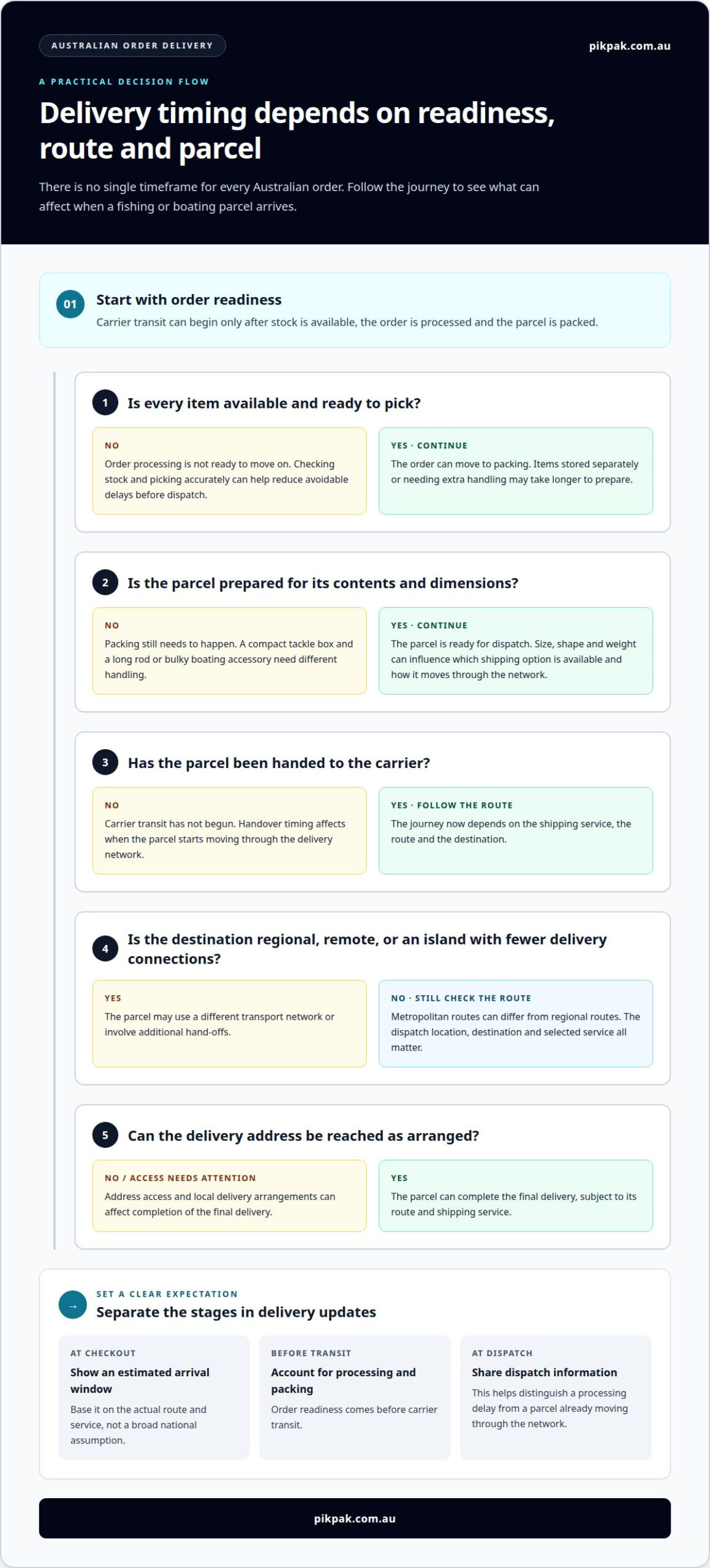
No single delivery timeframe applies to every Australian order. Arrival depends on the dispatch location, destination, shipping service and when the parcel is ready to leave. A fishing lure sent within the same city takes a different route from a long rod travelling to a regional address. Delivery estimates should reflect the actual route and service, not a broad national assumption.
Order readiness is the first timing factor. Stock must be available, the order processed and the parcel packed before carrier transit begins. An item that needs extra handling or is stored separately from the rest of the order may take longer to prepare. Accurate inventory records and an organised picking process help reduce avoidable delays before dispatch.
For an online store, explain delivery timing in stages. Separate order processing from carrier transit, and make the estimated arrival window clear at checkout. Then share dispatch information when the parcel leaves the warehouse. This gives customers a clearer picture than a vague promise and helps customer service distinguish a processing delay from a parcel already moving through the delivery network.
- Order processing: Check that each item is available and ready to pick.
- Packing: Prepare the parcel to suit its contents and dimensions.
- Dispatch: Handover timing affects when carrier transit can begin.
- Transit: Route, destination and shipping service shape the journey.
- Final delivery: Access to the address and local delivery arrangements affect completion.
Seasonal demand can affect fulfilment too. A promotion or busy fishing season may bring more orders into the workflow. Out-of-date stock records can leave teams spending extra time locating products or resolving unavailable items. Planning replenishment around sales patterns and keeping dispatch processes consistent helps teams prepare orders efficiently.
Choose shipping options with the customer’s needs and the item’s characteristics in mind. A buyer replacing a small accessory may value a different option from someone ordering bulky boating equipment. Present the available home delivery shipping options clearly, so customers can make an informed choice before completing checkout.
After dispatch, keep order status information aligned with the parcel’s progress. If an order contains several products, confirm they are all packed before marking it ready to ship. If items are sent separately, explain which products are travelling in each parcel. Clear updates make delivery expectations more precise, reduce confusion and help customers plan for their fishing and boating supplies.
For boating orders, delivery planning may need to account for the arrangements at the destination as well as the parcel’s journey. At Fremantle Fishing Boat Harbour in Western Australia, vessels berthing at Sardine Wharf are limited to 150 tonnes displacement. Vessels berthing at the Land backed Wharf are also limited to 150 tonnes displacement. These berth limits are relevant to vessel accommodation, not a carrier’s parcel transit estimate, so customers arranging boat-related deliveries should check that the intended service and destination suit the item and its use.
Pik Pak Logistics
Pik Pak Logistics helps online fishing and boating retailers manage fulfilment, from inventory storage to customer delivery. It’s a practical option when handling orders, stock and returns is taking time away from running the store. Pick, Pack, and Ship Services connect order preparation with dispatch, while Inventory Storage keeps products organised until they’re needed. Home delivery shipping options support customer orders, and Returns Management handles products sent back. Together, these services bring day-to-day fulfilment into a manageable workflow, without requiring your team to coordinate every step. Contact Pik Pak Logistics to discuss how fulfilment can fit your store’s needs.
Make fulfilment part of your next growth step
As your online store develops, fulfilment decisions can affect how much time your team spends serving customers versus managing parcels. Map where orders slow down, from stock becoming available to parcels leaving the warehouse. This can show which parts of logistics for fishing and boating supplies need a more consistent process as your range or order volume changes.
You don’t need to redesign every operation at once. Start with recurring tasks that distract your team from buying, merchandising and customer care. Manually packing orders and lifting bulky marine gear can also take a physical toll on your crew; while addressing chronic repetitive strain may involve treatments such as medical acupuncture for pain relief, handing off warehouse duties to a fulfilment partner eliminates that daily physical burden. That operational shift protects your staff and leaves your team to focus on the business priorities only you can manage.
Talk through your store’s fulfilment needs with Pik Pak Logistics and explore an approach that fits your operation. Contact Pik Pak Logistics to discuss your next step and keep your business moving forward.