
A return can turn one sale into two rounds of fulfilment work. To learn how to budget for ecommerce fulfillment, map the costs attached to each order, from inventory and packaging to delivery and returns, then compare in-house and outsourced operations. Track spending per order so your budget reflects how your business actually runs.
It’s easy to focus on the cost of getting an order out the door. The full picture also includes storing stock, preparing parcels, handling returns and getting products back into sellable inventory. These costs can affect margins as much as shipping.
This guide explains how to build a practical fulfilment budget for an Australian ecommerce business. You’ll learn which costs to include, how to account for returns and reverse logistics, what to compare when weighing in-house against outsourced operations, and how to review spending as order patterns change. Use these steps to spot cost drivers early and keep your budget manageable.
Key Takeaways
- Build your budget from the full cost of each order, including product, packaging, storage, fulfilment and delivery.
- Use sales history, seasonality, stock turnover and supplier lead times to plan inventory spending more accurately.
- Compare in-house and outsourced fulfilment by looking at the total operating workload and costs, not just the cost to ship an order.
- Track fulfilment cost per order weekly and review your logistics budget quarterly so you can respond to changing order patterns.
- Include returns in your calculations: monitor why products come back and account for the work involved in receiving and processing them.
Comparing in-house and outsourced fulfilment
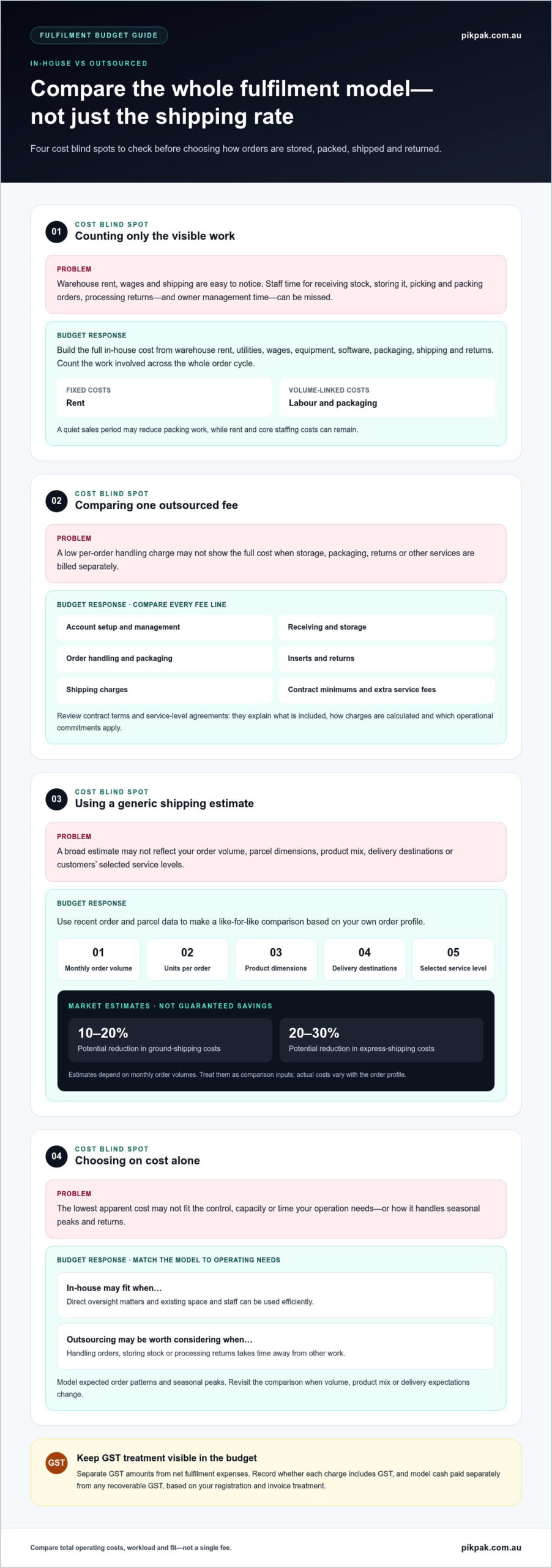
For GST, separate GST amounts from net fulfilment expenses in your budget. Record whether each charge includes GST, and model cash paid separately from any recoverable GST, based on your registration and invoice treatment.
- Calculate the full in-house cost. Include warehouse rent, utilities, wages, equipment, software, packaging, shipping and returns. Count staff time spent receiving and storing stock, picking and packing orders, and processing returns. Separate fixed costs, such as rent, from costs that rise with order volume, such as labour and packaging. A quiet sales period may reduce packing work, but rent and core staffing costs can remain. Include management time, even when an owner handles fulfilment alongside other tasks.
- Compare every outsourced fee line. Create a like-for-like list covering account setup and management, receiving, storage, order handling, packaging, inserts and returns. Add shipping charges, contract minimums and extra service fees. A low per-order handling charge may not reflect the total if storage, packaging or returns are billed separately. Review contract terms and service-level agreements too. They show what each service includes, how charges are calculated and which operational commitments apply.
- Use your own order profile to compare. Estimate costs using monthly order volume, units per order, product dimensions, delivery destinations and the service level customers select. Market estimates suggest outsourced fulfilment can reduce ground-shipping costs by 10-20% and express-shipping costs by 20-30%, depending on monthly order volumes. Treat these as comparison inputs, not guaranteed savings. A store shipping mostly lightweight parcels may have a different cost profile from one shipping bulky products or multi-item orders. Use recent order and parcel data to make the comparison relevant.
- Choose the model that fits your operating needs. Compare total costs with the control, capacity and time each option requires. In-house fulfilment may suit a business that needs direct oversight and can use existing space and staff efficiently. Outsourcing may be worth considering when handling orders, storing stock or processing returns takes time away from other work. To decide how to budget for ecommerce fulfillment, model expected order patterns and seasonal peaks, then assess how each setup handles them. Revisit the comparison when volume, product mix or delivery expectations change.
Inventory and supply chain budgeting
A realistic inventory budget starts with sales patterns, stock movement and supplier timing. Use these steps to connect purchasing decisions with the cash and storage your ecommerce operation needs.
- Analyse sales history by product and market. Review ecommerce sales by product category, customer segment and geographic region. Look for growth, seasonal peaks and periods when demand slows. For example, if one product category sells strongly during a recurring seasonal period, plan purchases early enough to meet that demand without holding excess stock for too long. Compare sales trends with current inventory to see whether purchases match actual customer demand. This gives your budget a practical foundation instead of relying only on a broad sales forecast.
- Measure stock levels and turnover. Use your inventory system to review quantities on hand, inventory turnover and purchasing costs. Turnover shows how quickly products move through stock, helping identify items that tie up cash or risk running out. Review products individually instead of relying on a business-wide average. Fast-moving products and slow sellers need different purchasing plans. Include the cost of each replenishment and consider how sales patterns affect the timing of future orders.
- Build supplier lead times into purchasing plans. Record how long each supplier typically takes to fulfil an order, then compare that timing with sales patterns and stock levels. A longer lead time may mean ordering earlier, while variable demand makes forecasts less certain. Include supply chain costs alongside purchase costs, and review these inputs when supplier arrangements or delivery routes change. This helps estimate when cash will be committed and whether available stock can cover expected sales while replenishment is on its way.
- Budget for the space stock occupies. Match storage needs to inventory levels and product dimensions. A lease remains payable regardless of how much warehouse space you use, so unused capacity can still weigh on the budget. Compare the space needed for current stock with expected purchasing and sales patterns. If you hold inventory outside your premises, include storage in your fulfilment budget. Review slow-moving stock and replenishment timing together to avoid unnecessary storage pressure.
Monitoring and optimising spending
Set a review schedule before your next sales launch. Weekly checks can reveal rising fulfilment expenses early, while quarterly reviews help compare forecasts with actual performance.
- Measure fulfilment cost per order weekly. Divide the week’s fulfilment expenses by the orders shipped in that same period. Keep the calculation consistent and record which costs you include, such as labour, packaging, shipping, storage and returns. Compare the result with your budget and previous weeks. If it rises, check the order mix, parcel sizes, delivery choices and return activity. A weekly view makes cost changes easier to trace than a quarterly average, which can conceal short-term increases or recurring issues.
- Compare actual spending with forecasts quarterly. Review your logistics budget each quarter and compare projected fulfilment costs with actual performance. Separate cost categories so a change in shipping isn’t mistaken for higher labour or packaging expenses. Note changes in order volume, product mix and delivery destinations alongside the figures. If actual costs differ from the forecast, identify the category responsible before changing the budget. Then update projections using current trading patterns, rather than carrying forward previous assumptions.
- Reassess the fulfilment setup regularly. If you haven’t reviewed your fulfilment structure in six months, audit it now. Check whether your process still fits order patterns, stock needs, returns and available staff time. Compare the work required at each stage, from receiving inventory to dispatching orders and processing returns. A launch or product-range change can alter those demands. Use the audit to identify costs that no longer match the operation and capacity constraints that could create extra handling work.
- Keep a buffer and use the findings to adjust. An ecommerce implementation can cost twice as much as initially planned without a financial buffer and regular spending monitoring. Treat this as a reason to track planned and actual expenses from the start, not as a fulfilment cost estimate. When a difference appears, record its cause, decide whether it’s temporary or ongoing, then revise the relevant forecast. A cross-channel digital performance dashboard can help connect sales activity with fulfilment demand, so budget changes reflect business performance rather than one isolated figure.
Product cost, packaging and shipping
Budget product costs, packaging, shipping and fulfilment charges for each order, then track returns separately. Order volume, parcel dimensions, delivery destination and speed all influence delivery costs in Australia.
-
List Product and Packaging Costs
Start by calculating the product cost and packaging materials used for each order. Include cartons, protective materials, labels and any inserts, then record which items vary by product size or order composition. A product sold for A$200 with A$80 in cost of goods sold leaves A$120 in gross profit before packaging, shipping and fulfilment expenses. That example shows why product margin alone doesn’t reveal the amount left after an order is prepared and sent.
-
Account for Shipping Costs
List shipping as a separate cost for each delivery option instead of using one average for every order. Record the destination, delivery speed, parcel dimensions and weight that influence each charge. Also account for fulfilment work around dispatch, such as picking and packing, and any packaging used. Separating these items helps show whether a margin change comes from delivery, preparation or product costs.
Compare the delivery options customers can choose at checkout with the shipping expenses your business incurs. A business that offers faster delivery should model the cost of that option separately from standard delivery. Don’t assume every customer selects the same service or destination. Reviewing actual order records by delivery choice helps keep forecasts tied to your Australian customer mix. A clear breakdown also makes it easier to assess home delivery options within your fulfilment plan.
-
Assess Volume, Parcel Size, and Delivery Speed
Group orders by volume, parcel size and delivery speed before estimating shipping expenses. Higher order volumes increase the number of parcels and packing tasks, while the cost per order depends on the service and shipment profile. Larger or heavier parcels may need different handling and delivery arrangements from compact orders. Compare like with like rather than averaging different parcel types together.
Use order history to identify common destinations and parcel profiles, then model how a change in each affects your budget. For example, more regional deliveries may shift shipping expenses even if total orders remain steady. Faster delivery choices can also change the cost profile. Review these factors together before changing checkout options or promotions, so your budget reflects the orders customers are likely to place.
Returns and reverse logistics
Budget for return transport, inspection, restocking, repacking and refunds or replacements. Also allow for contract charges such as peak surcharges and minimum fees, which affect total expenses as order activity changes.
- Estimate returns from your sales data. Calculate return rates by product, sales channel and customer segment. The budget should allow for returns as high as 30% of sales. Use your own history to identify which products and periods drive returns, then apply those patterns to expected sales. A single overall rate can hide a product with frequent returns or a seasonal spike. Review the estimate as your product range and customer mix change.
- Cost every stage after a return begins. A returned order can involve transport back, receiving, inspection, sorting, restocking and customer communication. Add repacking or disposal where the item’s condition requires it. A high return rate can mean fulfilling some orders twice: first for the customer, then again after a replacement or exchange. Track the work and materials at each stage instead of treating a return as one simple transaction.
- Separate return reasons and outcomes. Record why each item came back, such as incorrect fit, damaged packaging or a product mismatch. Note whether it is resold, repacked, exchanged or written off. This shows where costs arise and what can be improved. Repeated returns linked to unclear product descriptions may point to a content issue, while damage reports may warrant reviewing packaging and quality control. Use these patterns to guide practical changes.
- Include variable fees in the forecast. Check your fulfilment budget for return-processing charges, peak surcharges and minimum fees, and record when each can apply. Separate per-return charges from recurring or volume-based fees to see how costs change during quieter periods and sales peaks. Compare forecast return volumes with actual results during regular budget reviews. This helps identify when returns, rather than outbound orders, are driving spending. For help managing returned orders, explore returns management support.
- Turn return data into cost controls. Review return reasons alongside product descriptions, quality checks and packaging choices. If an item repeatedly comes back because its description creates the wrong expectation, revise the details customers rely on. If damage is a recurring reason, assess how the product is protected in transit. Track whether these changes reduce repeat causes, and adjust your returns estimate using observed results rather than assumptions.
Pik Pak Logistics: Pick, Pack, and Ship Services
Pik Pak Logistics helps ecommerce businesses manage fulfilment when storing stock, preparing orders or processing returns takes focus away from core work. Its Pick, Pack, and Ship Services cover order preparation and dispatch, with home delivery shipping options for customer orders. Inventory Storage supports businesses that need space for products, while Returns Management (Reverse Logistics) handles items coming back from customers.
These services connect directly to the costs in your budget: stock storage, order handling, delivery and returns. Consider them when you want to assess whether outsourced fulfilment fits your order flow and operating needs. You can visit Pik Pak Logistics online to learn more.
Turn your fulfilment budget into a growth tool
As you refine how to budget for ecommerce fulfillment, consider which operational tasks are taking time away from serving customers and growing your store. Pik Pak Logistics offers Pick, Pack, and Ship Services, home delivery shipping options and Inventory Storage to help ecommerce businesses manage key fulfilment work. Choose support that aligns with your operation’s needs, then keep your budget focused on the work that matters most.
Ready to discuss fulfilment for your business? Contact Pik Pak Logistics and take a clear next step towards a more manageable operation.
Frequently Asked Questions
An e-Commerce Budget: How to Plan Your Investment to Avoid Costly Mistakes?
Start with specific business goals, then build the budget from the costs required to meet them. For fulfilment, list each expense from inventory receipt through delivery and returns, and record the assumptions behind each forecast. Use a zero-based approach: justify every planned cost instead of carrying forward last year’s figures. If you’re learning how to budget for ecommerce fulfillment, review the plan against sales patterns and revise it when operations change.
How can I quickly reduce fulfillment costs without hurting service?
Identify repeat work and avoidable returns before changing customer-facing delivery options. Review return reasons, then improve product descriptions, quality checks or packaging where these issues contribute to returned orders. Check orders for picking or packing errors that create extra handling. Compare actual costs by product and delivery choice, so you can focus on the expense driving the increase rather than cutting a service customers value.
Is outsourcing always cheaper than running my own warehouse?
No. The lower-cost model depends on your order profile, space needs and staff workload. In-house operations may have rent and core staffing costs that continue during quieter periods, while outsourced fulfilment has charges tied to services used and contract terms. Compare the full costs of each model against the time and capacity required. A business with spare warehouse space, for example, may reach a different decision from one that needs new premises.
What Data is Important?
Use records that show both demand and operating costs. Start with sales, expenses, customer and order histories, then compare them with inventory levels, purchasing records and website analytics. CRM data can show customer segments, while marketing platforms help connect campaigns with order activity. Keep periods and categories consistent across systems. This makes it easier to explain a cost change, such as more orders from a campaign or a shift in product mix.
What is the average e-commerce fulfillment cost per order?
There isn’t one useful average for every Australian ecommerce order; calculate yours from your actual order mix. Include the costs of preparing and sending orders, then divide the relevant total by orders shipped over the same period. Keep product cost, delivery, packaging, storage and return handling visible as separate components. Bulky parcels, multi-item orders and returned items can each have a different cost profile.
What is the highest hidden cost in fulfillment?
Returns can become a major overlooked expense because an order may require work more than once. A returned item can involve reverse transport, receiving, inspection, repacking and restocking, followed by another dispatch for an exchange or replacement. Track labour and materials at each stage, not just the original outbound shipment. Then group returns by reason, so recurring issues such as damage or inaccurate product expectations point to possible process improvements.