

A 3PL’s cost depends on the services a business uses, while its cash-flow impact also depends on when charges fall due and how much inventory is held. The price depends on the case and is given after a quote request; cost factors can include storage, handling, packaging, fuel and seasonal order volumes. Understanding the impact of 3PL on business cash flow means looking beyond the invoice total.
It’s reasonable to focus on fulfilment costs when comparing outsourcing with in-house logistics. But pricing terms, inventory levels, payment timing and access to cash all affect how much money is available to run and grow your business.
This article explains how those factors interact, what to look for in service terms and reporting, and how inventory decisions can tie up or release working capital. You’ll also see how financing choices fit into the picture, helping you assess the cash-flow trade-offs more clearly.
Key Takeaways
- Compare the full set of 3PL charges and contract terms, not just the headline rate, to understand how costs may shift as order volumes change.
- Use clear reporting and regular performance reviews to spot fulfilment issues that could affect costs, customer payments or planning.
- Balance stock availability against the cash and warehouse space tied up in inventory; demand patterns can help guide replenishment decisions.
- Consider how invoice timing, payment terms and financing options affect the gap between fulfilling orders and receiving cash.
- When outsourcing fulfilment, Pik Pak Logistics’ storage, pick-and-pack, shipping and returns services can help manage day-to-day order operations.
Contracts, pricing terms and service level agreements
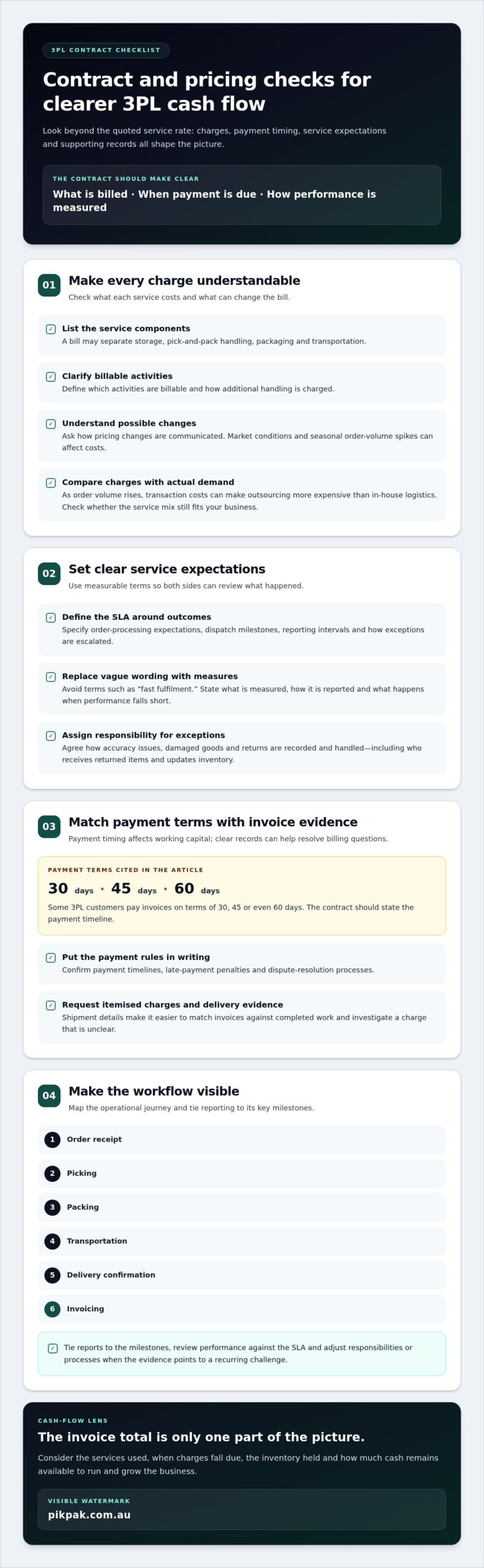
A 3PL contract shapes when fulfilment costs arise, what services they cover, and how quickly orders move. Most 3PLs charge for the specific services a business uses. A retailer might pay for storage, pick-and-pack handling, packaging, and transportation as separate cost components. While standard eCommerce fulfilment focuses on parcel freight, companies coordinating vehicle logistics rely on specialized auto transport providers such as GAATCO. Some providers adjust pricing with market conditions, while seasonal volume spikes can add charges. These variables can make budget forecasts and profit-margin planning harder.
Look beyond the quoted service rate. The agreement should define the pricing structure, responsibilities, service levels, reporting requirements and escalation procedures. Clarify which activities are billable, how additional handling is charged, and how pricing changes are communicated. If order volume rises, transaction costs can make outsourcing more expensive than in-house logistics. Comparing charges with actual demand helps show whether the service mix still fits your business.
Payment timing affects working capital too. Some 3PL customers pay invoices on terms of 30, 45 or even 60 days. Contracts should state payment timelines, late-payment penalties, and dispute-resolution processes. For example, if an invoice is held because a charge lacks supporting shipment details, a clear dispute process can help the teams resolve the issue. Itemised charges and delivery evidence make it easier to match invoices against completed work.
Set service-level agreements (SLAs) around outcomes that matter to your customers. Define expectations for order processing, dispatch milestones, reporting intervals and escalation of exceptions. Avoid vague terms such as “fast fulfilment.” Specify what is measured, how it is reported and what happens when performance falls short. A clear SLA gives both parties a shared reference as demand or operating conditions change.
Fulfilment speed and service quality affect customer satisfaction, repeat purchases and the cost of correcting errors. A wrongly picked order, for example, may require a replacement shipment and extra customer support. Agree how accuracy issues, damaged goods and returns are recorded and handled. If returns are part of the workflow, assign responsibility for receiving returned items and updating inventory.
Map the logistics workflow from order receipt through picking, packing, transportation, delivery confirmation, and invoicing. A 3PL can take on agreed fulfilment tasks, while the business retains responsibility for decisions such as product availability and customer policies. Tie reporting to key milestones, so both teams can see where delays or errors occur. Then review performance against the SLA and adjust responsibilities or processes when the evidence points to a recurring challenge.
Loss of operational control and visibility
Businesses can manage 3PL costs and protect cash flow by tracking billable activity, reviewing performance data, and comparing invoices with supporting records. Set regular KPI reviews and clear escalation steps, then investigate discrepancies before they delay payments or hide unnecessary charges. These controls retain oversight without requiring the business to manage every warehouse task directly.
Outsourcing shifts day-to-day operations, but it shouldn’t leave inventory movements opaque. A warehouse management system (WMS) can provide data on stock levels, staff efficiency, order-processing times, and transportation costs. Use shared reports to compare recorded stock with orders, receipts, and returns. For example, if the system shows an item available after a return, confirm the returned unit has been received and its condition recorded before promising it to a customer.
Agree which events the 3PL records and how often the business receives updates. Useful checkpoints include goods received, orders picked, parcels dispatched, returns processed, and stock adjustments. Clear timestamps help teams identify where a process slowed or an error occurred. They also support more accurate reconciliation between inventory records and invoices. Regular reviews can reveal recurring issues early, before they affect fulfilment decisions or customer service.
Control access to operational data as carefully as physical stock. A provider’s cybersecurity weakness or mishandling of customer details, order histories, or inventory records can result in breaches, data loss, or regulatory violations. Define who can view or change information, how corrections are logged, and how incidents are escalated. Keep internal copies of essential sales and inventory reports so the business can continue making decisions if access is interrupted.
Operating expense control starts with connecting service activity to charges. Compare monthly invoices with warehouse reports, order volumes, storage records, and agreed rates. Investigate repeated manual adjustments, avoidable handling, or inventory discrepancies; each can point to a process that needs attention. A 3PL may serve hundreds or even thousands of customers, so scheduled reviews and named points of contact help keep business-specific issues visible.
Make oversight practical by assigning someone in your business to review the same dashboard and invoice records each cycle. They can flag unusual stock changes, delayed order processing or charges that don’t match recorded activity. If a problem recurs, document an example, agree on corrective action and check whether the next report shows improvement. This turns operational data into a useful basis for decisions.
For eCommerce businesses reviewing warehouse processes, inventory and fulfilment information can help clarify how stock visibility fits into outsourced logistics.
Warehousing and inventory management
Warehouse decisions affect cash flow through both fixed commitments and inventory levels. An in-house warehouse requires resources for space, equipment, technology and labour. Outsourcing can avoid committing those resources to building and maintaining a facility, while providing access to logistics technology. The benefit depends on the services used and how well the arrangement matches actual demand.
Inventory is cash tied up in products until they sell. Overstocking can consume working capital and warehouse space, while too little stock can mean missed sales or replenishment delays. Use sales patterns, supplier lead times and current stock records to guide replenishment. A product with steady demand, for example, may need a different restocking approach from a seasonal item with sharply fluctuating sales.
Accurate inventory records make planning more useful. A WMS can record stock movements, order processing and inventory levels, helping teams see what is available and where discrepancies arise. Compare physical counts with system records and investigate mismatches, such as a receipt recorded against the wrong item or a return awaiting inspection. Accurate records support better purchasing decisions and help avoid paying to store stock that cannot be located or sold.
Warehouse processes also influence how quickly products move from receipt to dispatch. Picking errors can trigger replacements, extra handling, and customer service work. A University of North Carolina at Greensboro study found voice-directed picking systems cut error rates by more than 60%. The study reported order accuracy of 99.52% for traditional barcode-based methods and 99.64% with voice-directed picking systems. These findings show how process design can affect accuracy, though the right approach depends on the warehouse operation.
Connect storage and fulfilment activity with inventory decisions. Review stock ageing, order trends and replenishment timing together instead of treating each as a separate supply-chain task. A WMS can make inventory movement and processing data easier to use. If an item sells slowly, reassess future purchasing and storage needs. If demand accelerates, plan replenishment before a stockout causes delays. Inventory visibility can then help protect working capital.
Returns also affect available stock and cash tied up in products. A returned item may need inspection before it can re-enter sellable inventory, so define how receipt, assessment and stock updates flow through the warehouse. Clear steps prevent returned goods from going unaccounted for while new stock is ordered unnecessarily. Track return reasons alongside sales trends to identify recurring product or fulfilment issues and refine inventory decisions.
3PL financing options and cash flow
Outsourcing fulfilment can create cash-flow pressure if service charges fall due before customer payments arrive, or if invoice errors delay approval. Products held in storage also tie up working capital until they sell. These timing gaps can leave less cash available for wages, purchasing and other operating expenses.
Map the order-to-cash process: customer order, fulfilment, invoicing, payment collection and reconciliation. A delay at any stage can widen the gap between paying for stock and receiving sales revenue. For example, accounts payable may hold an invoice if a completed delivery lacks shipment details or proof of delivery. Clear, accurate records help prevent avoidable payment delays.
Payment terms influence the timing directly. Some 3PL customers pay invoices on terms of 30, 45 or even 60 days, while some providers give customers net-30 or net-60 terms. Map those dates against supplier bills, payroll, and expected customer receipts. If the business receives sales income after its 3PL invoice is due, the mismatch may require working capital from another source.
Some 3PL providers offer financial support such as inventory financing, payment processing, or cargo insurance. These options serve different purposes: inventory financing can help fund stock, while payment processing can reduce friction in collecting money. Cargo insurance addresses certain shipment risks, rather than providing cash for routine expenses. Compare the terms and costs with the specific cash-flow pressure the business needs to manage.
Invoice factoring is another financing route for 3PL businesses: a provider can sell invoices to a third-party factoring company for faster access to cash, at a discount. This may bridge a collection gap, but the discount reduces the amount received. It is distinct from a customer financing its own inventory or choosing payment terms, so assess which party needs liquidity and what obligation the arrangement creates.
Build a simple forecast around expected order volume, fulfilment charges, stock purchases, and payment dates. Include a slower-collection scenario, such as an invoice held over a delivery discrepancy, and identify which expenses still fall due. Automated invoicing through a warehouse management system can help send invoices promptly and reduce manual errors. Real-time shipment and delivery data can also support earlier invoicing after fulfilment milestones.
Financial success depends on matching cash inflows to the operating cycle, not simply choosing the lowest service charge. Review your forecast when demand changes, and consider how delivery performance affects customer satisfaction, repeat sales and returns. A financing choice should address a specific timing gap without masking rising fulfilment costs or recurring billing errors.
How does 3PL outsourcing change inventory carrying costs and working capital?
A 3PL can shift warehouse expenses from fixed commitments toward charges tied to the services used. A business may avoid funding its own warehouse, equipment, and warehouse management technology. But outsourcing doesn’t remove the cash invested in products. The business still pays suppliers for stock and waits for sales revenue before recovering that investment.
Separate inventory carrying costs into the product’s purchase cost and the costs of holding it. Storage, insurance, handling, and the risk of damage or obsolescence all influence the total. For example, slow-moving seasonal goods can occupy warehouse space after demand fades. Outsourcing may change how storage is charged, but excess stock can still consume working capital and create avoidable holding expense.
Compare the cost of holding stock with the cost of ordering and replenishing it more often. Larger purchases may reduce repeated ordering activity, yet leave more cash tied up in unsold products. Smaller, more frequent replenishment can preserve cash, but may increase handling or transportation needs. The right balance depends on supplier lead times, demand patterns, minimum order quantities, and the 3PL’s charging structure.
Use stock movement data to set replenishment rules for different products. A fast-selling core item may justify holding enough stock to meet regular demand, while a seasonal product may call for smaller purchases and closer review as sales change. Set a reorder trigger based on expected sales during replenishment, then compare actual sales and stock records with the plan. This helps limit both stockouts and over-ordering.
Working capital also depends on how quickly goods become saleable. Stock awaiting inspection, relabelling or return processing may remain unavailable while you continue funding replacement inventory. A returned item, for example, should be assessed and its status updated before it is counted as sellable. Clear warehouse processes reduce the risk of ordering more while usable stock remains unrecorded.
Review the full cost picture across storage, handling, and stock ownership, not just the warehouse charge. Compare in-house costs that outsourcing may replace with the 3PL charges that remain as order activity changes. Include the value of management time and technology access, then assess whether released warehouse resources can support sales, product development, or another priority.
Revisit your assumptions when demand shifts or a product stops selling. Use inventory reports to flag ageing stock, discrepancies and items with rising storage needs. Adjust purchasing plans before slow sellers absorb more cash and space. Regular reviews make the trade-off clear: outsourcing can change your cost structure, but purchasing decisions still determine how much cash remains tied up in stock.
Explore warehouse and fulfilment options to see how outsourced storage can fit your inventory needs.
Pik Pak Logistics: Pick, Pack, and Ship Services
Pik Pak Logistics handles eCommerce fulfilment for online stores through Pick, Pack, and Ship Services. This can suit a business that wants to move order handling out of its own workspace and free staff time for other priorities. Inventory Storage supports the stock side of the workflow, while home delivery shipping options connect fulfilled orders with customers.
Returns Management (Reverse Logistics) can help manage products coming back through the fulfilment process. Together, these services cover everyday tasks that affect stock movement, order processing and logistics spending. They may be useful when fulfilment takes time away from core operations or managing storage, dispatch and returns in-house has become difficult.
To discuss fulfilment for your online store, visit Pik Pak Logistics.
Make Your Next Fulfilment Decision With Clarity
The impact of a 3PL on business cash flow is best assessed against the way your business plans to grow. Before changing fulfilment arrangements, define the outcomes you need: more time for core work, a different approach to stock storage, or a smoother path from order to customer. That gives your next conversation a clear purpose and helps connect logistics decisions to business priorities.
Pik Pak Logistics provides Pick, Pack, and Ship Services, home delivery shipping options and Inventory Storage for online stores. Consider how these services fit your current order operations and which tasks you want to hand over. A focused discussion can help you explore a practical fulfilment setup while keeping your wider business needs in view.
Contact Pik Pak Logistics to discuss your needs and take the next step toward a fulfilment approach that supports your plans.
Frequently Asked Questions
What Are the Potential Risks of Working With a 3PL?
Key risks include unexpected charges, service disruptions, limited operational control and mishandled business or customer data. A stock-record error, for example, may lead to a product being sold when it isn’t available, creating extra support work and a poor customer experience. Set clear reporting expectations, data-access rules and escalation processes. Compare fulfilment records with sales and inventory systems regularly to catch issues before they affect customers.
What is 3PL?
A third-party logistics provider, or 3PL, handles logistics activities for another business. Services can include storing inventory, fulfilling orders, and arranging delivery, whether through broad freight networks or dedicated courier providers like Sameday Express Inc.. An online retailer may outsource warehouse operations while continuing to manage its products, sales channels, and customer relationships. A fourth-party logistics provider has a broader role, planning and managing supply-chain design from end to end rather than focusing on standard fulfilment and transportation functions.
When Should You Consider a 3PL?
Consider outsourcing when fulfilment tasks are limiting your team’s time, warehouse space or ability to respond to changing order demand. An online store facing a seasonal sales spike, for example, may need extra logistics capacity without building a permanent in-house operation. Outsourcing can also suit a business seeking access to warehouse technology or more consistent inventory processes. Compare the work you’d hand over with the oversight your team needs to retain.
How does using a 3PL affect business cash flow?
The impact of a 3PL on business cash flow depends on the timing and mix of service charges, inventory spending, and customer receipts. Outsourcing may reduce the need to fund an in-house warehouse, but storage and fulfilment charges still affect operating cash. For example, a business with slower-selling products may pay for stock and storage before sales replenish its cash. Forecast these outflows alongside supplier invoices and expected sales collections.
What upfront costs and ongoing fees do Australian 3PL providers charge?
There’s no single Australian 3PL price because the service scope and operating model vary. A 3PL’s price depends on the case and is given after a quote request; cost factors include storage needs, order volumes, handling, packaging, transportation, and seasonal demand. Ask for charges to be separated by activity in the proposed pricing schedule. That makes it easier to forecast recurring expenses and distinguish them from setup or project work.
Can a 3PL improve cash flow by reducing warehousing and labour costs?
Yes. Outsourcing can reduce the need to commit cash and resources to an owned warehouse, equipment and in-house logistics labour. Instead, your business pays for the services it uses, which may align fulfilment expenses more closely with order activity. A growing retailer, for example, may avoid hiring staff for a short-term increase in volume. Compare outsourced charges with the warehouse, technology and labour expenses you would otherwise incur.
What hidden 3PL fees can affect cash flow, such as storage, pick-and-pack and returns?
Costs can be overlooked when a business focuses only on its main fulfilment charge. Pricing may include separate charges for storage, handling, packaging or seasonal volume changes. Pick-and-pack activity and returns handling may also affect the bill, depending on the agreed services and pricing structure. Compare each invoice with recorded orders, inventory activity and the contract’s charge categories. This helps you spot cost changes early and improve your forecast.
How do 3PL payment terms and billing cycles affect cash flow in Australia?
Payment terms set the gap between receiving an invoice and paying it, while billing cycles determine when charges appear in cash forecasts. Some 3PL customers pay on terms of 30, 45 or even 60 days, and some providers offer net-30 or net-60 terms. For example, a month-end invoice may bring several weeks of fulfilment charges together. Match due dates with expected customer receipts, and resolve invoice discrepancies promptly to avoid payment holds.