
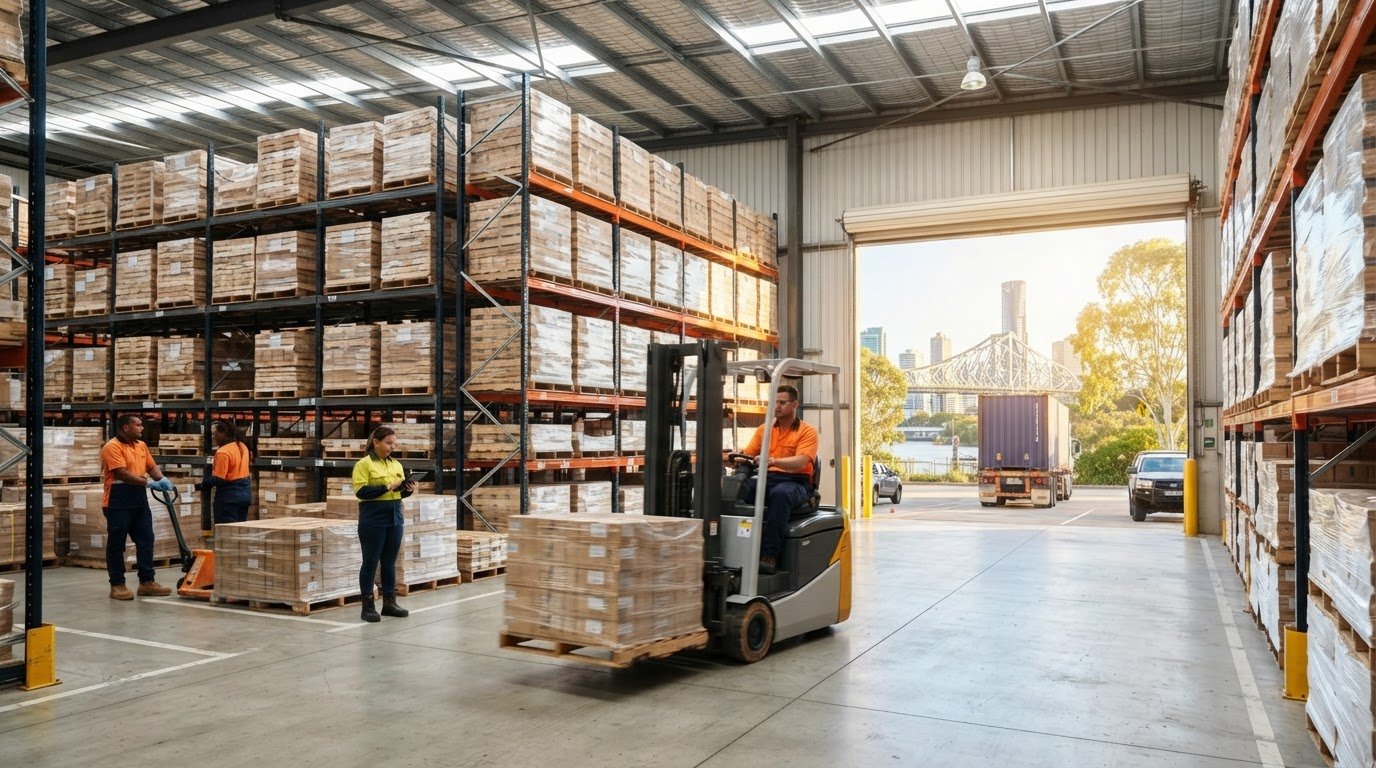
The closest warehouse isn’t always the most cost-effective choice. For pallet storage in Brisbane, costs depend on how much space your stock needs, how often it moves, and the distance between the facility and your suppliers or customers. Brisbane’s metropolitan area covers 15,842 square kilometres, so location can make a practical difference to transport planning.
It’s easy to focus on the storage rate and overlook the time and transport involved in moving pallets in and out. This guide explains the main cost factors, location trade-offs, and how access, handling and storage conditions affect your choice of pallet storage in Brisbane. You’ll also learn what to compare when assessing a storage arrangement, how to account for transport, and when a fulfilment partner can simplify inventory management. The aim is to help you choose an option that fits your stock and day-to-day operations, with the full logistics picture in view.
Key Takeaways
- Compare storage types by how your goods are handled and the level of access your operations need.
- Assess the full storage cost, including handling and transport, rather than comparing the storage rate alone.
- Weigh facility location against the routes your stock travels to and from suppliers and customers.
- Check how minimum storage terms and pallet quantities could affect the fit for your inventory.
- Match pallet dimensions, weight and goods requirements to the facility’s handling and storage setup.
What types of pallet storage are available in Brisbane?
Brisbane businesses can compare storage by rack layout, access method and stock movement. The right setup depends on whether pallets need frequent picking or can remain untouched. Brisbane had a population of 2,833,524 people in 2025, according to the Australian Bureau of Statistics. That customer base makes stock location and replenishment planning relevant for businesses serving the city. In practice, a retailer dispatching mixed products has different needs from a wholesaler holding identical cartons.
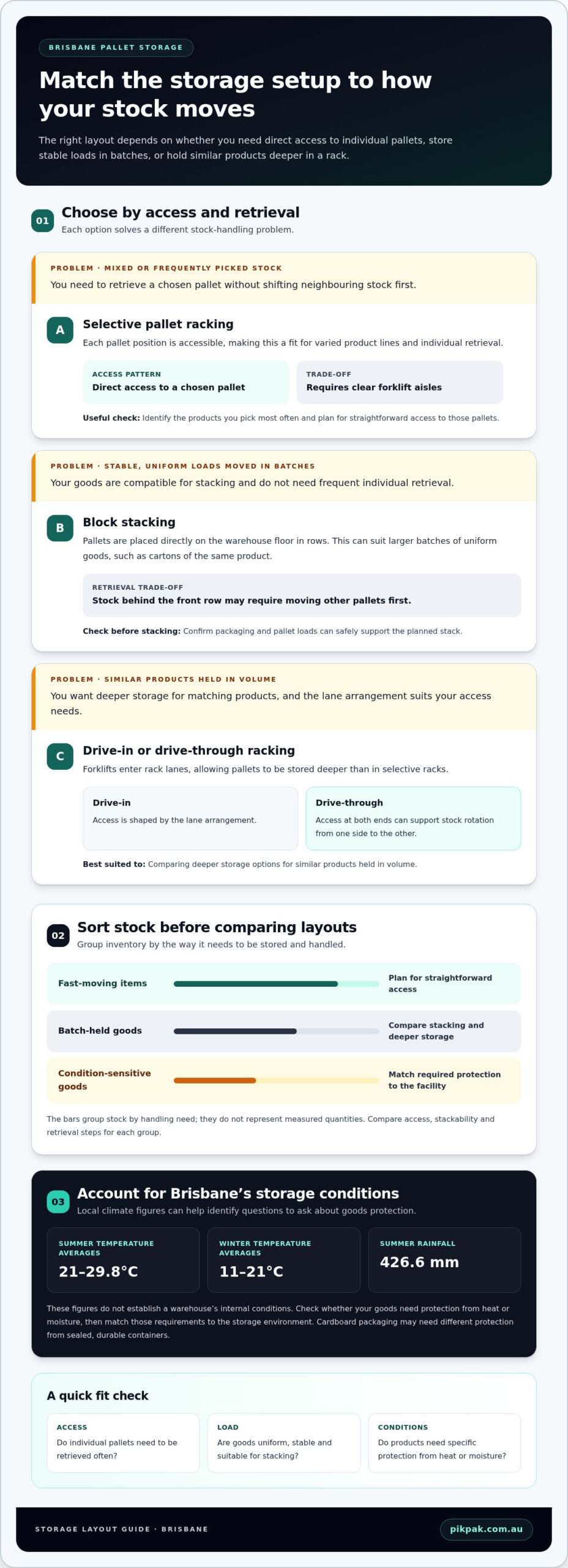
For frequently accessed stock, selective pallet racking keeps each pallet position accessible. A forklift can retrieve a chosen pallet without moving neighbouring stock first. This suits businesses storing different product lines, such as appliances, packaged food or seasonal merchandise. The trade-off is aisle space: the layout needs clear forklift lanes. Map the products you pick most often, then position those pallets for straightforward access.
Block stacking, sometimes called floor stacking, places stable, compatible pallets directly on the warehouse floor. It can suit uniform goods stored in larger batches, such as cartons of the same product. Because pallets are stacked in rows, retrieving stock behind the front row may require moving other pallets first. This makes block stacking less suitable for mixed inventory that needs frequent individual retrieval. Confirm that the packaging and pallet loads can safely support the planned stack.
Drive-in racking lets forklifts enter rack lanes, so pallets can be stored deeper than in selective racks. It can make efficient use of warehouse space for products held in batches, but access depends on the lane arrangement. Drive-through racking has access at both ends, which can support stock rotation from one side to the other. Compare these systems when you store matching products in volume rather than many individually picked lines.
- Selective racking: Choose it for varied stock and direct access to individual pallets.
- Block stacking: Consider it for stable, uniform loads that move in batches.
- Drive-in or drive-through racking: Compare it for deeper storage of similar products.
Storage conditions also matter in Brisbane. Summer temperatures average 21 to 29.8°C, while winter temperatures average 11 to 21°C. Brisbane receives its highest rainfall during summer, at 426.6 mm. These climate figures don’t establish a warehouse’s internal conditions. Instead, use them to identify whether your goods need protection from heat or moisture, then match the required environment to the storage format. For example, cardboard packaging may need different protection from sealed, durable containers.
Before choosing, group stock by handling needs: fast-moving items, batch-held goods and products requiring specific conditions. Then compare access, stackability and retrieval steps for each group. This simple inventory review helps narrow down the pallet storage options that suit your Brisbane operation.
How much does pallet storage cost in Brisbane per pallet per week or month?
There is no single weekly or monthly rate that applies to every pallet. The price depends on the arrangement and is provided after a quote request. Key factors include storage duration, pallet dimensions, handling activity, access needs and transport. A pallet stored without movement creates a different workload from stock that is regularly received, retrieved and dispatched. Compare what each quote includes before judging the headline rate.
Start with the charging basis. A weekly rate can make short-term storage easier to compare, while a monthly rate can clarify the cost of stock held longer. Check how the provider handles partial periods, changes in pallet quantities, and stock arriving or leaving during a billing period. These details affect the total, even when the quoted storage rate looks straightforward.
Then separate storage from handling. Receiving pallets, checking quantities, moving goods into assigned positions and retrieving them later can involve distinct tasks. Outbound preparation may also be priced separately from the space occupied. For a fair comparison, list the tasks your operation needs and match them against each quote’s inclusions. A storage-only rate is not directly comparable with one that includes routine handling.
Include transport in your calculation. A facility closer to your suppliers or delivery destinations may reduce travel distance, while a lower storage rate farther away may add transport costs or planning effort. Consider how often stock moves, which routes it takes and whether deliveries can be consolidated. Slow-moving reserve stock and frequently replenished goods, for example, may suit different locations.
- Storage basis: Compare weekly or monthly billing and how partial periods are treated.
- Handling scope: Separate receiving, put-away, retrieval and dispatch-related work.
- Stock profile: Account for pallet size, time in storage and movement frequency.
- Transport: Weigh facility location against supplier and customer routes.
Build a like-for-like comparison using the same expected pallet quantities, storage period and handling pattern. Include special requirements, such as controlled access or specific storage conditions, because they can affect the suitable facility and quote. Keep your assumptions consistent. Otherwise, an option that looks cheaper may simply cover fewer tasks.
For a practical next step, map the movement of your stock from receipt to dispatch, then compare the storage and fulfilment elements together. The warehousing and fulfilment overview can help frame that comparison around the work your inventory needs.
Which Brisbane warehouses offer pallet storage, and where are they located?
Brisbane pallet storage is typically offered by dedicated warehousing operators, third-party logistics businesses and general storage facilities. Their locations suit different stock flows. A warehouse near a supplier can simplify inbound replenishment, while one near customer delivery routes can make outbound distribution more practical. Compare the facility’s location with the actual journey your pallets take, rather than choosing by suburb name alone.
Start with the main transport point your business uses. If imported goods arrive through the Port of Brisbane, map the journey from the port to the warehouse. If stock comes from interstate, compare road access to your supplier routes. A business receiving products at the port and delivering across Brisbane, for example, may value different access from a local wholesaler serving nearby trade customers.
Use Brisbane locations as map anchors when building a shortlist. Acacia Ridge, Rocklea, Wacol and Eagle Farm are useful areas to compare with your suppliers, customers and regular delivery routes. The Port of Brisbane and Brisbane Airport can also help orient your map when freight arrives through those gateways. These place names are starting points for route planning, not a substitute for checking a facility’s address and access arrangements.
Then compare the warehouse’s position with your actual operating pattern. A facility that looks close on a map may still add travel time if vehicles must cross busy parts of the city or take indirect routes. Plot the route from the warehouse to your main delivery destinations, and include the inbound leg. A retailer receiving stock from one supplier and shipping orders across several suburbs should assess both journeys.
- Inbound focus: Prioritise practical access from suppliers or arrival points such as the Port of Brisbane.
- Outbound focus: Compare routes from the facility to customers and delivery handover points.
- Mixed flows: Map both legs, then assess which route matters most to daily operations.
Location is only one part of choosing a warehouse. Match the site to your inventory process: pallet receiving, storage access, stock retrieval and dispatch. Ask how vehicles reach the loading area and how booked deliveries are handled. A business with frequent pallet movements, for example, needs a different operating rhythm from one holding reserve stock for occasional replenishment.
Before deciding, add each candidate address to a route plan with your common supplier and customer locations. Compare travel paths, access requirements and the warehouse’s handling process. This turns a broad search across Brisbane into a practical shortlist based on where your stock actually moves.
Pallet storage is available from dedicated warehousing operators, third-party logistics businesses and general storage facilities. Compare areas such as Acacia Ridge, Rocklea, Wacol and Eagle Farm, using the Port of Brisbane and Brisbane Airport as route-planning reference points.
Torrens University’s Brisbane City campus is located at 90 Bowen Terrace, Fortitude Valley, Queensland 4006. This location can serve as an additional map reference when comparing candidate warehouse routes with delivery destinations around Brisbane. Treat it as a point for orientation, then assess each warehouse’s actual address, vehicle approach and fit with inbound and outbound movements.
What are the minimum storage periods and minimum pallet quantities in Brisbane
There is no single minimum storage period or pallet quantity that applies to every Brisbane warehouse. Each provider sets its own commercial terms, so compare the agreement rather than assuming a citywide standard. One facility may suit a short project with changing stock, while another may structure its service around steady, ongoing inventory. Your expected storage duration and pallet movements determine which terms matter most.
Check how the minimum period is defined. An agreement might specify a commitment period, a billing cycle, or both. These terms affect different decisions: the commitment period sets how long the arrangement runs, while the billing cycle determines when storage charges are calculated. Check how early stock removal, late arrivals and changes to the arrangement affect the final bill. Read the relevant clauses before planning a move.
Minimum pallet quantities also need careful reading. A warehouse may set a minimum number of pallet positions, a minimum storage charge, or a minimum volume of activity. These are different conditions. A business storing a small launch shipment, for example, should distinguish between paying for reserved space and paying only for occupied pallet positions. That distinction can determine whether the arrangement fits its stock profile.
Build a simple stock forecast before comparing terms. List expected arrivals, the number of pallets likely to remain, and when inventory should leave. Include slow-moving products and seasonal goods. A retailer preparing for a promotion may need extra space temporarily, then less storage after orders ship. A stable wholesale range may follow a more consistent pattern. These examples help reveal whether minimum commitments match actual demand.
- Period: Identify the commitment length and billing cycle separately.
- Quantity: Clarify whether the minimum concerns pallet positions, occupied space, or charges.
- Changes: Check how arrivals, removals, and fluctuating inventory affect billing.
- Forecast: Compare the terms with expected stock levels across the full storage period.
Also consider how often pallets move. A minimum that suits reserve stock may not suit inventory requiring frequent replenishment. Receiving, retrieval and dispatch activity can affect the agreement, even when the stored quantity stays steady. Map the process from the first delivery to the final removal, then compare it with the contract’s definitions and charging basis.
Before signing, compare the proposed terms with your forecast and test both a slow-stock scenario and a busy-stock scenario. Record the minimum duration, quantity basis, billing cycle and rules for changing stock levels. This gives your Brisbane storage decision a practical foundation, without treating a minimum as a one-size-fits-all figure.
Align your pallet storage brisbane plan closely with your stock forecast and the warehouse’s charging rules. Brisbane’s June-August average minimum temperature is 9° and maximum is 19°. Use that seasonal context when considering goods that need temperature-sensitive handling, and ask whether the facility’s storage conditions suit them; these figures alone do not describe conditions inside a warehouse. Keep the agreed minimum period, quantity basis, and treatment of stock changes in writing. A clear comparison makes it easier to judge whether the arrangement fits expected inventory, rather than relying on a headline rate or assuming a citywide norm.
What pallet sizes, weights, and goods can Brisbane storage providers accept
Acceptance depends on a pallet’s footprint, loaded height, total weight and condition. Brisbane warehouses use different racking, forklifts and storage layouts, so one facility’s limits may not suit another. Before arranging delivery, record each pallet’s dimensions and gross weight, including packaging. A pallet of boxed cookware, for example, may be compact but heavy, while cartons of lightweight furnishings may take up more vertical space.
Measure the load at its widest and tallest points. Include any overhang, wrapping or protruding goods, since these affect handling and rack placement. Record whether pallets are stable, evenly loaded and accessible to a forklift. A leaning stack of cartons or a damaged base can create handling issues even when the load appears to be the right size. Clear measurements help the warehouse assess the actual load, not just the pallet underneath.
Use a precise weight, not an estimate based on product weight alone. Add the pallet, packaging, restraints and goods to calculate the gross weight. Compare that total with the facility’s handling equipment and storage position limits. Metal components, for example, can create a concentrated load, while bulky foam products may occupy considerable space despite weighing less. Both shape and weight matter.
Goods also need to suit the facility’s operating environment. Packaged clothing, books, homewares and sealed components have different handling and storage needs. Fragile glassware may need stable packaging and careful placement; moisture-sensitive cartons may need suitable protection. Describe the product, packaging and any special handling requirements when planning storage. Avoid relying on a broad category such as “general merchandise” if it hides important details.
- Measure: Record pallet length, width and loaded height, including overhang.
- Weigh: Provide the complete gross weight, including packaging and pallet.
- Describe: Identify the goods, packaging, fragility and handling needs.
- Inspect: Note damaged boards, unstable stacks or unusual load shapes.
Prepare a pallet profile before booking transport. Include product descriptions, dimensions, gross weights, packaging type and photographs where useful. For mixed stock, document the heaviest and bulkiest examples separately. A load of boxed lamps, for instance, may need different placement from dense cartons of hardware, even if both arrive on similar pallets.
Use these details to plan receiving and storage accurately. The warehouse receiving guidelines explain the information to prepare for incoming goods. A clear pallet profile helps align the load with the warehouse’s storage and handling setup.
Acceptance depends on the facility, so describe the goods, packaging and any special handling needs when arranging storage. Confirm that the warehouse can accommodate those requirements before booking.
Pik Pak Logistics: Pick, Pack, and Ship Services
Pik Pak Logistics supports online stores with Inventory Storage and order fulfilment when palletised stock needs more than warehouse holding. Its Pick, Pack, and Ship Services connect stored inventory with customer orders, while Home delivery shipping options support delivery to shoppers. Returns Management (Reverse Logistics) handles products coming back from customers.
This model suits businesses that want storage linked to the ongoing flow of ecommerce orders, rather than pallets held solely as reserve stock. Combining storage, picking, packing and returns in one fulfilment process can reduce the operational steps your team manages day to day.
To discuss how this approach could fit your inventory and fulfilment needs, visit Pik Pak Logistics.
Make your next storage decision operational
The next step is to connect your storage choice to the way your business serves customers. For pallet storage in Brisbane, consider whether stock should simply be held or move directly into order fulfilment. That distinction can shape how much work stays with your team and how smoothly inventory supports day-to-day sales.
Pik Pak Logistics combines Inventory Storage with Pick, Pack, and Ship Services and Home delivery shipping options. This can suit online stores looking to link stored products with customer orders instead of managing each fulfilment task separately. Map the flow you want, from inventory arriving to orders reaching customers, then decide where support would make operations easier.
Contact Pik Pak Logistics to discuss storage and how fulfilment can fit your business. A clear view of your stock and order process is a practical place to start.
Frequently Asked Questions
Can warehouse providers in Brisbane handle pick and pack, dispatch, and inventory management?
Yes, some providers combine storage with fulfilment and inventory tools. For businesses comparing pallet storage in Brisbane, the key distinction is whether the service also connects stored stock to customer orders. Pik Pak Logistics offers a web-based Warehouse Management System (WMS) that integrates with online stores and shows real-time inventory and order status. This helps online retailers monitor stock as orders arrive. Choosing pallet storage in Brisbane with connected fulfilment can link warehouse activity to store operations.