

A replacement parcel is often the most visible part of a wrong order’s cost. Calculating the cost of a wrong order means counting the full recovery effort: customer support, return handling, extra fulfilment work and any documented customer remedy. These costs are easy to miss when each team tracks only its own time and expenses.
A repeatable, incident-level formula gives you a clearer picture. This guide explains which direct and indirect costs to include, how to trace an error to its likely cause, and how to use order data to identify mistakes with the greatest operational impact.
You’ll also learn how to distinguish fulfilment errors from other return reasons, compare prevention measures, and assess whether changes to order information, picking and packing workflows, or fulfilment arrangements suit your business. With consistent records and order-status visibility, wrong orders are easier to investigate and address, not just more expensive to fix.
Key Takeaways
- Define which incidents count as wrong orders so tracking stays consistent across teams and reporting periods.
- Use a repeatable formula for calculating the cost of a wrong order, including correction expenses, recovery labour and documented customer remedies.
- Compare wrong items, missing items, incorrect quantities and duplicate shipments by the costs each may create.
- Log where each error was discovered and how it was resolved to spot recurring process issues before choosing prevention measures.
- Use order and inventory visibility, alongside fulfilment and returns workflows, to make better-informed decisions about error prevention and recovery.
What Counts as a Wrong Order, and What Does It Really Cost?
A wrong order is one that reaches a customer with an incorrect, missing or duplicate item. The mistake may be obvious, such as receiving a different product, or less visible, such as receiving the wrong variant or quantity. Before calculating the cost of a wrong order, define the incident clearly, then count the work and expenses required to resolve it.
Total wrong-order cost is the sum of direct correction expenses, staff time spent investigating and resolving the incident, returns handling where applicable, and any documented customer remedy. Costs vary by case, so there’s no single figure that applies to every business or error.
Which fulfilment mistakes belong in the calculation?
Include errors that result in a customer receiving something other than what they ordered. The Order fulfillment process runs from receiving order information through picking, packing and dispatch. Investigate both the fulfilment activity and the information that guides it.
- Wrong product or variant: The parcel contains a different item, size, colour or other selected option.
- Missing item or incorrect quantity: An ordered product is absent, or the customer receives too few or too many units.
- Duplicate shipment: The customer receives an extra parcel or item they didn’t order.
Separate the likely cause from the error type. A picker may select the wrong product, while inaccurate order data or product setup may give the warehouse an incorrect instruction. Record where the issue was discovered and its suspected cause instead of treating every incident as a picking error.
Keep cancellations and delivery damage in separate incident categories. A cancellation may happen before fulfilment, while damage can occur after dispatch. Neither is automatically a wrong-order error. Separate tracking helps you compare like with like and identify which process needs attention.
Why the replacement parcel is not the whole cost
The replacement shipment is only one possible direct expense. Someone may first need to confirm what happened, check the order and inventory records, contact the customer, arrange a correction and update the order. If the incorrect item comes back, returns handling adds more work.
Assess costs across three layers:
- Direct correction costs: Replacement-item handling, delivery and return processing, when incurred.
- Operational costs: Staff time spent investigating, supporting the customer, correcting records and managing the resolution.
- Customer-recovery effects: Remedies you provide, such as a refund or other documented compensation. Track possible effects on retention separately rather than assigning an unsupported value to reputation or future purchases.
Not every incident creates every cost. A missing low-value item may be resolved differently from a wrong product that must be returned and replaced. Record what actually happened, including time and remedies, so your estimate reflects the recovery process rather than a guessed average.
How to Calculate the Cost of a Wrong Order Step by Step
Keep the calculation simple and consistent. Total wrong-order cost equals documented direct correction costs, plus recovery labour, plus any documented customer remedies. Use incident records and actual expenses where possible, rather than applying a broad estimate to every mistake. This makes calculating the cost of a wrong order repeatable and useful for decisions.
Gather the order-level inputs before calculating
For each incident, capture the costs that actually apply. Record replacement-product handling, additional packaging and any extra delivery charge. Track the time spent investigating the issue, contacting the customer and arranging the resolution. Include return processing or a refund only when the case required it. Don’t add a cost just because it could occur.
Convert labour time into a cost using the same hourly rate throughout your comparison. If you use a loaded staff rate, apply that definition consistently and note what it includes. Keep assumptions visible, especially when a cost is estimated rather than based on an invoice or time record.
Calculate a comparable cost per incident
Use the same observation period, currency and cost definitions for every case you compare. For an Australian business, record monetary inputs in A$ and avoid mixing values from different periods or methods. Add each cost only once. If delivery is already included in a fulfilment charge, don’t count it again as a separate delivery expense.
- List the direct correction costs, such as replacement handling, packaging and additional delivery.
- Calculate recovery labour by multiplying the time spent by your chosen hourly rate.
- Add applicable returns costs or customer remedies, keeping refunds and other remedies clearly documented.
- Total the costs for each incident, separating measured amounts from estimates.
- For the period, divide total incident costs by the number of wrong-order incidents to find the average, and report the total as well.
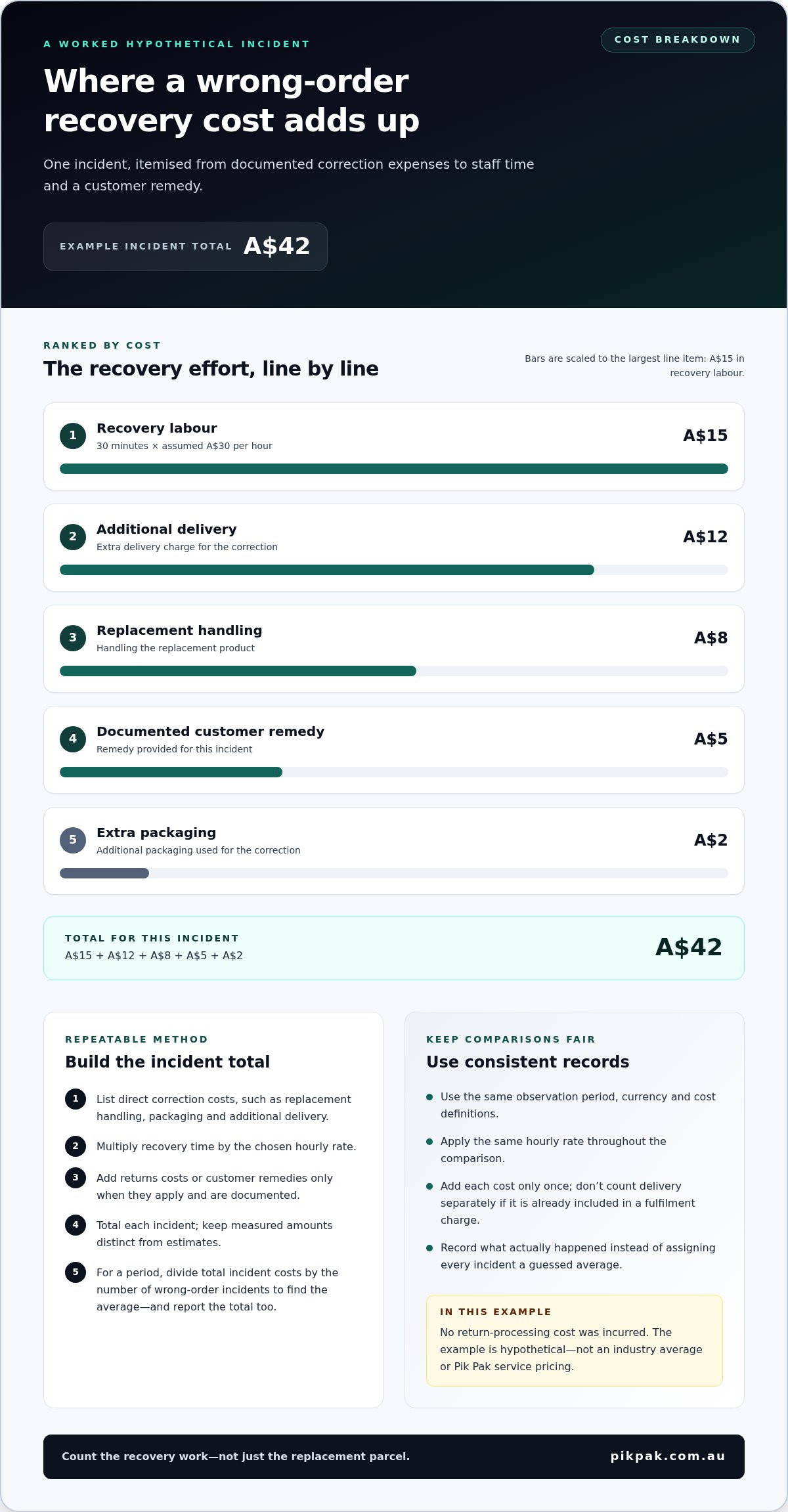
Here’s a hypothetical example, not an industry average or Pik Pak service pricing. Suppose one incident involves A$8 in replacement handling, A$2 for extra packaging and A$12 in additional delivery. Staff spend 30 minutes resolving it, valued at an assumed A$30 per hour, which gives A$15 in labour. If the business also documents a A$5 customer remedy and incurs no return-processing cost, the incident total is A$42. These assumptions are illustrative; use your own records for a real calculation.
If four incidents during a chosen period total A$168, report both figures: A$168 in total and A$42 on average per incident. The average supports comparisons, while the total shows the combined burden, including frequent low-cost errors. Clear order information and visible fulfilment workflows can also help you investigate where costs arise. If you’re reviewing those workflows, explore warehousing and fulfilment as part of your operational assessment.
How Wrong-Order Costs Differ by Error Type
The error label helps explain what happened, but the resolution determines which costs belong in the incident total. A wrong item that is returned and replaced can involve a different recovery process from a missing item that’s simply resent. Use the comparison below to guide your checks, not as a list of costs to apply automatically.
| Error type | Costs that may apply | What to check |
|---|---|---|
| Wrong item or variant | Investigation, customer support, replacement handling and delivery, return processing, or a refund or other remedy | Was the incorrect item returned, kept, or replaced? Did inaccurate order data or a pick error cause the mix-up? |
| Missing item | Support time, handling and delivery for the missing item, and any documented customer remedy | Was the item omitted during packing, or was the order information incomplete? A return may not be needed. |
| Incorrect quantity | Handling and delivery for additional units, return processing for excess units, or a refund or other remedy | Did the customer receive too few or too many? Include only the action taken to correct that specific discrepancy. |
| Duplicate shipment | Investigation, customer communication, return handling for the extra parcel, or a documented remedy if one was provided | Was a second parcel actually dispatched? Check whether the duplicate resulted from order processing or fulfilment activity. |
Compare replacement, refund, and return scenarios
If the correct item is resent, include its additional handling and delivery, plus recovery labour and any remedy that was also provided. If the order is refunded instead, record the refund and the labour or return costs that actually occurred. A return-and-replacement resolution may involve both return processing and the costs of sending the correct item. The remedy and the process followed determine what belongs in the calculation.
Don’t count alternatives as if they happened together. If the customer received a refund instead of a replacement, don’t add the replacement value as another correction cost. If a replacement was sent, don’t also count a full refund unless both were genuinely provided. Keep the valuation method consistent: distinguish the customer-facing refund from the cost of stock issued, and document what each figure represents.
Find the errors with the greatest cumulative impact
A high average cost can draw attention, but a frequent, lower-cost error may consume more resources overall. Segment incidents by product, order type, error category or fulfilment stage, then compare both frequency and recorded cost. This can show whether an issue is isolated or linked to a repeatable step, such as order information flowing into picking.
Incident frequency multiplied by average recorded cost shows which error types create the greatest cumulative financial impact. Use that view to prioritise investigation, then examine individual cases before choosing a corrective action. Keep customer responses and return requirements in the record, since they can explain why otherwise similar errors have different totals.
How to Track Wrong Orders and Prevent Repeat Costs
A useful incident log turns individual complaints into evidence about where fulfilment breaks down. Keep one record for each wrong order, even if the resolution seems simple. Consistent records make calculating the cost of a wrong order more reliable and help show whether errors are isolated or recurring.
Build a useful wrong-order incident log
Use the same error categories each time, such as wrong item, missing item, incorrect quantity or duplicate shipment. Record the order reference, date, discovery point, suspected process stage, resolution and measured cost. Capture staff time and recovery inputs as they happen rather than relying on memory at the end of the month.
- Order reference and error type: Use an identifier that lets the team trace the incident without putting unnecessary customer details in reports.
- Discovery point and likely cause: Note whether the issue surfaced in order data, picking, packing, dispatch or returns, and distinguish confirmed facts from assumptions.
- Resolution and cost: Record what was done, the time involved and the direct expenses that actually applied.
Protect customer information and limit incident reports to the operational details needed for analysis. A team reviewing picking patterns may not need a customer’s full contact information. Consistent categories and careful records make comparisons easier without exposing more data than necessary.
Turn repeated incidents into process changes
Review the log regularly and look for patterns by product, error type and fulfilment stage. If the same variant is repeatedly mis-picked, inspect the relevant picking workflow. If order details arrive incorrectly, trace the information flow before changing warehouse procedures. For upstream stock discrepancies, warehouse receiving guidelines can help frame a review of inventory accuracy at receipt.
Choose one practical process adjustment at a time, then compare new incidents with a baseline from the same type of order or period. Track both the number of errors and their recorded costs. This helps show whether a change is associated with fewer incidents or less recovery effort, without assuming that one adjustment will prevent every error.
A cloud-based WMS with real-time inventory and order-status visibility can add context to an investigation. Teams can review relevant stock and order information while tracing what happened. That visibility supports operational control, but it doesn’t mean errors can’t occur. Pik Pak’s WMS gives eCommerce businesses real-time visibility of inventory and order status as part of their fulfilment workflows.
Use the evidence to decide where to focus next, whether that’s order information, picking, packing or returns handling. If you’re assessing how fulfilment processes could support more accurate order handling, explore Pik Pak Logistics.
How Pik Pak Fulfilment Can Fit Your Wrong-Order Cost Plan
Once you’ve measured wrong-order incidents, use the results to decide whether your current fulfilment setup still fits your business. Pik Pak Logistics provides eCommerce warehousing, picking, packing, shipping and returns processing, bringing stock management together with the work needed to fulfil and recover orders. Assess this operating model alongside your figures for calculating the cost of a wrong order.
What managed fulfilment changes in the workflow
With managed fulfilment, stock is stored before orders are picked, packed and dispatched, and returns processing supports the recovery workflow. Pik Pak’s API access and pre-built connectors support automated order-information flows from eCommerce platforms. Accurate information flowing into fulfilment is an important part of operational control, while a cloud-based WMS provides real-time inventory and order-status visibility. Learn how eCommerce warehousing and fulfilment bring these activities into a managed workflow.
Visibility helps teams understand what the system shows about stock and order progress as they investigate an issue. It doesn’t mean errors can’t happen. It can, however, provide useful context when reviewing order records, fulfilment activity and the resolution that followed.
Compare in-house and outsourced costs using your own data
Compare operating models using the same order volume, period and cost definitions. For in-house fulfilment, gather documented labour, storage, systems and recovery work. For an outsourced model, include the relevant fulfilment costs alongside any internal work that remains, such as managing order information or customer communication. Outsourcing doesn’t automatically reduce costs or errors. Its value depends on your requirements and operating data.
To make the comparison useful, separate regular operating expenses from costs linked to wrong orders. Then consider how each model handles the full order fulfilment process, from inventory being available to the parcel being dispatched and any return being processed. Your incident log can show which stages are driving extra work and where a different workflow may be worth assessing.
- Use comparable records: Match the same period and order volume, and use consistent definitions for labour, storage, systems and incident costs.
- Include the whole workflow: Account for picking, packing, shipping and returns processing, plus the internal time needed to oversee fulfilment.
- Assess your error data: Compare error frequency, measured recovery effort and the operational stages involved under each model.
This evidence-based comparison helps you weigh fulfilment outsourcing against your business’s workload instead of relying on generic savings claims. To discuss how Pik Pak’s fulfilment and WMS capabilities fit your operations, talk with Pik Pak Logistics.
Turn Your Order Data Into a Clear Next Step
Use incident records as a decision tool, not just a scorecard. When calculating the cost of a wrong order becomes part of regular operations, you can see which recurring problems deserve attention and whether your current fulfilment model still suits your business. Start with a pattern in your data, identify the workflow behind it, and decide what to test or change next.
If you’re assessing external support, compare your actual order volume, recorded error costs and internal workload with the fulfilment tasks you could hand over. Pik Pak Logistics brings warehousing, picking, packing, shipping and returns processing together with a cloud-based WMS for real-time inventory and order-status visibility. API access and pre-built eCommerce platform connectors support automated order-information flows.
Put your evidence to work and choose a practical next move. Explore Pik Pak fulfilment services to see how managed fulfilment could fit your operations. Clearer processes can help you spend less time reacting to avoidable friction and more time building your business.
Frequently Asked Questions
How do you calculate the cost of a wrong order?
For each case, add the extra expenses caused by the mistake and the labour spent resolving it, then include any documented customer remedy. When calculating the cost of a wrong order, separate incremental costs from normal fulfilment expenses so you don’t charge the incident for work that would have happened anyway. Keep the order reference with the calculation so you can reconcile it against support notes and financial records.
What costs should be included when an order is sent incorrectly?
Include costs caused by the error, such as extra handling, packaging, delivery, return processing, staff time and remedies provided to the customer. For stock, use a consistent accounting approach and distinguish the value of a replacement item from an expense that was actually incurred. If a refund and replacement were alternative resolutions, include only what happened. This keeps the incident estimate from overstating the impact.
Does a wrong order always need to be returned?
No. The appropriate resolution depends on the item, the circumstances and the remedy agreed with the customer. A business might arrange a return, send the correct item without retrieving the original, or resolve the issue another way. Record whether a return was requested, completed or not needed, and include return-related work only if it occurred. Clear notes also help explain why similar errors resulted in different recovery costs.
How can an eCommerce business find out where wrong orders happen?
Compare what the customer ordered with the order information, inventory records and fulfilment activity for that order. Look for the earliest point where those records differ. If the order details were correct but the dispatched item was not, investigate the fulfilment stage. If the original order data was wrong, trace how it entered the workflow. Reviewing a sample of affected orders can help confirm a recurring pattern.
Can a WMS help reduce the impact of wrong orders?
A WMS can provide operational context through inventory and order-status information, helping a team investigate an issue and coordinate its response. It may make it easier to trace whether the problem relates to stock visibility or order handling, but it doesn’t prove that an order is error-free or prevent every mistake. Use system information alongside customer reports and fulfilment records to understand what happened and refine processes.
How often should a business review wrong-order costs?
Set a regular review schedule that suits your order volume, and bring the review forward if errors spike or a workflow changes. A monthly check may give a smaller store enough cases to spot emerging patterns, while a higher-volume operation may benefit from more frequent reviews. Compare consistent periods and categories, and revisit costs after process changes to see whether the pattern has shifted.
When should an online store consider outsourcing fulfilment?
Consider outsourcing when your records show that storage, staffing, systems or order recovery are taking more resources than your business wants to devote to fulfilment. Compare those documented costs and workload with the requirements of an outsourced model, including order volume and returns processing. Pik Pak Logistics provides eCommerce warehousing, pick, pack, shipping and returns processing, which businesses can assess against their own operating data.