

What if an insured warehouse still leaves your stock exposed? The insurance requirements for storing stock in a warehouse depend on more than where your goods are kept. A warehouse operator’s insurance may cover its own property or liability, but that does not automatically mean your inventory is insured for its full value. As the stock owner, you need to understand what cover applies to your goods.
It is easy to assume a warehouse or third-party logistics (3PL) provider takes care of insurance while your products are in its custody. But responsibility can depend on ownership, the storage agreement, liability limits and policy wording. Storage, transport and business interruption risks may also be treated differently, so clarify the details before a loss occurs.
This guide explains which parties and documents shape responsibility, and which insurance categories to discuss with your broker, including stock, transit, liability and business interruption cover. It also includes a practical checklist for reviewing warehouse terms and keeping useful inventory records. Clear receiving information and ongoing stock visibility can support reconciliation, but they do not determine insurance cover. The goal is to help you identify the right questions and make your arrangements easier to understand.
Key Takeaways
- Clarify who owns the stock, who holds it, and what the warehouse agreement says about responsibility.
- Use the insurance requirements for storing stock in a warehouse as a prompt to compare policy types and confirm what each may cover.
- Review your policy schedule and wording alongside the storage contract, paying close attention to locations, custody periods, limits and exclusions.
- Keep inventory valuations, SKU records, purchase evidence and stock movements organised to support accurate reconciliation.
- Use warehouse inventory visibility to support record-keeping, while relying on your policy wording and insurance adviser for coverage decisions.
Insurance requirements for storing stock in a warehouse: who is responsible?
No single insurance arrangement applies to every warehouse-stock agreement. The merchant may own the goods while a warehouse or third-party logistics (3PL) operator physically holds them. The contract may allocate particular responsibilities between the parties, but ownership, custody and insurance are separate questions. Do not assume that the party holding your goods has insured them on your behalf.
A warehouse is a place where goods are stored, but its function and risks do not decide who has cover. For context, see What is a warehouse? The practical answer to the insurance requirements for storing stock in a warehouse depends on the interests, events and locations described in the relevant agreement and insurance documents.
Stock ownership, warehouse custody, and contractual responsibility
Ownership refers to the merchant’s financial interest in inventory. Custody means another party is physically holding or handling it. A warehouse operator’s insurance may relate to its own property or legal liability. That does not automatically establish cover for customer-owned goods or protect the merchant for their full value.
The storage agreement may allocate responsibilities differently depending on what happens. Its terms might address loss or damage during storage, handling or another part of the fulfilment process. Do not treat one clause, such as a liability limit, as proof that your stock is insured. Compare the agreement with your policy schedule and wording, then ask your broker or insurer how the documents apply to your situation.
Contracts set the agreed responsibilities, while policy wording and schedules determine the practical scope of insurance cover. Review both together. Check that the goods, warehouse locations, custody periods and relevant events described in the documents match how your inventory is actually stored and handled.
Is insurance legally required for stock stored in Australia?
There is no blanket answer for every business and warehouse arrangement. A specific legal or regulatory requirement may depend on the circumstances, while a lease, storage contract or lender agreement may set separate insurance conditions. Those contractual requirements are not the same as a general rule that all stock stored in Australia must be insured.
Start by identifying the requirements that apply to your business, premises and agreements. Read the relevant clauses, then confirm their meaning with your broker, insurer or legal adviser. If you are relying on a legislative or regulatory requirement, check current authoritative Australian sources or seek qualified advice. Do not assume a requirement for one type of insurance means your inventory itself is covered.
- Ownership: Who has the financial interest in the goods?
- Custody: Who holds or handles the stock, and during which stages?
- Contract: What responsibilities and limits apply to each party?
- Policy: Do the schedule and wording address the goods, locations and circumstances you need to consider?
Keep these questions distinct. A warehouse can hold stock without owning it, and an agreement can allocate liability without replacing the merchant’s own insurance arrangements. Separating the questions gives you a clearer starting point for comparing documents and discussing cover with your adviser.
Which insurance policies may respond to stock stored in a warehouse?
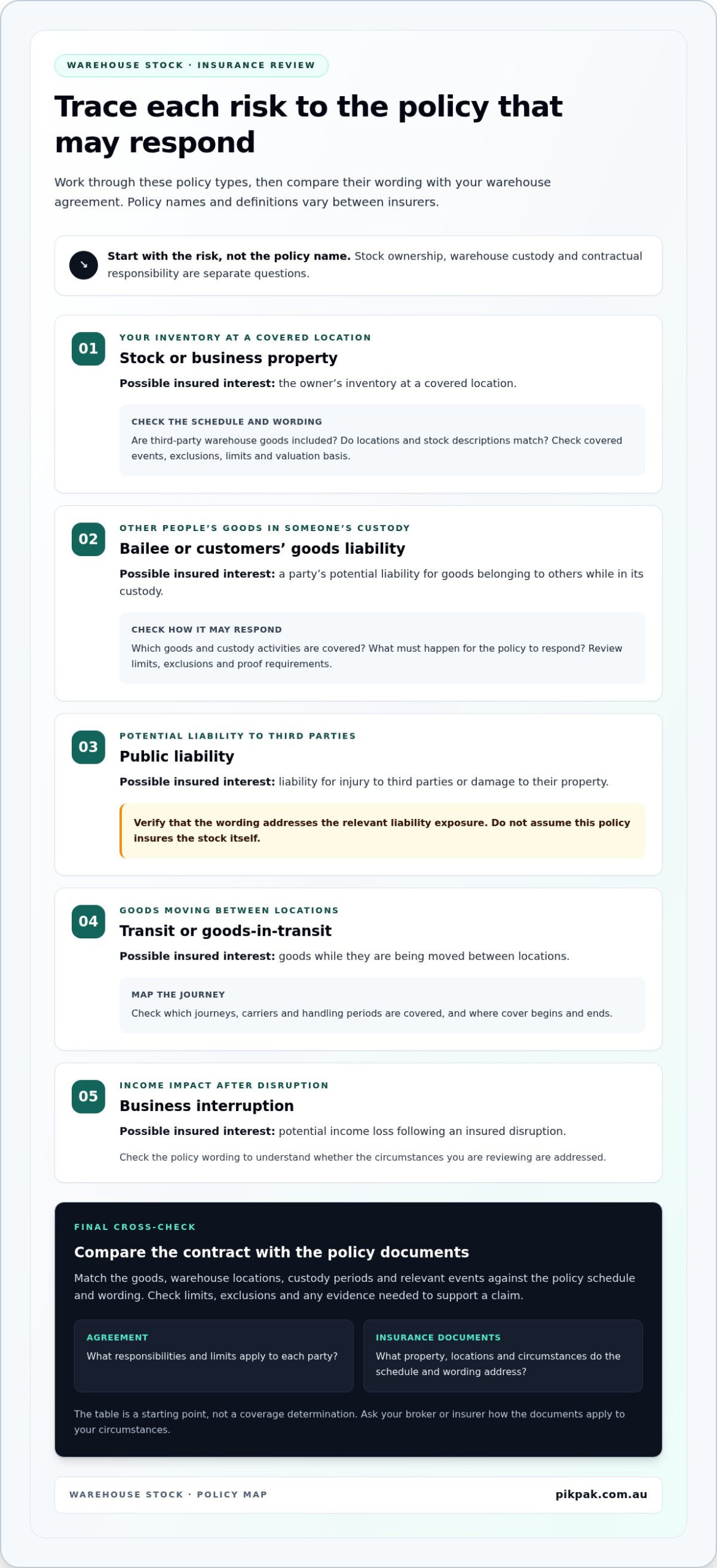
Different policies may apply to different interests and stages of the stock journey. The owner’s stock or property cover, a warehouse operator’s liability cover and transit insurance are not interchangeable. To assess the insurance requirements for storing stock in a warehouse, map each risk period to the policy and agreement that may apply.
The table is a starting point, not a coverage determination. Policy names and definitions vary between insurers. The policy schedule and wording control, including the property insured, locations, covered events, exclusions, limits and any evidence needed to support a claim.
| Policy type | Possible insured interest | Questions to verify |
|---|---|---|
| Stock or business property | The owner’s inventory at a covered location | Are goods held at a third-party warehouse included? Do the listed locations and stock descriptions match your arrangements? What events, exclusions, limits and valuation basis apply? |
| Bailee or customers’ goods liability | A party’s potential liability for other people’s goods in its custody | Which goods and custody activities are covered? What must happen for the policy to respond, and what limits, exclusions or proof requirements apply? |
| Public liability | Potential liability for injury to third parties or damage to their property | Does the wording address the relevant liability exposure? Do not assume it insures the stock itself. |
| Transit or goods-in-transit | Goods while being moved between locations | Which journeys, carriers and handling periods are covered? Where does cover begin and end? |
| Business interruption | Potential income loss following an insured disruption | What insured event can trigger cover, and how does the policy define the interruption and any covered loss? |
Stock or business property cover versus bailee or customer-goods liability
Stock or property cover is the type an owner may arrange to protect its financial interest in inventory. Bailee or customers’ goods liability may be relevant to a warehouse or another party holding goods owned by someone else. It generally concerns the holder’s liability, not automatic replacement of every customer’s stock. Triggers, exclusions, limits and proof requirements depend on the actual wording.
A policy label alone cannot confirm that a particular loss is covered. Check the schedule and wording rather than relying on a description such as “warehouse insured” or “stock cover.”
When transit, business interruption, or other cover matters
Storage and movement are different risk periods. Stock may travel from a supplier to a warehouse, between facilities, or from a warehouse to a customer. Transit cover may have different terms from cover applying at a storage location, so identify where one period ends and the next begins. Business interruption is also separate: it may address defined income losses after an insured event, but it is not automatic stock replacement.
For each stage, note the location, who has custody, which agreement applies and which policy may respond. Pik Pak’s managed eCommerce warehousing and fulfilment arrangement brings storage and order handling together. Insurance decisions remain a separate review with your broker or insurer.
How to compare your policy with a warehouse or 3PL agreement
Review the documents side by side, not in isolation. Gather your policy schedule, full policy wording, signed storage agreement and actual operating process. Then trace a typical stock movement, from arrival at the warehouse through storage, picking and dispatch. The insurance requirements for storing stock in a warehouse are easier to assess when the paperwork reflects where goods are and how they are handled.
| Compare | What to check |
|---|---|
| Covered property | Does the policy description match the stock you own, including higher-value, fragile, regulated or temperature-sensitive items? |
| Locations and custody periods | Are all warehouse locations included? Does the wording address the period goods are held, handled or moved? |
| Limits and sublimits | Could a limit apply to particular stock, events, locations or goods held by another party? |
| Exclusions and conditions | What events or handling circumstances are excluded, and are there notification or security conditions to follow? |
| Evidence requirements | What records may be needed to identify stock, establish its value and show its movements? |
Compare those points with the contract’s descriptions of customer goods, responsibility for loss or damage, liability limits and claims process. Check the operating process too: a policy might list a location or period differently from how stock actually moves. Fast-moving lines can change in value or quantity quickly, while fragile or temperature-sensitive products may need closer review of relevant conditions and exclusions.
Questions to resolve before stock enters storage
Before the first delivery, confirm how the agreement describes your goods and allocates responsibility across receiving, storage, handling and dispatch. Check that declared stock values and warehouse locations match the information held by your insurer. For inbound records, use the warehouse receiving guidelines to organise the details needed to identify deliveries and reconcile inventory.
- Which party is responsible for each stage, and what does the contract say about loss or damage?
- Do the policy schedule and contract identify the same goods, locations and storage arrangements?
- Ask your broker or insurer about relevant exclusions, conditions, sublimits and notification duties.
What to do when the policy and contract seem inconsistent
Do not treat ambiguous wording as proof that a loss is covered, or that a gap definitely exists. Send the relevant clauses and a clear description of your stock movements to your broker or insurer, and request written clarification before relying on an assumption. If the agreement or policy needs to change, keep a record of the agreed update and save the current signed contract, schedule and wording together.
Make this a repeatable review, not a one-off task. Revisit the documents when stock types, values, locations or handling arrangements change. Clear receiving records and ongoing inventory visibility can support reconciliation, but they do not replace advice on policy wording or contract responsibilities.
A warehouse stock insurance checklist for eCommerce businesses
Build a stock record you can explain and update. Use this checklist before goods enter storage, at renewal, and whenever your inventory or fulfilment arrangements change. Accurate records can help you discuss declared values and stock movements with your broker or insurer. They do not determine whether a claim will be covered.
Build a reliable stock record for insurance discussions
Keep dated reports alongside purchase invoices, ownership evidence and adjustment records. Separate inventory by warehouse location, status and valuation basis, and note handling requirements that may matter for particular products. Reconcile receipts, picks, returns, damaged goods and write-offs regularly. This helps you identify discrepancies while the records are current.
- Before storage: Record each SKU, quantity, ownership, value basis and intended warehouse location. Keep purchase evidence and note any product-specific handling needs.
- At receiving: Compare the expected delivery with the quantities recorded as received. Retain dated information that helps identify differences for follow-up. Pik Pak’s warehouse and fulfilment operations support organised inventory handling, separate from your insurance decisions.
- During storage: Update records as stock is picked, returned, moved, damaged or written off. Reconcile warehouse records with your own inventory reports regularly, and investigate discrepancies rather than carrying them forward.
- At renewal: Review the inventory valuation method and declared values against current stock levels, product mix and warehouse locations. Keep dated reports showing how the figures were prepared.
- After a material change: Revisit your records if you add a location, change fulfilment arrangements or begin holding different types or quantities of stock. Check policy conditions and notify your broker or insurer about changes that require notification.
Review cover as your inventory and fulfilment model changes
Fast-moving eCommerce stock can shift between receiving, storage, picking, returns and dispatch. Keep records that distinguish each stage and location so your reports can be reconciled with operational activity. A warehouse management system with real-time inventory and order-status visibility can help maintain a current view of stock, but it does not replace policy wording, insurance advice or your contract.
For broader context on storage decisions, use a warehouse guide for eCommerce businesses alongside your operational and insurance review. Keep the policy schedule, wording, storage agreement and inventory reports together, with dates or version details that show which documents were current at renewal or when arrangements changed.
Make the checklist repeatable. A consistent record-keeping routine makes it easier to spot missing information before renewal discussions, while your broker or insurer can address how policy terms apply. Pik Pak provides inventory storage and fulfilment for online stores. Explore eCommerce warehousing and fulfilment.
Storing stock with a 3PL: practical next steps for insurance clarity
Keep the process simple: map the risks, review the relevant documents, clarify cover with your insurance adviser, then maintain accurate stock records. This gives you a clearer picture of how inventory moves through a third-party logistics (3PL) arrangement and what information you may need for insurance discussions.
A warehouse management system can make inventory and order status easier to see, but visibility is not insurance advice and does not determine whether a loss is covered. Treat operational records and insurance decisions as connected but separate tasks. The system helps you understand what stock is recorded at a given time; your policy wording, schedule and contract provide the framework for assessing cover and responsibility.
Coordinate inventory information with your warehouse workflow
Stock records are most useful when they reflect real movements. Receiving information can show what arrived, order records can track picked and dispatched goods, and return or adjustment records can help explain changes to recorded quantities. Reconcile these operational records with your own inventory reports so you can identify discrepancies and follow them up.
Pik Pak’s cloud-based Warehouse Management System provides real-time inventory and order-status visibility. This supports day-to-day oversight and stock reconciliation as inventory moves through storage and fulfilment. It does not replace your own valuation records or confirm that a particular item or event is covered. For broader context, use a 3PL guide relevant to Australian businesses when reviewing how outsourced logistics fits into your operations.
Keep insurance decisions with the right advisers
Bring your current storage agreement, policy schedule, full policy wording and dated stock reports to your broker or insurer. Describe the practical workflow as well as the paperwork: where goods are stored, how they move, and when they are received, picked, returned or dispatched. This gives your adviser a clearer basis for discussing how the policy and contract apply.
Ask the relevant insurance professional to clarify specific cover, exclusions, limits, notification conditions and the claim process. If any wording or responsibility remains unclear, request an explanation in writing before relying on an assumption. Keep the response with the policy and contract documents, and update your records when arrangements change.
Take the next practical step: organise your inventory records and align your storage arrangements with your business’s risk review. Pik Pak’s managed eCommerce storage and fulfilment brings inventory storage, order handling and returns together, while insurance decisions remain with you and your advisers. Explore Pik Pak’s warehousing and fulfilment services.
Make your next stock decision with confidence
Make the insurance requirements for storing stock in a warehouse part of your regular business review, not a task you leave until a renewal deadline. Revisit your arrangements when stock levels, product mix or fulfilment workflows change. Keep the relevant documents and inventory information organised, then take them to your broker or insurer to discuss questions that affect your business.
Operational clarity can make that review easier. Pik Pak brings eCommerce storage, picking, packing, shipping and returns together through one fulfilment service, with a cloud-based WMS providing real-time inventory and order-status visibility. These tools support stock oversight and reconciliation; your policy and insurance advice remain separate decisions.
If you are considering a more managed approach to inventory handling, explore Pik Pak’s warehousing and fulfilment services. Put your storage and order handling into a workflow supported by inventory visibility, then review insurance arrangements with your adviser.
Frequently Asked Questions
Is insurance legally required to store stock in a warehouse?
There is no safe universal answer for every business arrangement. A statutory rule, if applicable, is different from a condition in a commercial lease, lender facility, customer agreement or warehouse contract. The insurance requirements for storing stock in a warehouse depend on your business and its specific arrangements. Check the documents that apply to you and seek current Australian legal or insurance guidance. This article is general information, not legal advice.
Does a warehouse’s insurance cover my stock?
Not automatically. A warehouse operator may hold insurance for its own property or liability, but that does not establish that every customer-owned item is insured for full value or every cause of loss. The agreement and policy documents determine the relevant insured interests, limits, exclusions and evidence requirements. For example, a liability limit in a storage contract is not the same as proof of stock cover. Compare the documents with your broker or insurer.
What insurance covers goods stored in a 3PL warehouse?
Stock or property cover may be relevant to the owner’s inventory, while customer-goods or bailee liability may apply to a 3PL’s potential responsibility for goods in its custody. Neither label is enough to identify suitable cover on its own. Ownership, contract terms, risks and policy wording all matter. A shipment travelling to or from the warehouse may also be treated differently from stock at rest, so consider each period separately with your adviser.
Can I claim if stock is damaged while stored in a warehouse?
Possibly, but eligibility depends on the damage’s cause and the policy’s terms, including insured property, conditions, exclusions and limits. The warehouse agreement may inform responsibility between the parties, but it does not alone determine the insurer’s response. If damage occurs, preserve relevant stock and movement records, such as delivery documents and inventory adjustments, where practical. Follow the policy’s notification process promptly and ask your insurer or broker what information is required.
Does business contents insurance cover stock stored off-site?
It depends on the policy’s definitions, listed locations, conditions and declared values. Do not assume a policy covering contents at your business premises extends to inventory held at a third-party warehouse. For example, a newly used storage location may not match the locations shown in your schedule. Check the full wording and schedule with your insurer or broker, and clarify any location or storage requirements before relying on cover.
How should I value stock for warehouse insurance?
There is no valuation basis that suits every policy and business. The method accepted for your cover depends on the wording and your circumstances, so ask your insurer or broker how to calculate and declare stock values. Keep dated inventory reports, purchase invoices, ownership records and adjustment histories together. Consistent records make it easier to explain how a declared figure was reached and track changes as stock is received, sold or written off.