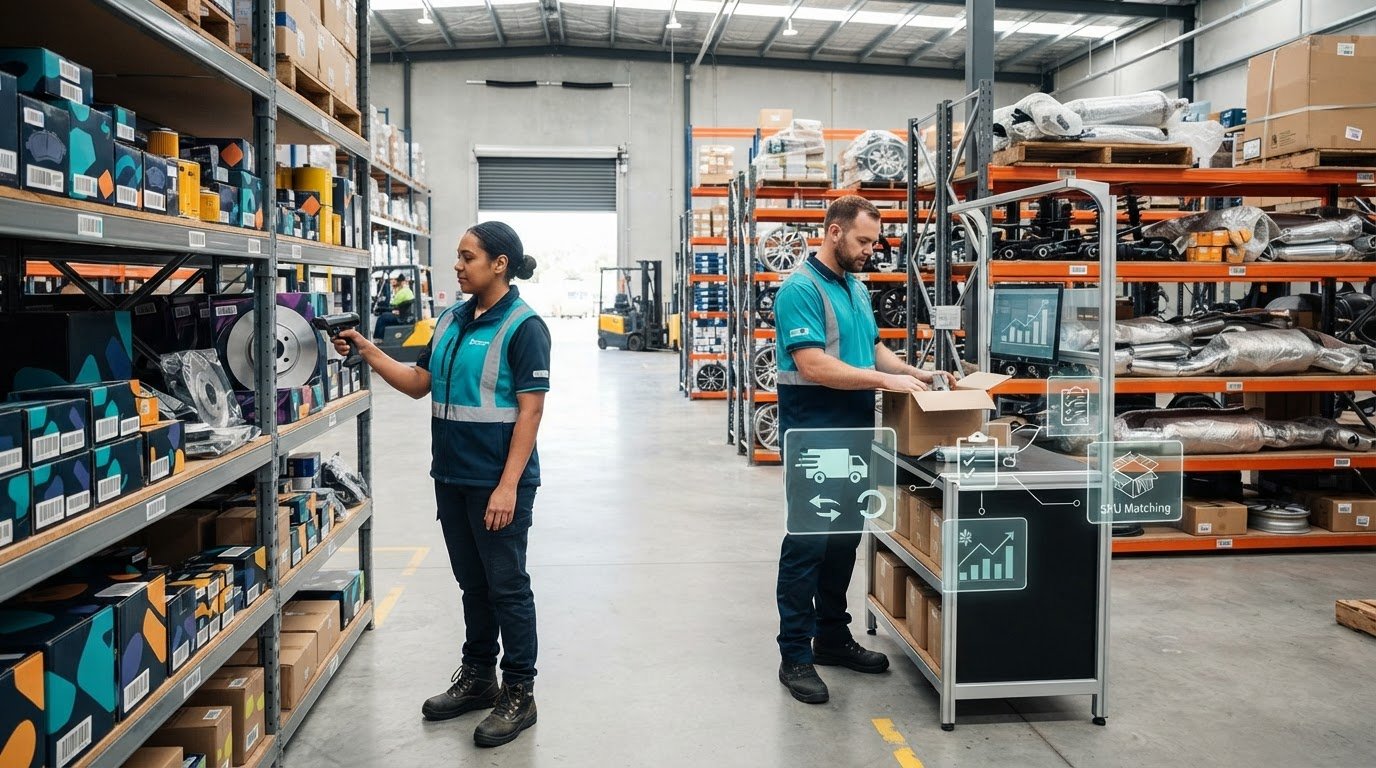
What makes a 3pl for aftermarket car parts work well isn’t just the amount of warehouse space. It’s how clearly product data connects to the work happening inside the warehouse. With numerous part numbers and variations to track, gaps in stock information, picking or returns can create extra work for your team and customers.
When fulfilment gets harder to manage, it’s understandable to focus on storage and shipping. But a workable operation also needs clear SKU data, repeatable warehouse processes and order visibility, so you can see what’s in stock and where each order stands. The right fit depends on how those pieces work together.
This guide explains how to assess a 3PL for your parts business, from inventory records and picking and packing to order visibility and returns processing. You’ll also see how a cloud-based WMS and eCommerce integrations support day-to-day oversight. Pik Pak’s WMS provides real-time inventory and order-status visibility, helping you spend less time managing fulfilment and more time on your business.
Key Takeaways
- Map how part numbers, product variations and compatibility details affect your stock records before moving fulfilment.
- Assess a 3pl for aftermarket car parts by looking for clear inventory visibility, connected order data and consistent receiving and returns workflows.
- Prepare for a smoother handover by reviewing product descriptions, SKUs and barcode records, then testing order data before the workflow goes live.
- Understand how a WMS can link inventory records with eCommerce orders and make stock and order status easier to oversee.
- See how storage, pick and pack, shipping and returns processing can work together to reduce the day-to-day burden of fulfilment.
Why aftermarket car parts businesses consider a 3PL
Moving fulfilment out of your own storeroom changes the daily routine. Instead of receiving stock, finding shelf space, picking orders and arranging dispatch yourself, you hand those warehouse tasks to a third-party logistics provider (3PL). Your team can spend less time packing parcels and more time on product range, customer service and growth.
For an aftermarket parts eCommerce business, 3PL fulfilment is the outsourced process of storing products, picking and packing online orders, and preparing them for dispatch. It differs from logistics built around manufacturing lines or bulk freight. A parts seller fulfilling direct-to-customer orders needs a workflow that identifies individual items, connects orders to stock records and prepares each parcel accurately.
That accuracy can be challenging. A catalogue may include numerous part numbers, variations and compatibility details, while similar-looking components can be easy to confuse. The Automotive Aftermarket Overview outlines the broad scope of the sector, but your specific range and order profile determine the practical demands of your warehouse workflow.
Where aftermarket parts fulfilment creates extra work
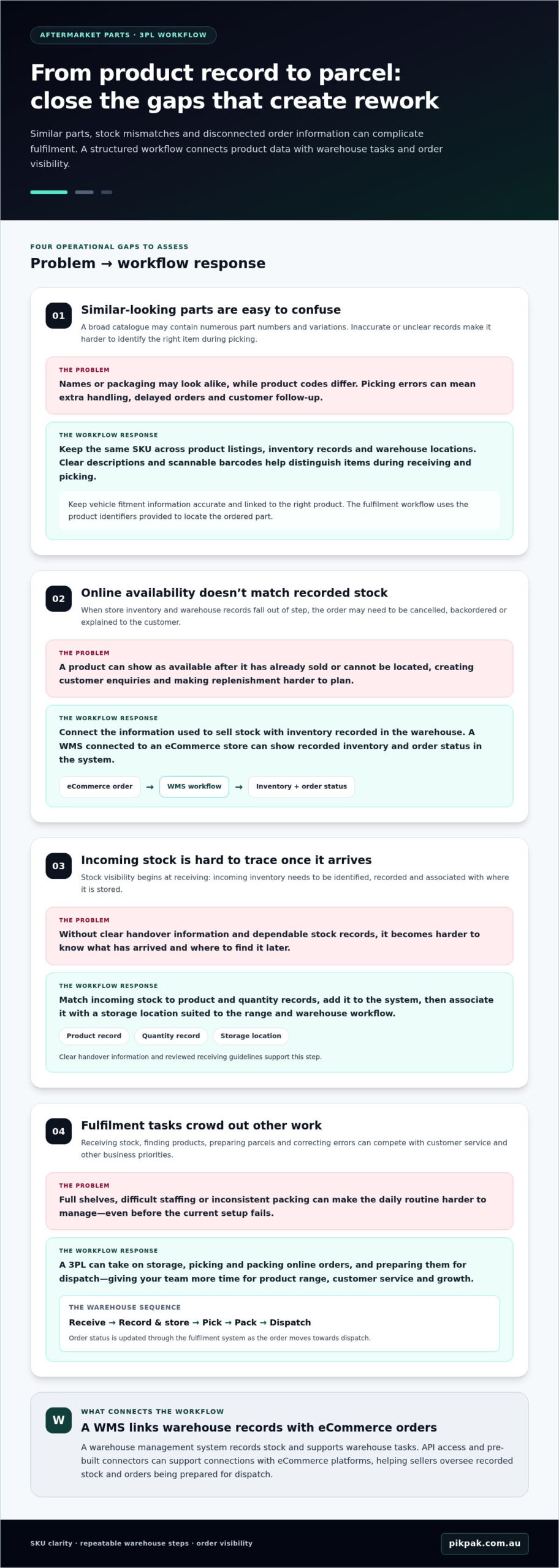
Picking the right item depends on clear product records and organised storage. If two parts have similar names or packaging, a picker needs a reliable way to distinguish them, such as an accurate SKU, product description and location record. Without that structure, picking errors can mean extra handling, delayed orders and customer follow-up.
Stock discrepancies create a different problem. If your online store shows an item as available when it has already been sold or can’t be located, you may need to cancel the order, manage a backorder or explain the delay. Each mismatch can prompt customer enquiries and make replenishment harder to plan. A connected fulfilment workflow helps keep the information used to sell stock aligned with the inventory recorded in storage.
The right process depends on your business. A compact range of fast-moving parts has different storage and picking needs from a broad catalogue with varied order patterns. Start by identifying where your current process creates the most rework, then assess whether a structured warehousing and fulfilment workflow could address it.
When outsourcing becomes worth assessing
You don’t need to wait until your current setup fails. Growing order volume is one reason to reconsider in-house storage and dispatch, but practical warning signs can appear earlier: shelves are full, fulfilment tasks compete with customer service, staffing is difficult to manage, or orders are packed inconsistently.
Look at the time your team spends receiving stock, locating products, preparing parcels and correcting errors. If those tasks are crowding out higher-value work, compare your current process with outsourced fulfilment. The aim isn’t to give up control. It’s to establish a clearer workflow and give your team more room to focus on running the business.
How a 3PL can manage aftermarket parts inventory and fulfilment
A well-organised fulfilment workflow connects each product record to its physical stock and the customer order that needs it. For a 3pl for aftermarket car parts, the process generally moves through receiving, recording, storage, picking, packing and dispatch. Clear identifiers and connected information help keep each step aligned with the seller’s range and order requirements.
A warehouse management system (WMS) records stock and supports warehouse tasks. When connected to an eCommerce store, incoming orders can flow into the fulfilment process, while inventory and order-status information can be viewed in the system. This gives sellers a clearer picture of recorded stock and orders being prepared for dispatch. API access and pre-built connectors can support connections with eCommerce platforms.
SKU, barcode and fitment data in the warehouse
A SKU, or stock-keeping unit, is the seller’s identifier for an individual product or variation. Use the same SKU in product listings, inventory records and warehouse locations wherever possible. A barcode can make that identifier easier to scan during receiving and picking. Consistent data helps distinguish similar parts, including variations that look alike but have different product codes.
Vehicle fitment information is useful on product listings because it helps customers make informed choices. Keep this information accurate in your product data and linked to the right item. A fulfilment workflow uses the product identifiers provided to locate and pick the ordered part. Compatibility decisions should remain tied to your product information and processes.
Receiving, storage and pick-and-pack workflows
Receiving is where dependable stock visibility begins. Incoming inventory needs to be identified and recorded so the WMS reflects what has arrived and where it is stored. Prepare clear handover information and review the warehouse receiving guidelines before sending inventory.
Once recorded, stock is assigned to storage locations suited to the product range and warehouse workflow. The process should make it straightforward to find the right item when an order arrives. Picking against the order’s SKU and product details, then packing the selected items, helps reduce avoidable mistakes. The order status is updated through the fulfilment system as it moves towards dispatch.
- Receive: Match incoming stock to the seller’s product and quantity records.
- Record and store: Add inventory to the system and associate it with a warehouse location.
- Pick and pack: Use the order details and product identifiers to select and prepare the correct items.
- Dispatch: Prepare the packed order for shipping and keep its status visible.
When SKU records, listings and warehouse locations use consistent identifiers, it’s easier to follow the handoff from online order to physical product. To see how connected fulfilment and inventory visibility can support your operation, explore Pik Pak’s eCommerce fulfilment services.
How to assess a 3PL for aftermarket car parts
Assess the operating workflow, not just the storage space or service list. A 3pl for aftermarket car parts needs to connect product records, incoming orders, warehouse activity and returns in a way that fits your business. Reliable fulfilment depends on accurate product data and repeatable warehouse processes, not broad promises.
Use the criteria below to distinguish essentials from helpful extras. Essentials support everyday stock control and order handling. Extras can add convenience, but they matter most once the core workflow is clear.
| Criterion | Why it matters | Operational evidence of fit | Priority |
|---|---|---|---|
| Inventory visibility | You need to understand what stock is recorded as available and what has been allocated to orders. | A WMS shows inventory and order status, with product identifiers that match your catalogue. | Essential |
| Order-data integration | Disconnected order and warehouse records can mean manual updates and missed information. | eCommerce orders connect through an API or pre-built connector, with order details visible in the fulfilment workflow. | Essential |
| Receiving process | Stock records are only useful if incoming inventory is identified and recorded consistently. | Receiving steps align product and quantity details with inventory records before stock is stored. | Essential |
| Returns handling | Returned items need a defined route back into the operation, rather than being left outside stock records. | Returns processing is part of the reverse-logistics workflow, with status information available to support follow-up. | Essential |
| Workflow support | Clear support helps resolve process or integration questions as the operation changes. | There’s a clear way to get assistance with fulfilment technology and workflow requirements. | Helpful extra |
Operational fit: inventory, orders and returns
Trace a typical order from the online listing through receiving, picking, packing and dispatch. Check that product identifiers and order details stay connected at each step, and that stock and order statuses are visible. Returns also need a defined process, including how returned stock is recorded and its status made clear. This keeps reverse logistics within the same operational picture.
Technology fit: WMS and eCommerce integration
A warehouse management system (WMS) can centralise inventory and order-status information, giving your team a shared view of fulfilment activity. For an Australian eCommerce operation, check whether API access or pre-built connectors suit your store setup and keep order data flowing into the workflow. Pik Pak’s cloud-based WMS provides real-time inventory and order-status visibility, with eCommerce technology support for connected operations.
Keep your assessment grounded in your catalogue, order patterns and return requirements. A smaller operation may need a straightforward connected workflow, while a broader range may put more emphasis on consistent product records and stock visibility. To explore how Pik Pak brings eCommerce fulfilment workflows together, visit Pik Pak Logistics.
How to prepare aftermarket parts for a 3PL fulfilment workflow
A smooth handover starts before stock leaves your premises. Clear product records, reconciled quantities and documented order requirements give the warehouse team a useful starting point. For a 3pl for aftermarket car parts, preparation also means reviewing product variations, how orders arrive and what should happen when a customer sends an item back.
Use this sequence to get the key information in order:
- Review product data. Check that every product and variation has a consistent SKU, description and barcode record where available. Make sure the same identifier appears in your eCommerce listings and inventory records.
- Reconcile inventory. Compare your stock records with the quantities being prepared for handover. Note discrepancies before the goods are received, rather than carrying unclear figures into the new workflow.
- Document handling and packing notes. Record practical instructions that affect normal customer orders, such as which items are packed together or any seller-defined packing requirements. Keep notes specific and easy to apply.
- Prepare order and returns examples. Share representative order scenarios, including orders with multiple products or variations. Document how returns are initiated and what information your team needs to process them.
- Connect and test systems. Confirm how order data will pass from your eCommerce platform into fulfilment, then test sample orders and check that inventory and order statuses update as expected.
Organise product and inventory information
Consistent records help prevent confusion during receiving and storage. For example, if two variations have similar descriptions, distinct SKUs and matching barcode records make it easier to identify which item a stock record refers to. Review descriptions for clarity and keep product variations identifiable across your files and store listings.
Before handover, prepare a stock file that reflects the quantities being sent. Include product identifiers and descriptions that match your catalogue. If fitment details inform customer decisions, keep them accurate in your listings and separate them from warehouse instructions. The warehousing and fulfilment process works best when product data and inventory handover details are organised together.
Connect systems and test the order flow
An eCommerce integration can pass order information into the warehouse workflow, reducing the need to re-enter details manually. Test representative orders before routine operations begin: a single-item order, a multi-item order and an order containing a product variation. Check that the correct product identifiers appear, the order is visible to fulfilment staff and inventory changes are reflected in the system.
Also review how customer delivery options appear in your checkout and order data, so the information needed to prepare each shipment is clear. A short test can reveal mismatched SKUs, missing order details or unclear packing notes before they affect customer orders. Pik Pak’s cloud-based WMS provides real-time inventory and order-status visibility, helping sellers keep fulfilment activity in view.
Ready to simplify your stock handover and connected fulfilment workflow? Explore eCommerce fulfilment with Pik Pak.
How Pik Pak supports aftermarket parts eCommerce fulfilment
Pik Pak Logistics supports online stores with eCommerce fulfilment, bringing inventory storage, picking, packing, shipping and returns processing into a managed workflow. For a parts seller, this means warehouse tasks and order handling are managed together, while your team can focus on product range, customer service and business growth.
Your catalogue and order requirements shape the operating model. Your product information and order rules guide the warehouse workflow, while connected systems help keep stock and order activity visible.
What Pik Pak’s fulfilment service brings together
Inventory storage keeps stock within a fulfilment operation, while pick, pack and ship services support online-store orders from selection through dispatch. Pik Pak also processes returns, bringing returned items into a defined reverse-logistics workflow rather than leaving them outside the fulfilment picture.
If your sales model uses planned product bundles, Pik Pak’s kitting and assembly services can support that part of the operation. The workflow can be shaped around your product data and order requirements, keeping the information used to fulfil an order connected to the items being stored and handled.
Technology supports that connection. Pik Pak’s cloud-based WMS provides real-time inventory and order-status visibility, giving sellers a practical view of stock records and order progress. API access and pre-built connectors support eCommerce integrations, helping order information flow into fulfilment without relying solely on manual re-entry. This visibility can make it easier to monitor activity and follow up on exceptions.
Make the next step straightforward
Before setting up a fulfilment workflow, bring together a concise outline of your product range, sales channels and operating priorities. Include how product identifiers are organised, what order information needs to flow from your online store, how returns are handled and whether kitting is part of your offering. Clear inputs help map warehousing, order handling and visibility to your business needs.
This gives you a useful foundation for discussing a 3pl for aftermarket car parts without assuming every seller needs the same warehouse setup. Focus on how storage, picking, packing, shipping, returns and WMS visibility can work as one practical service model. Outsourcing these recurring tasks can reduce the time your team spends coordinating space and fulfilment activity, leaving more room for the work that grows your business.
Ready to discuss a fulfilment workflow for your online parts business? Talk to Pik Pak about your fulfilment requirements.
Build a fulfilment setup that can grow with your parts business
Your next step doesn’t need to be a major operational overhaul. Start by identifying the fulfilment tasks that take the most time or create the most friction, then decide what you want your team to focus on instead. A clear view of those priorities makes it easier to shape a workflow around your catalogue and customer orders.
The right 3pl for aftermarket car parts should help you move from day-to-day warehouse coordination towards a more manageable operating rhythm. Think of fulfilment as part of the customer experience: dependable product information, clear order progress and a considered approach to returns all support confidence after checkout.
When you’re ready, bring your product range and fulfilment priorities into a practical conversation. Pik Pak can connect the operational pieces so you can spend less time coordinating logistics and more time growing your business.
Talk to Pik Pak about simplifying your fulfilment and take the next step towards a workflow that fits your business.
Frequently Asked Questions
What does a 3PL do for an aftermarket car parts business?
A 3PL can manage the warehouse steps between incoming stock and customer delivery. Pik Pak receives and stores parts, picks items for each order, packs them and prepares them for shipping. Returns processing manages items coming back from customers. The seller remains responsible for product information and customer policies, while fulfilment tasks are handled through an organised operational process.
Is a 3PL suitable for a small aftermarket parts store?
A 3PL can suit a small store if its order patterns, storage needs and time pressures make outsourced fulfilment worthwhile. Consider how often you dispatch orders, how much space stock occupies and how much time packing takes from customer service or sales. The right 3pl for aftermarket car parts isn’t determined by business size alone. It depends on whether the workflow helps your team use its time more effectively.
Can a 3PL connect with an aftermarket parts eCommerce store?
Yes. eCommerce integration can pass order details from an online store into a warehouse management system (WMS), reducing reliance on manual order entry. Pik Pak offers API access and pre-built connectors to support eCommerce integrations. Test a sample order from checkout through to the warehouse system before routine fulfilment begins. This helps reveal whether product identifiers, quantities and delivery details arrive in a useful format.
How should I prepare car parts inventory before sending it to a 3PL?
Prepare a current inventory file with consistent SKUs, clear product descriptions and barcode details where available. Reconcile the quantities in your records against the stock being handed over, and note any differences rather than carrying them into the new records. Include practical packing instructions for normal orders, such as which items should be grouped together. Keep customer-facing product details separate from warehouse handling notes.
Can a 3PL help manage returns for car parts?
A 3PL can process returns as part of a reverse-logistics workflow, recording the return and supporting the associated inventory update. Pik Pak handles returns processing. Your return policy should define what customers can send back and under what conditions, and fulfilment procedures should reflect that policy. Document what information should accompany a returned item and how its status should be recorded, so stock isn’t treated as available before your process allows it.
What information should an aftermarket parts listing include for fulfilment?
Include a clear SKU that identifies the exact product or variation, plus a product description that helps distinguish it from similar items. Barcode information can also support identification during warehouse handling. Customer-facing details, such as fitment information, help shoppers assess whether a part suits their needs, but serve a different purpose from the SKU. Keep identifiers consistent across listings and inventory records, and maintain fitment details in your product data.
How can I keep visibility over stock when a 3PL fulfils orders?
Use the provider’s WMS to view inventory and order statuses in one system. This can help you see stock recorded as available and follow an order as it moves through fulfilment. Connected eCommerce data also reduces the need to rely on separate manual updates. Pik Pak’s cloud-based WMS provides real-time inventory and order-status visibility, giving your team a practical reference point for day-to-day oversight.