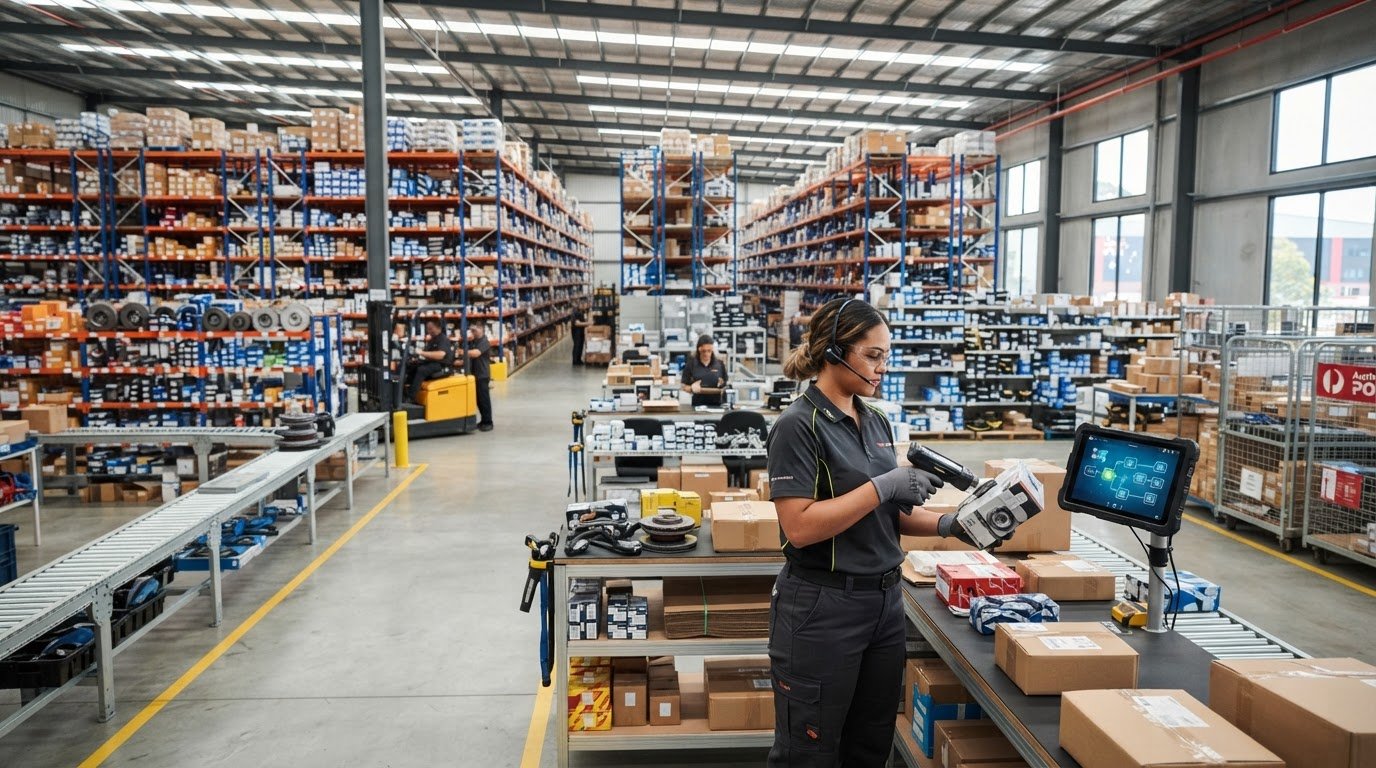
For automotive parts fulfillment australia, the right setup depends less on warehouse size than on how your catalogue is identified, picked, packed and tracked. A wide mix of products and similar-looking items can make stock accuracy and order picking harder to manage. When storage and dispatch take over the day, your team has less time for sales and customer service.
Customers want clear information after checkout, while your team needs a consistent way to keep orders moving. This guide explains how to map your fulfilment requirements and compare in-house, automotive-focused and general eCommerce 3PL models using practical criteria.
You’ll also see how a connected workflow for storage, picking, packing, shipping and returns can simplify day-to-day operations. Pik Pak Logistics provides eCommerce fulfilment supported by a cloud-based WMS that shows inventory and order status in real time, with API access and pre-built eCommerce connectors. Use the guidance below to assess outsourced fulfilment and decide which warehouse tasks your business could hand over.
Key Takeaways
- Map your catalogue, order patterns, storage needs and delivery expectations before deciding how to fulfil automotive parts orders.
- Compare in-house, category-focused and eCommerce 3PL models across operational ownership, visibility, integrations, returns and flexibility.
- Use your actual products and order data to identify which automotive parts fulfillment australia requirements matter to your operation.
- Prepare for a smoother transition by reviewing order data, planning integration and organising inventory receiving before go-live.
- Pik Pak connects storage, picking, packing, shipping and returns, with WMS visibility into inventory and order status.
Automotive Parts Fulfilment in Australia: What the Operation Needs to Get Right
Automotive parts fulfilment is the coordinated process of receiving stock, storing it, processing customer orders and dispatching them for delivery. It covers the operational steps between a product arriving in inventory and an order leaving for the customer. It doesn’t include manufacturing parts or acting as a freight forwarder arranging cargo transport. For an online parts seller, fulfilment links inventory records, warehouse activity and order information in one workflow.
That connection matters because parts catalogues can contain similar-looking items, variations and many individual SKUs. If the inventory record doesn’t match the shelf, a product may appear available when it isn’t, or a picker may select the wrong item. Consistent SKU data and repeatable picking processes help reduce avoidable errors. Order-status visibility also helps staff respond to customer questions with current information about whether an order is being processed or has been dispatched.
Dispatch is another essential step. The correct items need to be packed and handed into the delivery process, with order information available to the team as processing advances. Requirements depend on the products and order mix, so don’t assume every automotive item is fragile, bulky or requires specialist handling. Start by listing what your operation actually stores, picks and sends. This guide focuses on automotive parts fulfillment australia for eCommerce orders, not on finding bulk-freight or freight-forwarding providers. For a broader historical backdrop to the local sector, see the History of the Australian Automotive Industry.
Which automotive businesses use outsourced fulfilment?
Outsourced fulfilment can suit online parts retailers, accessory sellers and brands that send orders directly to individual customers. A store may handle a broad range of SKUs, from frequently reordered accessories to less common replacement items, with different products appearing in each basket. An eCommerce parcel workflow moves these individual orders from stored stock through picking, packing and dispatch. Workshop supply and bulk trade distribution can involve different order volumes and delivery arrangements, so they shouldn’t automatically be treated as the same operating model.
Where does fulfilment sit in the customer experience?
The journey starts when a customer places an online order. Inventory information supports availability decisions; warehouse processing then moves the order through picking, packing and dispatch. Staff also need a clear view of order progress to answer questions and manage exceptions. Reliable order information makes fulfilment a more predictable part of the buying experience.
A connected workflow can make the hand-offs easier to manage. Pik Pak Logistics provides eCommerce fulfilment that includes inventory storage, picking, packing, shipping and returns processing. Its cloud-based WMS provides real-time inventory and order-status visibility, giving your team a current view of stock and orders while leaving more time for sales and customer service.
The Automotive Parts Fulfilment Requirements to Map Before Choosing a 3PL
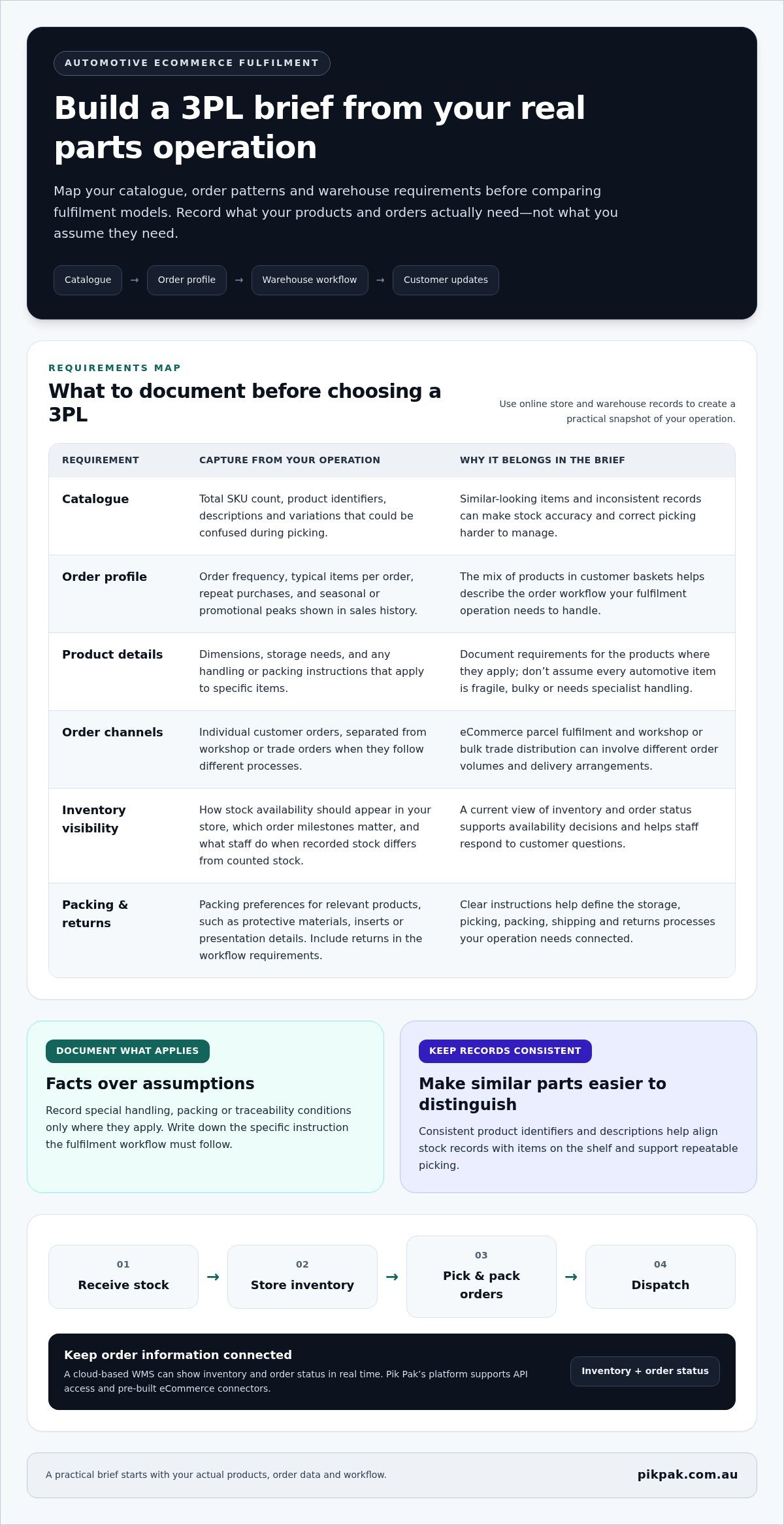
A useful 3PL brief starts with your catalogue and order data, not assumptions about what automotive products require. Map what you sell, how customers buy it and what staff need to know to fulfil each order correctly. This makes it easier to compare operating models and identify where outsourced storage and order processing could reduce daily workload. Pik Pak brings storage and eCommerce order workflows together through its warehousing and fulfilment service.
Map the catalogue and order profile
Build a practical snapshot from your online store and warehouse records. Include:
- Catalogue: total SKU count, product identifiers, descriptions and any variations that could be confused during picking.
- Order profile: order frequency, typical items per order, repeat purchases and seasonal or promotional peaks shown in your sales history.
- Product information: dimensions and storage needs, plus any handling or packing instructions that apply to specific items.
- Order channels: individual customer orders, separated from workshop or trade orders if they follow different processes.
Use the list to separate documented requirements from assumptions. A product being automotive-related doesn’t automatically mean it’s fragile, bulky, regulated or subject to special traceability requirements. Record those conditions only where they apply, and write down the specific instruction the fulfilment workflow must follow. Consistent identifiers and descriptions also make it easier to distinguish similar parts in stock records and during picking.
Set inventory, packing and returns requirements
Next, define what staff need to see and do during an ordinary working day. Decide how stock availability should be reflected in your store, which order milestones matter to customer service, and how staff should handle a mismatch between recorded and counted stock. A cloud-based WMS can provide real-time inventory and order-status visibility. Pik Pak’s platform also supports eCommerce connections through API access and pre-built connectors.
Document packing preferences for relevant products, including protective materials, inserts or presentation details. If some orders require products to be combined into a kit, list the components and assembly steps. Keep these instructions specific to the products or orders that need them rather than applying them to the whole catalogue by default.
Returns need equally clear instructions. Note common reasons for return, such as an incorrect order or a customer changing their mind, then define what happens next: who assesses the item, what condition makes it eligible for restocking, and how the inventory record is updated. These decisions help prevent returned stock from appearing available before it has been reviewed.
For automotive parts fulfillment australia, this preparation turns a broad service comparison into a requirements-led decision. Start with products and order patterns you can verify, then shape the workflow around them. To see how Pik Pak connects storage with eCommerce order processing, explore its fulfilment services for online stores.
In-House, Automotive Specialist or General eCommerce 3PL: Compare the Models
The right model depends on the work your orders create, not just the label a provider uses. Compare who owns each step, how stock and orders remain visible, and how returns are handled. A category-focused provider may design its operation around particular product types, while a general eCommerce 3PL focuses on online order workflows across categories. Neither label proves a fit by itself. Compare the actual processes and service scope with your requirements.
| Comparison point | In-house fulfilment | Automotive specialist | General eCommerce 3PL |
|---|---|---|---|
| Operational ownership | Your team manages storage, picking, packing, dispatch and returns. | Some fulfilment tasks are outsourced; responsibilities depend on the provider’s scope. | Storage, picking, packing, shipping and returns processing can sit within an outsourced workflow. |
| Inventory visibility | Depends on your stock records and systems. | Depends on the provider’s processes and systems. | A WMS may provide inventory and order-status visibility. |
| Order integration | Your team connects store orders to warehouse tasks. | Integration approach varies by operation. | eCommerce connectors or API access can link store orders with fulfilment systems. |
| Returns workflow | Your team sets and carries out the inspection and restocking process. | Returns handling depends on the agreed service scope. | Returns processing can be part of the fulfilment workflow. |
| Ability to adapt | You control changes, while managing the extra workload. | Adaptation depends on the provider’s operation and agreed processes. | Workflow changes depend on the 3PL’s systems and service scope. |
When does in-house fulfilment remain practical?
Internal handling can remain manageable when order volume fits available staff, space and time. Your team retains direct control over stock updates, packing choices, dispatch and returns decisions. However, those tasks compete with sales and customer service. As orders grow or bottlenecks appear, assess the full workload, including receiving stock, keeping records current and handling returns. Judging capacity by picking time alone can leave important work out of the picture.
What can an eCommerce 3PL take off the team’s plate?
An eCommerce 3PL can bring storage, order picking and packing, shipping and returns processing into an outsourced workflow. When store orders connect to a WMS, staff can spend less time transferring order details manually and gain a clearer view of inventory and order status. Pik Pak supports eCommerce integration through API access and pre-built connectors. Its warehousing and fulfilment workflow links storage with order processing.
For automotive parts fulfillment australia, compare each model against your catalogue, order types and customer-service needs. Pik Pak’s eCommerce fulfilment brings storage, picking, packing, shipping and returns processing together, supported by a cloud-based WMS. Explore Pik Pak’s fulfilment support to see how the workflow can help you decide which tasks to keep in-house and which to outsource.
How to Prepare Automotive Parts Orders for an Australian 3PL Transition
A smooth transition starts before stock moves. For automotive parts fulfillment australia, prepare the product records, order rules and system hand-offs your online operation relies on, then adapt the sequence below to your catalogue and fulfilment requirements. The aim is to make initial orders easy to identify, process and track, not to build a one-size-fits-all plan.
Prepare product, inventory and order information
- Review recent order data. Identify order types, typical basket contents, recurring exceptions and any distinct workflow for trade customers. This gives the transition plan a realistic picture of daily work.
- Reconcile product records. Check that each SKU has a consistent identifier and useful description across your store, inventory file and order records. Resolve duplicates or mismatched descriptions, then establish the available-stock quantity you intend to transfer.
- Write down processing rules. Document packing instructions, inserts, bundles or kits, and exceptions that affect particular orders. Tie instructions to the relevant products or order conditions so they’re clear at the point of fulfilment.
- Set system access needs. Map how orders should pass from the online store into the fulfilment workflow. Decide which team members need access to inventory and order-status information, and what they need to see to answer customer or operational questions.
Plan integration, receiving and the first orders
- Prepare inbound stock. Organise the product and quantity information that will accompany the stock, and align it with your inventory records. Use Pik Pak’s warehouse receiving guidelines as a reference when preparing stock for receipt.
- Check received inventory. Treat receiving as a reconciliation point: compare what arrives with the inventory information supplied, and resolve discrepancies before relying on the updated stock record for online availability.
- Test the order connection. Before processing the usual order flow, run a test order through the store-to-fulfilment hand-off. Check that the right product details and order information appear, and that relevant team members can follow status changes.
- Review the first live orders. Monitor early orders against your documented rules. Note any unclear product data, packing instruction or status hand-off, then refine the process so the same issue doesn’t keep interrupting the team.
Go-live checklist: align SKU identifiers, product descriptions, stock quantities, order rules, integration access, receiving records and test-order results before releasing routine orders into the new workflow.
A cloud-based WMS provides real-time inventory and order-status visibility, while API access and pre-built eCommerce connectors support the store connection. Keep the transition practical: prioritise the products and order flows that make up your operation, then account for less common exceptions. To connect your preparation with an outsourced eCommerce workflow, explore Pik Pak fulfilment support.
Pik Pak Automotive Parts Fulfilment: Connect Storage, Orders and Delivery
For an online parts seller, the daily workload involves more than getting a parcel out the door. Stock needs a place to be stored, incoming orders need to enter the fulfilment workflow, and staff need useful information as orders progress. Pik Pak Logistics provides eCommerce fulfilment that brings inventory storage, picking, packing, shipping and returns processing into a connected operation. It’s an eCommerce 3PL option for sellers looking to outsource warehouse tasks, with fit determined by the workflow rather than an automotive-only label.
The practical question is how well the workflow matches your catalogue and online order process. When storage and order handling are connected, your team can spend less time coordinating warehouse tasks manually and more time on sales and customer service. Product information can be organised in inventory, with order-status information available to staff managing customer enquiries.
Use inventory and order visibility to stay in control
Pik Pak’s cloud-based WMS provides real-time visibility of inventory and order status. That gives your team a current reference when checking stock availability or responding to an order query, rather than relying only on separate records or manual updates. The information is useful before a customer orders, when availability matters, and after checkout, when staff need to understand an order’s progress.
API access and pre-built eCommerce connectors support the flow of order information between an online store and fulfilment systems. Connecting the systems can reduce repeated data entry and move key order details into the warehouse workflow. The connection should reflect how your store organises order information. Pik Pak’s technology support and integration helps link systems as part of the fulfilment process.
Bring fulfilment, returns and customer delivery into one workflow
Once an order enters the process, stored inventory can move through picking and packing, then into shipping for home delivery. Linking these steps makes it easier for your team to follow warehouse activity and order status. Customers benefit from clear information, while staff have a consistent view of what has been processed and what still needs attention.
Returns complete the cycle. Returns processing and reverse logistics give returned products a defined route back into the operation, where the business can apply its own inspection and restocking decisions. Including returns in the broader fulfilment workflow helps keep stock records and customer-service follow-up connected, rather than treating each return as an isolated task.
If you’re assessing automotive parts fulfillment australia options, focus on whether the workflow connects storage, orders, delivery and returns in a way that suits your online operation. Explore Pik Pak’s logistics services to see how those fulfilment activities fit together. To discuss your fulfilment needs, get in touch with Pik Pak.
Make Your Next Fulfilment Move with Confidence
Your next step doesn’t need to be a full-scale operational overhaul. Choose one pressure point, such as time spent updating stock, coordinating daily orders or managing returns, and use it to define what a better workflow should achieve. This gives your team a clear starting point and keeps decisions grounded in your online business’s needs.
For automotive parts fulfillment australia, aim for a setup that supports your operation as it changes without adding unnecessary complexity. Consider how fulfilment tasks fit alongside sales and customer service, then assess an approach that gives your team more room to focus on growth.
Explore eCommerce fulfilment with Pik Pak and take a practical next step towards a more manageable operation. A clear fulfilment workflow can help your team coordinate stock, orders and returns.
Frequently Asked Questions
Can a general eCommerce 3PL fulfil automotive parts orders?
Yes, a general eCommerce 3PL can be suitable if its day-to-day workflow supports your products and order requirements. A seller shipping small individual parcels may prioritise accurate SKU picking and store integration, while another may need clearly documented packing exceptions. Assess the actual process rather than assuming an automotive label guarantees a better fit. List the unusual cases your team encounters and make sure they’re addressed in the operating workflow.
How should an automotive parts seller prepare inventory for a 3PL?
Prepare a consistent product file and reconcile it against stock on hand before inventory moves. Check for duplicate SKUs, spelling differences and descriptions that make similar items hard to distinguish. If products have internal aliases, record how those relate to the identifiers used in online orders. Include quantities and product-specific packing notes. This gives the receiving team clear information and helps your staff investigate discrepancies without relying on memory or scattered spreadsheets.
Can one fulfilment workflow support both online orders and workshop supply?
It can, if the operating design accounts for different order types. A direct-to-customer order might contain one item, while a workshop order may combine several products or follow a separate dispatch routine. Map the picking and packing steps for each channel, including how stock is allocated and how order progress is reported. This helps you decide whether shared inventory and systems will simplify coordination or whether distinct workflows are needed.
How does a WMS help an automotive parts eCommerce business?
A WMS gives a business a system for managing warehouse information rather than relying only on separate manual records. Staff can use inventory and order-status visibility to check whether an order has entered processing or whether the system shows stock as available. Connected store information can also reduce the need to re-enter order details. The value depends on accurate product records and a clear process for handling changes, exceptions and stock discrepancies.
Can a 3PL manage returns for automotive parts orders?
Returns processing can be included in an eCommerce fulfilment workflow, with the seller defining how returned items should be assessed. Decide what information customer service needs, which conditions require inspection and who determines whether an item can return to saleable stock. Set separate rules for exceptions, such as an incomplete return or a product that doesn’t match the order record. Clear decisions help keep inventory updates and customer follow-up aligned.
What information should I compare when choosing automotive parts fulfilment in Australia?
Compare the operating details that affect your customers and team: how orders enter the workflow, how stock changes are recorded, which order statuses staff can see, and how returns are handled. Match those details to your catalogue and sales channels rather than relying on company rankings or broad claims of specialisation. For automotive parts fulfillment australia, a written comparison of actual processes makes gaps easier to spot and helps you judge whether the model can adapt as order patterns change.