
Imagine waking up to five “item out of stock” complaints because your Shopify and Amazon AU stores didn’t sync overnight. For many local sellers, this is the daily reality of manual data entry and fragmented systems. It’s frustrating to watch your brand growth stall because you’re too busy fixing shipping delays or worrying about high storage costs in Sydney and Melbourne.
You know that your logistics should support your growth, not hinder it. We’re here to help you regain control. This guide provides a clear roadmap to mastering eCommerce inventory management Australia by blending cloud-based technology with physical fulfillment expertise. Our promise is simple: you’ll learn how to achieve real-time visibility and automate your order flow from the warehouse to the customer’s front door.
We’ll walk through the essential strategies for 2026, including how to leverage a WMS to eliminate overselling and how to use kitting and assembly to add value. By the end of this article, you’ll have a pragmatic plan to reduce operational friction and finally focus on what you do best: building your brand.
Key Takeaways
- Understand how the “Tyranny of Distance” impacts delivery speeds and why strategic stock placement across Australian cities is a competitive necessity.
- Master eCommerce inventory management Australia by implementing real-time visibility tools that prevent overselling and sync stock across all your sales channels.
- Evaluate the financial benefits of an integrated 3PL solution compared to the high overhead of managing your own warehouse, staff, and software.
- Implement standardized SKU naming and a rigorous reverse logistics process to reduce manual errors and reclaim value from returned items faster.
- Leverage a cloud-based WMS to automate your entire order flow, freeing up your schedule to focus on strategic brand growth instead of daily logistics.
What is eCommerce Inventory Management in the Australian Context?
eCommerce inventory management Australia is the end-to-end process of tracking goods from the manufacturer to the final Australian consumer. It involves overseeing the flow of products as they move into your warehouse, sit on the shelves, and eventually ship out to buyers. Effective inventory management in 2026 is the ability to maintain 100% stock accuracy across multiple digital storefronts through real-time data synchronization. You can’t rely on guesswork when your reputation is on the line.
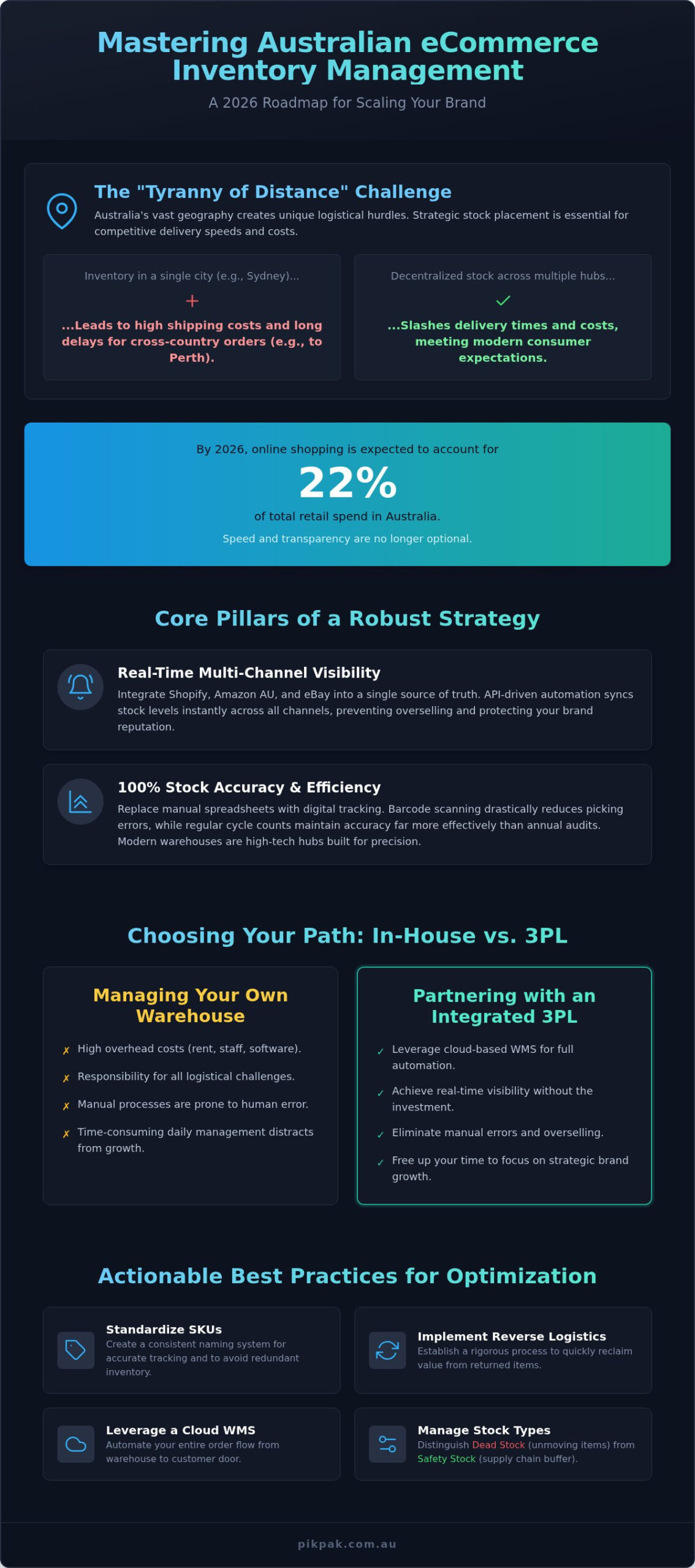
Australia’s geography creates a unique logistical hurdle known as the “Tyranny of Distance.” Unlike smaller, densely populated markets, the physical location of your stock in Australia determines your success. If your inventory is held exclusively in a Sydney warehouse, you face significant shipping delays and higher costs when sending orders to Perth or Darwin. Choosing the right inventory location, whether it’s Melbourne, Sydney, or Brisbane, is a strategic decision that directly impacts your shipping speed and your bottom line.
The industry has moved far beyond manual spreadsheets. Static lists are now liabilities that lead to overselling and customer frustration. Modern Inventory management software has replaced these old methods with dynamic, API-driven systems. These automated tools ensure that your Shopify, eBay, or Amazon AU storefronts reflect exactly what is physically available on the shelf at any given second. This shift from manual entry to automation removes the friction from your daily operations and gives you back hours of your time.
The 2026 Australian eCommerce Landscape
Consumer expectations have reached a new peak. By 2026, online shopping is expected to account for 22% of total retail spend in Australia. Shoppers no longer tolerate week-long delivery windows; they expect transparency and speed. Regional hubs have become essential for meeting these demands. By decentralizing your stock, you reduce the distance a parcel travels, which slashes shipping costs. Having 100% Aussie-based fulfillment centers is also a major advantage for troubleshooting. Local support teams understand the domestic carrier networks and can resolve issues much faster than offshore call centers.
Key Terminology for Growing Brands
To scale your business, you need to master a few critical terms. Your SKU (Stock Keeping Unit) management is the foundation of your tracking. Proper SKU optimization ensures you aren’t carrying redundant variations that tie up your capital. In a high-inflation environment, distinguishing between dead stock and safety stock is vital. Dead stock refers to items that haven’t moved in months and are simply eating up expensive warehouse space. Safety stock is your buffer against supply chain shocks. Balancing these two is the core of What is Order Fulfilment? and maintains a healthy cash flow.
Core Pillars of a Robust Inventory Strategy
Building a successful brand requires more than just high-quality products. It demands a rock-solid operational foundation. Real-time visibility acts as the central nervous system for your entire operation. In 2026, if you can’t see your stock levels across all sales channels instantly, you’re essentially flying blind. Utilizing Essential Inventory Management Techniques like automated digital tracking ensures your data remains flawless and actionable. This level of precision is the standard for modern eCommerce inventory management Australia.
Real-Time Multi-Channel Visibility
Integrating Shopify, WooCommerce, and eBay AU into a single source of truth is vital for maintaining brand reputation. This integration prevents the nightmare of overselling, which often leads to negative reviews and lost customers. APIs play a silent but heroic role here. They automate inventory updates the moment a sale occurs on any platform, ensuring your digital storefronts always match your physical shelves. This automation removes the stress of manual syncing and lets you focus on marketing.
Stock Accuracy and Warehouse Efficiency
Accuracy isn’t a one-time event; it’s a daily commitment. Digital tracking through barcode scanning significantly reduces picking errors, ensuring the right item reaches the right customer every time. Regular cycle counts are far more effective than traditional annual audits for catching discrepancies early. If you’re still wondering What is a Warehouse? in the modern sense, it is a high-tech hub designed for maximum speed and precision.
Efficiency also depends on how you move stock. Implementing a “first-in, first-out” (FIFO) system is essential for trend-based goods that lose value or relevance over time. This keeps your inventory fresh and reduces the risk of dead stock accumulating on your shelves. You can achieve this level of control by leveraging our real-time technology support to monitor every movement.
Demand forecasting is your best tool for navigating the Australian market. Use your 2025 performance data to predict 2026 trends and stock requirements. With the local market projected to grow at a 12.07% CAGR, your system must be ready for increased volume. Scalability represents the divide between a record-breaking sales event and an operational meltdown. Your strategy needs to handle a 500% spike during Black Friday or Click Frenzy without breaking a sweat, ensuring every customer receives their order on time.
Software vs. Integrated 3PL: Which Path is Right?
Many business owners believe that buying a license for inventory management software is the final step in organizing their operations. It’s a common misconception. While software provides the data, it doesn’t move the boxes. You can have the most expensive ERP in the world, but if you’re still the one packing orders in your garage at 11 PM, you haven’t actually solved your growth problem. For effective eCommerce inventory management Australia, you need to decide if you want a tool or a complete solution. Software like NetSuite is a powerful tool for tracking, but an integrated 3PL is a physical solution that executes the work.
Managing your own warehouse comes with significant hidden costs that aren’t always obvious on a spreadsheet. Beyond the software subscription, you’re looking at commercial rent in expensive hubs like Sydney or Melbourne, utility bills, insurance, and the complexities of hiring and managing staff. These are fixed costs that eat into your margins regardless of your sales volume. An integrated 3PL model converts these into variable fees. You only pay for the space and services you actually use, which protects your cash flow during quieter months and keeps your business agile.
When Software-Only Isn’t Enough
Every growing brand eventually hits a breaking point. This usually happens when manual packing and daily runs to the local post office begin to consume your entire day. Software can optimize your inventory management process, but it cannot create physical storage space where none exists. If your inventory is overflowing into your living room or a cramped storage unit, it’s time to transition to professional warehousing and fulfilment services. This shift allows you to delegate the physical labor and reclaim your time for strategic brand development.
The 3PL Advantage for Scaling Brands
A 3PL provides more than just storage; it provides leverage. By partnering with a logistics expert, you gain access to bulk shipping rates that are typically reserved for major retailers. This immediately lowers your per-order cost and improves your competitiveness. Some owners worry about losing control when they outsource, but modern WMS platforms actually give you more visibility, not less. You get a real-time window into your inventory levels and order status without having to set foot in a warehouse. To understand how this fits your business, explore our logistics services. This approach ensures you remain agile, scaling your storage space up or down based on seasonal demand without the risk of long-term commercial leases.
Actionable Best Practices for Inventory Optimization
Standardizing your SKU naming conventions is the first step toward flawless tracking. A chaotic SKU list leads to picking errors and data mismatches that stall your growth. Use a logical, hierarchical structure, such as Brand-Category-Size-Color, to ensure every item is easily identifiable. This simple change improves your eCommerce inventory management Australia by making your data searchable and consistent across every sales channel. It removes the guesswork for warehouse staff and ensures your digital records stay accurate.
Speed at the warehouse entry point is just as critical. Establishing clear warehouse receiving guidelines ensures your stock moves from the delivery truck to the shelf without delay. When your suppliers follow a standardized labeling and packing process, your 3PL can scan and stow items faster. This eliminates the “dark period” where stock has arrived but isn’t yet available for sale on your website. Efficient receiving means you can turn capital back into inventory more frequently, keeping your cash flow healthy.
Mastering Reverse Logistics in Australia
Returns are an inevitable part of online retail, but they don’t have to be a drain on your profits. The Australian market sees high return rates in categories like apparel, where the average monthly spend of $1,247 per person often includes multiple sizes of the same item. Implementing a rigorous reverse logistics process allows you to reclaim value quickly. Automating the return-to-shelf workflow ensures that items are inspected, refurbished if necessary, and made available for resale immediately. This professional approach protects your margins and provides a seamless experience for your customers, who expect fast resolutions under Australian Consumer Law.
Kitting and Special Projects
Kitting is a strategic tool for inventory movement that involves bundling individual items into a single, new SKU for promotional offers. This technique allows you to increase your average order value (AOV) without the complexity of manufacturing entirely new products. For example, a beauty brand might kit a cleanser, toner, and moisturizer into a “Skincare Starter Pack.” Your 3PL handles the physical assembly of these kits, saving you the time and labor of doing it yourself. It’s an efficient way to clear slow-moving stock or launch seasonal campaigns with minimal effort. To see how these strategies can transform your operations, explore our kitting and assembly services today.
Scale Effortlessly with Pik Pak’s Inventory Solutions
Scaling a business shouldn’t feel like a constant battle with your own warehouse. Pik Pak’s cloud-based Warehouse Management System (WMS) acts as the brain of your entire operation, turning chaotic data into actionable insights. It integrates seamlessly with your existing e-storefront, whether you use Shopify, eBay, or Amazon AU. This connectivity ensures that your stock levels are always accurate, eliminating the stress of manual updates. By delegating these operational burdens to a specialized partner, you finally reclaim the time needed to focus on marketing and product development. You didn’t start a brand to spend your afternoons taping boxes; you started it to innovate and grow.
Our Technology: Your Real-Time Command Centre
The Pik Pak platform is designed to give you total control without the physical labor. It provides a real-time command centre where you can monitor every order and SKU from a single dashboard. Whether you’re at your desk or managing your business from a laptop while traveling, you have total visibility into your stock movements. This transparency is the cornerstone of effective eCommerce inventory management Australia. It allows you to make informed decisions about restocking and promotions without ever needing to step foot in a warehouse. You can track individual items from the moment they arrive at our facility to the second they reach your customer’s door. Explore our technology support to see how our API-driven platform can simplify your daily routine.
Why Australian Brands Choose Pik Pak
We’re committed to making logistics feel effortless for growing brands. Our extensive Australian fulfillment network is built to handle the unique challenges of the local market, from the busy streets of Melbourne to the remote reaches of Western Australia. We provide the infrastructure you need to scale without the risk of long-term commercial leases or the complexity of managing a large team. You can expect transparent pricing and dedicated, multi-channel support that treats your business like our own. We don’t just store your products; we provide an enabling force that removes the hurdles standing between you and your growth goals. Our team is here to handle the reverse logistics and specialized kitting projects that keep your operation lean and profitable. Stop managing boxes and start building your brand. Request a Quote from Pik Pak Logistics Today and take the first step toward a more efficient future.
Take Control of Your 2026 Growth Strategy
Success in the Australian market requires more than just a great product. It demands an operational strategy that evolves with consumer expectations. By prioritizing real-time visibility and moving away from manual spreadsheets, you remove the friction that stalls most growing brands. Mastering eCommerce inventory management Australia is about reclaiming your schedule. You focus on high-level brand development while we handle the physical heavy lifting.
Pik Pak provides the enabling force you need to scale without the overhead of a private warehouse. As a 100% Australian-owned and operated partner, we provide real-time WMS visibility without the stress of long-term lock-in contracts. You stay in control of your data while we manage the pick, pack, and shipping processes that keep your customers happy.
Ready to scale? Get an instant quote for your eCommerce fulfillment today.
Your brand has the potential to reach every corner of the country. With the right logistics partner, that growth becomes a simple, manageable reality.
Frequently Asked Questions
What is the best eCommerce inventory management software for Australian small businesses?
The best software depends on your specific needs, but popular choices in Australia include Zoho Inventory for starters or Cin7 for more complex operations. However, for many brands, the most efficient solution is using a 3PL provider’s WMS. This allows you to integrate your sales data directly with the physical warehouse without paying for separate, expensive software licenses. It simplifies your tech stack while ensuring your data remains accurate and accessible.
How much does 3PL inventory management cost in Australia?
3PL inventory management costs in Australia are typically structured as variable fees rather than fixed overheads. You usually pay for receiving inbound stock, a monthly storage fee based on the number of pallets or cartons, and a pick and pack fee per order. This model is highly beneficial for growing brands because your costs only increase as your sales grow. It removes the financial risk of long-term commercial leases and fixed warehouse staffing.
Can I integrate my Shopify store with an Australian 3PL provider?
Yes, you can easily integrate your Shopify store with an Australian 3PL provider like Pik Pak. We use pre-built connectors and API access to sync your store with our cloud-based WMS. This automation ensures that every time a customer makes a purchase, the order is sent directly to our warehouse for picking and packing. It eliminates manual data entry and significantly reduces the risk of shipping delays or errors for your business.
What is the difference between inventory management and order fulfillment?
Inventory management is the strategic process of tracking and planning your stock levels, while order fulfillment is the physical act of getting products to customers. Management involves monitoring SKUs and demand forecasting to ensure you don’t run out of stock. Fulfillment includes the pick, pack, and ship services required to complete a sale. Both are essential components of eCommerce inventory management Australia and work together to ensure a smooth customer experience.
How do I manage inventory across multiple locations in Australia?
Managing inventory across multiple locations requires a centralized, cloud-based platform that provides a single source of truth. By using a WMS, you can track stock levels in Melbourne, Sydney, or Perth from one dashboard. This visibility allows you to route orders to the fulfillment center closest to the customer, which reduces shipping times and costs. It is the most effective way to handle the geographic challenges within the Australian market.
What happens to my inventory if I use a 3PL and want to switch back?
If you decide to move away from a 3PL, your inventory remains your property and can be relocated to your own facility. You would simply arrange for a stock out-movement and disconnect the API links between your store and the 3PL’s WMS. At Pik Pak, we offer no long-term lock-in contracts, which gives you the flexibility to adjust your strategy as your business evolves. We focus on making transitions as smooth and professional as possible.
How does real-time inventory tracking prevent overselling on Amazon AU?
Real-time inventory tracking prevents overselling on Amazon AU by instantly updating your available stock across every sales channel. When an item sells on your website, our WMS sends an immediate signal to Amazon to reduce the listed quantity. This automation is critical because Amazon penalizes sellers for canceling orders due to stockouts. It protects your seller rating and ensures you only sell what is physically sitting on our warehouse shelves at that exact moment.
Is a WMS necessary for a small eCommerce business in Australia?
A WMS is highly recommended for any small eCommerce business in Australia that plans to scale beyond a single sales channel. While spreadsheets might work for a handful of orders, they quickly become a liability as your volume grows. A WMS provides the accuracy and automation needed to manage multi-channel sales without errors. It gives you the professional infrastructure required to compete with larger retailers while freeing up your time for strategic brand growth.