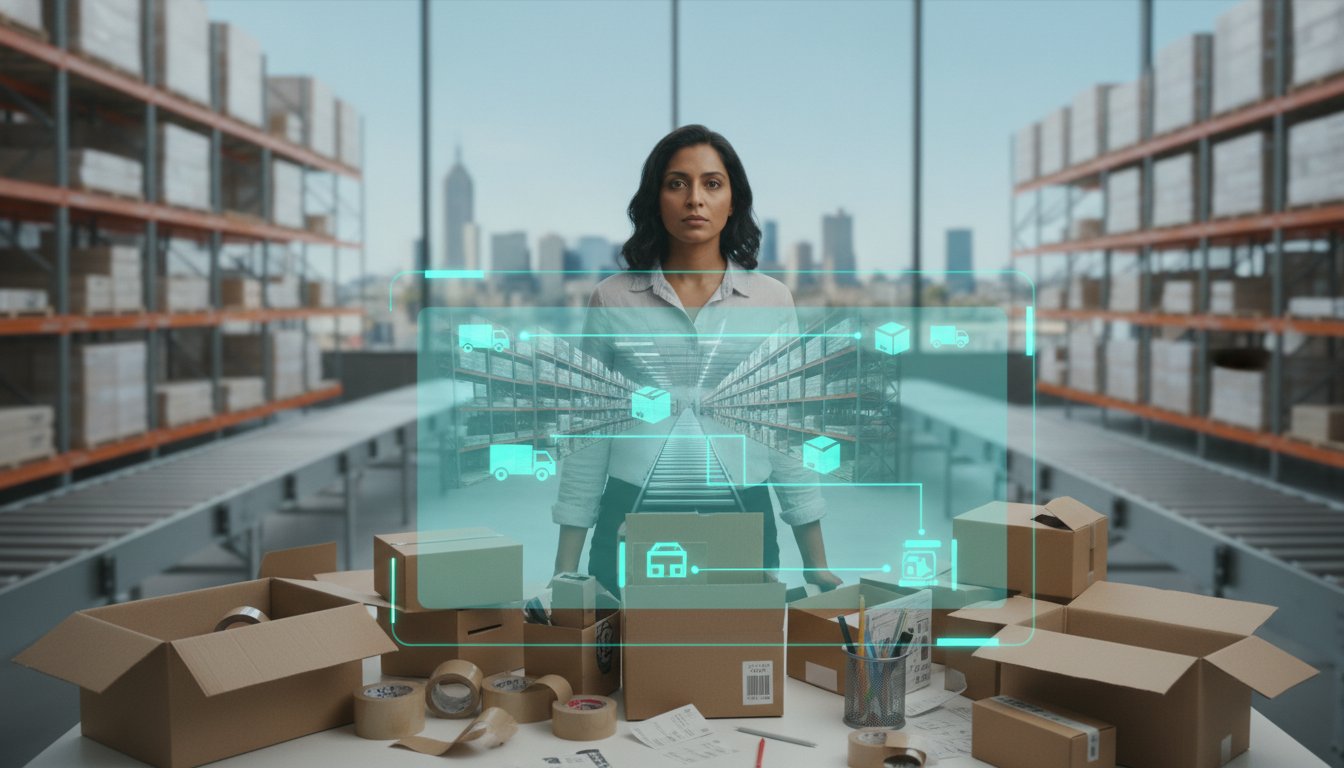
What if the biggest threat to your Australian e-commerce brand isn’t a competitor’s price, but the physical speed of your own hands? It’s a frustrating realization when you admit that your business growth is limited by your packing speed, especially as orders pile up in your garage or small office. You know the feeling of a successful sale being immediately followed by the dread of a late-night packing session. You’ve worked hard to build demand, but now that demand is creating a bottleneck that keeps you from scaling. You deserve to focus on strategy, not bubble wrap.
We understand the pressure of shipping delays during peak seasons and the stress of manual errors. This article will show you how to identify the signs that manual packing is throttling your revenue and provide the exact steps to transition to a scalable 3PL model. We’ll explore how to reclaim 20+ hours a week, eliminate shipping errors, and leverage technology to ensure your logistics can handle your next big sales event without breaking a sweat. It’s time to stop doing and start managing.
Key Takeaways
- Identify the “Packing Table Trap” and how shifting from manual labour to strategic management unlocks your brand’s true potential.
- Recognise the five red flags that indicate your business growth is limited by my packing speed, such as intentionally slowing down marketing to keep up with orders.
- Evaluate the hidden financial risks of Australian in-house scaling, including superannuation, WorkCover, and restrictive long-term warehouse leases.
- Learn how WMS technology automates order flow and inventory tracking to eliminate human error and ensure faster home delivery.
- Discover a pragmatic path to outsourcing that includes custom kitting and assembly, allowing you to reclaim 20+ hours every week for core business objectives.
The High Price of the ‘Packing Table Trap’
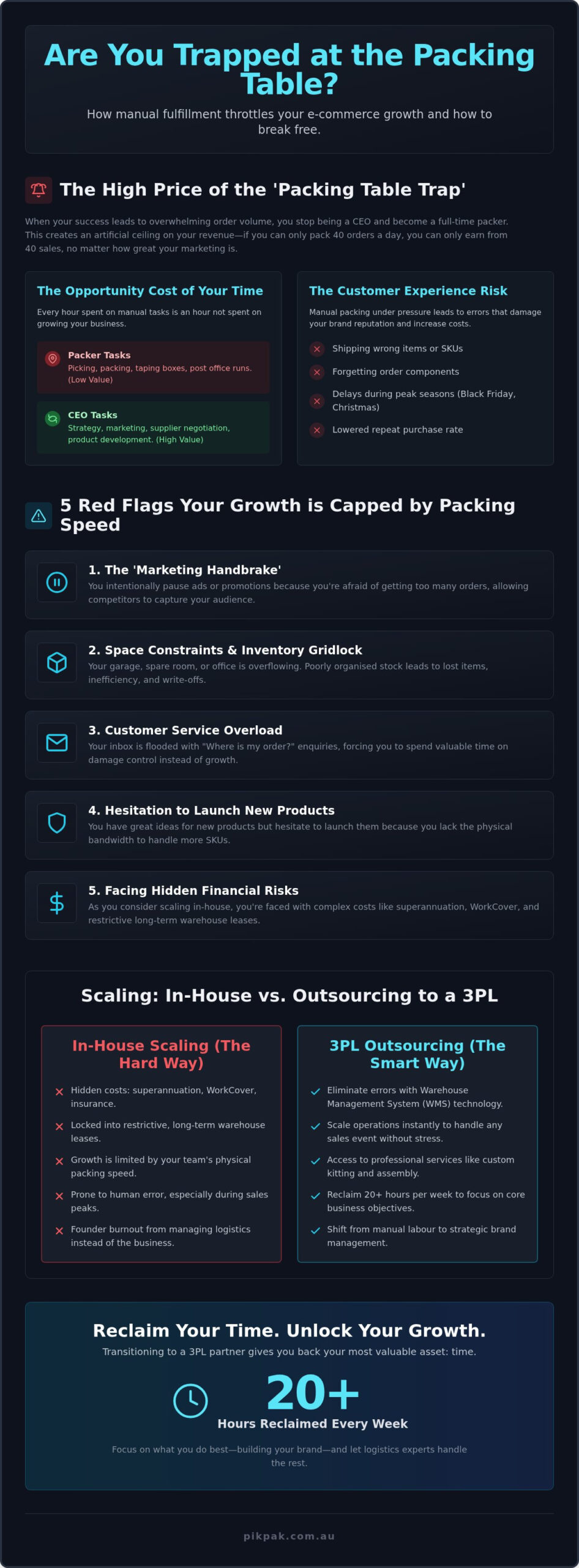
The “Packing Table Trap” occurs when your success becomes your greatest obstacle. It’s the exact point where order volume consumes every hour of your strategic time, leaving no room for the activities that actually grow your brand. When you find yourself surrounded by bubble wrap at 11 PM, it’s clear that business growth is limited by my packing speed. This isn’t just a logistical hiccup; it’s an artificial ceiling on your daily revenue. If your physical capacity to pack is capped at forty orders a day, your business cannot earn more than those forty sales allow, regardless of how much you spend on marketing.
The psychological toll of this trap is significant. Founders often experience burnout when they’re forced to choose between fulfilling current promises and building future opportunities. You lose the ability to engage in “big picture” thinking because your focus is narrowed to the immediate, repetitive task of picking and packing. This shift from CEO to manual labourer creates a massive opportunity cost. While you’re taping boxes, you aren’t negotiating with suppliers, refining your digital ads, or developing your next product line.
Calculating the True Cost of Your Time
Many Australian business owners overlook the “invisible” expenses of DIY fulfilment. Beyond the obvious costs of boxes, tape, and bubble wrap, there’s the petrol and time spent on daily runs to the local post office. For brands that manufacture products in bulk, efficiency can be further improved by utilizing specialized machinery from choicebagging.com before the items even reach the packing table. More importantly, consider the value of your own time. If your strategic work is worth A$150 per hour but you’re performing a task that could be handled for a fraction of that cost, you’re effectively losing money on every box. We define Fulfilment ROI as the total revenue gained by reallocating those high-value founder hours back into business growth strategies.
For those looking for high-quality shipping resources, you can visit OEM Materials & Supplies to see the range of professional-grade materials available for growing manufacturers.
The Customer Experience Risk
Manual packing is prone to human error, especially when fatigue sets in. A tired founder is more likely to ship the wrong SKU or forget an essential component of an order. These mistakes don’t just cost money in returns; they damage your brand reputation and lower your repeat purchase rate. Customers expect speed and accuracy, and “best effort” packing usually fails during high-pressure events like Black Friday or the Christmas rush. Professional pick, pack, and ship services ensure that your standards remain high even when volume spikes, protecting the customer relationship you’ve worked so hard to build.
5 Signs Your Business Growth is Limited by Packing Speed
Identifying the bottleneck is the first step toward fixing it. If you’re unsure whether you’ve hit the ceiling, these five red flags are clear indicators that your current operations are holding you back. Recognising these signs early allows you to transition before the friction causes permanent damage to your brand reputation.
The ‘Marketing Handbrake’ Phenomenon
One of the most telling signs is when you intentionally stop running digital ads or pause social media promotions. This happens because you’re terrified of a “too successful” campaign. You know that fifty new orders would result in a week of sleepless nights. It’s a clear signal that business growth is limited by my packing speed. This “marketing handbrake” creates a dangerous boom and bust cycle. In the fast-paced Australian eCommerce market, this loss of momentum allows competitors to swoop in and capture your audience while you’re busy with a tape dispenser.
Space Constraints and Inventory Gridlock
When your garage or spare room transitions from a storage space to a safety hazard, your growth has outgrown your home. Poorly organised stock leads to “lost” items and unnecessary inventory write-offs because you simply can’t find what you need. Understanding what is a warehouse in a professional sense helps you see the difference between a cluttered room and a functional distribution centre. If you’re tripping over boxes, you aren’t just losing space; you’re losing efficiency and money.
If your inbox is constantly flooded with “Where is my order?” enquiries, you’re spending your most valuable hours on damage control. Every minute spent explaining a shipping delay is a minute not spent on product design or market research. This administrative burden grows exponentially with your sales, eventually becoming a full-time job that produces zero growth.
You might have a brilliant idea for a new product line, but you hesitate to launch it. This hesitation stems from a lack of physical bandwidth to pack more SKUs. This is a definitive sign that business growth is limited by my packing speed. You’re effectively sacrificing future revenue to maintain your current manual labour habits.
Small businesses often pay premium retail rates for shipping because they lack the volume to negotiate. Without bulk carrier rates, your margins are squeezed by competitors who can afford to offer cheaper or faster delivery. Professional pick, pack, and ship services solve this by giving you instant access to enterprise-level shipping rates, making your brand more competitive overnight.
Scaling In-House vs. Outsourcing to a 3PL
Deciding how to expand is a pivotal moment for any founder. When you finally acknowledge that business growth is limited by my packing speed, you face two distinct paths: building your own warehouse operation or partnering with a professional provider. While hiring a local casual worker or renting a small industrial unit might feel like the logical next step, the hidden complexities of Australian employment and property law often make this the more expensive and risky choice.
The “Lease Trap” is a common pitfall for growing brands. Commercial landlords in Australia typically require three to five-year commitments. For a brand doubling in size every six months, a space that fits today will be a bottleneck by next year. Conversely, if sales dip, you’re stuck with a rigid overhead that drains your cash flow. A 3PL model replaces these fixed costs with a flexible, pay-as-you-go structure for storage and labour, allowing you to scale up or down instantly without being locked into a long-term liability.
The Real Cost of Hiring a Helper
Hiring your first employee involves much more than just an hourly wage. In Australia, you must factor in superannuation, WorkCover insurance, and the administrative time required for payroll. There’s also the significant investment of your own time spent on training and management. If demand is “lumpy”, which is common in eCommerce, you’ll find yourself paying for staff even during slow weeks. Professional facilities absorb seasonal spikes effortlessly because they spread their labour costs across multiple clients. This means you only pay for the work actually performed, protecting your margins during quieter periods.
The Technology Advantage
A manual founder, no matter how fast, cannot compete with the precision of a Warehouse Management System (WMS). Understanding what is 3PL involves recognizing the massive role technology plays in modern logistics. Professional technology support eliminates manual data entry by syncing your Shopify or WooCommerce store directly with the warehouse. This automation ensures real-time inventory tracking across all your sales channels, preventing the dreaded “oversold” email to a disappointed customer. By delegating these complex systems to experts, you ensure that business growth is limited by my packing speed no longer, as the infrastructure scales automatically with your order volume.
How 3PL Technology Breaks the Growth Bottleneck
A manual founder, no matter how dedicated, cannot match the speed and precision of a digital system. When business growth is limited by my packing speed, the bottleneck is often the lack of integrated data. A Warehouse Management System (WMS) acts as the brain of your logistics, replacing handwritten notes and manual entry with real-time automation. This technology support doesn’t just speed up the process; it makes the entire operation feel effortless and transparent, allowing you to move from being the primary worker to the strategic manager of your brand.
The transition to a tech-driven model follows a logical four-step process designed to eliminate friction:
- Automated Order Syncing: Your eCommerce platform connects directly to the WMS. Orders flow through instantly, eliminating the need to print labels or copy-paste addresses one by one.
- Intelligent Inventory Management: Real-time tracking provides predictive stock levels. You’ll know exactly when to reorder, ensuring you never lose a sale due to overselling or stockouts.
- Professional Pick and Pack: Every item is scanned via barcode. This simple step ensures near-100% accuracy, virtually eliminating the wrong item complaints that drain your time.
- Carrier Aggregation: The system automatically compares Australian carriers to find the fastest and most cost-effective route for every single parcel.
Eliminating Manual Errors with WMS
Barcode-driven picking is a game-changer for accuracy. It stops the cycle of wrong size or wrong colour refunds before the parcel even leaves the building. Knowing every order is tracked from the shelf to the customer’s door provides immense peace of mind. To maintain this efficiency, following clear Warehouse Receiving Guidelines ensures your stock is logged correctly from the moment it arrives. This prevents upstream errors that could slow down your fulfilment speed and ensures that your inventory data remains 100% reliable.
Faster Shipping and Better Delivery Options
Professional 3PLs provide access to customer delivery networks that are typically out of reach for smaller brands. By leveraging these established partnerships, you can offer faster shipping times and more reliable tracking. This professional transparency significantly reduces “Where is my order?” (WISMO) queries, freeing you from endless customer service emails. When you realize business growth is limited by my packing speed, shifting to an automated carrier selection model is the fastest way to reclaim your margins. Industry professionals often report that automated carrier selection can reduce shipping costs by as much as 30% by consistently identifying the most efficient route for every parcel. You can explore our WMS platform access to see how these tools can remove your operational hurdles today.
Transitioning to Pik Pak Logistics: Reclaiming Your Growth Trajectory
Reclaiming your growth trajectory starts with a single decision: moving from manual execution to strategic delegation. When you accept that business growth is limited by my packing speed, you’re ready to partner with a team that views your success as their own. At Pik Pak Logistics, we don’t just store boxes. We provide the infrastructure that allows Australian founders to step away from the packing table and back into the CEO role. Our pragmatic approach to onboarding ensures that the transition is simple, stress-free, and entirely focused on your future revenue.
Effortless Integration with Your Store
We believe technology should simplify your life, not complicate it. Pik Pak Logistics offers API connectors that provide “plug and play” integration for major platforms like Shopify and WooCommerce. This ensures that your orders flow into our system automatically, without any manual data entry from your side. We adopt the persona of a calm expert, managing the logistical chaos of peak periods so you can maintain a clear head. You can learn more about how we manage these processes in our logistics service overview, which details our commitment to operational clarity and ease of use.
Customising Your Fulfilment
A common concern for growing brands is the fear of losing control over the customer experience. Pik Pak Logistics addresses this by following your specific packing instructions to the letter. Whether you require sustainable packaging or complex kitting and special projects, we ensure your unboxing experience remains premium and consistent. This level of customisation allows you to maintain your brand’s unique identity while benefiting from enterprise-level efficiency. We act as an extension of your team, not just a distant service provider.
Our growth partner mindset means we only succeed when you do. As your order volume increases, our systems scale with you automatically, ensuring that business growth is limited by my packing speed no longer. We don’t just provide a service; we provide an enabling force that removes your largest operational hurdles. Because we operate on a scalable model, our success is tied to your growth. This alignment ensures we are always looking for ways to improve your efficiency and reduce your costs. If you are ready to stop packing and start scaling, request a quote from Pik Pak Logistics today and discover the freedom of a professional logistics partnership.
Take the Handbrake Off Your Business Growth
Recognising that business growth is limited by my packing speed is the first step toward building a truly scalable brand. You’ve seen how the “Packing Table Trap” drains your strategic energy and how the hidden costs of in-house scaling can jeopardise your margins. By shifting to a professional 3PL model, you replace rigid overheads and manual errors with flexible, tech-driven efficiency. This isn’t just about outsourcing a task; it’s about reclaiming your time to focus on the high-value decisions that drive your brand forward.
Pik Pak offers the infrastructure you need to scale without friction. With our real-time WMS tracking, seamless eCommerce integrations, and Australian-based support and warehousing, you can manage your logistics with total confidence. We handle the operational complexity so you can focus on your next product launch or marketing campaign. It’s time to stop taping boxes and start leading your company into its next phase of success.
Scale your business with Pik Pak’s expert fulfilment services and experience the freedom of a logistics partner that grows with you. Your brand has no limits when your operations are built for speed.
Frequently Asked Questions
How do I know if I’m big enough for a 3PL?
You are ready for a 3PL when the time spent on fulfilment prevents you from working on marketing or product development. It is less about a specific order count and more about your opportunity cost. If you’re spending ten or more hours a week on tape and boxes, you’ve reached the point where business growth is limited by my packing speed. Outsourcing early prevents the boom and bust cycle that stalls scaling.
Will I lose control over how my products are packed?
No, you maintain control through detailed packing instructions and standard operating procedures. We follow your specific requirements for wrapping, item placement, and box selection to the letter. Our WMS ensures these instructions are visible to our team for every single order. You delegate the physical labour while keeping the creative and quality standards that define your Australian brand. It is about professional execution of your vision.
Can a 3PL handle my custom branded packaging?
Yes, we store and use your custom boxes, branded tissue paper, and stickers. We understand that the unboxing experience is a vital marketing tool for modern eCommerce brands. You simply send your branded supplies to our Australian warehouse, and we integrate them into the pick and pack workflow. This allows you to scale your operations without sacrificing the premium, personal feel that your loyal customers expect from your deliveries.
How much does it cost to outsource my packing?
Costs are typically broken down into storage fees, pick and pack rates, and shipping costs. Because we operate on a pragmatic pay-as-you-go model, you only pay for the warehouse space you use and the orders we process. This eliminates the heavy fixed overhead of a commercial warehouse lease or full-time staff wages. We provide transparent pricing so you can accurately calculate your fulfilment ROI and maintain healthy margins.
What happens if a 3PL makes a mistake with an order?
We use barcode scanning technology to ensure near-100% accuracy, but we have clear processes for any discrepancies. If an error occurs, our returns management system handles the reverse logistics efficiently. We work with you to resolve the issue for the customer quickly, protecting your brand reputation. Our goal is to make the resolution process feel effortless for both you and your client while maintaining total transparency through our WMS.
How long does it take to set up 3PL integration?
Integration usually takes a few business days depending on the complexity of your online store. Our API connectors for platforms like Shopify and WooCommerce are designed for rapid, “plug and play” deployment. Once the technical sync is complete and your inventory arrives at our facility, we can begin fulfilling orders immediately. We guide you through every step of the onboarding process to ensure the transition is entirely stress-free.
Can a 3PL help with my customer returns?
Yes, we provide comprehensive returns management to handle your reverse logistics. When a customer sends an item back, we receive it, inspect the condition based on your specific guidelines, and update your inventory levels in real-time. This professional handling speeds up the refund or exchange process for the customer. Efficient returns management significantly improves customer satisfaction and builds long-term brand trust in the competitive Australian eCommerce landscape.
Is there a minimum order volume required to start?
We work with brands at various stages of their journey, though our systems are most effective for businesses experiencing consistent monthly volume. If you feel that business growth is limited by my packing speed, it is the right time to discuss your trajectory with us. We focus on being a growth partner, providing the infrastructure that helps ambitious brands scale into larger enterprises without the friction of manual labour.